

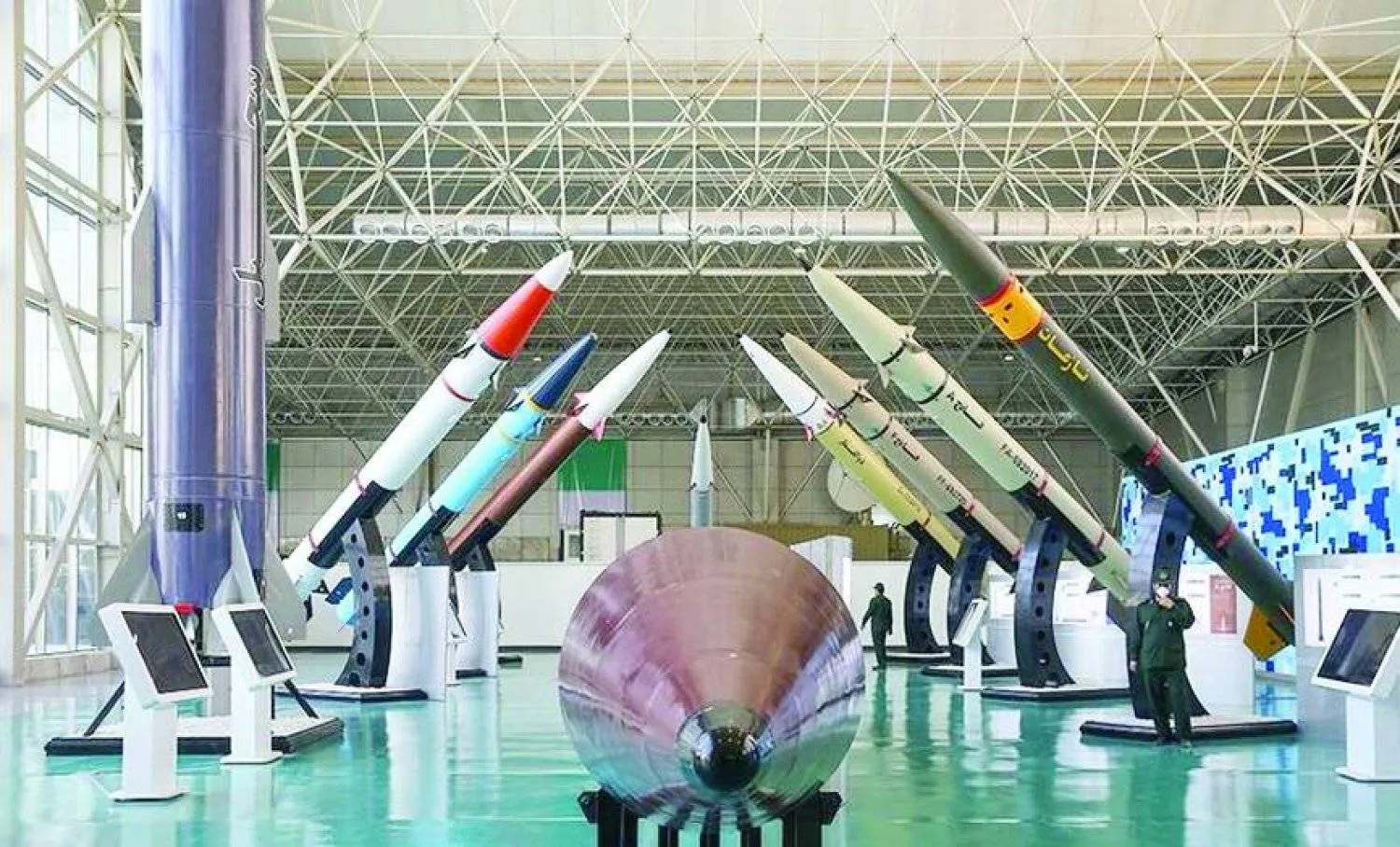

Iran’s Revolutionary Guard Media Highlights Arsenal Capable of Striking Israel

The Permanent Exhibition of Ballistic Missiles belonging to the Revolutionary Guard in Tehran, Iran (Fars News Agency)
TT

Iran’s Revolutionary Guard Media Highlights Arsenal Capable of Striking Israel

The Permanent Exhibition of Ballistic Missiles belonging to the Revolutionary Guard in Tehran, Iran (Fars News Agency)

As tensions rise between Iran and Israel following the killing of Iranian Revolutionary Guard leaders in Syria, a Tehran newspaper, “Hamshahri,” showcased nine Iranian ballistic missiles, claiming they could target Israel.

However, it’s unclear if they’re ready for deployment.

The newspaper’s report is part of a broader media push by the Revolutionary Guard, amid threats from Iranian officials of retaliating against Israel.

Hamshahri’s editorial team, now aligned with the hardline Revolutionary Guard, reflects a shift from its previous reformist stance.

Iranian authorities vow a response to Israel, though it’s uncertain if they’ll launch missiles from their territory.

Iran has previously attacked Syria, Iraq, and Pakistan with missiles and drones.

If Iran attacks Israel, it would be the first test of Israel’s defenses against Iran’s claimed “deterrent” ballistic missiles.

These missiles range from 1,400 km to 2,500 km. Some are in use, while others, like the supersonic “Fateh-2” showcased last November, are yet to be deployed.

It appears that the Fateh-2 missile is still in the production phase and hasn’t been tested yet. It might take years before it’s ready for mass production.

Iran hasn’t revealed the exact specifications of the Fateh-2 missile as of last November.

However, according to Hamshahri, it’s believed to have a range of up to 1,400 km.

In June, Iran’s Revolutionary Guard revealed the “Fateh-1” missile, reaching 1,400 km. It’s unclear if it’s been tested.

Hamshahri listed various missiles: Khormashahr 4 (2,000 km), Sejjil (2,500 km), Qasem Soleimani (1,400 km), Qadr (1,950 km), Emad (1,700 km), and Shahab 3 (2,000 km) fueled by liquid.

The Sejjil ballistic missile was first tested in 2008, reaching 2,000 km with a two-stage design and solid fuel.

Khormashahr and Qassem Soleimani missiles joined service last August. President Ebrahim Raisi ordered arming both units in the Guards and Army.

Iran unveiled the fourth-gen Khormashahr missile in 2016, tested in January 2017, drawing criticism for violating Resolution 2231.



Health of Norway's King Deteriorated but he is Stable Now

(FILES) Norway's King Harald gives a speech at the gala dinner at the Castle in Oslo on April 8, 2025 during the state visit of Iceland's President Halla Tomasdottir and her husband Bjorn Skulason. (Photo by Fredrik Varfjell / NTB / AFP)
TT

Health of Norway's King Deteriorated but he is Stable Now

(FILES) Norway's King Harald gives a speech at the gala dinner at the Castle in Oslo on April 8, 2025 during the state visit of Iceland's President Halla Tomasdottir and her husband Bjorn Skulason. (Photo by Fredrik Varfjell / NTB / AFP)

Crown Prince Haakon visited his father King Harald of Norway on Monday at the hospital, after the king's health deteriorated over the weekend, public broadcaster NRK reported.

The 89-year-old monarch, who has been on sick leave for several weeks, was admitted to the National Hospital a week ago. He is now receiving antibiotics for a bacterial blood infection and has responded to treatment, the royal palace said late Sunday, adding that his condition is stable.

Haakon, has been serving as regent during that time, The Associated Press quoted the palace as saying.

The king has hemolytic anemia and was being treated with cortisone, leading to fluid accumulation in the body that required hospital treatment, the palace said last week.

Norway's prime minister sent his wishes for the king and said that “all of Norway is following and thinking about the king,” NRK reported.

“My strong wish is that he continues to receive good treatment from the good healthcare system we have,” Prime Minister Jonas Gahr Støre said.

Harald, who has been monarch since 1991, has been in and out of the hospital several times in recent years.

In February, he was admitted to a hospital in Spain’s Canary Islands during a winter vacation for treatment for a skin infection.

Two years ago, the king fell ill during a private vacation with the queen in Malaysia and received a temporary pacemaker there. Harald returned aboard a medical airplane to Norway, where he was fitted with a permanent pacemaker.


Report: Pakistan’s Munir Spoke to Trump Ahead of Tehran Visit

Pakistan's army chief Asim Munir. (Reuters file)
TT

Report: Pakistan’s Munir Spoke to Trump Ahead of Tehran Visit

Pakistan's army chief Asim Munir. (Reuters file)

Pakistan's army chief Asim Munir spoke with US President Donald Trump last week, according to three Pakistani sources, days before Munir was expected to hold talks in the Iranian capital Tehran on Monday.

The call, which has not been previously reported, came as the US threatened to roll out major economic sanctions targeting Iran and its trade partners.

The White House Office of the Press Secretary did not immediately respond to a request for comment. It was unclear what Munir and Trump ‌discussed.

Pakistan's military ‌confirmed the visit on Monday, saying ‌it was "part ⁠of Pakistan’s efforts ⁠to promote regional peace and stability." Iranian officials had confirmed the visit on Sunday, saying it was focused on security and peace.

Trump last week warned of economic consequences against any country that provided "any type of lifeline to Iran" as he seeks to isolate the country. Iran in turn vowed ⁠to shut down all oil exports from the ‌Gulf.

Pakistan, which has played ‌a key mediating role between the US and Iran this year, has ‌remained a trading partner of Iran throughout the recent ‌fighting.

Munir was expected to meet with people close to Iran's Supreme Leader Mojtaba Khamenei on Monday, one Pakistani source said.

Pakistan's earlier mediation efforts between the US and Iran resulted in an interim peace agreement signed in June. But the Islamabad Memorandum quickly faltered, amid new fighting between Iran and the US that has threatened to spiral into a wider regional conflict in recent weeks.

"There is a trust deficit on both sides," a third Pakistani source said about the US and Iran, adding that Munir's aim was to mitigate the lack of mutual trust on Monday.


Iran Says France's Move to Expel Two Iranian Diplomats 'Illegal'

Iranian Foreign Ministry spokesperson Esmaeil Baqaei (Archive photo – MEHR)
TT

Iran Says France's Move to Expel Two Iranian Diplomats 'Illegal'

Iranian Foreign Ministry spokesperson Esmaeil Baqaei (Archive photo – MEHR)

Iran's foreign ministry said on Monday that France's decision to expel two Iranian diplomats in response to Tehran's ban on two French diplomats was "illegal".

"The action that France took is an illegal action in response to Iran's legal action, and is in no way helpful to bilateral relations," ministry spokesman Esmaeil Baqaei said at a weekly press conference.

Last week, Baqaei said two French diplomats who were briefly arrested in Iran in July over "interference" in Iran's internal affairs "would not be permitted to return".

French Foreign Minister Jean-Noel Barrot responded by saying that two Iranian diplomats in France would be expelled "in the coming days".

Barrot said the French move was a consequence of "intolerable" treatment of the French diplomats, who were briefly detained last month in Tehran.

He said the pair had been targeted by Iranian officials "in flagrant violation of diplomatic immunity".

They had also suffered "an extremely serious act of intimidation" at the hands of Iran's security service, he added.

Baqaei had previously said Paris should apologize for the actions of the French diplomats, which he said had violated the Vienna Convention.