3 Men Rescued from Pacific Island After Writing ‘Help’ With Palm Leaveshttps://english.aawsat.com/varieties/4962811-3-men-rescued-pacific-island-after-writing-%E2%80%98help%E2%80%99-palm-leaves
3 Men Rescued from Pacific Island After Writing ‘Help’ With Palm Leaves
A trio of sailors who spent more than a week stranded on a remote, uninhabited atoll in the Pacific were rescued by the US Coast Guard after a search and rescue team spotted a giant sign spelling ‘HELP’ the men had constructed from palm fronds on the beach.
The sailors, identified as three men in their 40s with sailing experience, set out from Polowat Atoll, southeast of Guam, on 31 March.
Their boat, a 20-foot open skiff with an outboard motor, sustained damage and the men were stranded on Pikelot Atoll, The Independent reported.
Nearly a week later, on 6 April, the US Joint Rescue Sub-Center in Guam got a distress call from a relative of the sailors, saying they hadn’t returned from Pikelot.
The call prompted US officials to begin a rescue operation spanning an area of over 78,000 nautical miles.
The following day, a US Navy P-8 Poseidon aircraft operating out of Kadena Air Force Base in Japan spotted the mariners, along with a crude shelter they’d erected on the beach and dropped them survival packages.
On 8 April, a US Coast Guard HC-130J Hercules aircraft flew over the stranded men, dropping a radio to the missing sailors.
The men radioed back that they were “in good health” and “had access to food and water,” according to the Coast Guard. They had been surviving by eating coconuts.
The next day, a Coast Guard ship, the USCGC Oliver Henry, which had been diverted from its original course to join the rescue, picked up the sailors.
Merlin the Duck: From Mexico City Streets to World Cup Stardomhttps://english.aawsat.com/varieties/5285165-merlin-duck-mexico-city-streets-world-cup-stardom
Merlin, a duck, wearing a Mexico national football team ('El Tri') jersey that shot to fame after a chance encounter on Reforma Avenue went viral following the FIFA 2026 match between Mexico and South Africa, walks in Alameda Central in Mexico City, Mexico, June 16, 2026. (Reuters)
TT
TT
Merlin the Duck: From Mexico City Streets to World Cup Stardom
Merlin, a duck, wearing a Mexico national football team ('El Tri') jersey that shot to fame after a chance encounter on Reforma Avenue went viral following the FIFA 2026 match between Mexico and South Africa, walks in Alameda Central in Mexico City, Mexico, June 16, 2026. (Reuters)
A domesticated duck named Merlin, sporting a miniature Mexico shirt and custom duck socks, has waddled his way into the hearts of football fans, becoming an unlikely unofficial mascot for the country's World Cup campaign.
Merlin's fame was ignited during street celebrations following the co-hosts' 2-0 victory over South Africa in last week's World Cup opening game.
As fans gathered to cheer Mexico's goals, the dressed-up duck wandered among the crowds on the capital's busy Reforma Avenue.
Onlookers recorded the surprising scene on their cell phones and the footage immediately went viral online, with fans demanding Merlin be the new official Mexican mascot during the World Cup.
"We are very respectful," said his owner, street merchant Karla Gomez. "We respect the (Mexico City mascot) axolotl as much as the (FIFA) jaguar. We don't like controversy, honestly."
Gomez, who usually sells beverages in Mexico City's streets with her son Christian and her duck, thought they had not been noticed.
Christian Gomez poses with Merlin, a duck, wearing a Mexico national football team ('El Tri') jersey, that shot to fame after a chance encounter on Reforma Avenue went viral following the FIFA 2026 match between Mexico and South Africa, at Chinatown in Mexico City, Mexico, June 16, 2026. (Reuters)
"It was a normal day for us," she said. "We thought we were passing by unnoticed, because obviously we never thought Merlin would have that boom."
Now, Gomez proudly embraces her role in the duck's newfound stardom. Fans frequently stop the family to take selfies with the feathered supporter, who can also be seen cooling off in public fountains.
"I'm Merlin's mum. I already consider myself as such," Gomez said. "For us it has been a surprise, truly. The fact that Merlin is the unofficial mascot of the World Cup ... we feel very pleased about such a situation and above all that people love my duck."
Channeling the spirit of Paul the Octopus, Merlin recently tried his beak at match predictions, choosing Mexico over South Korea when presented with both flags.
Mexico meet South Korea on Thursday in Group A before facing the Czech Republic on June 24.
Trap, Neuter, Release: Jakarta Battles Cat-Astrophic Stray Numbershttps://english.aawsat.com/varieties/5285151-trap-neuter-release-jakarta-battles-cat-astrophic-stray-numbers
This picture taken on May 14, 2026 shows a volunteer preparing carriers to transport stray cats from a park in Jakarta to be vaccinated and neutered. (AFP)
TT
TT
Trap, Neuter, Release: Jakarta Battles Cat-Astrophic Stray Numbers
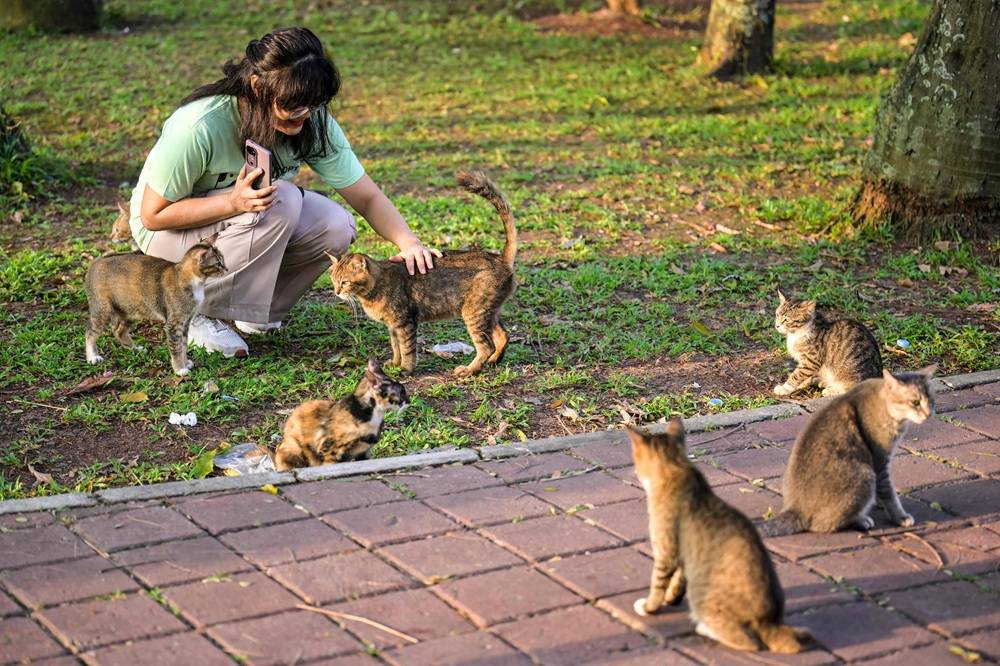
This picture taken on May 14, 2026 shows a volunteer preparing carriers to transport stray cats from a park in Jakarta to be vaccinated and neutered. (AFP)
Three flea-riddled kittens frolic under the feet of a food vendor at a bustling train station in Jakarta, home to one of the biggest urban stray cat populations on Earth.
Numbering as many as 1.5 million by some counts -- about one for every ten human inhabitants of the sprawling Indonesian capital -- street cats are ubiquitous and, for the most part, doted on.
"Cats are there to neutralize negative auras and to cheer you up," 33-year-old vendor Saiful Faizin told AFP.
He gives the strays water and leftovers from his chicken porridge cart and plays tenderly with the little ones.
With no government department dedicated to domestic animal welfare, stray cat numbers in Jakarta have exploded over the years.
They live at the mercy of the elements, dodging Jakarta's notoriously chaotic traffic and depending on kind-hearted people for food and medical care.
"There are too many cats here... so they end up dying... (in) incidents involving motorbikes," said Hilwa Tasya Sholehah, 25, a vendor at a public park in Jakarta.
While they welcome the free rat control, some residents decry smelly cat urine, noisy territorial fights and property damage such as scratches to motorbike seats.
And though Jakarta has boasted rabies-free status since 2004 -- partly thanks to mass vaccination of strays -- cats can transfer other bugs or parasites to humans.
"Some people don't realize that giving food for the cats without spaying or neutering them can cause another problem, which is overpopulation," Carolina Fajar of the Let's Adopt Indonesia NGO told AFP at a sterilization drive in the park.
"They keep mating, they keep having babies, and the population is increasing... exponentially," she said as volunteers stuffed cats into baskets by the dozens.
This picture taken on May 14, 2026 shows a volunteer calling stray cats with food before checking if they have been neutered or not at a park in Jakarta, prior to taking them to a clinic. (AFP)
- Herding cats -
The morning's effort yielded 89 cats, spirited away to private and government-sponsored facilities to get the snip before being released where they were found.
Let's Adopt Indonesia, which spayed and neutered 2,274 cats in Jakarta last year, receives money from private donors and overseas foundations to cover the sterilization costs.
Estimates of the true number of strays in Jakarta vary wildly, from about 305,000, according to one city official, to five times that, according to another.
The municipality is conducting a census that will for the first time come up with a scientific estimate.
Last year, the city sterilized 21,000 cats under a new program for which it budgeted 3.5 billion rupiah ($198,000) for 2026.
"Funding is required far exceeding what is currently allocated" to reach the population control threshold of at least 70 percent of strays sterilized, Jakarta's top agriculture official, Hasudungan Sidabalok, told AFP.
He said the service did not have nearly enough official shelters, vets or paramedics to deal with cats in need.
This picture taken on May 21, 2026 shows a stray cat relaxing on a sidewalk in Jakarta. (AFP)
- 'Loved by the Prophet' -
It may seem like a drop in the ocean, but Jakarta politician Francine Widjojo has said every cat sterilized can prevent dozens of new cats from being born on the street.
"One female cat can give birth three to four times a year, and each time can produce four to eight kittens," she told AFP at her office, surrounded by feline paraphernalia and photos of Yakult, one of her 27 cats and the mascot for her 2024 election campaign.
"Besides the free sterilization program run by the government, many animal welfare actors and members of the public are now willing to pay for sterilizations themselves," she said of a growing awareness of the issue.
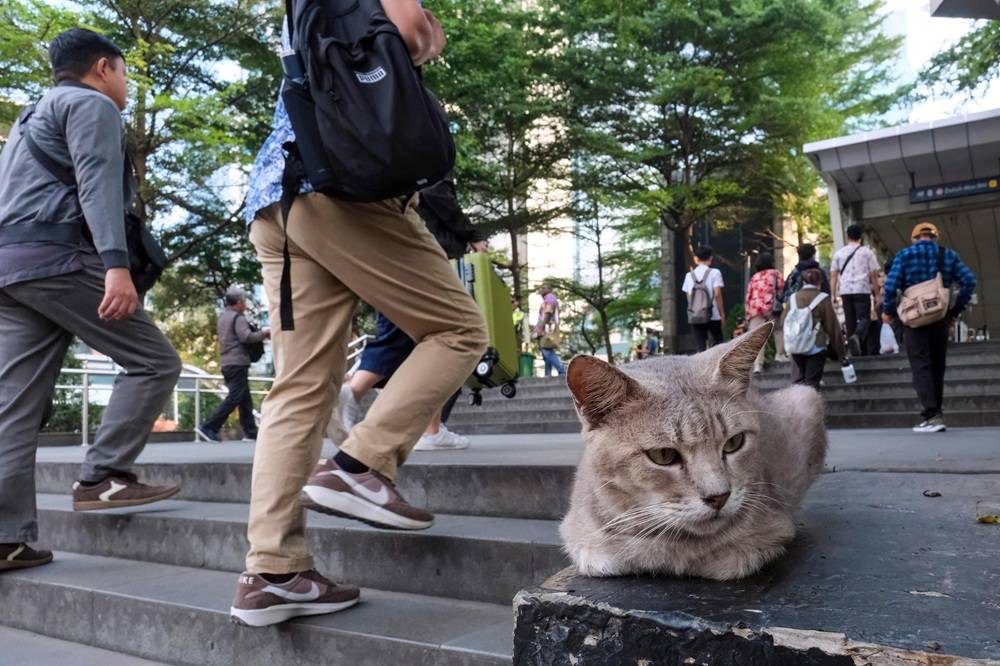
In the city center, strays gather in large numbers at Dukuh Atas station, flitting fearlessly between commuters and traffic.
A ragged older tabby catches the eye of a woman and meows. She stops obligingly, zips open her handbag and takes out a small plastic bag of kibble, placing a fistful on the pavement -- a common sight.
Taking care of cats is partly a religious imperative in the country with the world's largest Muslim population.
Cats "are among the animals loved by the Prophet Mohammed" and unlike dogs -- very rare in the city -- are not considered "impure", Islamic scholar Nur Achmad from Bogor, south of Jakarta, told AFP.
Scientists Make New Discovery about Northern Ireland’s Giant’s Causewayhttps://english.aawsat.com/varieties/5285142-scientists-make-new-discovery-about-northern-ireland%E2%80%99s-giant%E2%80%99s-causeway
Scientists Make New Discovery about Northern Ireland’s Giant’s Causeway
People explore the basalt columns of the Giant’s Causeway on Northern Ireland’s north coast on March 20, 2025. (AFP via Getty Images)
The geological timeline for Northern Ireland's iconic Giant’s Causeway has been dramatically revised following new scientific research, according to The Independent.
New findings indicate that the volcanic activity responsible for the distinctive 40,000 basalt columns occurred over a significantly condensed period.
Scientists now believe the region's volcanic events, including those forming the Causeway, transpired in just 5.5 million years – a staggering eight million years less than earlier estimations.
Dr. Simon Tapster, geochronologist at the British Geological Survey (BGS), said: “Fundamentally, what we’ve done is by piecing together this tapestry of volcanic rocks all across the North Atlantic, but focusing on Northern Ireland, we have been able to reassess a major globally impacting volcanic event.”
“In doing that, and in reassessing the timescales, we have shown that actually it occurred in a much shorter duration,” he added.
The Giant’s Causeway’s distinctive landscape was formed during intense volcanic activity which forced molten rock up through cracks in the earth. Thick lava flows then cooled, contracted and cracked, creating about 40,000 basalt columns.
Tapster said the cutting-edge research by the Geological Survey of Northern Ireland (GSNI) and the BGS, has reconstructed a new timeline for volcanic activity across Northern Ireland.
It has allowed researchers to place the volcanic activity that led to the formation of the Giant’s Causeway within a much more precise global context for the first time.
The research has significantly updated the understanding of when specific volcanic events happened in Northern Ireland.
As a result, scientists can more confidently connect those events to activity and landmarks elsewhere, including Scotland.
It also connects the processes that caused the development of the Giant’s Causeway to a globally significant volcanic event seen in rocks as far away as Greenland about 60 million years ago.
The first lava flows of Northern Ireland’s Antrim Plateau previously were thought to have occurred millions of years before the Staffa basalts and the formation of Fingal’s Cave, but they can now be connected much more definitively as part of the same volcanic activity.
Researchers said it is the same for the Giant’s Causeway with formations on Rum, the Mourne Mountains, and magmatism in Skye.
Tapster said: “By looking at the timescales and the high resolution timeline, we’re able to match it up with various other locations, particularly in the Inner Hebrides in Scotland, the volcanics of Mull, Rum, the Isle of Skye, and taking a bigger view, looking at Greenland and the Faroe Islands.”
The research is part of a wider initiative at the British Geological Survey to improve the understanding of the UK’s geology through better quantifying geological time in the rocks.
لم تشترك بعد
انشئ حساباً خاصاً بك لتحصل على أخبار مخصصة لك ولتتمتع بخاصية حفظ المقالات وتتلقى نشراتنا البريدية المتنوعة