


Israeli War Cabinet to Hold Third Meeting on Response to Iran’s Attack

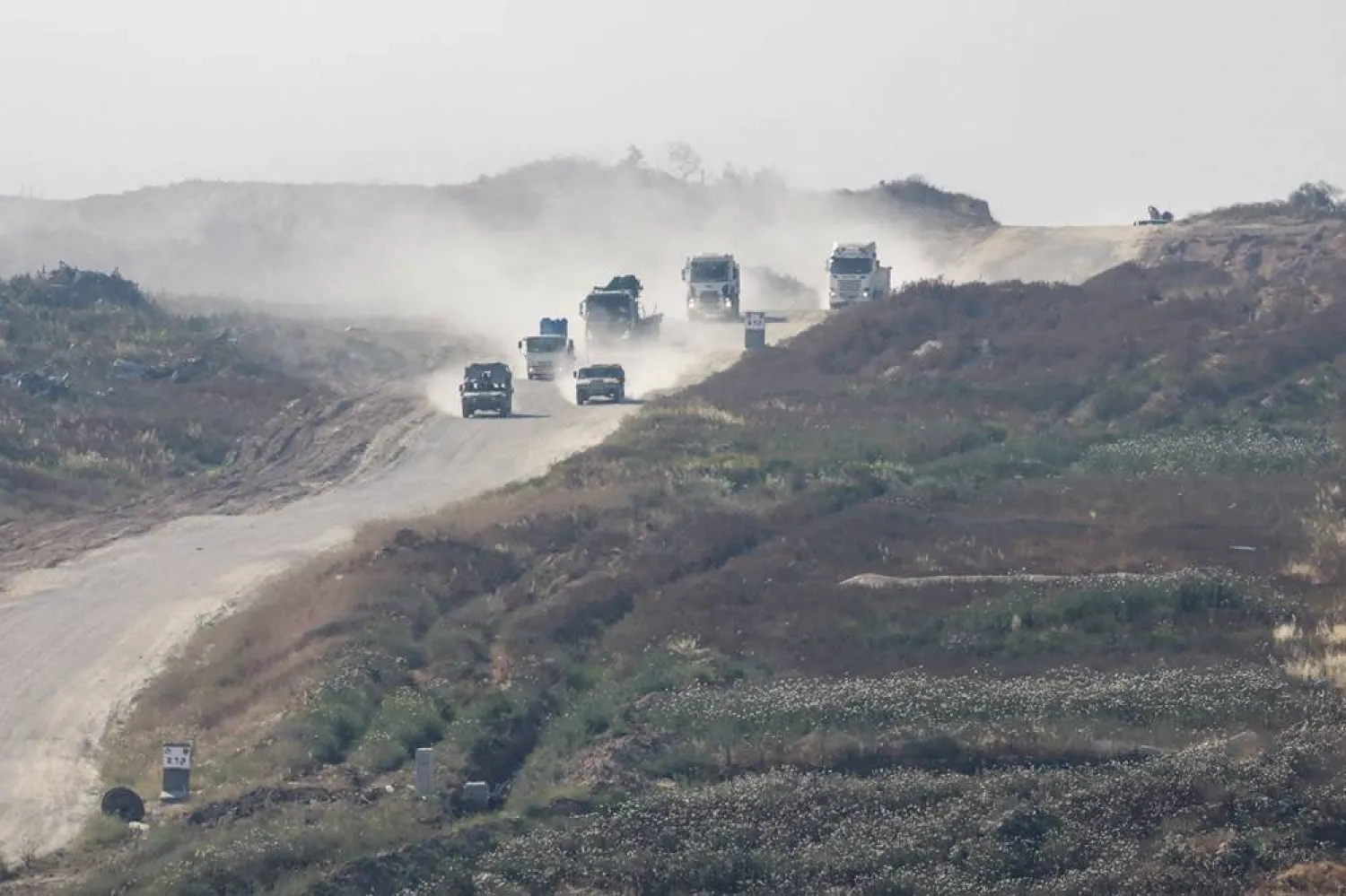
 This picture taken from Israel's southern border with the Gaza Strip shows Israeli army vehicles driving along the border with the Palestinian territory on April 16, 2024, amid the ongoing conflict between Israel and Hamas. (AFP)
This picture taken from Israel's southern border with the Gaza Strip shows Israeli army vehicles driving along the border with the Palestinian territory on April 16, 2024, amid the ongoing conflict between Israel and Hamas. (AFP)
TT

Israeli War Cabinet to Hold Third Meeting on Response to Iran’s Attack

 This picture taken from Israel's southern border with the Gaza Strip shows Israeli army vehicles driving along the border with the Palestinian territory on April 16, 2024, amid the ongoing conflict between Israel and Hamas. (AFP)
This picture taken from Israel's southern border with the Gaza Strip shows Israeli army vehicles driving along the border with the Palestinian territory on April 16, 2024, amid the ongoing conflict between Israel and Hamas. (AFP)

Israel's war cabinet was set to meet for the third time in three days on Tuesday, an official said, to decide on a response to Iran's first-ever direct attack, amid international pressure to avoid further escalating Middle East conflicts.

Military chief of staff Herzi Halevi had promised that Saturday night's launch of more than 300 missiles, cruise missiles and drones from Iran at Israeli territory "will be met with a response," but gave no details.

While the attack caused no deaths and little damage, thanks to the air defenses and countermeasures of Israel and its allies, it has increased fears that violence rooted in the Gaza war is spreading, with the risk of open war between long-time foes Iran and Israel.

Iran launched the attack in retaliation for an airstrike on its embassy compound in Damascus on April 1 attributed to Israel, but signaled that it did not seek further escalation.

President Joe Biden told Israeli Prime Minister Benjamin Netanyahu at the weekend that the United States, Israel's main protector, would not participate in an Israeli counter-strike.

Together with European allies, Washington instead strove on Tuesday to toughen economic and political sanctions against Iran in an attempt to dissuade Israel from violent retaliation.

Israeli Foreign Minister Israel Katz said he was "leading a diplomatic attack," writing to 32 countries to ask them to place sanctions on Iran's missile program and follow Washington in proscribing its dominant military force, the Revolutionary Guard Corps, as a terrorist group.

Treasury Secretary Janet Yellen said the US would use sanctions, and work with allies, to keep disrupting Iran's "malign and destabilizing activity".

She told a news conference in Washington that all options to disrupt Iran's "terrorist financing" were on the table, and that she expected further sanctions against Iran to be announced in coming days.

European Union foreign ministers scheduled a video meeting on the Middle East for Tuesday.

Last autumn, Germany campaigned with France and other EU partners to extend the bloc's existing sanctions regime against Iran that targets drone production.

German Foreign Minister Annalena Baerbock said on Tuesday that several EU members had now promised to look again at extending those sanctions, announcing that she would head to Israel within hours to discuss how to prevent an escalation.

British Prime Minister Rishi Sunak said on Monday the Group of Seven major democracies was working on a package of measures against Iran; Italy, which has the G7 presidency, suggested any new sanctions would target individuals.

IRAN PROMISES RESPONSE 'IN SECONDS, NOT DAYS'

Iranian Deputy Foreign Minister Ali Bagheri Kani had told state TV on Monday night that Tehran's response to any Israeli counterattack would come in "a matter of seconds, as Iran will not wait for another 12 days to respond".

The prospect of Israeli retaliation has alarmed many Iranians already enduring economic pain and tighter social and political controls since major protests in 2022-23.

Since the war in Gaza began in October, clashes have erupted between Israel and Iran-aligned groups based in Lebanon, Syria, Yemen and Iraq.

Israel said four of its soldiers were wounded hundreds of meters inside Lebanese territory overnight, the first known Israeli ground penetration into Lebanon since the Gaza war erupted, although it has regularly traded fire with the heavily armed Lebanese Hezbollah militia.

White House national security spokesman John Kirby declined on Monday to say whether Biden had urged Netanyahu in talks on Saturday night to exercise restraint in responding to Iran.

"We don't want to see a war with Iran. We don't want to see a regional conflict," Kirby told a briefing, adding that it was for Israel to decide "whether and how they'll respond".

Some analysts said the Biden administration is unlikely to seek to sharpen sanctions on Iran's oil exports due to worries about a big spike in oil prices and angering top buyer China.

In a call between the Chinese and Iranian foreign ministers, China said it believed Iran could "handle the situation well and spare the region further turmoil" while safeguarding its sovereignty and dignity, according to Chinese state media.

Iran's weekend attack caused modest damage in Israel and wounded a 7-year-old girl. Most missiles and drones were shot down by Israel's Iron Dome defense system and with help from the US, Britain, France and Jordan.

In Gaza itself, where more than 33,000 Palestinians have been killed in the Israeli offensive according to Gaza health ministry figures, Iran's action drew applause.

Israel began its campaign against Hamas, the Iranian-backed Palestinian group that runs Gaza, after Hamas attacked Israel on Oct. 7, killing 1,200 people and taking 253 hostages, by Israeli tallies.

Iran's attack prompted at least a dozen airlines to cancel or reroute flights, with Europe's aviation regulator still advising caution in using Israeli and Iranian airspace.



Thousands Protest Israeli President Herzog’s Visit to Australia

 Demonstrators gather at Town Hall Square to protest against Israeli President Isaac Herzog's state visit to Australia following a deadly mass shooting during a Jewish Hanukkah celebration at Bondi Beach on December 14, 2025, in Sydney, Australia, February 9, 2026. (Reuters)
Demonstrators gather at Town Hall Square to protest against Israeli President Isaac Herzog's state visit to Australia following a deadly mass shooting during a Jewish Hanukkah celebration at Bondi Beach on December 14, 2025, in Sydney, Australia, February 9, 2026. (Reuters)
TT

Thousands Protest Israeli President Herzog’s Visit to Australia

 Demonstrators gather at Town Hall Square to protest against Israeli President Isaac Herzog's state visit to Australia following a deadly mass shooting during a Jewish Hanukkah celebration at Bondi Beach on December 14, 2025, in Sydney, Australia, February 9, 2026. (Reuters)
Demonstrators gather at Town Hall Square to protest against Israeli President Isaac Herzog's state visit to Australia following a deadly mass shooting during a Jewish Hanukkah celebration at Bondi Beach on December 14, 2025, in Sydney, Australia, February 9, 2026. (Reuters)

Thousands gathered across Australia on Monday to protest the arrival of Israeli President Isaac Herzog, who is on a multi-city trip aimed at expressing solidarity with Australia's Jewish community following a deadly mass shooting last year.

Herzog is visiting Australia this week following an invitation from Australian Prime Minister Anthony Albanese in the aftermath of the December 14 shooting at a Hanukkah event at Sydney's Bondi Beach that killed 15.

The visit has attracted the ire of some people in Australia, who accuse Herzog of being complicit in civilian deaths in Gaza. Pro-Palestine groups have organized protests ‌in cities and ‌towns across the country on Monday evening.

In Sydney, thousands gathered ‌in ⁠a square ‌in the city's central business district, listening to speeches and shouting pro-Palestine slogans.

"The Bondi massacre was terrible but from our Australian leadership there’s been no acknowledgment of the Palestinian people and the Gazans," said Jackson Elliott, a 30-year-old protestor from Sydney.

"Herzog has dodged all the questions about the occupation and says this visit is about Australia and Israeli relations but he is complicit."

There was a heavy police presence with a helicopter circling overhead and officers patrolling on horseback.

About 3,000 police personnel ⁠will be deployed across Sydney during Herzog's visit to the city.

PRESIDENT COMMEMORATES LIVES LOST

Herzog began his visit at Bondi ‌Beach, where he laid a wreath at a memorial for ‍the victims of the attack. He ‍also met survivors and the families of 15 people killed in the shooting.

"This was ‍also an attack on all Australians. They attacked the values that our democracies treasure, the sanctity of human life, the freedom of religion, tolerance, dignity and respect," Herzog said in remarks at the site.

In a statement, the Executive Council of Australian Jewry Co-Chief Executive Alex Ryvchin said Herzog's visit "will lift the spirits of a pained community."

Some Jews oppose the visit.

The Jewish Council of Australia, a vocal critic of the Israeli government, released an open letter ⁠on Monday signed by over 1,000 Jewish Australian academics and community leaders, urging Albanese to rescind Herzog's invitation.

POLICE DEPLOY SPECIAL POWERS

Authorities in Sydney have declared Herzog's visit a major event and have been authorized to use rarely invoked powers during the visit, including the ability to separate and move crowds, restrict their entry to certain areas, direct people to leave and search vehicles.

The Palestine Action Group organizing the protest failed in a legal challenge in a Sydney court on Monday against restrictions placed on the expected demonstration.

"We're hoping we won't have to use any powers, because we've been liaising very closely with the protest organizers," New South Wales Police Assistant Commissioner Peter McKenna told Nine News on Monday.

"Overall, it is all of the community that we ‌want to keep safe ... we'll be there in significant numbers just to make sure that the community is safe."


Crackdown on Dissent After Nationwide Protests in Iran Widens to Ensnare Reformist Figures

Iranians cross a road near an anti-US and anti-Israeli billboard reading "You start... we finish it" in Palestine Square in Tehran, Iran, 09 February 2026, amid heightened regional tensions. (EPA)
TT

Crackdown on Dissent After Nationwide Protests in Iran Widens to Ensnare Reformist Figures

Iranians cross a road near an anti-US and anti-Israeli billboard reading "You start... we finish it" in Palestine Square in Tehran, Iran, 09 February 2026, amid heightened regional tensions. (EPA)

Iranian security forces have launched a campaign to arrest figures within the country's reformist movement, reports said Monday.

That widens a crackdown on dissent after authorities earlier put down nationwide protests in violence that killed thousands and saw tens of thousands more detained.

Detained Nobel Peace Prize laureate Narges Mohammadi has received another prison sentence of over seven years. It signals a widening effort to silence anyone opposed to the bloody suppression of unrest by Iran's theocracy as it faces new nuclear talks with the United States. President Donald Trump has repeatedly warned he could launch an attack on the country if no deal is reached.

Media reports quoted officials within the reformist movement, which seeks to change Iran's theocracy from inside, as saying at least four of their members had been arrested. They include Azar Mansouri, the head of the Reformist Front, which represents multiple reformist factions; and former diplomat Mohsen Aminzadeh, who served under reformist President Mohammad Khatami.

Also detained was Ebrahim Asgharzadeh, who led students who stormed the US Embassy in Tehran in 1979, sparking the 444-day hostage crisis.

Their arrests likely stem from a reformist statement in January that called for Iran's 86-year-old Supreme Leader Ali Khamenei to resign from his position and have a transitional governing council oversee the country.

Iran's state-run IRNA news agency quoted a statement from prosecutors in Tehran, the country's capital, saying four people had been arrested and others summoned to meet authorities. It accused those allegedly involved of “organizing and leading ... activities aimed at disrupting the political and social situation in the country amid military threats from the United States and the Zionist regime.”

“Having bludgeoned the streets into silence with exemplary cruelty, the regime has shifted its attention inward, fixing its stare on its loyal opposition,” wrote Ali Vaez, an Iran expert at the International Crisis Group.

“The reformists, sensing the ground move beneath them, had begun to drift — and power, ever paranoid, is now determined to cauterize dissent before it learns to walk.”

However, it remains unclear just how much political support reformists have within Iran. The anger on the streets of Iran during the demonstrations, heard in people shouting “Death to Khamenei!” and in support of the country's exiled crown prince, appeared to lump reformists in with all other politicians now working in the country.

Iran and the US held new nuclear talks last week in Oman. Foreign Minister Abbas Araghchi, speaking Sunday to diplomats at a summit in Tehran, signaled that Iran would stick to its position that it must be able to enrich uranium — a major point of contention with Trump, who bombed Iranian atomic sites in June during the 12-day Iran-Israel war.

Israeli Prime Minister Benjamin Netanyahu is to travel to Washington this week, with Iran expected to be the major subject of discussion, his office said.

The US has moved the aircraft carrier USS Abraham Lincoln, ships and warplanes to the Middle East to pressure Iran into an agreement and have the firepower necessary to strike the country should Trump choose to do so.

Meanwhile, Iran issued a warning to pilots that it planned “rocket launches” Monday into Tuesday in an area over the country’s Semnan province, home to the Imam Khomeini Spaceport. Such launches have corresponded in the past with Iran marking the anniversary of its 1979 revolution.


China Vows ‘Resolute Response’ to Any Reckless Acts After Japan Election

 Japan's Prime Minister Sanae Takaichi, leader of the ruling Liberal Democratic Party (LDP), arrives at the Prime Minister's office after her party's historic election win in Sunday's poll in Tokyo, Japan, February 9, 2026. (Reuters)
Japan's Prime Minister Sanae Takaichi, leader of the ruling Liberal Democratic Party (LDP), arrives at the Prime Minister's office after her party's historic election win in Sunday's poll in Tokyo, Japan, February 9, 2026. (Reuters)
TT

China Vows ‘Resolute Response’ to Any Reckless Acts After Japan Election

 Japan's Prime Minister Sanae Takaichi, leader of the ruling Liberal Democratic Party (LDP), arrives at the Prime Minister's office after her party's historic election win in Sunday's poll in Tokyo, Japan, February 9, 2026. (Reuters)
Japan's Prime Minister Sanae Takaichi, leader of the ruling Liberal Democratic Party (LDP), arrives at the Prime Minister's office after her party's historic election win in Sunday's poll in Tokyo, Japan, February 9, 2026. (Reuters)

Beijing warned Tokyo on Monday that reckless actions would be met with a "resolute response", a day after Japan's Prime Minister Sanae Takaichi, who is viewed as critical of China, won a landslide election.

China and Japan have been locked in a spat over comments by Takaichi in November that Tokyo could intervene militarily in any attack on self-ruled Taiwan.

China claims the democratic island as part of its territory and has not ruled out force to annex it.

A spokesman for China's foreign ministry on Monday urged Japan to retract the comments and warned of consequences for any rash actions.

"If the far-right forces in Japan misjudge the situation and act recklessly, they will inevitably face resistance from the Japanese people and a resolute response from the international community," spokesman Lin Jian told a regular news conference.

"We once again urge the Japanese side to retract the erroneous remarks made by Takaichi regarding Taiwan and demonstrate basic sincerity in safeguarding the political foundation of China-Japan relations, through concrete actions," he said.

In the wake of Takaichi's comments in November, China has discouraged its nationals from travelling to Japan, citing deteriorating public security and criminal acts against Chinese nationals in the country.

In the latest escalation of the row in December, Chinese military aircraft locked radar onto Japanese jets, prompting Tokyo to summon Beijing's ambassador.

Beijing also reportedly choked off exports to Japan of rare-earth products crucial for making everything from electric cars to missiles.

And last month, two popular pandas departed Tokyo for China, leaving Japan without any of the beloved bears for the first time in 50 years.