


New Study Calculates Climate Change’s Economic Bite Will Hit about $38 Trillion a Year by 2049

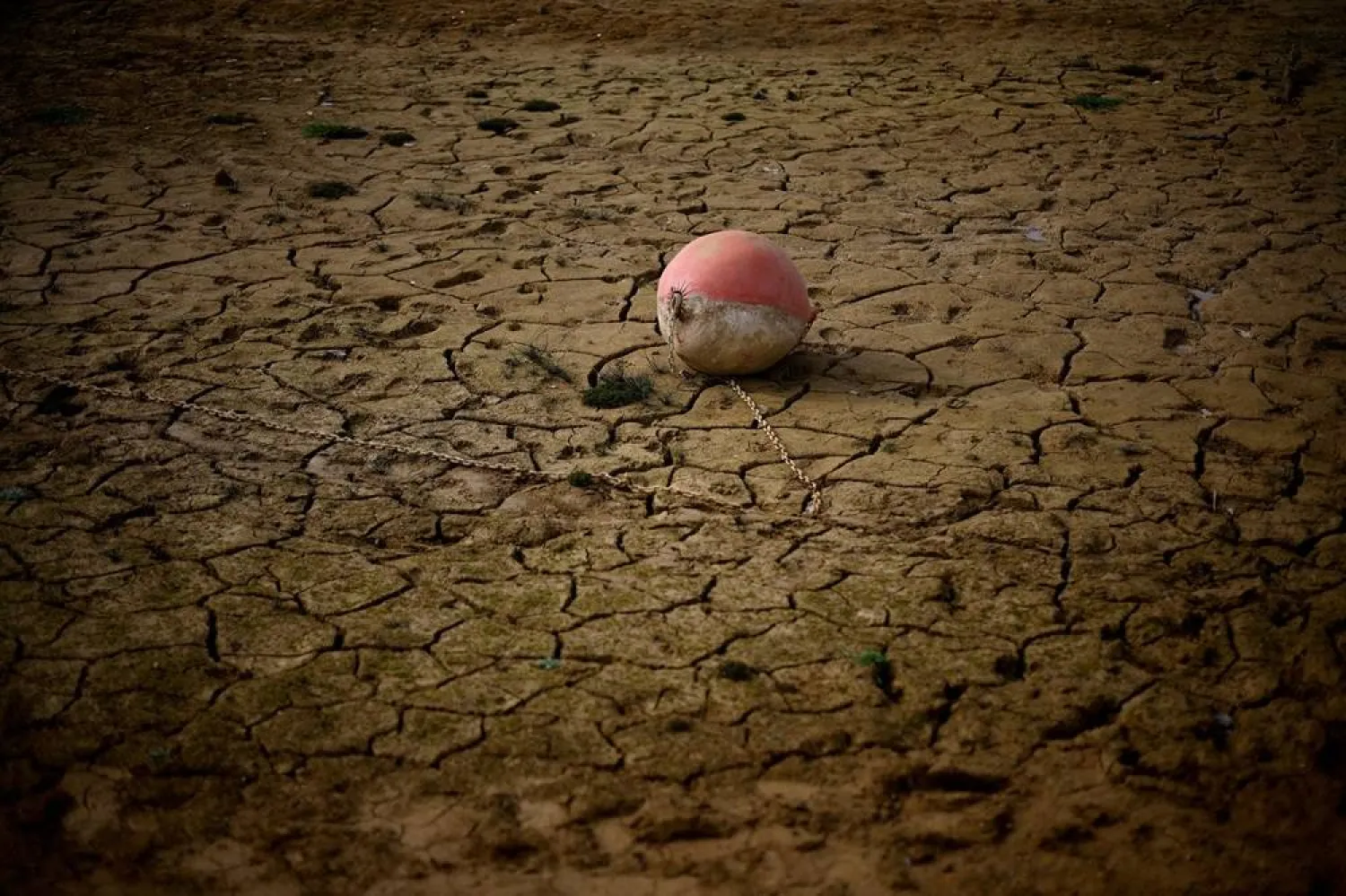
A buoy is seen on the banks of the partially dry Lake Montbel at the foot of the Pyrenees Mountains as France faces records winter dry spell raising fears of another summer of droughts and water restrictions, March 13, 2023. (Reuters)
TT

New Study Calculates Climate Change’s Economic Bite Will Hit about $38 Trillion a Year by 2049

A buoy is seen on the banks of the partially dry Lake Montbel at the foot of the Pyrenees Mountains as France faces records winter dry spell raising fears of another summer of droughts and water restrictions, March 13, 2023. (Reuters)

Climate change will reduce future global income by about 19% in the next 25 years compared to a fictional world that's not warming, with the poorest areas and those least responsible for heating the atmosphere taking the biggest monetary hit, a new study said.

Climate change's economic bite in how much people make is already locked in at about $38 trillion a year by 2049, according to Wednesday's study in the journal Nature by researchers at Germany's Potsdam Institute for Climate Impact Research. By 2100 the financial cost could hit twice what previous studies estimate.

“Our analysis shows that climate change will cause massive economic damages within the next 25 years in almost all countries around the world, also in highly-developed ones such as Germany and the US, with a projected median income reduction of 11% each and France with 13%,” said study co-author Leonie Wenz, a climate scientist and economist.

These damages are compared to a baseline of no climate change and are then applied against overall expected global growth in gross domestic product, said study lead author Max Kotz, a climate scientist. So while it's 19% globally less than it could have been with no climate change, in most places, income will still grow, just not as much because of warmer temperatures.

For the past dozen years, scientists and others have been focusing on extreme weather such as heat waves, floods, droughts, storms as the having the biggest climate impact. But when it comes to financial hit the researchers found “the overall impacts are still mainly driven by average warming, overall temperature increases,” Kotz said. It harms crops and hinders labor production, he said.

“Those temperature increases drive the most damages in the future because they're really the most unprecedented compared to what we've experienced historically,” Kotz said. Last year, a record-hot year, the global average temperature was 1.35 degrees Celsius (2.43 degrees Fahrenheit) warmer than pre-industrial times, according to the US National Oceanic and Atmospheric Administration. The globe has not had a month cooler than 20th century average since February 1979.

In the United States, the southeastern and southwestern states get economically pinched more than the northern ones with parts of Arizona and New Mexico taking the biggest monetary hit, according to the study. In Europe, southern regions, including parts of Spain and Italy, get hit harder than places like Denmark or northern Germany.

Only Arctic adjacent areas — Canada, Russia, Norway, Finland and Sweden — benefit, Kotz said.

It also means countries which have historically produced fewer greenhouse gas emissions per person and are least able to financially adapt to warming weather are getting the biggest financial harms too, Kotz said.

The world's poorest countries will suffer 61% bigger income loss than the richest ones, the study calculated.

“It underlies some of the injustice elements of climate,” Kotz said.

This new study looked deeper than past research, examining 1,600 global areas that are smaller than countries, took several climate factors into account and examined how long climate economic shocks last, Kotz said. The study examined past economic impacts on average global domestic product per person and uses computer simulations to look into the future to come up with their detailed calculations.

The study shows that the economic harms over the next 25 years are locked in with emission cuts producing only small changes in the income reduction. But in the second half of this century that's when two different possible futures are simulated, showing that cutting carbon emissions now really pays off because of how the heat-trapping gases accumulate, Kotz said.

If the world could curb carbon pollution and get down to a trend that limits warming to 2 degrees Celsius (3.6 degrees Fahrenheit) above pre-industrial times, which is the upper limit of the 2015 Paris climate agreement, then the financial hit will stay around 20% in global income, Kotz said. But if emissions increase in a worst case scenario, the financial wallop will be closer to 60%, he said.

That shows that the public shouldn't think it's a financial “doomsday” and nothing can be done, Kotz said.

Still, it's worse than a 2015 study that predicted a worst case income hit of about 25% by the end of the century.

Marshall Burke, the Stanford University climate economist who wrote the 2015 study, said this new research's finding that the economic damage ahead is locked in and large “makes a lot of sense.”

Burke, who wasn't part of this study, said he has some issues with some of the technical calculations “so I wouldn't put a ton of weight on their specific numerical estimates, but I think the big picture is basically right.”

The conclusions are on the high end compared to other recent studies, but since climate change goes for a long time and economic damage from higher temperatures keep compounding, they “add up to very large numbers," said University of California Davis economist and environmental studies professor Frances Moore, who wasn't part of the study. That's why fighting climate change clearly passes economists' tests of costs versus benefits, she said.




Olympic Tourists in Cortina Can Explore the Dolomites with the New ‘Uber Snowmobile’ Service

 The peaks of the Dolomites are seen from the Cortina Sliding Centre during the Milano Cortina 2026 Winter Olympic Games in Cortina d'Ampezzo on February 5, 2026. (AFP)
The peaks of the Dolomites are seen from the Cortina Sliding Centre during the Milano Cortina 2026 Winter Olympic Games in Cortina d'Ampezzo on February 5, 2026. (AFP)
TT

Olympic Tourists in Cortina Can Explore the Dolomites with the New ‘Uber Snowmobile’ Service

 The peaks of the Dolomites are seen from the Cortina Sliding Centre during the Milano Cortina 2026 Winter Olympic Games in Cortina d'Ampezzo on February 5, 2026. (AFP)
The peaks of the Dolomites are seen from the Cortina Sliding Centre during the Milano Cortina 2026 Winter Olympic Games in Cortina d'Ampezzo on February 5, 2026. (AFP)

The peaks of the Dolomites are seen from the Cortina Sliding Centre during the Milano Cortina 2026 Winter Olympic Games in Cortina d'Ampezzo on February 5, 2026. (AFP)

For one month starting on Saturday, Olympic spectators keen for a side trip to a UNESCO World Heritage Site can use Uber to reserve a ride on a snowmobile along the snow-covered road to the base of the Three Peaks of Lavaredo.

The dramatic, jagged limestone pinnacles stand just 23 kilometers (14.3 miles) from the Cortina venues where athletes are competing in the 2026 Winter Olympics and Paralympics.

One of the Olympic torchbearers, Giulia Baffetti, runs snowmobiling tours through Cortina-based winter activities outfit Snowdreamers. The company partnered with Uber, the official ride-hailing sponsor for the Games, to offer free tours on the weekends in February to people in town.

"Uber Snowmobile" tours, which can only be booked through Uber, include a ride in an Uber transfer bus for up to eight people from Cortina to the spot where riders mount their snowmobiles for departure. Tourgoers then follow the instructor, who leads the line of snowmobiles.

The first slots offered went fast, but Uber spokesperson Caspar Nixon said Friday that it planned to add more.

The three peaks are a magical place, Baffetti said, and this is a way for more people to experience it. Hikers and climbers flock there in the warmer months. In the winter, it’s a prime spot for cross-country skiing, snowshoeing and sledding. Snowmobiling is allowed in a limited area in order to protect the environment.

"We want to give an experience to the tourists, so they can feel the mountains in a different way," she said.

The Associated Press took the one-hour tour on Thursday, ahead of the Saturday launch, along with one other person. Helmets are essential, while heated handgrips are a most welcome feature. And that red button? Passengers can push it to stop the snowmobile if it veers off course or they feel unsafe.

The adrenaline-filled ride reaches speeds up to 40 kph (25 mph) when zooming past snow-covered trees, and drivers are instructed to slow when coming upon cross-country skiers and sledders. Deer and wolves are sometimes seen along the 7-kilometer (4.3-mile) route up to the base of the peaks.

Also visible on Thursday was the southernmost of the three Lavaredo peaks, rising sharply out of the fog. While the Dolomites are breathtaking from Cortina — and on Friday, the sun shone and the view was clear from town — they are even more impressive up close.

The route back includes a short loop around Lake Antorno. Before traversing all the ups and downs, the snowmobile instructor leading the tour offers a reminder about that red button.

Saher Deeb, an Israeli tourist, was along for the ride Thursday, one day after his 29th birthday. It was his first time on a snowmobile, and he was all smiles as he climbed off at the end.

"It was perfect," he said.


French Duo Finish Walking from France to Shanghai After 1.5 Years

 Performers throw molten iron to create sparks during a performance on the Bund promenade along the Huangpu river, ahead of the upcoming Lunar New Year of the Horse in Shanghai on February 2, 2026. (AFP)
Performers throw molten iron to create sparks during a performance on the Bund promenade along the Huangpu river, ahead of the upcoming Lunar New Year of the Horse in Shanghai on February 2, 2026. (AFP)
TT

French Duo Finish Walking from France to Shanghai After 1.5 Years

 Performers throw molten iron to create sparks during a performance on the Bund promenade along the Huangpu river, ahead of the upcoming Lunar New Year of the Horse in Shanghai on February 2, 2026. (AFP)
Performers throw molten iron to create sparks during a performance on the Bund promenade along the Huangpu river, ahead of the upcoming Lunar New Year of the Horse in Shanghai on February 2, 2026. (AFP)

Two French adventurers reached the end of an epic walk from France to Shanghai on Saturday, after nearly a year and a half crossing 16 countries almost entirely on foot.

Loic Voisot and Benjamin Humblot embraced as they stood by the river on the Bund promenade, the financial hub's distinctive skyline glittering in the background.

Voisot and Humblot set off from Annecy in September 2024.

"We were thinking about this moment almost every day for more than a year now, so it's a really strong feeling," Humblot said of reaching their destination.

Hanging out after work one day, the two friends realized they both yearned for a "great adventure".

They wanted to visit China -- but without flying, which they believe is too harmful to the environment.

A plan to set out on foot was hatched, and except for a stretch in Russia which was done by bus for safety reasons, 518 days and around 12,850 kilometers (7,980 miles) later they took the last steps to completing it.

Around 50 people gathered at the start point for the last 10km stretch of their odyssey, many local people who have been following them on social media.

Along the way their numbers swelled, as media, French residents of Shanghai and others joined.

"If your dreams are crazy, just take it step by step and sometimes you will not succeed, but sometimes you will," said Voisot.

Asked what he would do first now the walk was over, he joked: "Sleep a lot!"


Annual Orchids Show Brings Vivid Color to Chicago Winter

Orchids adorn a Volkswagen Beetle as finishing touches are placed on the 12th annual Chicago Botanic Garden Orchid Show, Friday, Feb. 6, 2026, in Glencoe, Ill. (AP)
TT

Annual Orchids Show Brings Vivid Color to Chicago Winter

Orchids adorn a Volkswagen Beetle as finishing touches are placed on the 12th annual Chicago Botanic Garden Orchid Show, Friday, Feb. 6, 2026, in Glencoe, Ill. (AP)

A soft layer of white snow blankets the grounds of the Chicago Botanic Garden. The air is chilly, the sky gray.

Inside, however, the air is warm and lights illuminate more than 10,000 vividly colored orchids. Staff members move in and out of greenhouses, preparing to open the garden’s 12th annual Orchid Show on Saturday.

This year’s theme is “Feelin’ Groovy" with several installations calling back to the 1970s, including a yellow Volkswagen Beetle filled with orchids.

“It’s just a really great way to get out of the winter cold and come into our greenhouses,” said Jodi Zombolo, associate vice president of visitor events and programs. “I think people are really looking for something to kind of bring happiness and something that they will enjoy and find whimsy in.”

The orchid family is one of the largest in the plant world and some of the species in the show are rare, exhibits horticulturist Jason Toth said. One example is the Angraecum sesquipedale, also known as Darwin’s orchid, on display in the west gallery.

Toth said the orchid led Darwin to correctly conclude that pollinators have adapted in order to reach down the flower's very long end.

"It has a great story and it’s quite remarkable-looking,” said Toth.

Elsewhere, massive, gnarly roots dangle from purple, pink and yellow Vanda orchids in the south greenhouse. These epiphytic orchids grow on the surface of trees instead of in soil.

“I think everyone’s tired of the winter,” said Toth. “So having some kind of flower show at this point is what we’re all craving. And 'Orchids' fits the bill.”

The show is expected to draw 85,000 visitors this year.