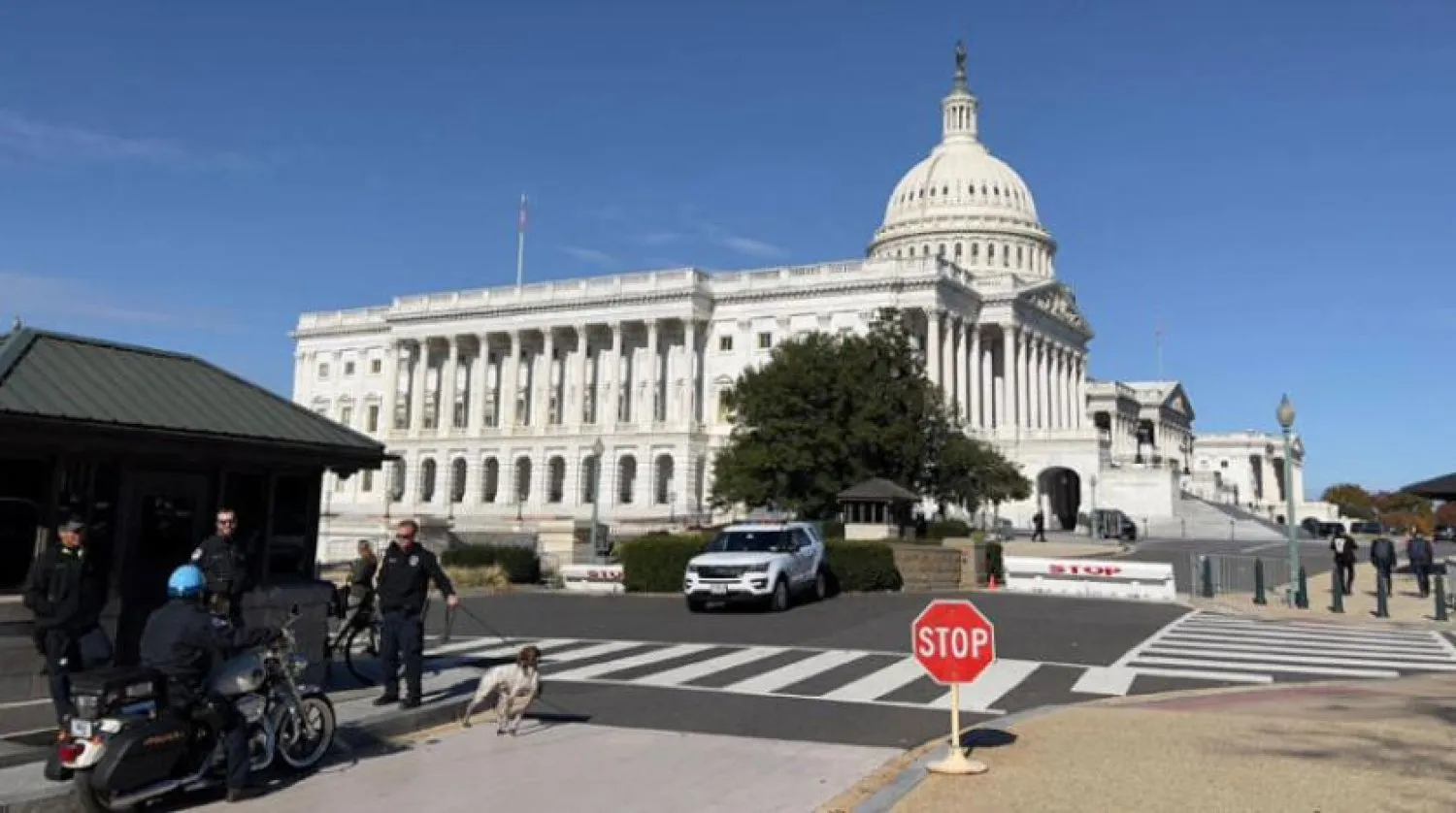
Congress Moving Swiftly on Bipartisan Action to Punish Iran after Revenge Attack on Israel

Capitol Hill in Washington (File/AFP)
TT

Congress Moving Swiftly on Bipartisan Action to Punish Iran after Revenge Attack on Israel

Capitol Hill in Washington (File/AFP)

Iran's attack against Israel over the weekend has spurred a flurry of bipartisan legislative action in Congress, uniting lawmakers against the country even as the risk of a larger regional war looms.
Several measures introduced and passed in the House and Senate seek to both publicly condemn Iran and punish Iran financially. Lawmakers have denounced Iran's actions, which came in response to a suspected Israeli strike weeks earlier on an Iranian consular building in Syria that killed two Iranian generals, The Associated Press said.
“The world is on fire, and history will judge us for our action,” said Rep. Mike McCaul, R-Texas, chairman of the House Foreign Relations Committee, during a news conference Tuesday.
The swift, bipartisan condemnation of Iran has put on sharp display the durability of American support for Israel, even amid growing partisan division over how the country is handling its more than six-month war with Hamas.
The House passed nearly a dozen bills by Wednesday that would, among other things, issue a slate of new sanctions and other financial restrictions against Iran and its leaders. Other legislation looks to prevent current Iranian officials sanctioned from evading those penalties and urge the European Union to “expeditiously” designate Iran’s Revolutionary Guard as a terrorist organization as the US has already done.
On the other side of the Capitol, the Senate Foreign Relations Committee on Tuesday advanced five bills, including ones that targeted Iran for its human rights record and would require sanctions on ports and refineries that receive and process Iranian oil.
“Iran’s direct attack on Israel this week underscores the need to further cut off the Iranian regime’s key revenue streams,” Democratic Sen. Jeanne Shaheen of New Hampshire said in a statement. "I urge my colleagues in the Senate to support this bill — which has already passed the House — so that we can send it to President Biden’s desk immediately.”
A number of the bills had passed the House weeks before Hamas' deadly attack on Israel in October but have been stalled in the Senate committee. An Israeli offensive in Gaza has since caused widespread devastation and killed over 33,000 people, according to local health officials. Israel's conduct of the war has revealed the depth of unease among US lawmakers as concerns over the delivery of humanitarian aid to Gaza have caused even some of President Joe Biden's closest allies to threaten conditioning future aid to Israel.
Congressional Democrats have been reluctant to challenge Biden's handling of the ongoing conflict and related regional tensions that have taken shape, mindful that criticism could further weaken Biden in his reelection campaign against former President Donald Trump.
But the attack on Saturday has proven to consolidate public support for the Biden administration's quick response as it ordered US forces to help Israel down “nearly all” the 300 drones and missiles that were headed its way.
It also comes as House Speaker Mike Johnson, R-La., released legislation Wednesday that would provide $95 billion in aid collectively to Israel, Ukraine and Taiwan. The aid package had been held up for months over Republican opposition to continuing wartime funding for Ukraine as it battles Russia. Iran's attack on Israel added urgency to Johnson's plans to bring the issue to the floor for a vote.
While the measures targeting Iran have received overwhelming support — with the series of House bills mostly passing with at least 300 votes — there has been a quiet but growing dissent among progressive Democratic lawmakers in both chambers, who warn that legislative efforts could risk further escalation in the Middle East.
“Following last weekend’s unprecedented response by Iran to Israel’s attack on its consulate, the Republican Majority is explicitly leveraging a series of bills to further escalate tensions in the Middle East," Rep. Alexandria Ocasio-Cortez, D-N.Y., said in a statement Tuesday. “This is a blatant attempt to distract from their own incompetence.”
The strike on Saturday marked the first time Iran has launched a direct military assault on Israel despite decades of enmity dating back to the country’s 1979 Iranian Revolution. Israel has vowed to retaliate against Iran, risking further expanding the shadow war between the two foes into a direct conflict.
Sen. Bernie Sanders, a Vermont independent, condemned Iran's attack in a statement but called on his colleagues to respond cautiously. He warned that further US action against Iran could lead to a dangerous escalation that could drag America into a war in the Middle East.
“Cooler heads must now prevail to ensure peace in the region and security for Israel,” Sanders said.


Netanyahu Vows to Eliminate Iran Threat ‘Once and for All’

10 November 2026, Israel, Jerusalem: Caretaker Israeli Prime Minister Benjamin Netanyahu delivers a speech on the sidelines of the opening session of the new Knesset. (dpa)
TT

Netanyahu Vows to Eliminate Iran Threat ‘Once and for All’

10 November 2026, Israel, Jerusalem: Caretaker Israeli Prime Minister Benjamin Netanyahu delivers a speech on the sidelines of the opening session of the new Knesset. (dpa)

Israel's caretaker prime minister Benjamin Netanyahu on Saturday reiterated his calls for a national unity government with his opponent Gadi Eisenkot, as well as his vow to eliminate the threat from Iran.

A meeting with Eisenkot on Thursday "only strengthened the conviction that it is essential to form a national unity government" to guarantee Israel's security, Netanyahu said in a video statement, adding that such a government could "eliminate the Iranian threat once and for all".


Ukraine’s Zelenskiy Escalates Criticism of SpaceX Over Speed Caps

Ukraine's President Volodymyr Zelenskiy holds a press briefing in Copenhagen November 10, 2026. (AFP)
TT

Ukraine’s Zelenskiy Escalates Criticism of SpaceX Over Speed Caps

Ukraine's President Volodymyr Zelenskiy holds a press briefing in Copenhagen November 10, 2026. (AFP)

Ukraine's President Volodymyr Zelenskiy ‌escalated his criticism of SpaceX on Saturday, saying speed restrictions on its military-grade Starshield satellite terminals had dangerous political implications and undermined critical air defenses.

Zelenskiy said Starshield terminals operating in temporarily Russian-occupied territories of Ukraine had been limited to a maximum speed of 161 kph for the past five days, hampering Ukraine's military capabilities.

The Ukrainian Defense Ministry has raised the issue with SpaceX at the ‌institutional level, ‌Zelenskiy said.

"The restrictions have now ‌been ⁠in place for ⁠five days. They say it is some kind of technical issue. We do not believe that is the case," Zelenskiy told reporters in remarks released by his office on Saturday.

"If you impose restrictions there, you are already partially recognizing the temporarily ⁠occupied territories as not ours. And ‌that is why I ‌believe we have the right to raise this ‌issue and restore the speed – so that there ‌are no restrictions at all."

Zelenskiy said the speed restrictions made it more difficult for Ukrainian air defense units to intercept Russian jet-powered drones and made Ukrainian cities ‌more vulnerable. He said he had ordered his top military and foreign ministry ⁠officials ⁠to address the issue and seek clarification.

SpaceX has pushed back against the allegations, denying that it introduced new restrictions or made any changes to its satellite operations.

It is the second such outage in recent weeks. In mid-October, Ukrainian officials said that SpaceX limited the speed of Starlink and its Starshield communication systems to about 160 kph (100 mph) amid tensions with US President Donald Trump's administration over Ukrainian attacks on Russian oil refineries. Service was then restored on October 24.


UN Official Urges Iran, US to Let Fertilizers Through Hormuz Strait

Jorge Moreira da Silva, Executive Director of UNOPS (United Nations Office for Project Services), and coordinator of the UN Strait of Hormuz Task Force established by the UN Secretary-General, speaks during an interview with AFP on the sidelines of the 31st United Climate Change Conference (COP31), at the media center located on the Antalya Expo Center in Antalya on November 14, 2026. (AFP)
TT

UN Official Urges Iran, US to Let Fertilizers Through Hormuz Strait

Jorge Moreira da Silva, Executive Director of UNOPS (United Nations Office for Project Services), and coordinator of the UN Strait of Hormuz Task Force established by the UN Secretary-General, speaks during an interview with AFP on the sidelines of the 31st United Climate Change Conference (COP31), at the media center located on the Antalya Expo Center in Antalya on November 14, 2026. (AFP)

Iran and the United States should "immediately" allow fertilizer shipments through the Strait of Hormuz to ease the crisis in some of the most vulnerable countries, a senior UN official said Saturday.

Jorge Moreira da Silva, head of the UN Office for Project Services, told the COP31 climate talks in the Turkish resort city of Antalya that the lack of fertilizers could push millions into poverty.

The Iranian blockade of the vital waterway, which started after the joint US-Israeli attack against Iran in late February, has choked shipping in the region and beyond. The US blockade of Iranian ports has further complicated matters.

While Iran and the United States are still trying to negotiate an end to the conflict, Moreira da Silva said he had the same message for both countries.

"They should continue their negotiations about the comprehensive deal -- but that deal should not avoid an immediate, exceptional, limited, and time-bound solution for the fertilizers," he said.

"Basically, what we need is five vessels a day with fertilizers," he added.

- Millions at risk -

Moreira da Silva heads up the UN task force dedicated to facilitating the safe passage of fertilizers during the crisis.

Before the conflict, a third of the world's fertilizers passed through the Strait of Hormuz, and since the blockades, their prices had risen by 30 percent, he said.

"But what I think is not sufficiently recognized is the disproportionate impact on the most vulnerable countries," he added.

Sudan's finance minister recently told him that the price of food there had doubled in six months, he added. In Nepal, they had told him that farmers could no longer afford to buy fertilizers.

"So, it's very important that we are aware that countries such as Mozambique, Kenya, Sudan, Somalia, Nepal, Bangladesh, Sri Lanka are facing very significant impact."

The effects of this shortage could be catastrophic, he warned.

"If we continue missing the planting seasons in different parts of the world we may have 45 million people facing severe and acute food insecurity," he said.

"We may have 30 million people being forced into poverty."

The UN had a system ready to get fertilizer shipments moving within seven to 10 days, he said.