


Taiwan Says New Chinese Air Routes Threaten Taiwanese Islands’ Flight Safety 

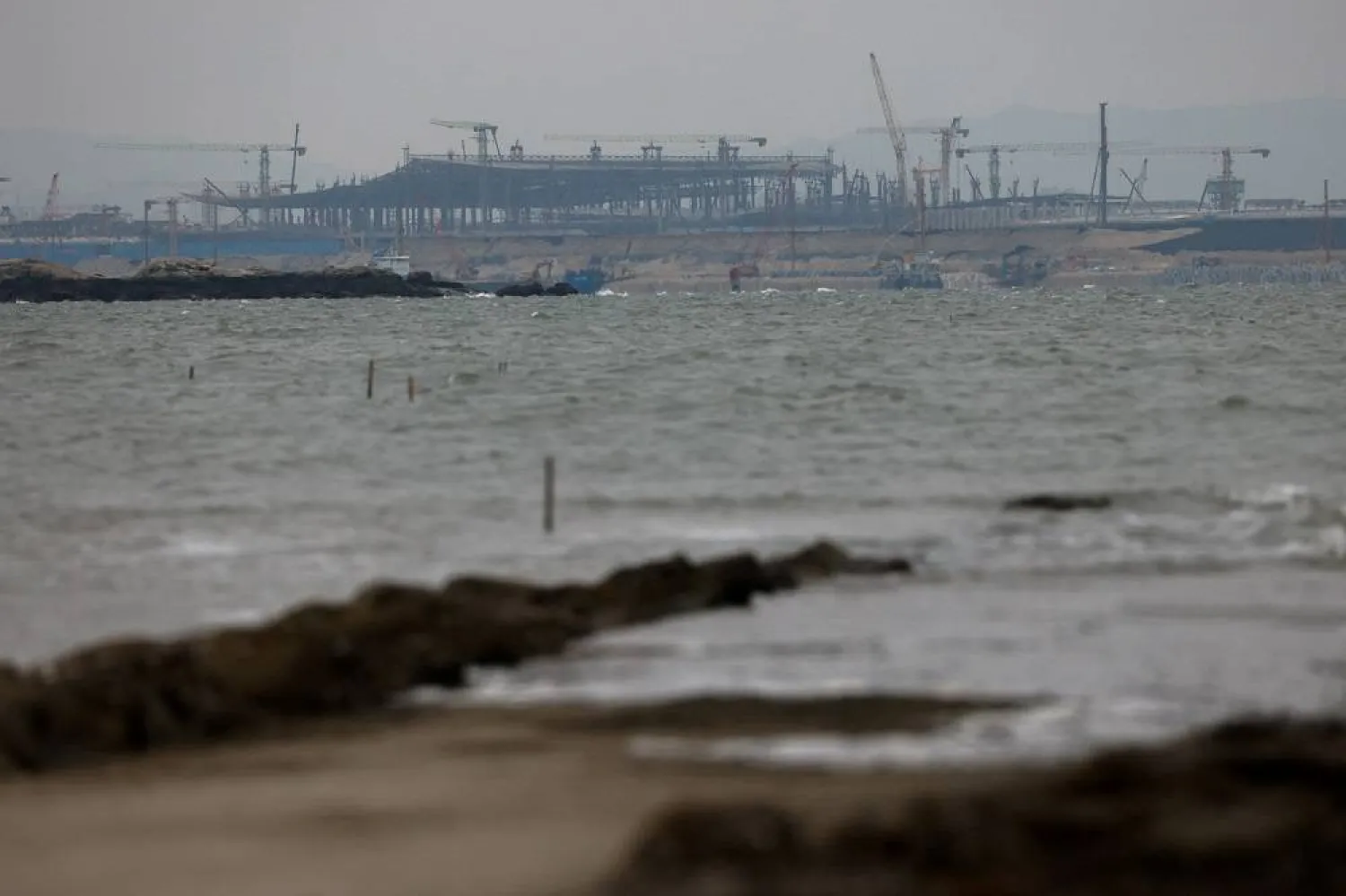
Construction of Xiang'an International Airport in China's Xiamen as seen from Kinmen, Taiwan December 20, 2023. (Reuters)
TT

Taiwan Says New Chinese Air Routes Threaten Taiwanese Islands’ Flight Safety 

Construction of Xiang'an International Airport in China's Xiamen as seen from Kinmen, Taiwan December 20, 2023. (Reuters)

Taiwan said on Friday China's decision to open new air routes that run perilously close to two Taiwanese-controlled islands was a flight safety risk taken without consultation, adding it will demand any aircraft using them be asked to turn around.

Taiwan's government expressed anger in January after China "unilaterally" changed a flight path called M503 close to the sensitive median line in the Taiwan Strait. China claims democratically-governed Taiwan as its own territory.

The new Chinese routes to China's Xiamen and Fuzhou cities, called W123 and W122 respectively, connect to the M503 flight route, and run alongside existing routes to the islands of Kinmen and Matsu, which have regular flights to and from Taiwan.

China had said in January it was opening routes from west to east - in other words, in the direction of Taiwan - on the two flight paths from Xiamen and Fuzhou, but had not until now announced when they would go into operation.

China's civil aviation regulator said in its brief statement on Friday that those routes were now in operation, adding that from May 16 it would "further optimize" airspace around Fuzhou airport.

It did not elaborate, but that is four days before Taiwan President-elect Lai Ching-te is inaugurated, a man Beijing believes is a dangerous separatist. Lai has repeatedly offered talks with China but has been rebuffed.

China's regulator added that the changes to the flight paths will help meet the "development needs" of flights along the Chinese coast, ensure flight safety, enhance the ability to respond to thunderstorms and improve normal flight operations.

Taiwan's Civil Aviation Administration said the measure seriously impacted aviation safety in Taiwanese airspace, calling it a unilateral move taken without consultation.

At its nearest point, close to Kinmen, there is only a 1.1 nautical mile distance between the Chinese and Taiwanese flight paths, it said.

"The airspace between the two sides is very small, and there are certain risks," it added.

CONTROLLED AIR SPACE

Taiwanese air traffic controllers will "strongly request" their Chinese counterparts guide any aircraft away when an aircraft approaches Taiwan's air space, it said.

Chinese aircraft are not permitted by Taiwan to fly in the airspace Taipei controls around Kinmen and Matsu.

The strait's median line had for years served as an unofficial demarcation between Taiwan and China and was not crossed by combat aircraft from either side.

But China says it does not recognize the line's existence and Chinese warplanes now regularly fly over it as Beijing seeks to pressure Taipei to accept its sovereignty claims.

Flights to and from Taiwan and China's Xiamen and Fuzhou take a circuitous route skirting the median line rather than flying directly across the strait. Domestic Taiwanese flights to Kinmen and Matsu fly directly across the strait.

Taiwan has complained about the M503 route before, in 2018, when it said China opened the northbound part of it without first informing Taipei in contravention of a 2015 deal to first discuss such flight paths.

The democratically elected government of Taiwan rejects China's sovereignty claims and says only the island's people can decide their future.



Trump Hints at Wind-Down of War as US Sends More Troops and Iran Threatens Tourism Sites

 An Iranian missile with cluster munitions flies over the city, amid the US-Israeli conflict with Iran, in Jerusalem, March 20, 2026. (Reuters)
An Iranian missile with cluster munitions flies over the city, amid the US-Israeli conflict with Iran, in Jerusalem, March 20, 2026. (Reuters)
TT

Trump Hints at Wind-Down of War as US Sends More Troops and Iran Threatens Tourism Sites

 An Iranian missile with cluster munitions flies over the city, amid the US-Israeli conflict with Iran, in Jerusalem, March 20, 2026. (Reuters)
An Iranian missile with cluster munitions flies over the city, amid the US-Israeli conflict with Iran, in Jerusalem, March 20, 2026. (Reuters)

US President Donald Trump said he was considering “winding down” military operations in the Middle East even as the United States is sending three more amphibious assault ships and roughly 2,500 additional Marines to the region.

Trump’s post Friday on social media followed an Iranian threat to attack recreational and tourist sites worldwide and another day of the airstrikes and drone and missile attacks that have engulfed the region.

The mixed messages from the United States came after another climb in oil prices plunged the US stock market, and was followed by a Trump administration announcement it was lifting sanctions on Iranian oil already loaded on ships, a move aimed at wrangling soaring fuel prices.

The three-week-old war has shown no signs of abating, with Israel saying Iran continued to fire missiles at it early Saturday, while Saudi Arabia said it downed 20 drones in the country's Eastern Region.

The attacks came a day after Israeli airstrikes hit in Tehran as Iranians celebrated the Persian New Year, known as Nowruz, a normally festive holiday that has been muted by the war.

Trump says US near completion of its goals

The US and Israel have offered shifting rationales for the war, from hoping to foment an uprising that topples Iran’s leadership to eliminating its nuclear and missile programs. There have been no public signs of any such uprising and no end to the war in sight.

On social media, Trump said, “We are getting very close to meeting our objectives as we consider winding down our great Military efforts in the Middle East.”

That seemed at odds with his administration’s move to bolster its firepower in the region and request another $200 billion from Congress to fund the war.

The United States is deploying three more amphibious assault ships and roughly 2,500 additional Marines to the Middle East, an official told The Associated Press. Two other US officials confirmed that ships were deploying, without saying where they were headed. All three spoke on condition of anonymity to discuss sensitive military operations.

Days earlier the US redirected another group of amphibious assault ships carrying another 2,500 Marines from the Pacific to the Middle East. The Marines will join more than 50,000 US troops already in the region.

Trump has said he has no plans to send ground forces into Iran but also has asserted that he retains all options.

Iran threatens attacks beyond the Middle East

Iran’s top military spokesperson, Gen. Abolfazl Shekarchi, warned Friday that “parks, recreational areas and tourist destinations” worldwide will not be safe for the country’s enemies. The threat renewed concerns that Tehran may revert to using militant attacks beyond the Middle East as a pressure tactic.

Supreme Leader Mojtaba Khamenei praised Iranians’ steadfastness in the face of war in a written statement read on Iranian television to mark Nowruz. Khamenei has not been seen in public since he became supreme leader following Israeli strikes that killed his father, Ali Khamenei, and reportedly wounded him.

With little information coming out of Iran, it was not clear how much damage its arms, nuclear or energy facilities have sustained in the punishing US and Israeli strikes, which began Feb. 28 — or even who was truly in charge of the country. But Iran’s attacks are still choking off oil supplies and raising food and fuel prices far beyond the Middle East.

Israel continues wave of strikes against Hezbollah

The Israeli military said early Saturday that it began a wave of strikes targeting Iran-backed Hezbollah in Beirut’s southern suburbs.

Smoke was seen rising, fires broke out and loud explosions were heard across parts of central Beirut, hours after the Israeli army renewed evacuation warnings for seven neighborhoods.

Israeli strikes targeting Hezbollah in Lebanon have killed more than 1,000 people and displaced more than 1 million, according to the Lebanese government.

More than 1,300 people have been killed in Iran during the war. In Israel, 15 people have been killed by Iranian missiles and four others have died in the occupied West Bank. At least 13 US military members have been killed.

US pauses sanctions on Iranian oil

Brent crude oil, the international standard, has soared during the fighting and was around $106 per barrel, up from roughly $70 before the war.

The newly announced US pause in sanctions applies to Iranian oil loaded on ships as of Friday and is set to end April 19.

The new move does not increase the flow of production, a central factor in the surging prices. Iran has managed to evade US sanctions for years, suggesting that much of what it exports already reaches buyers.

Looking for ways to boost global oil supplies during the Iran war, the Trump administration has previously paused sanctions on certain Russian oil shipments for 30 days, which critics said rewarded Moscow while having only a modest effect on markets.


‘Ending Soon’: Netanyahu Shifts Iran War Goals

 Israeli Prime Minister Benjamin Netanyahu speaks at a press conference (Reuters)
Israeli Prime Minister Benjamin Netanyahu speaks at a press conference (Reuters)
TT

‘Ending Soon’: Netanyahu Shifts Iran War Goals

 Israeli Prime Minister Benjamin Netanyahu speaks at a press conference (Reuters)
Israeli Prime Minister Benjamin Netanyahu speaks at a press conference (Reuters)

Israeli Prime Minister Benjamin Netanyahu is gradually scaling back his sweeping ambition to end the war with Iran by toppling its regime, bringing his rhetoric closer to that of US President Donald Trump.

Netanyahu now speaks of “achieving tremendous gains” through three objectives: curbing Iran’s nuclear program, halting its ballistic missile program, and creating conditions that would allow the Iranian people to take control of their own future.

He acknowledged that overthrowing the Iranian regime from the air is not possible, drawing criticism from Israeli opposition leader Yair Lapid, who accused him of manipulating public sentiment.

Lapid noted that, only weeks ago, Netanyahu had pledged to completely destroy the nuclear project, the missile industry, and the ability to repair damage, topple the regime, and eliminate Lebanon’s Hezbollah.

“The question is not what Iran can do today, but what it will be able to do tomorrow, at the end of the war or in a year,” Lapid wrote in a post on X.

Netanyahu held a press conference late Thursday into Friday, his second since the start of the Israeli-US war on Iran, addressing international audiences in English and Israelis in Hebrew.

His appearance seemed aimed at responding to debate in the United States and its echoes in Israel, particularly accusations that he had drawn Trump into the war and was now pushing to expand and prolong it.

War paradoxes

As Netanyahu spoke of dismantling Iran’s nuclear and missile capabilities, Iranian missiles were falling on Jerusalem, oil refineries in Haifa, as well as Ashdod and the Galilee.

The prevailing impression in Israel is that Netanyahu convened the conference to counter accusations that he had succeeded in drawing Trump into a war with Iran, similar to the 2018 US withdrawal from the nuclear deal.

While Netanyahu may see such accusations as flattering, portraying him as influential in shaping international policy, many in Israel are concerned about their implications for future relations between Tel Aviv and Washington.

Many believe Israel’s critics in Washington, whose numbers are growing and whose rhetoric is sharpening, even within the Republican Party, are using this narrative to fuel hostility toward Israel and antisemitism.

Israel’s strike on Iran’s South Pars gas field and joint Iranian-Qatari energy facilities has also triggered a crisis in Gulf countries, particularly since such an operation could hardly have taken place without US knowledge.

The strike has raised questions about Washington’s conduct and its potentially hostile implications. While the United States denied prior knowledge, semi-official Israeli sources said the attack was carried out in full coordination with the Americans through a joint war command room.

Netanyahu appeared to defend Trump on both issues.

Netanyahu forcefully rejected claims Thursday that he misled President Trump into a potential conflict with Iran, calling the notion “fake news” and insisting the president made his own decisions based on American interests.

“Does anyone really think that someone can tell President Trump what to do? Come on,” Netanyahu said at a press conference on Thursday, adding that Trump “always makes his decisions based on what he thinks is good for America.”

“I misled no one, and I didn’t have to convince President Trump about the need to prevent Iran from developing its nuclear program, putting it underground, and being able to launch nuclear-tipped missiles at the United States. He understood that,” he added.

Addressing American journalists, Netanyahu cast speculation around how Iran would behave if it acquired nuclear weapons after decades of slogans such as ‘Israel is the lesser Satan and America the greater Satan,’ ‘Death to America’ and ‘Death to Israel.’

He then reiterated his accusations against Iran on its overt goal of erasing Western civilization. He said Iran tried to assassinate Trump twice and now it is engaging in blackmail.

On the second issue, Netanyahu said Israel had “acted alone” in striking the South Pars facility before President Trump requested a halt to any further attacks. Netanyahu then said Israel was complying with his request.

His remarks came shortly before Trump confirmed that he had asked the Israeli prime minister not to strike Iran’s energy facilities, and that he agreed.

Who will topple Iran’s regime?

Responding to further questions, Netanyahu said Iran’s Supreme Leader Ali Khamenei, who was killed at the start of the war, had ordered the resumption of missile and nuclear programs and their burial deep underground.

He added that Israel was targeting the industries enabling the production of such programs, rather than remaining missiles.

After 20 days of war, Netanyahu said he can confirm that Iran has no capability to enrich uranium or produce ballistic missiles.

He added that it was “too early to predict” whether the Iranian people would take advantage of the conditions Israel is trying to create and take to the streets, though he expressed hope that they would, stressing that “it is entirely up to them.”

Netanyahu said he sees “cracks” within Iran’s leadership and on the ground, adding that Israel is working to deepen these divisions.

With the war entering its 20th day, Israel is seeking to intensify these fractures, he said, noting that he does not know exactly who is currently leading the country.

Netanyahu said that what Israel is seeing in Iran is significant tension among rivals for power, avoidance of confrontation, and abandonment of responsibility by many officials, as well as chaos in governance and contradictions in decision-making.

Israel will continue efforts to deepen these divisions “as quickly as possible,” not only within the top leadership but also on the ground, he added.


Pregnant Syrian Mum, 5 Kids Die in Container Fire in Türkiye

A crossing at the Syrian-Turkish borders. (AFP)
TT

Pregnant Syrian Mum, 5 Kids Die in Container Fire in Türkiye

A crossing at the Syrian-Turkish borders. (AFP)

A pregnant Syrian woman and her five young children died when a fire ripped through containers housing agricultural workers near the southwestern Antalya resort, the governor and media reports said Friday.

DHA news agency said the 27-year-old mother was seven months pregnant, with her husband fighting for his life after the blaze.

The tragedy occurred as Türkiye began celebrating the three-day Bayram holiday to mark the end of the Muslim fasting month of Ramadan.

Antalya Governor Hulusi Sahin said the fire ripped through several containers where greenhouse workers were living in Kepez district, just north of Antalya.

"Three containers caught fire, and we lost a mother and five children aged between four and nine," he told reporters standing in front of the charred remains of a container and a burned-out car.

Five others were injured in the blaze, one of whom had sustained "life-threatening injuries", he said.

DHA said the fire broke out in the northern Gaziler neighborhood at around 1:30 am (2230 GMT on Thursday), with local leader Suleyman Kaplan saying the victims were from a family of Syrian agricultural workers.

"A fire broke out in the middle of the night in a container where Syrians were staying. Unfortunately, five children and their pregnant mother died. The children's father was also injured and is in intensive care," he told DHA.

Anadolu said four of the injured -- one of whom was a two-year-old -- had the same family names as the victims, while the fifth was the business owner.

Although the cause was not immediately clear, Sahin said it appeared someone had been having a barbecue on a burner outside the containers.

"It seems they went to bed without extinguishing it. But for now, we cannot definitively say that's why it happened," he added.

Investigators were looking into the cause of the blaze and had arrested three people, he said.

Kaplan said he and other neighborhood leaders had repeatedly asked the authorities to set up a fire station in the area.

"As a community, we've asked for a fire engine because the fire station is so far away and it takes the fire brigade too long to arrive," he said.

"We urgently need a fire station."