Iraq's PMF Says Base Was Attacked, Army Investigates

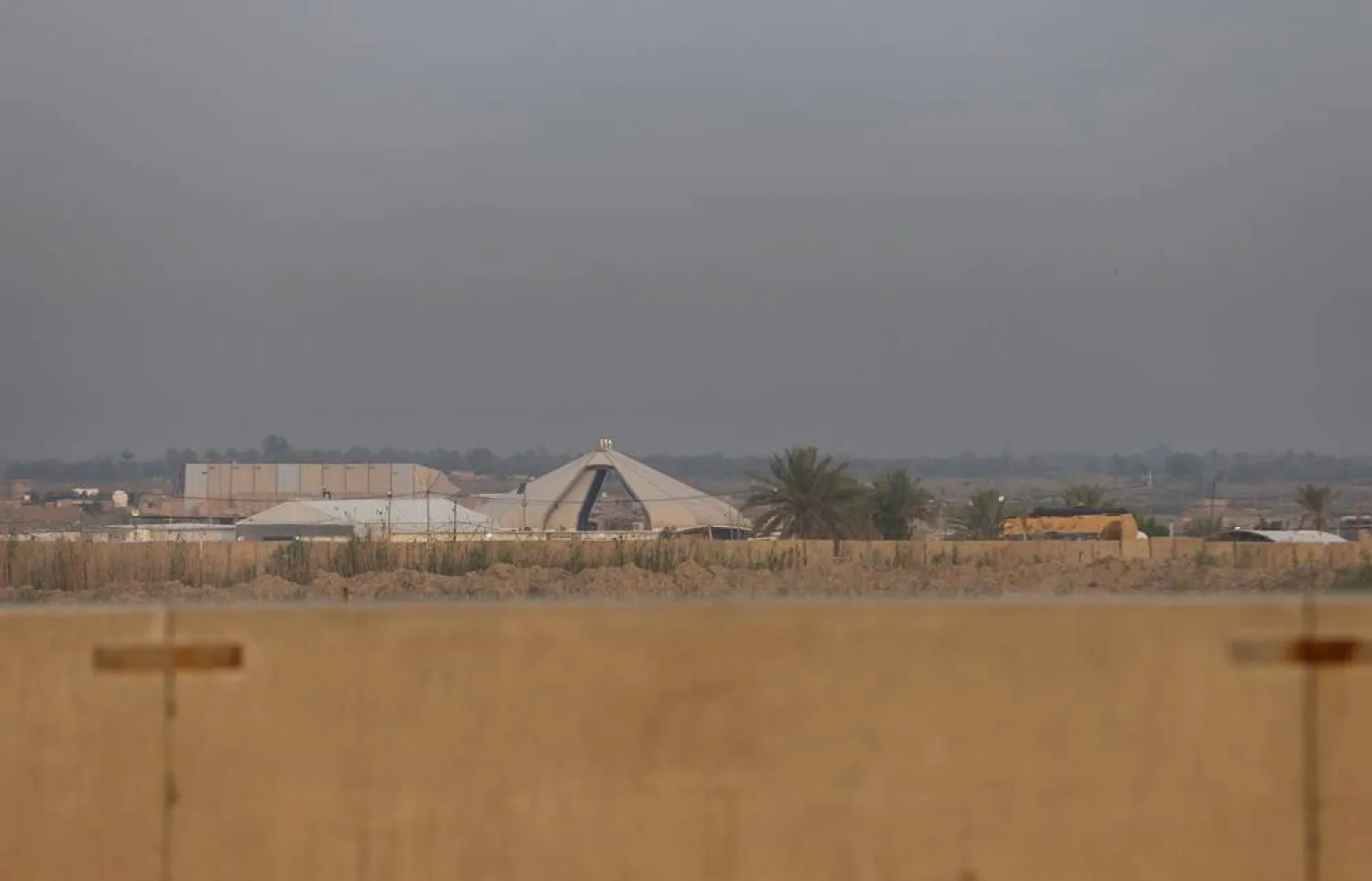
 A general view shows the Kalso military base after it was hit by a huge explosion on late Friday, in Babil Province, Iraq April 20, 2024. (Reuters)
A general view shows the Kalso military base after it was hit by a huge explosion on late Friday, in Babil Province, Iraq April 20, 2024. (Reuters)
TT

Iraq's PMF Says Base Was Attacked, Army Investigates

 A general view shows the Kalso military base after it was hit by a huge explosion on late Friday, in Babil Province, Iraq April 20, 2024. (Reuters)
A general view shows the Kalso military base after it was hit by a huge explosion on late Friday, in Babil Province, Iraq April 20, 2024. (Reuters)

A huge blast at a military base in Iraq early on Saturday killed a member of an Iraqi security force that includes Iran-backed groups. The force commander said it was an attack while the army said it was investigating and there were no warplanes in the sky at the time.

Two security sources had said earlier that an airstrike caused the blast, which killed a member of Iraq's Popular Mobilization Forces (PMF) and wounded eight others at Kalso military base about 50 km (30 miles) south of Baghdad.

In a statement, the PMF said its chief of staff Abdul Aziz al-Mohammedawi had visited the location and "reviewed the details of the investigative committees present in the place that was attacked".

The Iraqi military said a technical committee was looking into the cause of an explosion and fire at the base, which it said happened at 1 a.m. on Saturday (2200 GMT Friday).

"The air defense command report confirmed, through technical efforts and radar detection, that there was no drone or fighter jet in the air space of Babil before and during the explosion," the military said in a statement.

The incident in Iraq's Babil province occurred with tensions running even higher than usual across the Middle East, following what sources said was an Israeli attack in the Iranian city of Isfahan on Friday. Tehran has played it down and indicated it had no plans for retaliation.

That incident came six days after Iran fired a barrage of missiles and drones at Israel in response to a presumed Israeli airstrike that destroyed part of Iran's embassy in Damascus, killing seven Iranian Revolutionary Guards officers on April 1.

The PMF includes Iran-backed groups which, operating under the banner of the so-called “Islamic Resistance in Iraq”, have attacked US troops in the region and targeted Israel since the eruption of the Gaza war, declaring support for the Palestinians.

Their attacks on US forces in Syria and Iraq stopped in early February after a drone strike killed three US soldiers near the border with Jordan, prompting heavy US airstrikes in Iraq and Syria.

But they claimed responsibility for an attack on the Israeli city of Eilat on April 1.

The US military's Central Command, in a post on X early on Saturday, denied what it said were reports that the United States had carried out airstrikes in Iraq. "The United States has not conducted air strikes in Iraq today," it said.

The PMF started out as a grouping of armed factions, many close to Iran, that was later recognized as a formal security force by Iraqi authorities. 


Al-Shaibani: Syrian-Jordanian Relations at Their Strongest in Decades

 Jordanian Deputy Prime Minister and Minister of Foreign Affairs Ayman Safadi meets with Syrian Minister of Foreign Affairs and Expatriates Asaad Al-Shaibani on the sidelines of the second session of the Jordan-Syria Higher Coordination Council, a body established to institutionalize strategic cooperation between the two nations. Photo: dpa
Jordanian Deputy Prime Minister and Minister of Foreign Affairs Ayman Safadi meets with Syrian Minister of Foreign Affairs and Expatriates Asaad Al-Shaibani on the sidelines of the second session of the Jordan-Syria Higher Coordination Council, a body established to institutionalize strategic cooperation between the two nations. Photo: dpa
TT

Al-Shaibani: Syrian-Jordanian Relations at Their Strongest in Decades

 Jordanian Deputy Prime Minister and Minister of Foreign Affairs Ayman Safadi meets with Syrian Minister of Foreign Affairs and Expatriates Asaad Al-Shaibani on the sidelines of the second session of the Jordan-Syria Higher Coordination Council, a body established to institutionalize strategic cooperation between the two nations. Photo: dpa
Jordanian Deputy Prime Minister and Minister of Foreign Affairs Ayman Safadi meets with Syrian Minister of Foreign Affairs and Expatriates Asaad Al-Shaibani on the sidelines of the second session of the Jordan-Syria Higher Coordination Council, a body established to institutionalize strategic cooperation between the two nations. Photo: dpa

Jordanian Foreign Minister Ayman Safadi said Syria's security and stability were vital to Jordan and a cornerstone of regional stability.

Speaking at a joint news conference in Damascus with his Syrian counterpart Asaad al-Shaibani, Safadi said Jordan was working with Syria to build a future for a free, secure and stable Syrian state.

"We mourn the civilian victims who lost their lives in the Daraa incident and extend our sincere condolences to their families. Syrian blood is just as precious as Jordanian blood," Safadi said.

He added that a joint security committee had met and agreed on mechanisms to coordinate counterterrorism efforts.

"We are proud of what we have achieved so far and will continue strengthening cooperation between Jordan and Syria," Safadi said, pointing to the signing of 11 agreements aimed at deepening integration between the two countries.

He also reiterated Jordan's condemnation of Israeli attacks on Syrian territory.

For his part, al-Shaibani described Syrian-Jordanian relations as being "at their strongest in decades," reaffirming Damascus' commitment to strengthening ties with Amman across various sectors.

"We have agreed with Jordan to rehabilitate the international highway linking our two countries at a cost of $47 million, as well as to expand the capacity and improve the efficiency of the Nassib border crossing," he said.

"A joint security and technical committee has been established to investigate the Daraa incident and determine the circumstances surrounding it. Efforts are underway to provide redress and compensation to the innocent victims of the strikes," al-Shaibani added.


New Mass Grave Discovered South of Damascus

A photo posted on Facebook by the Tadamon Neighborhood Coordination Committee showing one of its demonstrations demanding that those responsible for the neighborhood's massacres be brought to justice.
TT

New Mass Grave Discovered South of Damascus

A photo posted on Facebook by the Tadamon Neighborhood Coordination Committee showing one of its demonstrations demanding that those responsible for the neighborhood's massacres be brought to justice.

Residents of the Tadamon neighborhood in southern Damascus discovered a new mass grave on Monday in the Al-Shuhada area, also known as Al-Sulaykha, bringing the number of mass graves found in the neighborhood to eight.

The discovery came a day after Syria's Justice Ministry referred the case of Amjad Youssef, known as the "Butcher of Tadamon," to an investigating judge ahead of his trial.

The newly discovered grave contained the remains of more than five victims, according to the Tadamon Neighborhood Coordination Committee, which said search operations were continuing with the assistance of Civil Defense teams and the National Commission for the Missing.

It is the eighth mass grave discovered in the same area.

The neighborhood coordination committee has been documenting suspected mass grave sites throughout Tadamon through video footage and eyewitness accounts.

In a video released by the committee, a local resident said children had discovered human bones at the site.

Another resident appealed to the relevant authorities to survey the entire area, recover the remains and preserve them properly, ensuring that the families of missing people have access to evidence that could help establish the fate of their loved ones.

"Every time someone starts laying the foundations for a house, they find human bones," he said.

The Interior Ministry's Counterterrorism Department referred the case of Amjad Youssef, the principal suspect in the Tadamon massacres, to the Office of the Prosecutor General for transfer to an investigating judge.

The referral is intended to initiate public prosecution proceedings against Youssef and his alleged accomplices based on the evidence and investigative findings submitted by the authorities.

In a statement issued upon receiving the case file, the Justice Ministry reaffirmed its determination to pursue accountability, prevent impunity and deliver justice to victims of crimes committed against the Syrian people, in accordance with the law and the principles of transitional justice.

The move followed the conclusion of preliminary investigations into Youssef, the main suspect in the massacres committed in 2013.

The Syrian Justice Ministry announced that the case had been referred to the Prosecutor General as a step toward bringing him to trial under the country's transitional justice process.

Syrian internal security forces arrested Youssef in April 2026 during an operation in the Hama countryside.

Youssef, a former warrant officer with Branch 227 of the Assad regime's Military Intelligence Directorate, was detained along with several members of his security unit and people close to him as part of the investigation.

The Interior Ministry subsequently released video footage of his confessions, in which he admitted to killing dozens of civilians in cold blood and burning their bodies in a pit in the Tadamon neighborhood in 2013, without having received direct orders.

Conflicting Death Tolls

Estimates of the number of victims killed in the Tadamon massacres vary considerably.

Some estimates put the death toll at 280, while testimonies from neighborhood residents suggest that several thousand people may have been killed.

The uncertainty reflects the large number of people who disappeared in the area and the discovery of numerous pits and sites containing the remains of victims of the 2013 massacres, which took place within a residential block that was under construction.

The case of Amjad Youssef, dubbed the "Butcher of Tadamon," has emerged as one of the most prominent cases pursued over the past year under Syria's transitional justice process.

It concerns one of the most horrific atrocities documented in video and audio recordings, filmed by the perpetrators themselves as a display of pride in what they portrayed as their "heroic" actions.

The Tadamon massacres are also closely connected to broader efforts to determine the fate of thousands of missing and forcibly disappeared people in Damascus during the early years of the uprising against Bashar al-Assad's regime.

Among them are the six children of Dr. Rania al-Abbasi and her husband, Dr. Abdul Rahman, who have been missing since 2013.

According to the Interior Ministry, investigations involving detainees in the Youssef case uncovered evidence indicating his involvement in the killing of the couple's six children.

In May 2026, Syria's National Commission for the Missing announced that it had reached reliable findings establishing, with a high degree of professional certainty, that the children had been killed.

The fate of their parents, however, remained unknown.

In August 2026, the commission also announced that it had established the fate of Bassam Bahra and his son, Samih Bahra, 13 years after their disappearance in Damascus.

It said the two had been killed in the Tadamon neighborhood by a group led by Youssef and his accomplice Kamel Abbas.

The Tadamon massacre first drew international attention following an investigation published by The Guardian on April 27, 2022.

The investigation exposed a massacre carried out by forces loyal to Bashar al-Assad's regime on April 16, 2013, in which approximately 41 people were killed and buried in a mass grave in the Tadamon neighborhood.

The report included video footage showing Youssef, a noncommissioned officer serving with Branch 227 of the Military Intelligence Directorate, forcing dozens of blindfolded civilians of different ages toward a large, deep pit alongside other perpetrators.

The victims were shot as they fell into the pit, after which their bodies were set on fire.

Media reports have indicated that 27 videos documenting the Tadamon massacre are held in Britain, with only one having been made public.

Abdul Moneim Zain Al-Din, described as the general coordinator of the Syrian revolution, previously cited that figure and called for the release of the remaining recordings.


Iraq’s Badr Organization Demands Reopening of Border Crossings with Iran

The Shalamcheh border crossing with Iran in Basra, southern Iraq. (AFP)
TT

Iraq’s Badr Organization Demands Reopening of Border Crossings with Iran

The Shalamcheh border crossing with Iran in Basra, southern Iraq. (AFP)

Iraq’s Iran-aligned Badr Organization, led by Hadi al-Amiri, expressed anger on Sunday over remarks by Foreign Minister Fuad Hussein concerning the closure of land border crossings with Iran.

The closure of the al-Sheeb crossing in the southern province of Maysan continues to draw opposition from Tehran-aligned groups and businesses whose livelihoods depend on cross-border trade. The dispute also involves networks that exploit weak oversight and security procedures to smuggle prohibited goods.

Truck drivers have staged repeated protests demanding the reopening of the crossing.

The controversy resurfaced after Hussein told Al Jazeera that the US had formally asked Iraq to close all its border crossings with Iran except two.

Some political sources believe the request may have been conveyed during Prime Minister Ali al-Zaidi’s meeting with US envoy Tom Barrack last week, or during an earlier telephone conversation between al-Zaidi and President Donald Trump.

According to the prime minister’s media office, the call addressed the importance of coordination and consultation between Baghdad and Washington on current challenges and efforts to support regional stability.

Al-Zaidi reaffirmed Iraq’s position on respecting state sovereignty and preventing its territory from being used to launch attacks against neighboring countries.

Iraqi authorities closed the al-Sheeb crossing on October 21, citing the need to review security arrangements and procedures, as well as inadequate technical infrastructure and surveillance equipment requiring upgrades.

The decision drew criticism from parties and groups allied with or close to Iran, which portrayed it as compliance with US pressure and the economic blockade imposed on Tehran.

An official at Iraq’s Border Ports Authority confirmed to Asharq Al-Awsat that four of the five crossings with Iran remained open, with al-Sheeb the only one still closed.

Security sources, however, suggested that the shutdown was linked to sensitive security concerns, particularly reports that the crossing had served as a route for carrying out missile attacks against Saudi Arabia on October 10.

Badr rejects US demands

In a statement, the Badr Organization said it had followed recent developments, particularly Hussein’s disclosure of American requests and what it described as dictates to close border crossings with Iran.

The Badr parliamentary bloc categorically rejected those demands, insisting on Iraq’s national sovereignty.

“What the minister’s remarks contradict the previous technical justifications and exposes agendas targeting our resistance-minded south and interfering in sovereign decision-making,” the bloc declared.

The statement referred to the government’s earlier explanations for closing the crossing.

Badr maintained that Iraq was a fully sovereign state and that its people and national political forces would not stand idly by in the face of any violation of sovereignty or submission to foreign agendas harmful to the country’s interests.

The Iran-aligned organization also denounced what it called policies of economic blockade and the starvation of populations, underscoring the longstanding ties between Baghdad and Tehran.

“Iraqi-Iranian relations are deep-rooted, forged through the blood shed for liberation and in confronting terrorism,” it stated.

“We categorically reject Iraq becoming a tool in a campaign to besiege the Muslim Iranian people. Participation in such efforts would betray our fraternal commitments and squander the sacrifices of the martyrs.”

Badr argued that the continued closure of major border crossings, particularly al-Sheeb, had inflicted significant economic hardship on residents and disrupted livelihoods.

The organization urged the government to uphold Iraq’s declared policy of staying out of regional conflicts and avoid being drawn into “hegemonic policies” and “illegal wars” that fuel regional tensions.

It demanded the immediate reopening of border crossings, insisting that the interests of Iraqi citizens and national sovereignty take precedence over foreign pressure.