

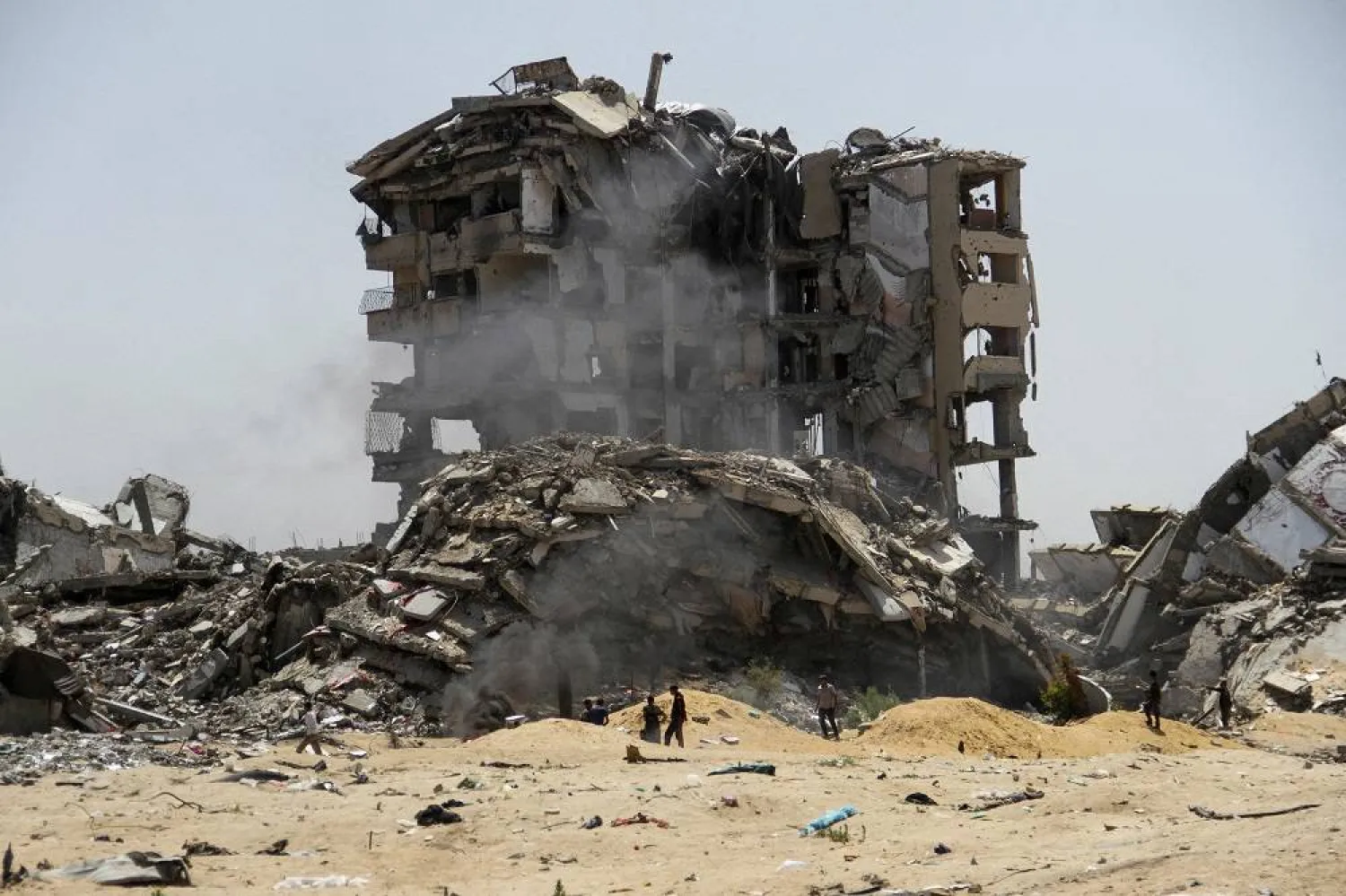

US Military Starts Pier Construction off Gaza 

Palestinians walk past the rubble of residential buildings destroyed by Israeli strikes, amid the ongoing conflict between Israel and Hamas, in the northern Gaza Strip, April 22, 2024. (Reuters)
TT

US Military Starts Pier Construction off Gaza 

Palestinians walk past the rubble of residential buildings destroyed by Israeli strikes, amid the ongoing conflict between Israel and Hamas, in the northern Gaza Strip, April 22, 2024. (Reuters)

US troops have begun construction of a maritime pier off the coast of Gaza that aims to speed the flow of humanitarian aid into the enclave when it becomes operational in May, the Pentagon said on Thursday.

President Joe Biden announced the pier in March as aid officials implored Israel to ease access for relief supplies into Gaza over land routes. Whether the pier will ultimately succeed in boosting humanitarian aid is unclear, as international officials warn of the risk of famine in northern Gaza.

Israel's six-month-long military campaign against Hamas has devastated the tiny Gaza Strip and plunged its 2.3 million people into a humanitarian catastrophe.

A senior Biden administration official, speaking to reporters on condition of anonymity, said humanitarian aid coming off the pier will need to pass through Israeli checkpoints on land. That is despite the aid having already been inspected by Israel in Cyprus prior to being shipped to Gaza. Israel wants to prevent any aid getting to Hamas fighters that boosts their war effort.

The prospect of checkpoints raises questions about possible delays even after aid reaches shore. The United Nations has long complained of obstacles to getting aid in and distributing it throughout Gaza.

"I can confirm that US military vessels, to include the USNS Benavidez, have begun to construct the initial stages of the temporary pier and causeway at sea," Pentagon spokesperson Major General Patrick Ryder told reporters.

Concerns about the risk to American troops getting caught up in the Israel-Hamas war were underscored on Thursday as news emerged of a mortar attack near the area where the pier will eventually touch ground. No US forces were present, however, and Biden has ordered US forces to not step foot on the Gaza shore.

The pier will initially handle 90 trucks a day, but that number could go up to 150 trucks daily when it is fully operational. The United Nations said this week that the daily average number of trucks entering Gaza during April was 200 and that there had been a peak on Monday of 316.

The official added that about 1,000 US troops would support the military effort, including in coordination cells in Cyprus and Israel.

A third party will be driving trucks down the pier onto the beach, the official added.

The northern Gaza Strip is still heading toward a famine, the deputy UN food chief said on Thursday, appealing for a greater volume of aid and for Israel to allow direct access from its southern Ashdod port to the Erez crossing.

In a statement, the Israeli military said it would provide security and logistics support for the pier.

An Israeli military brigade, which includes thousands of soldiers, along with Israeli Navy ships and Air Force would work to protect US troops who are setting up the pier.

Ryder said the Pentagon was tracking some type of mortar attack in Gaza that caused minimal damage in the marshalling area for the pier. But he added that US forces had not started moving anything to that area yet and there were no US forces on the ground.




Leading Harvard Trade Economist Says Saudi Arabia Holds Key to Success in Fragmented Global Economy

Professor Pol Antràs speaks during a panel discussion at the AlUla Conference for Emerging Market Economies (Asharq Al-Awsat).
TT

Leading Harvard Trade Economist Says Saudi Arabia Holds Key to Success in Fragmented Global Economy

Professor Pol Antràs speaks during a panel discussion at the AlUla Conference for Emerging Market Economies (Asharq Al-Awsat).

Harvard University economics professor Pol Antràs said Saudi Arabia represents an exceptional model in the shifting global trade landscape, differing fundamentally from traditional emerging-market frameworks. He also stressed that globalization has not ended but has instead re-formed into what he describes as fragmented integration.

Speaking to Asharq Al-Awsat on the sidelines of the AlUla Conference for Emerging Market Economies, Antràs said Saudi Arabia’s Vision-driven structural reforms position the Kingdom to benefit from the ongoing phase of fragmented integration, adding that the country’s strategic focus on logistics transformation and artificial intelligence constitutes a key engine for sustainable growth that extends beyond the volatility of global crises.

Antràs, the Robert G. Ory Professor of Economics at Harvard University, is one of the leading contemporary theorists of international trade. His research, which reshaped understanding of global value chains, focuses on how firms organize cross-border production and how regulation and technological change influence global trade flows and corporate decision-making.

He said conventional classifications of economies often obscure important structural differences, noting that the term emerging markets groups together countries with widely divergent industrial bases. Economies that depend heavily on manufacturing exports rely critically on market access and trade integration and therefore face stronger competitive pressures from Chinese exports that are increasingly shifting toward alternative markets.

Saudi Arabia, by contrast, exports extensively while facing limited direct competition from China in its primary export commodity, a situation that creates a strategic opportunity. The current environment allows the Kingdom to obtain imports from China at lower cost and access a broader range of goods that previously flowed largely toward the United States market.

Addressing how emerging economies should respond to dumping pressures and rising competition, Antràs said countries should minimize protectionist tendencies and instead position themselves as committed participants in the multilateral trading system, allowing foreign producers to access domestic markets while encouraging domestic firms to expand internationally.

He noted that although Chinese dumping presents concerns for countries with manufacturing sectors that compete directly with Chinese production, the risk is lower for Saudi Arabia because it does not maintain a large manufacturing base that overlaps directly with Chinese exports. Lower-cost imports could benefit Saudi consumers, while targeted policy tools such as credit programs, subsidies, and support for firms seeking to redesign and upgrade business models represent more effective responses than broad protectionist measures.

Globalization has not ended

Antràs said globalization continues but through more complex structures, with trade agreements increasingly negotiated through diverse arrangements rather than relying primarily on multilateral negotiations. Trade deals will continue to be concluded, but they are likely to become more complex, with uncertainty remaining a defining feature of the global trading environment.

Interest rates and artificial intelligence

According to Antràs, high global interest rates, combined with the additional risk premiums faced by emerging markets, are constraining investment, particularly in sectors that require export financing, capital expenditure, and continuous quality upgrading.

However, he noted that elevated interest rates partly reflect expectations of stronger long-term growth driven by artificial intelligence and broader technological transformation.

He also said if those growth expectations materialize, productivity gains could enable small and medium-sized enterprises to forecast demand more accurately and identify previously untapped markets, partially offsetting the negative effects of higher borrowing costs.

Employment concerns and the role of government

The Harvard professor warned that labor markets face a dual challenge stemming from intensified Chinese export competition and accelerating job automation driven by artificial intelligence, developments that could lead to significant disruptions, particularly among younger workers. He said governments must adopt proactive strategies requiring substantial fiscal resources to mitigate near-term labor-market shocks.

According to Antràs, productivity growth remains the central condition for success: if new technologies deliver the anticipated productivity gains, governments will gain the fiscal space needed to compensate affected groups and retrain the workforce, achieving a balance between addressing short-term disruptions and investing in long-term strategic gains.


Three Deadly Attacks on Health Centers in Sudan's South Kordofan in Past Week, Says WHO

Sudanese families prepare to ride on trucks while on their way to Egypt through the Qustul border, after the crisis in Sudan's capital Khartoum, in the Sudanese city of Wadi Halfa, Sudan May 1, 2023. (Reuters)
TT

Three Deadly Attacks on Health Centers in Sudan's South Kordofan in Past Week, Says WHO

Sudanese families prepare to ride on trucks while on their way to Egypt through the Qustul border, after the crisis in Sudan's capital Khartoum, in the Sudanese city of Wadi Halfa, Sudan May 1, 2023. (Reuters)

Sudan's South Kordofan region has seen attacks on three health facilities in the past week alone, leaving more than 30 dead, the World Health Organization said Sunday, AFP reported.

"Sudan's health system is under attack again," WHO chief Tedros Adhanom Ghebreyesus said on X, pointing out that, since February 3, "three health facilities were attacked in South Kordofan, in a region already suffering acute malnutrition".


Killing of Seif al-Islam al-Gadhafi Raises Succession Questions in September Current

Seif al-Islam al-Gadhafi (file photo, Reuters)
TT

Killing of Seif al-Islam al-Gadhafi Raises Succession Questions in September Current

Seif al-Islam al-Gadhafi (file photo, Reuters)

Since the killing of Seif al-Islam al-Gadhafi, son of Libya’s late leader Moammar Gadhafi, in the western Libyan city of Zintan last Tuesday, urgent questions have surfaced over who might succeed him in leading the political current he represented.

The questions reflect Seif al-Islam’s symbolic status among supporters of the former regime, known as the September Current, a reference to backers of the September 1 Revolution led by Moammar Gadhafi in 1969.

Search for new leadership

Othman Barka, a leading figure in the National Current that backed Seif al-Islam al-Gadhafi, said supporters of the former regime had yet to agree on a new leader but retained the organizational and political capacity to overcome the current phase and later move toward an alternative leadership framework.

Barka told Asharq Al-Awsat that ties to Gadhafi and his sons had been both emotional and political, but said that what he described as national work would continue. He said organized efforts would be made to reach a new leadership after the repercussions of the killing were overcome.

It remains unclear how Ahmed Gaddaf al-Dam, the political official in the Libyan National Struggle Front and one of the most prominent figures of the former regime, views the future leadership of the September Current following Seif al-Islam’s killing.

Sources close to him told Asharq Al-Awsat it was too early to speak of a new leadership while mourning ceremonies continued in Bani Walid.

Gaddaf al-Dam limited his public response to reposting a statement by those describing themselves as supporters of the Jamahiriya system on his Facebook page. He stressed unity, saying the killing would not lead to the fragmentation of the current and that September supporters remained a single, solid bloc.

In Bani Walid in western Libya, where Seif al-Islam was buried on Friday, shock was evident in the tone of Libyan activist Hamid Gadhafi, a member of the late leader’s tribe. He told Asharq Al-Awsat that clarity over the future leadership would emerge after about 10 days.

Possible successors

Libyan social media pages circulated the names of potential successors, including Seif al-Islam’s sister, Aisha, and his brother, Saadi. Libyan political analyst Ibrahim Belqasem rejected that view, telling Asharq Al-Awsat that the only remaining driver for supporters of the former regime would be the emergence of an unexpected, nonpolitical figure, describing it as an attempt to rescue the current.

After the fall of Gadhafi’s rule in 2011, following 42 years in power since the 1969 revolution, his supporters reemerged under the banner of the September Current. They are popularly known as the Greens, a reference to the Green Book.

Fragmented components and the absence of unified leadership mark the September Current. Seif al-Islam was widely seen as a central symbol among supporters, as well as among political figures and groups calling for the reintegration of former regime supporters into political life and for the recognition of their rights.

Nasser Saeed, spokesman for the Libyan Popular National Movement, one of the political arms of former regime supporters, said he expected a national political leadership to take shape in the coming phase to continue what he described as national work until the country stabilizes. Libyans can determine their future.

He said the emergence of a new leader or symbol was a matter for a later stage, stressing that the project was ideological rather than tied to individuals.

Saeed told Asharq Al-Awsat that Seif al-Islam al-Gadhafi’s legacy lay in a unifying national project that rejected foreign intervention and sought to restore sovereignty and stability. He said Seif al-Islam had represented hope for overcoming the crisis and that his project extended the path of the September Revolution as a liberation choice that still retained supporters.

Structural challenges

Organizationally, the former regime cannot be confined to a single political framework. Its structures and leadership are diverse, including independent organizations and figures.

Among the most prominent are the Libyan Popular National Movement, founded in 2012, and the Popular Front for the Liberation of Libya, formed in 2016 by politicians and tribal leaders in support of Seif al-Islam al-Gadhafi.

Their representatives increased their presence after 2020, whether in the Geneva forum that led to the formation of the Government of National Unity or in UN-sponsored structured dialogue tracks, before suspending participation following Seif al-Islam’s killing.

Voices within the September Current believe the killing marked a decisive turning point that cast heavy shadows over the ability of former regime supporters to forge unified leadership, citing structural difficulties rooted in historical disagreements between what is known as the old guard and supporters of change led by Seif al-Islam.

Khaled al-Hijazi, a prominent political activist in the September Current, agreed with that assessment, saying Seif al-Islam’s symbolic role had helped balance internal disputes due to his reformist project before the February 17 uprising.

Al-Hijazi told Asharq Al-Awsat that the loss of that symbolism could revive old divisions and complicate efforts to recreate an inclusive leadership, amid internal and external factors that make unification highly complex in the foreseeable future.

Barka said differences were natural, stressing that the current was not a closed party and believed in democracy and pluralism. He said generational competition did not amount to conflict and noted there had been no violent clashes between supporters of different paths within the September Current.

He concluded by saying that the diversity of approaches served a single goal: the freedom and prosperity of Libyan citizens and the building of a sovereign state capable of overcoming the crisis that has persisted since 2011.