

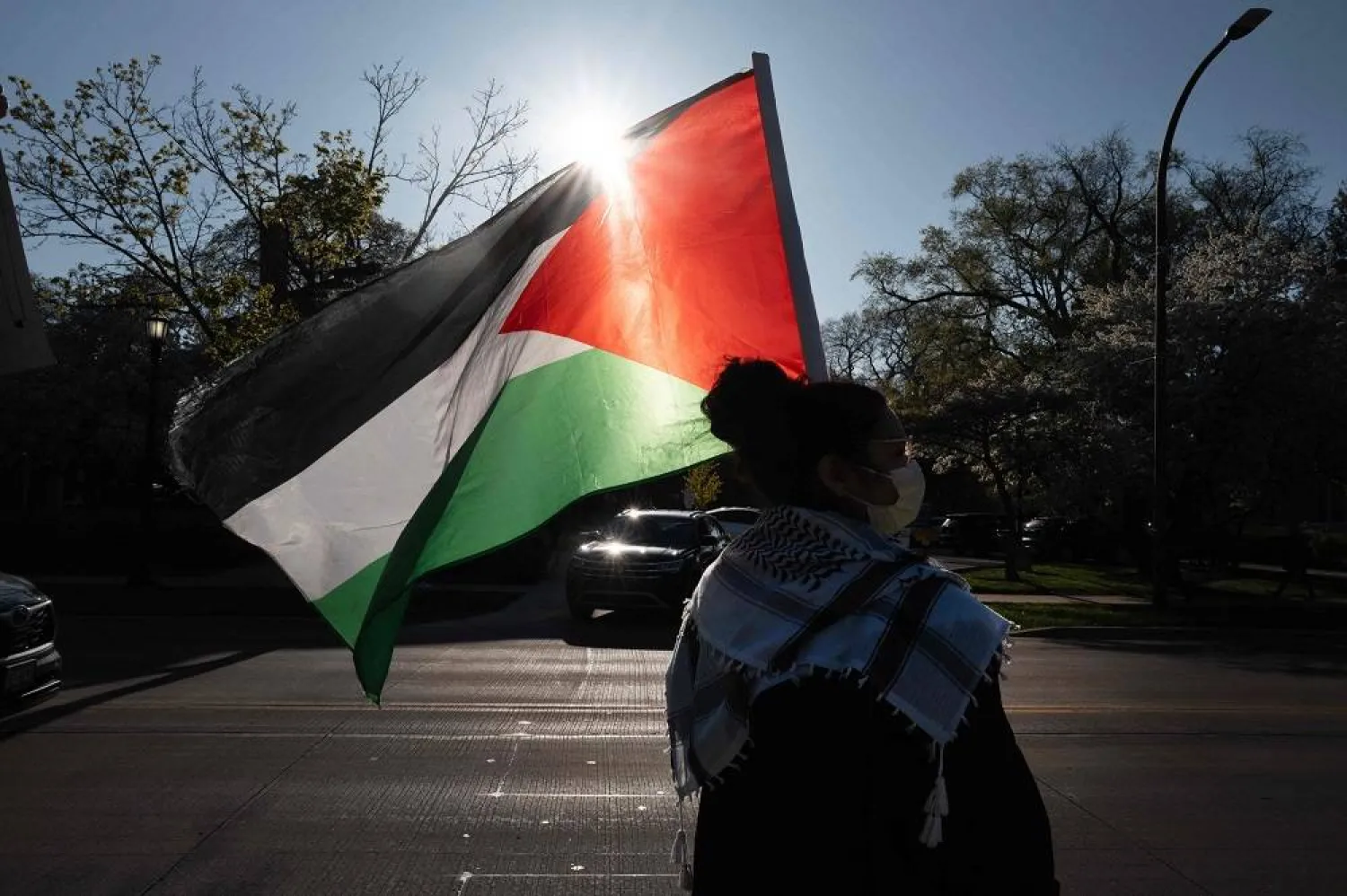

Wave of Pro-Palestinian Protests on US Campus Meets Forceful Response 

People rally on the campus of Northwestern University to show support for residents of Gaza on April 25, 2024 in Evanston, Illinois. (Getty Images/AFP)
TT

Wave of Pro-Palestinian Protests on US Campus Meets Forceful Response 

People rally on the campus of Northwestern University to show support for residents of Gaza on April 25, 2024 in Evanston, Illinois. (Getty Images/AFP)

Renewed clashes between police and students opposed to Israel's war in Gaza broke out on Thursday, raising questions about forceful methods being used to shut down protests that have intensified since mass arrests at Columbia University last week.

Over the past two days, law enforcement at the behest of college administrators have deployed Tasers and tear gas against students protesters at Atlanta's Emory University, activists say, while officers clad in riot gear and mounted on horseback have swept away demonstrations at the University of Texas in Austin.

Prosecutors on Thursday dropped charges against 46 of the 60 people taken into custody at the University of Texas, citing "deficiencies in the probable cause affidavits."

At Columbia, the epicenter of the US protest movement, university officials are locked in a stalemate with students over the removal of a tent encampment set up two weeks ago as a protest against the Israeli offensive.

The administration, which has already allowed an initial deadline for an agreement with students to lapse, has given protesters until Friday to strike a deal.

Other universities appear determined to prevent similar, long-running demonstrations to take root, opting to work with police to shut them down quickly and in some cases, with force.

Overall, nearly 550 arrests have been made in the last week across major US universities in relation to protests over Gaza, according to a Reuters tally. University authorities have said the demonstrations are often unauthorized and called on police to clear them.

At Emory, police detained 28 people on its Atlanta campus, the university said, after protesters began erecting a tent encampment in an attempt to emulate a symbol of vigilance employed by protesters at Columbia and elsewhere.

The local chapter of the activist group Jewish Voice for Peace said officers used tear gas and Tasers to dispense the demonstration and take some protesters into custody. Atlanta police acknowledged using "chemical irritants" but denied using rubber bullets.

Video aired on FOX 5 Atlanta showed a melee breaking out between officers and some protesters, with officers using what appeared to be a stun gun to subdue a person and others wrestling other protesters to the ground and leading them away.

"Our primary goal today was clearing the Quad of a disruptive encampment while holding individuals accountable to the law," Cheryl Elliott, Emory's vice president for public safety, said in a statement.

The Georgia office of the NAACP questioned what it called the "apparent use of excessive force" against people exercising free speech.

"The use of force should only be considered as an absolute last resort and must be proportionate to the threat posed," Georgia NAACP President Griggs said in a letter.

Similar scenarios unfolded on the New Jersey campus of Princeton University where officers swarmed a newly formed encampment, video footage on social media showed.

Boston police earlier forcibly removed a pro-Palestinian encampment set up by Emerson College, arresting more than 100 people, media accounts and police said.

At the University of Southern California, where 93 people were arrested at the Los Angeles campus on Wednesday, administrators canceled the main May 10 graduation ceremony, saying newly required security measures would have placed excessive delays on crowd control.

'Alarming reports'

Human Rights Watch and the American Civil Liberties Union have condemned the arrest of protesters and urged authorities to respect their free speech rights.

But some Republicans in Congress have accused university administrators of allowing Jewish students to be harassed, putting increasing pressure on schools to tightly control any demonstrations and to block any semi-permanent encampment.

US Education Secretary Miguel Cardona on Thursday said his department was closely monitoring the protests, including what he called "very alarming reports of antisemitism."

In response, activist groups have strongly denied that the protests are antisemitic. Their aim is to pressure universities from divesting from companies that contribute to the Israeli military actions in Gaza, they say.

Even so, protest leaders have acknowledged that hateful rhetoric has been directed at Jewish students, but insist that people who tried to infiltrate and malign their movement are responsible for any harassment.

Outside Columbia, hundreds of conservative pro-Israel demonstrators staged a counterprotest to the students, marching on the streets circling the campus, waving and draped in Israeli and US flags.

University officials have given protesters until 4 a.m. on Friday to reach an agreement with the university on dismantling dozens of tents set up on the New York City campus in a protest that started a week ago.

The university already tried to shut the protest down by force. On April 18, Columbia President Minouche Shafik took the unusual move of asking police to enter the campus, angering many rights groups, students and faculty.

More than 100 people were arrested and the tents were removed from the main lawn. But within a few days, the encampment was back in place.



Adviser to Iran's Supreme Leader to Visit Oman on Tuesday

FILED - 06 February 2009, Bavaria, Munich: Ali Larijani, then chairman of the Iranian parliament, speaks at the 45th Munich Security Conference in Munich. Photo: Andreas Gebert/dpa
TT

Adviser to Iran's Supreme Leader to Visit Oman on Tuesday

FILED - 06 February 2009, Bavaria, Munich: Ali Larijani, then chairman of the Iranian parliament, speaks at the 45th Munich Security Conference in Munich. Photo: Andreas Gebert/dpa

Ali Larijani, an adviser to Iran's Supreme Leader Ali Khamenei, will visit Oman accompanied by a delegation on Tuesday, the ‌semi-official Tasnim news ‌agency reported ‌on ⁠Monday.

American and ‌Iranian diplomats held indirect talks in Oman last week, aimed at reviving diplomacy amid a US ⁠naval buildup near Iran and ‌Tehran's vows ‍of a ‍harsh response if ‍attacked.

"During this trip, (Larijani) will meet with high-ranking officials of the Sultanate of Oman and discuss the latest regional ⁠and international developments and bilateral cooperation at various levels," Tasnim said.

The date and venue of the next round of talks are yet to be announced.


Russia’s Lavrov Sees No ‘Bright Future’ for Economic Ties with US

06 February 2026, Russia, Moscow: Russian Foreign Minister Sergei Lavrov gives a press conference following a meeting with Organization for Security and Cooperation in Europe (OSCE) Chairperson-in-Office Ignazio Cassis, head of Switzerland's Federal Department of Foreign Affairs, Federal Councilor of the Swiss Confederation, and OSCE Secretary General Feridun Sinirlioglu at the Russian Foreign Ministry's Reception House. (Sofya Sandurskaya/TASS via ZUMA Press/dpa)
TT

Russia’s Lavrov Sees No ‘Bright Future’ for Economic Ties with US

06 February 2026, Russia, Moscow: Russian Foreign Minister Sergei Lavrov gives a press conference following a meeting with Organization for Security and Cooperation in Europe (OSCE) Chairperson-in-Office Ignazio Cassis, head of Switzerland's Federal Department of Foreign Affairs, Federal Councilor of the Swiss Confederation, and OSCE Secretary General Feridun Sinirlioglu at the Russian Foreign Ministry's Reception House. (Sofya Sandurskaya/TASS via ZUMA Press/dpa)

Russia remains open for cooperation with the United States but is not hopeful about economic ties despite Washington's ongoing efforts to end the Ukraine war, Russian Foreign Minister Sergei Lavrov said in an interview published on Monday.

Speaking to Russia-based media outlet TV BRICS, ‌Lavrov cited what ‌he called the ‌United ⁠States' declared ‌aim of "economic dominance".

"We also don't see any bright future in the economic sphere," Lavrov said.

Russian officials, including envoy Kirill Dmitriev, have previously spoken of the prospects for a major restoration ⁠of economic relations with the United States as ‌part of any eventual Ukraine ‍peace settlement.

But although ‍President Donald Trump has also ‍spoken of reviving economic cooperation with Moscow and has hosted his Russian counterpart Vladimir Putin on US soil since returning to the White House, he has imposed further onerous sanctions on Russia's vital ⁠energy sector.

Lavrov also cited Trump's hostility to the BRICS bloc, which includes Russia, China, India, Brazil and other major developing economies.

"The Americans themselves create artificial obstacles along this path (towards BRICS integration)," he said.

"We are simply forced to seek additional, protected ways to develop our financial, economic, logistical and ‌other projects with the BRICS countries."


Prince William, Kate 'Deeply Concerned' by Latest Epstein Revelations

Britain's Prince William (R), Prince of Wales and Catherine (C), Princess of Wales arrive to meet with the Archbishop of Canterbury Sarah Mullally at Lambeth Palace in London on February 5, 2026. (Photo by Aaron Chown / POOL / AFP)
TT

Prince William, Kate 'Deeply Concerned' by Latest Epstein Revelations

Britain's Prince William (R), Prince of Wales and Catherine (C), Princess of Wales arrive to meet with the Archbishop of Canterbury Sarah Mullally at Lambeth Palace in London on February 5, 2026. (Photo by Aaron Chown / POOL / AFP)

Britain's Prince William and his wife Catherine have been "deeply concerned" by the latest revelations linking William's uncle Prince Andrew to late US sex offender Jeffrey Epstein, Kensington Palace said Monday.

"I can confirm that the Prince and Princess of Wales have been deeply concerned by the continued revelations," the palace said in a statement.

The statement -- first public comments from the heir to the throne and his wife on the scandal since the latest release of Epstein files more than a week ago -- added that "their thoughts remain focused on the victims" of Epstein, who died in prison awaiting trial on sex trafficking charges in 2019.

King Charles III’s 65-year-old brother is now known simply as Andrew Mountbatten-Windsor.

The king last week forced Mountbatten-Windsor to leave his longtime home at Royal Lodge near Windsor Castle, accelerating a move that was first announced in October but wasn’t expected to be completed until later this year.

Mountbatten-Windsor is now living on the king’s Sandringham estate in eastern England. He will live temporarily at Wood Farm Cottage while his permanent home on the estate undergoes repairs.