


US, Britain Urge Hamas to Accept Israeli Truce Proposal

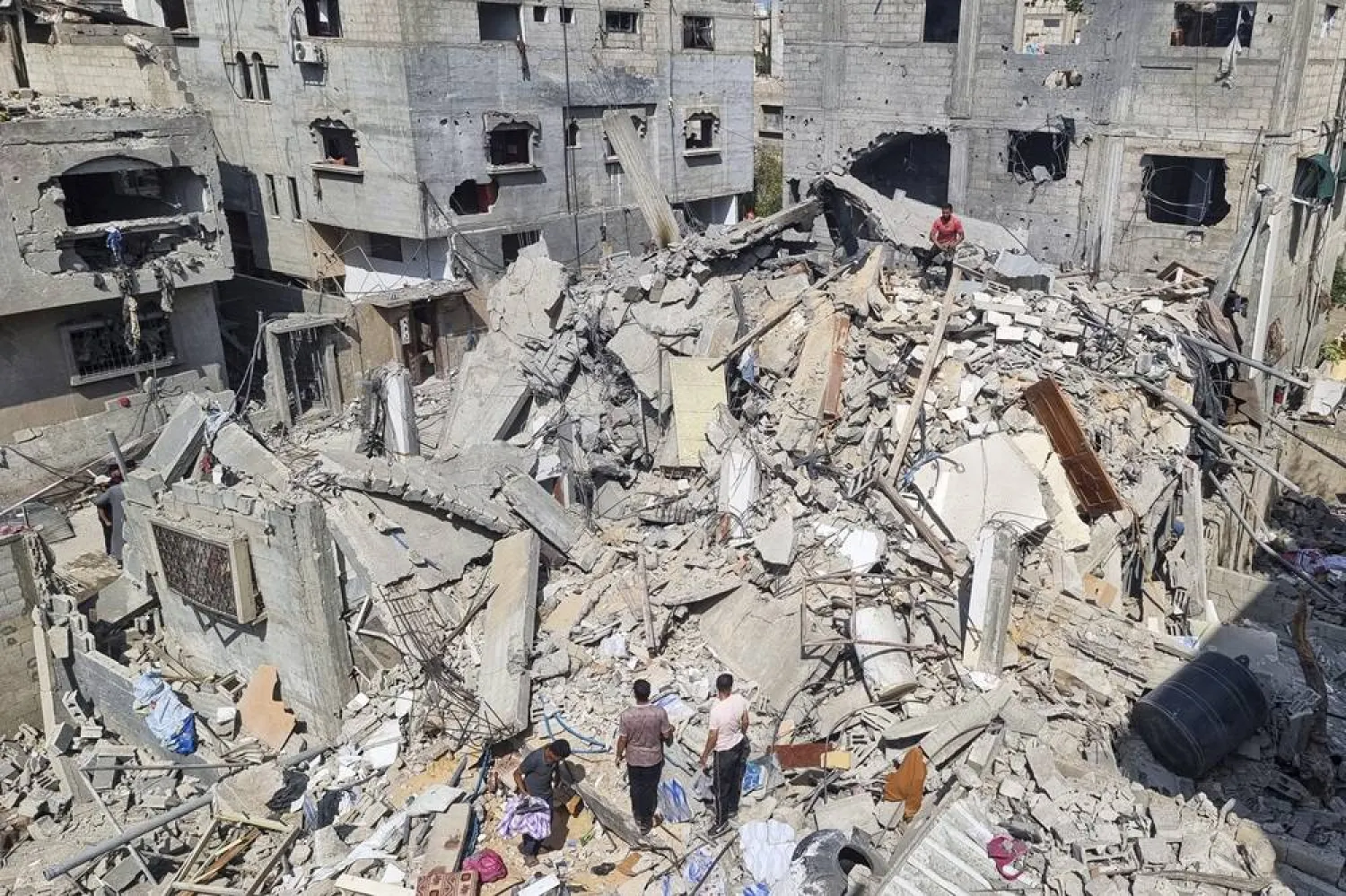
 Palestinians look at the destruction after an Israeli airstrike in Rafah, Gaza Strip. Monday, April 29, 2024. (AP)
Palestinians look at the destruction after an Israeli airstrike in Rafah, Gaza Strip. Monday, April 29, 2024. (AP)
TT

US, Britain Urge Hamas to Accept Israeli Truce Proposal

 Palestinians look at the destruction after an Israeli airstrike in Rafah, Gaza Strip. Monday, April 29, 2024. (AP)
Palestinians look at the destruction after an Israeli airstrike in Rafah, Gaza Strip. Monday, April 29, 2024. (AP)

US Secretary of State Antony Blinken on Monday urged Hamas to swiftly accept an Israeli proposal for a truce in the Gaza war and the release of Israeli hostages held by the Palestinian group.

Hamas negotiators were expected to meet Qatari and Egyptian mediators in Cairo on Monday to deliver a response to the phased truce proposal which Israel presented at the weekend.

"Hamas has before it a proposal that is extraordinarily, extraordinarily generous on the part of Israel," Blinken said at a meeting of the World Economic Forum in the Saudi capital Riyadh.

"The only thing standing between the people of Gaza and a ceasefire is Hamas. They have to decide and they have to decide quickly," he said. "I'm hopeful that they will make the right decision."

A source briefed on the talks said Israel's proposal entailed a deal for the release of fewer than 40 of the roughly 130 hostages believed to be still held in Gaza in exchange for freeing Palestinians jailed in Israel.

A second phase of a truce would consist of a "period of sustained calm" - Israel's compromise response to a Hamas demand for a permanent ceasefire.

A total of 253 hostages were seized in a Hamas attack on southern Israel on Oct. 7 in which about 1,200 Israelis were also killed, according to Israeli counts.

Israel retaliated by imposing a total siege on Gaza and mounting an air and ground assault that has killed about 34,500 Palestinians, according to Gaza health authorities.

Palestinians are suffering from severe shortages of food, fuel and medicine in a humanitarian crisis brought on by the offensive that has demolished much of the territory.

Britain's Foreign Secretary David Cameron, who was also in Riyadh for the WEF meeting, also described the Israeli proposal as "generous".

It included a 40-day pause in fighting and the release of potentially thousands of Palestinian prisoners as well as Israeli hostages, he told a WEF audience.

"I hope Hamas do take this deal and frankly, all the pressure in the world and all the eyes in the world should be on them today saying 'take that deal'," Cameron said.

Cameron is among several foreign ministers in Riyadh, including from the US, France, Jordan and Egypt, as part of a diplomatic push to bring an end to the Gaza war.

Blinken reiterated that the United States - Israel's main diplomatic supporter and weapons supplier - could not back an Israeli ground assault on Rafah if there was no plan to ensure that civilians would not be harmed.

More than a million displaced Gaza residents are crammed into Rafah, the enclave's southernmost city, having sought refuge there from Israeli bombardments. Israel says the last Hamas fighters are holed up there and it will open an offensive to root them out soon.



Israeli Army: Hezbollah Disarmament Needs Full Occupation of Lebanon

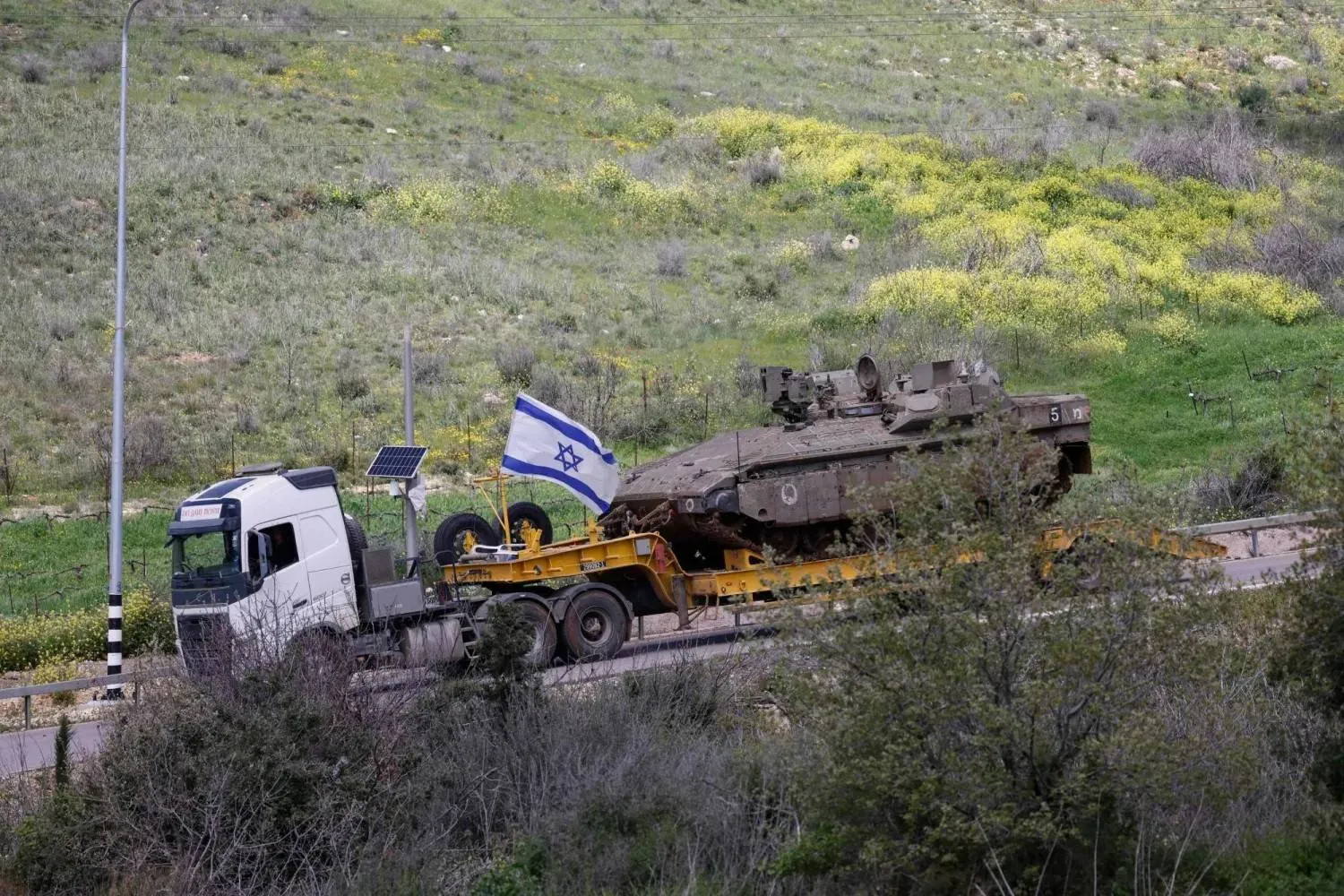
An Israeli military truck transports a tank in the Upper Galilee in northern Israel near the Lebanese border (AFP)
TT

Israeli Army: Hezbollah Disarmament Needs Full Occupation of Lebanon

An Israeli military truck transports a tank in the Upper Galilee in northern Israel near the Lebanese border (AFP)

A senior Israeli military commander said on Friday that disarming Hezbollah was not part of the current war objectives, and that the army’s plan instead focused on razing entire villages in southern Lebanon and forcibly displacing residents to create a buffer zone imposing a new border reality.

Defense Minister Israel Katz said the war aimed to achieve what he called the “top objective” of disarming Hezbollah and that the government remained committed to it.

The spokesperson for the Israeli army later walked back the commander’s remarks, saying the military remained committed to the long-term goal of disarming Hezbollah through a broad, gradual effort.

The current operation weakens Hezbollah and will contribute to its disarmament over time, the spokesperson noted.

A military source said Israel would act if the Lebanese government failed to disarm the group, adding that Hezbollah Secretary-General Naim Qassem was within the scope of Israeli assassination plans.

Former general Yom-Tov Samia said dismantling Hezbollah would require targeting the Lebanese state itself, including its infrastructure, to pressure the public against the group.

Despite the clarification, the initial remarks continued to reverberate. Military analysts and reserve generals said they reflected a blunt reality: the current war cannot destroy Hezbollah.

They said such a goal would require full occupation of Lebanon and sweeping searches across all towns and villages, which would exceed the scope of the current operation.

Amid the visible rift, Prime Minister Benjamin Netanyahu postponed a cabinet meeting scheduled for Friday, replacing it with limited consultations before rescheduling it for Saturday evening.

A military source said the army would present a plan to the cabinet to completely destroy Lebanese border villages and establish a depopulated security zone, barring residents from returning to areas along what Israel calls the “contact line,” with 20 Christian villages exempted.

The army says Hezbollah has tried over the past year to rebuild its infrastructure along the border. It proposes turning a 3-4 km strip into a forward defensive zone.

The plan calls for the total destruction of dozens of villages near Israeli towns, from Kfarkela opposite Metula to Naqoura opposite Shlomi, including the demolition of all infrastructure and a permanent ban on residents returning.

The military says the plan has received legal approvals, arguing that villages used by Hezbollah constitute “incriminated” infrastructure and that their existence would enable the group to rebuild in the future.

It added that after a November 2024 ceasefire, Hezbollah fighters returned to border villages and attempted to rebuild underground infrastructure and deploy weapons not previously detected.

The army said it would be impossible after the current operation to revert to the existing border, as Hezbollah would return, requiring a new line.

The proposed model mirrors what the army calls the “yellow line” in the Gaza Strip, a 2-4 km strip cleared of locals and controlled by Israeli forces with forward positions.

A senior Israeli officer said the plan differs from Israel’s past security zone in southern Lebanon, stressing that civilians would not be allowed to return.

The officer acknowledged that setting Hezbollah’s disarmament as a war goal had been “overly ambitious,” saying current constraints, including a prolonged war and the need to focus on Iran, prevent making it an immediate objective.


Israel Says Striking Hezbollah Sites in Beirut after Destroying Bridge

File photo of a bridge destroyed by an Israeli airstrike in Dalfy, Lebanon on March 26, 2026. Stringer, Reuters
TT

Israel Says Striking Hezbollah Sites in Beirut after Destroying Bridge

File photo of a bridge destroyed by an Israeli airstrike in Dalfy, Lebanon on March 26, 2026. Stringer, Reuters

The Israeli military said Saturday it had begun striking "Hezbollah infrastructure" in Beirut after it destroyed a bridge in eastern Lebanon to prevent the Iran-backed group's reinforcements from crossing.

An AFP journalist heard two loud explosions in the capital within half an hour early Saturday and saw smoke billowing from one of them, said AFP.

Local media reported two strikes on Beirut's southern suburbs, a locality that has been a target of Israeli strikes in recent days as the military presses on with its ground invasion in the country's south.

Lebanon was drawn into the Middle East war on March 2 when Hezbollah launched rockets at Israel to avenge the US-Israeli attack that killed Iran's supreme leader Ali Khamenei.

On Friday, the United Nations Interim Force in Lebanon (UNIFIL) said a blast at one of its positions in the country's south near the border wounded three peacekeepers, the third similar incident in days.

Israel's military had warned that it would target two adjacent bridges over the Litani River in the area "to prevent the transfer of reinforcements and military equipment".

The Lebanese state-run National News Agency (NNA) said: "Israeli warplanes targeted the bridge that links Sohmor with Mashghara, leading to its destruction."

Lebanese local media reported that a second bridge was also hit.

The strikes in Sohmor continued into early Saturday, with the NNA reporting the town's center being hit twice as warplanes roared in the skies.

Israel has previously struck five other bridges over the Litani in the country's south, including most of the main routes crossing the waterway.

The river runs around 30 kilometers (20 miles) north of the Israeli border, an area where Israel has said it wants to maintain "security control".

Also in Sohmor, two people were killed and 15 wounded in an Israeli strike that hit "as worshippers were leaving the town's mosque" after Friday prayers, according to Lebanon's health ministry.

Lebanese authorities say more than 1,300 people have been killed in a month of hostilities.

- 'No longer afraid' -

UNIFIL spokesperson Kandice Ardiel said an explosion inside a UN position injured three peacekeepers, adding that the origin was unknown.

Israel's army accused Hezbollah of launching a rocket that hit the post.

On the edge of the southern suburbs of Beirut, Christians marked Good Friday in Shiyah with a procession around Saint Maroun Church.

Resident Hala Farah, 62, said she had never before missed the religious rites, even during repeated conflicts in the country.

"We're always here, we have to hold on for the future of our children," she told AFP at the entrance to the overflowing church.

Another worshipper, Patricia Haddad, 32, said she was no longer afraid of the bombardments.

"We got used to it, unfortunately," she said.

Israel's army has said it has struck more than 3,500 targets across Lebanon since last month, while Hezbollah said it had carried out 1,309 operations against Israeli targets.

On Sunday, an Indonesian peacekeeper was killed when a projectile exploded in a UNIFIL position, while another blast the following day killed two more Indonesian troops.

According to the UN, 97 force members have been killed in violence since UNIFIL was first established to monitor the withdrawal of Israeli forces after they invaded Lebanon in 1978.

The force's mandate expires at the end of this year.


US Embassy in Beirut Warns of Possible Iran Threat to Universities in Lebanon

People walk past the main gate to the campus of the American University of Beirut (AUB) in the center of Beirut on January 13, 2022. (AFP)
TT

US Embassy in Beirut Warns of Possible Iran Threat to Universities in Lebanon

People walk past the main gate to the campus of the American University of Beirut (AUB) in the center of Beirut on January 13, 2022. (AFP)

The US embassy in Beirut said on ‌Friday ‌that Iran ‌and ⁠its aligned armed ⁠groups "may intend to target ⁠universities ‌in Lebanon".

In ‌a security ‌alert, ‌the embassy also ‌urged US citizens to depart ⁠Lebanon "while ⁠commercial flight options remain available".

Lebanon was dragged into the conflict in the Middle East when Iran-backed Hezbollah shot rockets at Israel in retaliation to the killing of Iranian supreme leader Ali Khamenei at the beginning of the war.

Over the past 24 hours, Israeli strikes killed 23 people and wounded 98, the Lebanese health ministry said Friday.

The ministry said that the overall death toll includes 125 children and 91 women, since Israel launched intense airstrikes across Lebanon after the Hezbollah fired rockets toward northern Israel in solidarity with Iran on March 2. The strikes have also wounded 4,138 others.

Among those killed are 53 health workers, while Israeli strikes have targeted 83 emergency medical service facilities, the health ministry said.