Trump Held in Contempt, Fined $9K for Violating Gag Order in Hush Money Trial

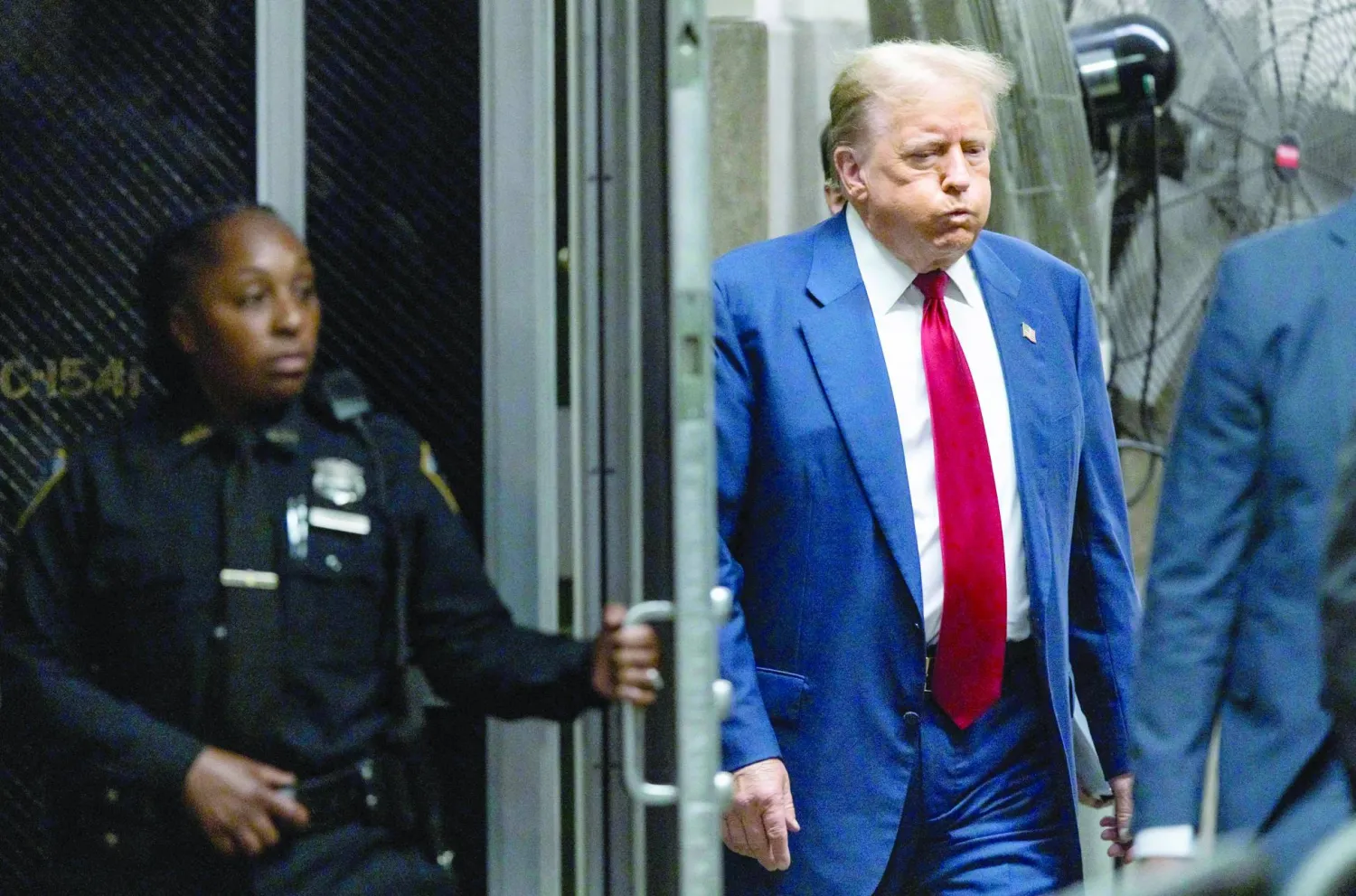
Former US President Donald Trump walks back to the courtroom after a break in his trial for allegedly covering up hush money payments linked to extramarital affairs, at Manhattan Criminal Court in New York City, on April 30, 2024. (Photo by JUSTIN LANE / POOL / AFP)
TT

Trump Held in Contempt, Fined $9K for Violating Gag Order in Hush Money Trial

Former US President Donald Trump walks back to the courtroom after a break in his trial for allegedly covering up hush money payments linked to extramarital affairs, at Manhattan Criminal Court in New York City, on April 30, 2024. (Photo by JUSTIN LANE / POOL / AFP)

Donald Trump was held in contempt of court Tuesday and fined $9,000 for repeatedly violating a gag order that barred him from making public statements about witnesses, jurors and some others connected to his New York hush money case. If he does it again, the judge warned, he could be jailed.
Prosecutors had alleged 10 violations, but New York Judge Juan M. Merchan found there were nine. Trump stared down at the table in front of him as the judge read the ruling, frowning slightly.
It was a stinging rebuke of the presumptive Republican presidential nominee’s insistence that he was exercising his free speech rights and a reminder that he’s a criminal defendant subject to the harsh realities of trial procedure. And the judge’s remarkable threat to jail a former president signaled that Trump’s already precarious legal standing could further spiral depending on his behavior during the remainder of the trial.
Merchan wrote that he is “keenly aware of, and protective of,” Trump’s First Amendment rights, “particularly given his candidacy for the office of President of the United States.”
“It is critically important that defendant’s legitimate free speech rights not be curtailed, that he be able to fully campaign for the office which he seeks and that he be able to respond and defend himself against political attacks,” Merchan wrote.
Still, he warned that the court would not tolerate "willful violations of its lawful orders and that if necessary and appropriate under the circumstances, it will impose an incarceratory punishment.”
With that statement, the judge drew nearer the specter of Trump becoming the first former president of the United States behind bars.
“This gag order is totally unconstitutional,” Trump said as court adjourned after a day that included testimony from a Hollywood lawyer who negotiated two of the hush money deals at issue in the case. “I’m the Republican candidate for president of the United States ... and I’m sitting in a courthouse all day long listening to this stuff.”
Trump is used to having constant access to his social media bullhorn to slam opponents and speak his mind. After he was banned from Twitter following the Jan. 6, 2021, attack on the Capitol by his supporters, Trump launched his own platform, where his posts wouldn’t be blocked or restricted. He has long tried to distance himself from controversial messages he’s amplified to his millions of followers by insisting they’re “only retweets.”
But he does have experience with gag orders, which were also imposed in other legal matters. After he was found to have violated orders in his civil fraud trial, he paid more than $15,000 in fines.
Trump also is subject to a gag order in his federal criminal election interference case in Washington. That order limits what he can say about known or reasonably foreseeable witnesses in the case and about court staff and other lawyers, though an appeals court freed him to speak about special counsel Jack Smith, who brought the case.
Tuesday's ruling in New York came at the start of the second week of testimony in the historic case, which involves allegations that Trump and his associates took part in an illegal scheme to influence the 2016 presidential campaign by purchasing and then burying seamy stories. The payouts went to a doorman with a torrid yarn; ex-Playboy model Karen McDougal, who had accusations of an affair; and to porn performer Stormy Daniels, who alleged a sexual encounter with Trump. He has pleaded not guilty and says the stories are all fake.
Trump deleted, as ordered, the offending posts from his Truth Social account and campaign website and has until Friday to pay the fine. The judge was also weighing other alleged gag-order violations by Trump and will hear arguments Thursday. He also announced that he will halt the trial on May 17 to allow Trump to attend his son Barron's high school graduation.
Of the 10 posts, the one Merchan ruled was not a violation came on April 10, a post referring to witnesses Michael Cohen and Daniels as “sleaze bags." Merchan said Trump’s contention that he was responding to previous posts by Cohen “is sufficient to give” him pause on whether the post was a violation.
Merchan cautioned that the gag order “not be used as a sword instead of a shield by potential witnesses” and that if people who are protected by the order, like Cohen, continue to attack Trump “it becomes apparent” they don’t need the gag order’s protection.
Cohen, Trump’s former attorney, has said he will refrain from commenting about Trump until after he testifies. On Tuesday, he said in a text message to The Associated Press: “Judge Merchan’s decision elucidates that this behavior will not be tolerated and that no one is above the law."
In other developments, testimony resumed Tuesday with a banker who helped Cohen open accounts, including one used to buy Daniels' silence. Trump’s attorneys have suggested that the payments were aimed at protecting his name and his family — not influencing the outcome of the presidential election.
Jurors also began hearing from Keith Davidson, a lawyer who represented McDougal and Daniels in their negotiations with the National Enquirer and Cohen. He testified that he arranged a meeting at his Los Angeles office during the summer of 2016 to see whether the tabloid's parent company American Media, Inc. was interested in McDougal’s story. At first they demurred, saying she “lacked documentary evidence of the interaction,” Davidson testified.
But the tabloid at the behest of publisher David Pecker eventually bought the rights, and Davidson testified that he understood — and McDougal preferred — it would never be published. Asked why American Media Inc., would buy a story it didn’t intend to run, Davidson said he was aware of two reasons.
“One explanation I was given is they were trying to build Karen into a brand and didn’t want to diminish her brand,” he said. “And the second was an unspoken understanding that there was an affiliation between David Pecker and Donald Trump and that AMI wouldn’t run this story, any story related to Karen, because it would hurt Donald Trump.”
As for Daniels, the October 2016 leak of Trump’s 2005 “Access Hollywood” tape — in which Trump bragged about grabbing women sexually without asking permission — had “tremendous influence” on the marketability of her story. Before the video was made public, “there was very little if any interest” in her claims, Davidson told jurors.
A deal was reached with the tabloid for Daniels story, but the Enquirer backed out. Though Pecker testified that he had agreed to serve as the Trump campaign’s “eyes and ears” by helping to squelch unflattering rumors and claims about Trump and women, he drew the line with Daniels after paying out $180,000 to scoop up and sit on stories. Davidson began negotiating with Cohen directly, hiked up the price to $130,000, and reached a deal.
But Daniels and Davidson grew frustrated as weeks passed and instead of the money, she got excuses from Cohen about broken computers, Secret Service “firewalls” and the Jewish holiday of Yom Kippur.
“I thought he was trying to kick the can down the road until after the election,” Davidson said.
While Cohen never explicitly said he was negotiating the deal on Trump’s behalf, Davidson felt the implication was clear.
“Every single time I talked to Michael Cohen, he leaned on his close affiliation with Donald Trump,” Davidson said. Plus, he figured that Trump “was the beneficiary of this contract.”
The GOP presidential hopeful is charged with 34 felony counts of falsifying business records in connection with the hush money payments. The detailed evidence on business transactions and bank accounts is setting the stage for testimony from Cohen, who went to federal prison after pleading guilty in 2018 to campaign finance violations and other crimes.
The trial — the first of Trump's four criminal cases to come before a jury — is expected to last for another month or more.



Iran Summons French, German, Italian, UK Envoys Over Support for Protests

 Cars burn in a street during a protest over the collapse of the currency's value, in Tehran, Iran, January 8, 2026. Stringer/WANA (West Asia News Agency) via Reuters
Cars burn in a street during a protest over the collapse of the currency's value, in Tehran, Iran, January 8, 2026. Stringer/WANA (West Asia News Agency) via Reuters
TT

Iran Summons French, German, Italian, UK Envoys Over Support for Protests

 Cars burn in a street during a protest over the collapse of the currency's value, in Tehran, Iran, January 8, 2026. Stringer/WANA (West Asia News Agency) via Reuters
Cars burn in a street during a protest over the collapse of the currency's value, in Tehran, Iran, January 8, 2026. Stringer/WANA (West Asia News Agency) via Reuters

Iran on Monday summoned diplomats in Tehran representing France, Germany, Italy and the UK to object to what it described as support by those countries for the protests that have shaken the country, its foreign ministry said.

The diplomats were shown a video of the damage caused by "rioters" and told their governments should "withdraw official statements supporting the protesters", the ministry said in a statement quoted by state television.

In Paris, the French foreign ministry confirmed that "European ambassadors" had been summoned by Iran.


Iran’s Traders, Frustrated by Economic Losses, Turn Against Clerics

 Cars burn in a street during a protest over the collapse of the currency's value, in Tehran, Iran, January 8, 2026. Stringer/WANA (West Asia News Agency) via Reuters
Cars burn in a street during a protest over the collapse of the currency's value, in Tehran, Iran, January 8, 2026. Stringer/WANA (West Asia News Agency) via Reuters
TT

Iran’s Traders, Frustrated by Economic Losses, Turn Against Clerics

 Cars burn in a street during a protest over the collapse of the currency's value, in Tehran, Iran, January 8, 2026. Stringer/WANA (West Asia News Agency) via Reuters
Cars burn in a street during a protest over the collapse of the currency's value, in Tehran, Iran, January 8, 2026. Stringer/WANA (West Asia News Agency) via Reuters

Iran's bazaar merchants, the trader class who were the financial backbone of the 1979 revolution, have turned against the clerics they helped bring to power, fueling unrest over an economy that has morphed into full-blown anti-government protests.

Frustration among bazaar merchants, from small-scale shopkeepers to large wholesale traders, has grown as their political and economic clout in Iran has diminished over the decades while the elite Revolutionary Guards have tightened their grip on the economy, building sprawling and tightly held networks of power.

"We are struggling. We cannot import goods because of US sanctions and because only the Guards or those linked to them control the economy. They only think about their own benefits," said a trader at Tehran’s centuries-old Grand Bazaar, speaking on condition of anonymity.

The wave of protests that has engulfed the country, posing one of the toughest challenges ever to the clerical leadership, erupted in late December in Tehran's Grand Bazaar, where hundreds of shopkeepers denounced the sharp fall in the rial currency.

The demonstrations quickly swelled and turned political, challenging the Islamic Republic's legitimacy. Protesters burned images of Supreme Leader Ali Khamenei and chanted "Death ‌to the dictator" - ‌undeterred by security forces armed with tear gas, batons, and, in many cases, live ammunition.

Iran’s ‌rulers, ⁠while acknowledging economic difficulties, have ‌blamed their longtime foes the US and Israel for fomenting the unrest. They appear intent on holding onto power at any cost, backed by a security apparatus refined over decades of suppressing ethnic revolts, student movements, and protests over economic hardship and social freedoms.

A combination of international sanctions and the Guards' sprawling economic empire has limited the government's ability to ease the dire economic situation.

Tehran-based analyst Saeed Laylaz said the government has lost control over the situation.

"What is striking is that the unrest began in the bazaar. For merchants, the core issue isn’t inflation - it’s price volatility, which leaves them unable to decide whether to buy or sell," he said.

Economic disparities between ordinary Iranians and the clerical and security elite, along with economic mismanagement and state corruption - ⁠reported even by state media - have fanned discontent at a time when inflation is pushing the price of many goods beyond the means of most people.

Iran's rial currency has lost nearly ‌half its value against the dollar in 2025, with official inflation reaching 42.5% in December.

CONTROL ‍OF SECTORS FROM OIL TO CONSTRUCTION

Created by the republic's ‍late founder Khomeini, the Guards first secured an economic foothold after the Iran-Iraq war in the 1980s, when clerical rulers allowed them ‍to invest in leading Iranian industries.

Their influence expanded exponentially over decades, benefiting from Khamenei's full backing and from opportunities created by Western sanctions, which effectively excluded Iran from the global financial and trading system.

The Guards now control vast sectors of the economy, from oil to transportation, communications, and construction.

Another trader said the crisis was not over, as the Guards have long proved adept at defending their economic interests.

"The government wants to resolve the problem, but it lacks the means and power in this system. The economy is not controlled by the government," said the trader, a 62-year-old carpet seller in Tehran.

All aspects of the country's sanctions-hit oil business have come under the growing influence of the ⁠Guards - from the shadow fleet of tankers that secretly ship sanctioned crude, to logistics and front companies selling the oil, mostly to China.

"No one knows how much of the oil money that the Guards get from selling Iran’s oil returns to the country ... they are too powerful to be questioned about it,” said a senior Iranian official, who asked not to be named.

During his 2013–2021 presidency, pragmatist Hassan Rouhani repeatedly clashed with the Guards, accusing them publicly of resisting budget cuts, while his attempts to curb their commercial networks and assets were largely frustrated.

THE ESTABLISHMENT RELIES ON THE GUARDS TO END UNREST

Even as it has relinquished economic power, the clerical establishment has relied on its loyal forces - the Guards and its affiliated Basij paramilitary - to violently crush ethnic uprisings, student unrest, and protests over economic hardship, preserving the political order.

"Given the sensitive circumstances when the country faces foreign threats, Khamenei cannot upset the Guards by curbing their economic influence. The establishment needs them to quell the protests and confront foreign threats," said an insider, close to Rouhani.

US-based rights group HRANA said it had verified the deaths of 544 people - 496 protesters and 48 security personnel - with 10,681 people arrested since ‌the protests began on December 28 and spread around the country. Reuters was unable to independently verify the tallies.

The authorities have not given numbers of casualties, but officials say many members of the security forces have been killed by "terrorists and rioters" linked to foreign foes, including the US States and Israel.


Greenland Says It Should Be Defended by NATO, Rejects Any US Takeover

 A view of houses in Nuuk, Greenland, June 22, 2025. (AP)
A view of houses in Nuuk, Greenland, June 22, 2025. (AP)
TT

Greenland Says It Should Be Defended by NATO, Rejects Any US Takeover

 A view of houses in Nuuk, Greenland, June 22, 2025. (AP)
A view of houses in Nuuk, Greenland, June 22, 2025. (AP)

Greenland's government said on Monday it will increase efforts to ensure the defense of the Arctic territory takes place under the auspices of NATO and again rejected US President Donald Trump's ambition to take over the island.

Trump has said the United States must own Greenland, an autonomous part of the Kingdom of Denmark, to prevent Russia ‌or China occupying the ‌strategically located and minerals-rich territory ‌in ⁠the future.

"All ‌NATO member states, including the United States, have a common interest in the defense of Greenland," the island's coalition government said in a statement, adding that it can in no way accept a US takeover of Greenland.

"As part of ⁠the Danish commonwealth, Greenland is a member of NATO and ‌the defense of Greenland ‍must therefore be through NATO," ‍the government said.

The European Union Commissioner ‍for Defense and Space Andrius Kubilius said earlier on Monday that any US military takeover of Greenland would be the end of NATO.

Trump first floated the idea of a US takeover of Greenland in 2019 during his first term ⁠in office, although he faces opposition in Washington, including from within his own party.

While Denmark has ruled Greenland for centuries, the territory has gradually been moving towards independence since 1979, a goal shared by all political parties elected to the island's parliament.

"We are a democratic society that makes our own decisions. And our actions are based on international law," Greenland's Prime Minister ‌Jens-Frederik Nielsen wrote on LinkedIn.