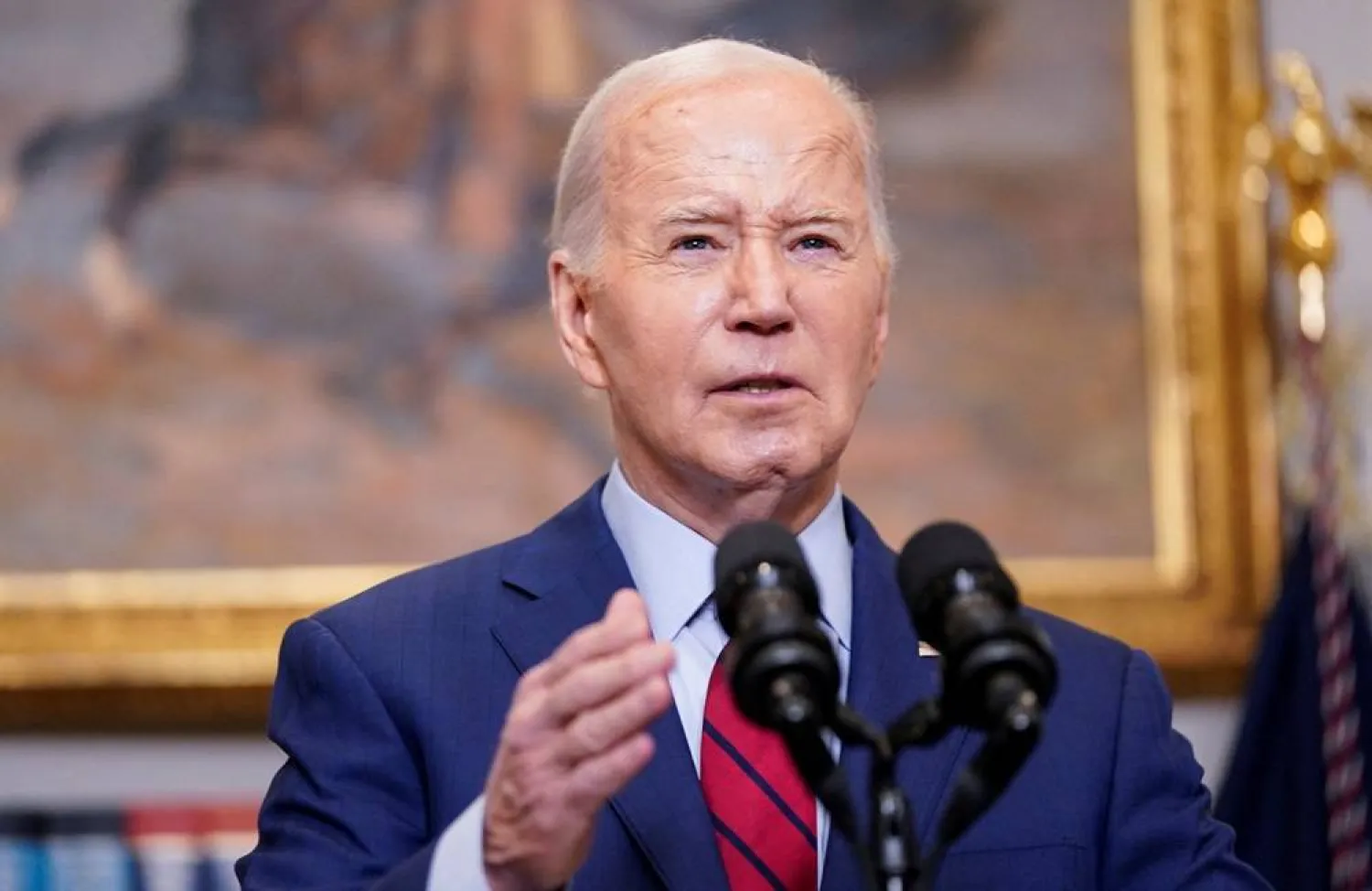
Biden Says ‘Order Must Prevail’ During Campus Protests over the War in Gaza

US President Joe Biden speaks about student protests at US universities, amid the ongoing conflict between Israel and Hamas, during brief remarks in the Roosevelt Room at the White House in Washington, US, May 2, 2024. (Reuters)
TT

Biden Says ‘Order Must Prevail’ During Campus Protests over the War in Gaza

US President Joe Biden speaks about student protests at US universities, amid the ongoing conflict between Israel and Hamas, during brief remarks in the Roosevelt Room at the White House in Washington, US, May 2, 2024. (Reuters)

President Joe Biden on Thursday defended the right to protest but insisted that "order must prevail" as college campuses across the country face unrest over the war in Gaza.

"Dissent is essential for democracy," he said at the White House. "But dissent must never lead to disorder."

Tensions have been building for days as demonstrators refuse to remove campus encampments and administrators turn to police to clear them by force, leading to clashes that have seized attention from politicians and the media.

Biden said he did not support calls to send in the National Guard. He also said that the protests have not prompted him to reconsider his approach to the war. The Democratic president has occasionally criticized Israel's conduct but continued to supply it with weapons.

His remarks, occurring shortly before he left the White House for a trip to North Carolina, came after days of silence about the protests. Republicans have tried to turn the scenes of unrest into a campaign cudgel, and Biden said he rejected efforts to use the situation to "score political points."

"This isn’t a moment for politics," he said. "It’s a moment for clarity."

Biden's last previous public comment on the protests came more than a week ago, when he condemned "antisemitic protests" and "those who don’t understand what’s going on with the Palestinians."

The White House, which has been peppered with questions by reporters, had gone only slightly further than the president. On Wednesday, press secretary Karine Jean-Pierre said Biden is "monitoring the situation closely," and she said some demonstrations had stepped over a line that separated free speech from unlawful behavior.

"Forcibly taking over a building," such as what happened at Columbia University in New York, "is not peaceful," she said. "It’s just not."

Biden has never been much for protesting. His career in elected office began as a county official when he was only 28 years old, and he’s always espoused the political importance of compromise over zealousness.

As college campuses convulsed with anger over the Vietnam War in 1968, Biden was in law school at Syracuse University.

"I’m not big on flak jackets and tie-dyed shirts," he said years later. "You know, that’s not me."

Despite the White House's criticism and Biden's refusal to heed protesters' demands to cut off US support for Israel, Republicans blame Democrats for the disorder and have used it as a backdrop for press conferences.

"We need the president of the United States to speak to the issue and say this is wrong," House Speaker Mike Johnson, a Louisiana Republican, said on Tuesday. "What’s happening on college campuses right now is wrong."

Johnson visited Columbia with other members of his caucus last week. House Republicans sparred with protesters while speaking to the media at George Washington University in Washington, D.C., on Wednesday.

Former President Donald Trump, his party's presumptive nominee, also criticized Biden in an interview with Sean Hannity on Fox News.

"Biden has to do something," he said. "Biden is supposed to be the voice of our country, and it’s certainly not much of a voice. It’s a voice that nobody’s heard."

He repeated his criticisms on Wednesday during a campaign event in Waukesha, Wisconsin.

"The radical extremists and far-left agitators are terrorizing college campuses, as you possibly noticed," Trump said. "And Biden’s nowhere to be found. He hasn’t said anything."

Kate Berner, who served as deputy communications director for Biden’s campaign in 2020, said Republicans already tried the same tactic four years ago during protests over George Floyd’s murder by a police officer.

"People rejected that," she said. "They saw that it was just fearmongering. They saw that it wasn’t based in reality."

Apart from condemning antisemitism, the White House has been reluctant to directly engage on the issue.

Jean-Pierre repeatedly deflected questions during a briefing on Monday.

Asked whether protesters should be disciplined by their schools, she said "universities and colleges make their own decisions" and "we’re not going to weigh in from here."

Pressed on whether police should be called in, she said "that's up to the colleges and universities."

When quizzed about administrators rescheduling graduation ceremonies, she said "that is a decision that they have to decide" and "that is on them."

Biden will make his own visit to a college campus on May 19 when he's scheduled to deliver the commencement address at Morehouse University in Atlanta.


Netanyahu Vows to Eliminate Iran Threat ‘Once and for All’

10 November 2026, Israel, Jerusalem: Caretaker Israeli Prime Minister Benjamin Netanyahu delivers a speech on the sidelines of the opening session of the new Knesset. (dpa)
TT

Netanyahu Vows to Eliminate Iran Threat ‘Once and for All’

10 November 2026, Israel, Jerusalem: Caretaker Israeli Prime Minister Benjamin Netanyahu delivers a speech on the sidelines of the opening session of the new Knesset. (dpa)

Israel's caretaker prime minister Benjamin Netanyahu on Saturday reiterated his calls for a national unity government with his opponent Gadi Eisenkot, as well as his vow to eliminate the threat from Iran.

A meeting with Eisenkot on Thursday "only strengthened the conviction that it is essential to form a national unity government" to guarantee Israel's security, Netanyahu said in a video statement, adding that such a government could "eliminate the Iranian threat once and for all".


Ukraine’s Zelenskiy Escalates Criticism of SpaceX Over Speed Caps

Ukraine's President Volodymyr Zelenskiy holds a press briefing in Copenhagen November 10, 2026. (AFP)
TT

Ukraine’s Zelenskiy Escalates Criticism of SpaceX Over Speed Caps

Ukraine's President Volodymyr Zelenskiy holds a press briefing in Copenhagen November 10, 2026. (AFP)

Ukraine's President Volodymyr Zelenskiy ‌escalated his criticism of SpaceX on Saturday, saying speed restrictions on its military-grade Starshield satellite terminals had dangerous political implications and undermined critical air defenses.

Zelenskiy said Starshield terminals operating in temporarily Russian-occupied territories of Ukraine had been limited to a maximum speed of 161 kph for the past five days, hampering Ukraine's military capabilities.

The Ukrainian Defense Ministry has raised the issue with SpaceX at the ‌institutional level, ‌Zelenskiy said.

"The restrictions have now ‌been ⁠in place for ⁠five days. They say it is some kind of technical issue. We do not believe that is the case," Zelenskiy told reporters in remarks released by his office on Saturday.

"If you impose restrictions there, you are already partially recognizing the temporarily ⁠occupied territories as not ours. And ‌that is why I ‌believe we have the right to raise this ‌issue and restore the speed – so that there ‌are no restrictions at all."

Zelenskiy said the speed restrictions made it more difficult for Ukrainian air defense units to intercept Russian jet-powered drones and made Ukrainian cities ‌more vulnerable. He said he had ordered his top military and foreign ministry ⁠officials ⁠to address the issue and seek clarification.

SpaceX has pushed back against the allegations, denying that it introduced new restrictions or made any changes to its satellite operations.

It is the second such outage in recent weeks. In mid-October, Ukrainian officials said that SpaceX limited the speed of Starlink and its Starshield communication systems to about 160 kph (100 mph) amid tensions with US President Donald Trump's administration over Ukrainian attacks on Russian oil refineries. Service was then restored on October 24.


UN Official Urges Iran, US to Let Fertilizers Through Hormuz Strait

Jorge Moreira da Silva, Executive Director of UNOPS (United Nations Office for Project Services), and coordinator of the UN Strait of Hormuz Task Force established by the UN Secretary-General, speaks during an interview with AFP on the sidelines of the 31st United Climate Change Conference (COP31), at the media center located on the Antalya Expo Center in Antalya on November 14, 2026. (AFP)
TT

UN Official Urges Iran, US to Let Fertilizers Through Hormuz Strait

Jorge Moreira da Silva, Executive Director of UNOPS (United Nations Office for Project Services), and coordinator of the UN Strait of Hormuz Task Force established by the UN Secretary-General, speaks during an interview with AFP on the sidelines of the 31st United Climate Change Conference (COP31), at the media center located on the Antalya Expo Center in Antalya on November 14, 2026. (AFP)

Iran and the United States should "immediately" allow fertilizer shipments through the Strait of Hormuz to ease the crisis in some of the most vulnerable countries, a senior UN official said Saturday.

Jorge Moreira da Silva, head of the UN Office for Project Services, told the COP31 climate talks in the Turkish resort city of Antalya that the lack of fertilizers could push millions into poverty.

The Iranian blockade of the vital waterway, which started after the joint US-Israeli attack against Iran in late February, has choked shipping in the region and beyond. The US blockade of Iranian ports has further complicated matters.

While Iran and the United States are still trying to negotiate an end to the conflict, Moreira da Silva said he had the same message for both countries.

"They should continue their negotiations about the comprehensive deal -- but that deal should not avoid an immediate, exceptional, limited, and time-bound solution for the fertilizers," he said.

"Basically, what we need is five vessels a day with fertilizers," he added.

- Millions at risk -

Moreira da Silva heads up the UN task force dedicated to facilitating the safe passage of fertilizers during the crisis.

Before the conflict, a third of the world's fertilizers passed through the Strait of Hormuz, and since the blockades, their prices had risen by 30 percent, he said.

"But what I think is not sufficiently recognized is the disproportionate impact on the most vulnerable countries," he added.

Sudan's finance minister recently told him that the price of food there had doubled in six months, he added. In Nepal, they had told him that farmers could no longer afford to buy fertilizers.

"So, it's very important that we are aware that countries such as Mozambique, Kenya, Sudan, Somalia, Nepal, Bangladesh, Sri Lanka are facing very significant impact."

The effects of this shortage could be catastrophic, he warned.

"If we continue missing the planting seasons in different parts of the world we may have 45 million people facing severe and acute food insecurity," he said.

"We may have 30 million people being forced into poverty."

The UN had a system ready to get fertilizer shipments moving within seven to 10 days, he said.