

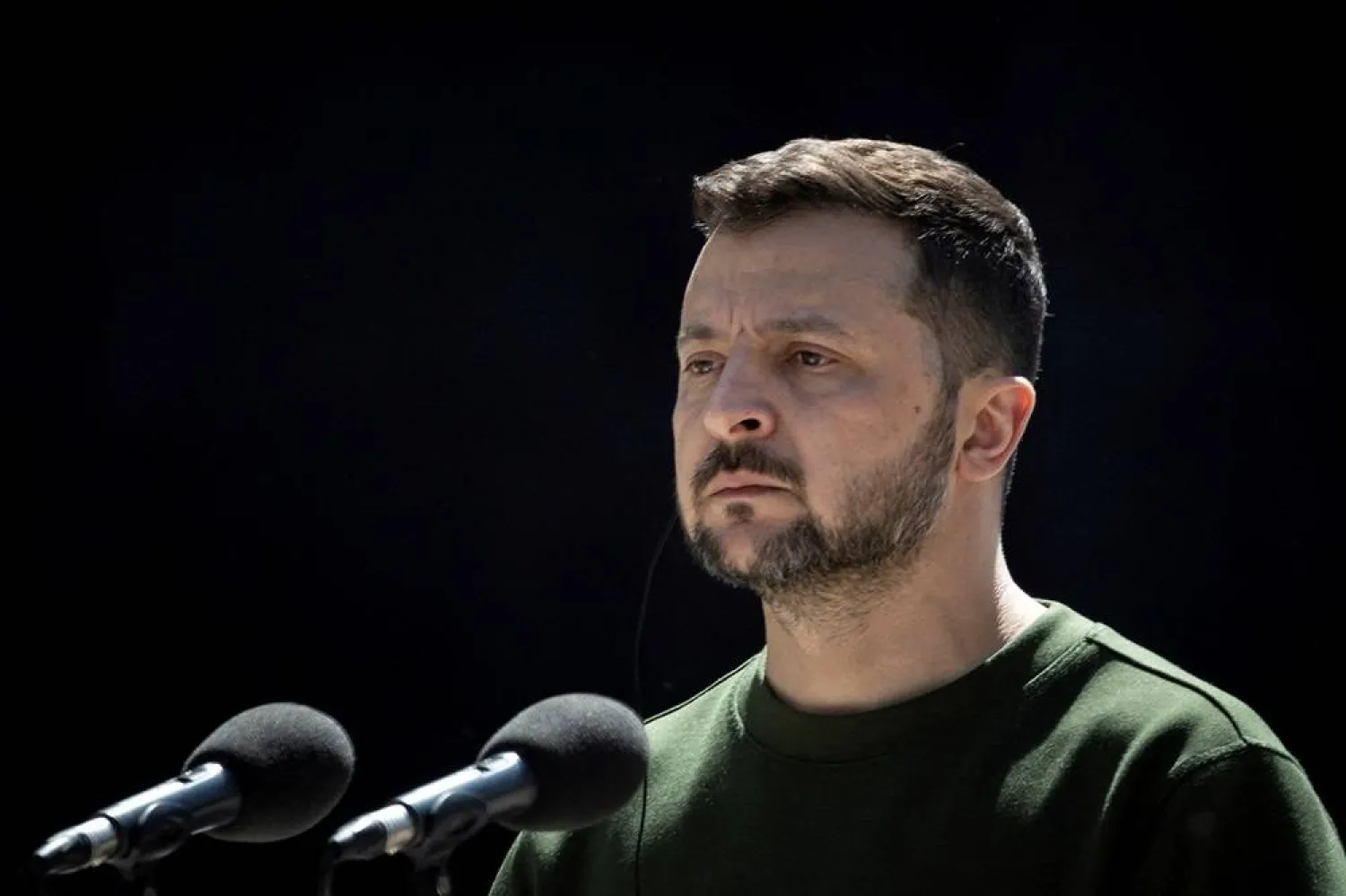

Russia Puts Ukrainian President Zelenskyy on Its Wanted List

Ukraine's President Volodymyr Zelenskyy attends a joint press conference with NATO Secretary-General Jens Stoltenberg, amid Russia’s attack on Ukraine, in Kyiv, Ukraine, April 29, 2024. (Reuters)
TT

Russia Puts Ukrainian President Zelenskyy on Its Wanted List

Ukraine's President Volodymyr Zelenskyy attends a joint press conference with NATO Secretary-General Jens Stoltenberg, amid Russia’s attack on Ukraine, in Kyiv, Ukraine, April 29, 2024. (Reuters)

Russia has put Ukrainian President Volodymyr Zelenskyy on its wanted list, Russian state media reported Saturday, citing the interior ministry’s database.

As of Saturday afternoon, both Zelenskyy and his predecessor, Petro Poroshenko, featured on the ministry's list of people wanted on unspecified criminal charges. Russian officials did not immediately clarify the allegations against Zelenskyy and Poroshenko, and independent Russian news outlet Mediazona claimed on Saturday that the two had been on the list for months.

In an online statement published that same day, Ukraine’s foreign ministry dismissed the reports of Zelenskyy’s inclusion as evidence of “the desperation of the Russian state machine and propaganda.”

Russia's wanted list also includes scores of officials and lawmakers from Ukraine and NATO countries. Among them is Kaja Kallas, the prime minister of NATO and EU member Estonia, who has fiercely advocated for increased military aid to Kyiv and stronger sanctions against Moscow.

Russian officials in February said that Kallas is wanted because of Tallinn’s efforts to remove Soviet-era monuments to Red Army soldiers in the Baltic nation, in a belated purge of what many consider symbols of past oppression.

Fellow NATO members Latvia, Lithuania and Poland have also pulled down monuments that are widely seen as an unwanted legacy of the Soviet occupation of those countries.

Russia has laws criminalizing the “rehabilitation of Nazism” that include punishing the “desecration” of war memorials.

Also on Russia’s list are cabinet ministers from Estonia and Lithuania, as well as the International Criminal Court (ICC) prosecutor who last year prepared a warrant for President Vladimir Putin on war crimes charges. Moscow has also charged the head of Ukraine’s military intelligence, Kyrylo Budanov, with what it deems “terrorist” activities, including Ukrainian drone strikes on Russian infrastructure.

The Kremlin has repeatedly sought to link Ukraine’s leaders to Nazism, even though the country has a democratically elected Jewish president who lost relatives in the Holocaust, and despite the aim of many Ukrainians to strengthen the country’s democracy, reduce corruption and move closer to the West.

Moscow named “de-Nazification, de-militarization and a neutral status” of Ukraine as the key goals of what it insists on calling a “special military operation” against its southern neighbor. The claim of “de-Nazification” refers to Russia’s false assertions that Ukraine’s government is heavily influenced by radical nationalist and neo-Nazi groups - an allegation derided by Kyiv and its Western allies.

The Holocaust, World War II and Nazism have been important tools for Putin in his bid to legitimize Russia’s war in Ukraine. World War II, in which the Soviet Union lost an estimated 27 million people, is a linchpin of Russia’s national identity, and officials bristle at any questioning of the USSR’s role.

Some historians say this has been coupled with an attempt by Russia to retool certain historical truths from the war. They say Russia has tried to magnify the Soviet role in defeating the Nazis while playing down any collaboration by Soviet citizens in the persecution of Jews, along with allegations of crimes by Red Army soldiers against civilians in Eastern Europe.



North Korea Says Japan's Nuclear Ambitions Must Be Stopped 'at Any Cost'

This picture taken on December 12, 2025 and released from North Korea's official Korean Central News Agency (KCNA) on December 13 shows North Korean leader Kim Jong Un (at podium) attending a welcoming ceremony for the Korean People's Army's 528th Regiment of Engineers, which returned from an overseas deployment in Russia's Kursk region during Moscow's war with Ukraine, in front of the April 25 House of Culture in Pyongyang. (KCNA VIA KNS / AFP)
TT

North Korea Says Japan's Nuclear Ambitions Must Be Stopped 'at Any Cost'

This picture taken on December 12, 2025 and released from North Korea's official Korean Central News Agency (KCNA) on December 13 shows North Korean leader Kim Jong Un (at podium) attending a welcoming ceremony for the Korean People's Army's 528th Regiment of Engineers, which returned from an overseas deployment in Russia's Kursk region during Moscow's war with Ukraine, in front of the April 25 House of Culture in Pyongyang. (KCNA VIA KNS / AFP)

North Korea said on Sunday that Japan's nuclear ambitions "must be prevented at any cost", after a Tokyo official reportedly suggested the country should possess atomic weapons.

Pyongyang's reaction came after the unnamed official in the prime minister's office was quoted by Kyodo News on Thursday as saying: "I think we should possess nuclear weapons."

The official was reported to have been involved in devising Japan's security policy.

The Kyodo report also quoted the source as saying: "In the end, we can only rely on ourselves" when explaining the necessity.

Pyongyang said the remarks showed Tokyo was "openly revealing their ambition to possess nuclear weapons, going beyond the red line".

"Japan's attempt to go nuclear must be prevented at any cost as it will bring mankind a great disaster," the director of the Institute for Japan Studies under the North's foreign ministry said in a statement carried by official Korean Central News Agency on Sunday.

"This is not a misstatement or a reckless assertion, but clearly reflects Japan's long-cherished ambition for nuclear weaponization," said the North Korean official, who was not named.

The official added that if Japan acquired nuclear weapons, "Asian countries will suffer a horrible nuclear disaster and mankind will face a great disaster".

The statement did not address Pyongyang's own nuclear program, which includes an atomic test first carried out in 2006 in violation of UN resolutions.

North Korea is believed to possess dozens of nuclear warheads and has repeatedly vowed to keep them despite a raft of international sanctions, saying it needs them to deter perceived military threats from the United States and its allies.

In an address to the United Nations in September, Pyongyang's vice foreign minister Kim Son Gyong said his country would never surrender its nuclear weapons.

"We will never give up nuclear power which is our state law, national policy and sovereign power as well as the right to existence. Under any circumstances, we will never walk away from this position," he said.

North Korean leader Kim Jong Un has also said he is open to talks with Washington, provided Pyongyang is allowed to keep its nuclear arsenal.


Putin Ready to Talk to France’s Macron on Ukraine, Says Spokesman

 French President Emmanuel Macron holds a press conference during a European Union leaders' summit, in Brussels, Belgium December 19, 2025. (Reuters)
French President Emmanuel Macron holds a press conference during a European Union leaders' summit, in Brussels, Belgium December 19, 2025. (Reuters)
TT

Putin Ready to Talk to France’s Macron on Ukraine, Says Spokesman

 French President Emmanuel Macron holds a press conference during a European Union leaders' summit, in Brussels, Belgium December 19, 2025. (Reuters)
French President Emmanuel Macron holds a press conference during a European Union leaders' summit, in Brussels, Belgium December 19, 2025. (Reuters)

Vladimir Putin is ready to talk with France's Emmanuel Macron over the war in Ukraine, the Russian president's spokesman said in an interview published Sunday.

Putin has "expressed readiness to engage in dialogue with Macron", Dmitry Peskov told state news agency RIA Novosti.

"Therefore, if there is mutual political will, then this can only be assessed positively."

Macron said this week he believed Europe should reach back out to Putin over ending the war.

"I believe that it's in our interest as Europeans and Ukrainians to find the right framework to re-engage this discussion" in the coming weeks, the French president said.

European Union leaders agreed on Friday to give Ukraine a loan of 90 billion euros ($105 billion) to plug looming budget shortfalls as the conflict approaches the end of its fourth year.

But they failed to agree on using frozen Russian assets to come up with the funds.


Australia Honors Bondi Beach Attack Victims as PM Orders Safety Review

Security watch over the "Light Over Darkness" vigil from the roof of the Bondi Hotel commemorating victims and survivors of a deadly mass shooting during a Jewish Hanukkah celebration at Bondi Beach on December 14, in Sydney, Australia, December 21, 2025. (Reuters)
TT

Australia Honors Bondi Beach Attack Victims as PM Orders Safety Review

Security watch over the "Light Over Darkness" vigil from the roof of the Bondi Hotel commemorating victims and survivors of a deadly mass shooting during a Jewish Hanukkah celebration at Bondi Beach on December 14, in Sydney, Australia, December 21, 2025. (Reuters)

Australia on Sunday was honoring victims of a gun attack a week earlier on a seaside Hanukkah celebration, as the prime minister announced a review of the country's law enforcement and intelligence agencies.

The nation was marking a day of reflection to honor the 15 people killed and the dozens wounded in the attack by two gunmen at Sydney's Bondi Beach. With security tight and flags at half-staff on government buildings, a minute of silence was to be held at 6:47 p.m. (0747 GMT), the time the attack began.

Authorities invited Australians to light a candle on Sunday evening, the start of the eighth and final day of the Jewish festival of lights, "as a quiet act of remembrance with ‌family, friends or loved ‌ones" of the victims of the attack, allegedly carried out by a ‌father ⁠and son.

An evening ‌memorial event at Bondi Beach will take place under a heavy police presence, including officers carrying long-arm firearms, police said in a statement.

ALBANESE UNDER PRESSURE TO CURB ANTISEMITISM

Prime Minister Anthony Albanese said the review, to be led by a former chief of Australia's spy agency, would probe whether federal police and intelligence agencies have the "right powers, structures, processes and sharing arrangements in place to keep Australians safe".

The attack exposed gaps in gun-license assessments and information-sharing between agencies that policymakers have said they want to plug. Albanese has announced a nationwide gun buyback, while gun safety experts say ⁠the nation's gun laws, among the world's toughest, are riddled with loopholes.

The authorities are investigating the shooting as an act of terrorism targeting ‌Jews. Patrols and policing across the country have been ramped up to ‍prevent further antisemitic violence. Authorities believe the gunmen were ‍inspired by the ISIS extremist group.

"The ISIS-inspired atrocity last Sunday reinforces the rapidly changing security ‍environment in our nation. Our security agencies must be in the best position to respond," Albanese said in a statement, adding that the review would conclude by the end of April.

Albanese, under pressure from critics who say his center-left government has not done enough to curb a surge in antisemitism since the start of the war in Gaza, has vowed to strengthen hate laws in the wake of the attack.

The Bondi Beach attack was the most serious of a string of antisemitic incidents in Australia, which have included attacks on synagogues, ⁠buildings and cars, since Israel launched the war in October 2023, in response to an attack by Hamas.

Albanese condemned anti-immigration rallies being held in Sydney and Melbourne on Sunday.

"There are organized rallies seeking to sow division in the aftermath of last Sunday’s antisemitic terrorist attack, and they have no place in Australia," he said in a statement. "They should not go ahead and people should not attend them.”

Only about 50 people were at the Sydney rally by mid-afternoon, according to a Reuters witness.

On Saturday, the government of New South Wales, which includes Sydney, pledged to introduce a bill on Monday to ban the display of symbols and flags of "terrorist organizations", including those of ISIS, Hamas, al-Qaeda, Al Shabaab, Boko Haram and Hezbollah.

Authorities say ISIS flags were found in the car the alleged attackers took to Bondi.

Alleged gunman Sajid Akram, 50, was shot dead by police at the scene. His 24-year-old ‌son Naveed Akram, who was also shot by police and emerged from a coma on Tuesday, has been charged with 59 offenses, including murder and terrorism, according to police. He remains in custody in hospital.