

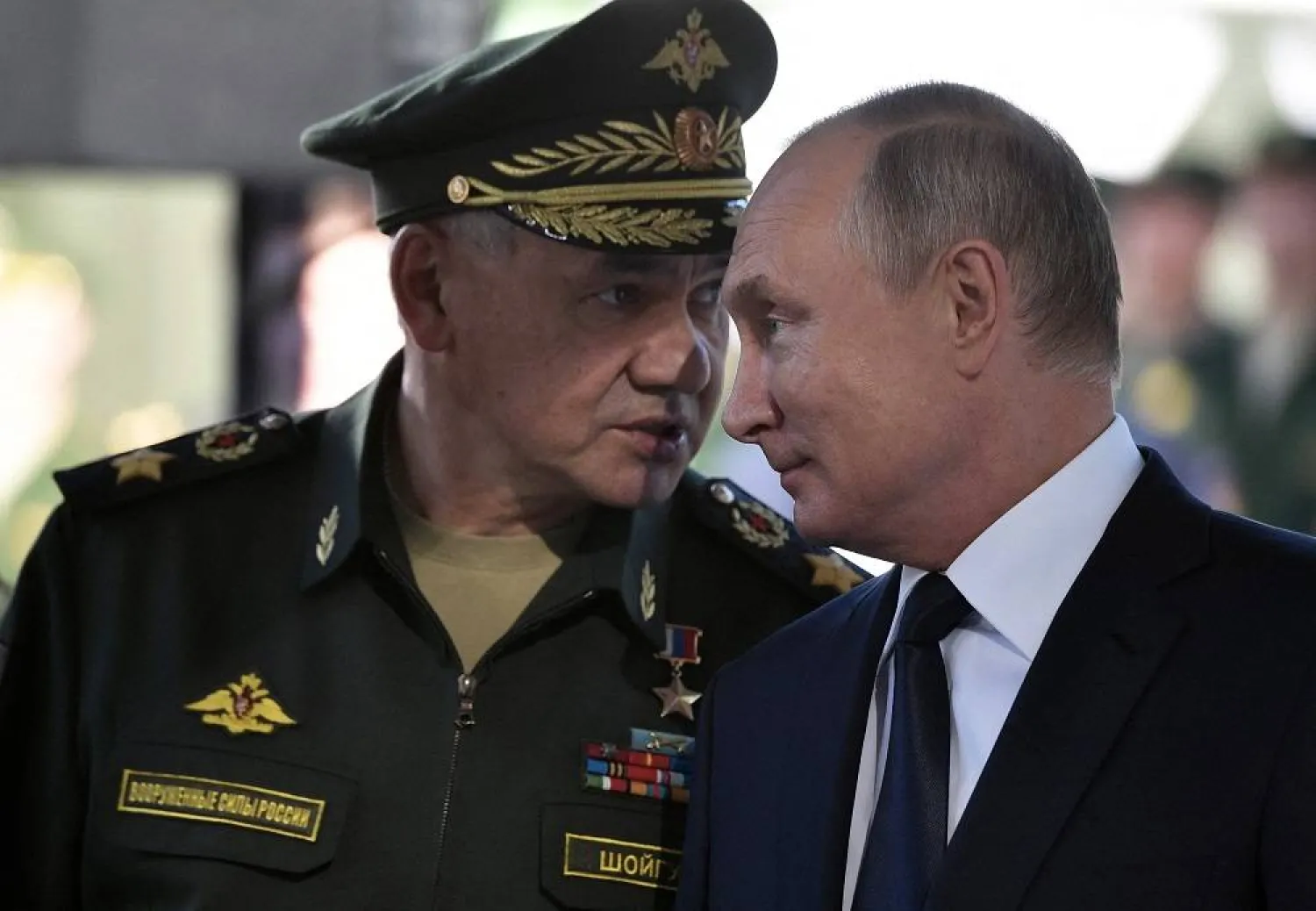

Putin Replaces Shoigu as Russia’s Defense Minister as He Starts His 5th Term 

In this pool photograph distributed by Russian state owned Sputnik agency Russian President Vladimir Putin (R) and Russian Defense Minister Sergei Shoigu visit the military Patriot Park in Kubinka, outside Moscow, on September 19, 2018. (AFP/Sputnik)
TT

Putin Replaces Shoigu as Russia’s Defense Minister as He Starts His 5th Term 

In this pool photograph distributed by Russian state owned Sputnik agency Russian President Vladimir Putin (R) and Russian Defense Minister Sergei Shoigu visit the military Patriot Park in Kubinka, outside Moscow, on September 19, 2018. (AFP/Sputnik)

Russian President Vladimir Putin on Sunday replaced Sergei Shoigu as defense minister in a Cabinet shakeup that comes as he begins his fifth term in office.

In line with Russian law, the entire Russian Cabinet resigned Tuesday following Putin’s glittering inauguration in the Kremlin, and most members have been widely expected to keep their jobs, while Shoigu's fate had appeared uncertain.

Putin signed a decree on Sunday appointing Shoigu as secretary of Russia's Security Council, the Kremlin said. The appointment was announced shortly after Putin proposed Andrei Belousov to become the country’s defense minister in place of Shoigu.

The announcement of Shoigu’s new role came as 13 people were reported dead and 20 more wounded in Russia’s border city of Belgorod, where a 10-story apartment building partially collapsed after what Russian officials said was Ukrainian shelling. Ukraine hasn’t commented on the incident.

Belousov's candidacy will need to be approved by Russia's upper house in parliament, the Federation Council. It reported Sunday that Putin introduced proposals for other Cabinet positions as well, but Shoigu is the only minister on that list who is being replaced. Several other new candidates for federal ministers were proposed Saturday by Prime Minister Mikhail Mishustin, reappointed by Putin on Friday.

Shoigu's deputy, Timur Ivanov, was arrested last month on bribery charges and was ordered to remain in custody pending an official investigation. The arrest of Ivanov was widely interpreted as an attack on Shoigu and a possible precursor of his dismissal, despite his close personal ties with Putin.

Kremlin spokesman Dmitry Peskov said Sunday that Putin had decided to give the defense minister role to a civilian because the ministry should be “open to innovation and cutting-edge ideas.” He also said the increasing defense budget “must fit into the country’s wider economy,” and Belousov, who until recently served as the first deputy prime minister, is the right fit for the job.

Belousov, 65, held leading positions in the finances and economic department of the prime minister's office and the Ministry of Economic Development. In 2013, he was appointed an adviser to Putin and seven years later, in January 2020, he became first deputy prime minister.

Peskov assured that the reshuffle will not affect “the military aspect," which “has always been the prerogative of the Chief of General Staff,” and Gen. Valery Gerasimov, who currently serves in this position, will continue his work.

Tatiana Stanovaya, a senior fellow at the Carnegie Russia Eurasia Center, said in an online commentary that Shoigu’s new appointment to Russia’s Security Council showed that the Russian leader viewed the institution as “a reservoir” for his "'former' key figures — people who he can’t in any way let go, but doesn’t have a place for.”

Figures such as former Russian President Dmitry Medvedev have also been appointed to the security council. Medvedev has served as the body’s deputy chairman since 2020.

Shoigu was appointed to the Security Council instead of Nikolai Patrushev, Putin's long-term ally. Peskov said Sunday that Patrushev is taking on another role, and promised to reveal details in the coming days.

Shoigu has been widely seen as a key figure in Putin’s decision to send Russian troops into Ukraine. Russia had expected the operation to quickly overwhelm Ukraine’s much smaller and less-equipped army and for Ukrainians to broadly welcome Russian troops.

Instead, the conflict galvanized Ukraine to mount an intense defense, dealing the Russian army humiliating blows, including the retreat from an attempt to take the capital, Kyiv, and a counteroffensive that drove Moscow’s forces out of the Kharkiv region.

Before he was named defense minister in 2012, Shoigu spent more than 20 years directing markedly different work: In 1991, he was appointed head of the Russian Rescue Corps disaster-response agency, which eventually became the Ministry of Emergency Situations. He became highly visible in the post. The job also allowed him to be named a general even though he had no military service behind him as the rescue corps absorbed the militarized Civil Defense Troops.

Shoigu does not wield the same kind of power as Patrushev, who has long been the country's top security official. But the position he will take — the same position that Patrushev worked to transform from a minor bureaucratic role to a place of sizable influence — will still carry some authority, according to Mark Galeotti, head of the Mayak Intelligence consultancy.

High-level security materials intended for the president’s eyes will still pass through the Security Council Secretariat, even with changes at the top. “You can’t just institutionally turn around a bureaucracy and how it works overnight,” he said.

Thousands of civilians have fled Russia's renewed ground offensive in Ukraine’s northeast that has targeted towns and villages with a barrage of artillery and mortar shelling, officials said Sunday.

The intense battles have forced at least one Ukrainian unit to withdraw in the Kharkiv region, capitulating more land to Russian forces across less defended settlements in the so-called contested gray zone along the Russian border.

By Sunday afternoon, the town of Vovchansk, among the largest in the northeast with a prewar population of 17,000, emerged as a focal point in the battle.

Volodymyr Tymoshko, the head of the Kharkiv regional police, said that Russian forces were on the outskirts of the town and approaching from three directions.

An Associated Press team, positioned in a nearby village, saw plumes of smoke rising from the town as Russian forces hurled shells. Evacuation teams worked nonstop throughout the day to take residents, most of whom were older, out of harm's way.

At least 4,000 civilians have fled the Kharkiv region since Friday, when Moscow’s forces launched the operation, Gov. Oleh Syniehubov said in a social media statement. Heavy fighting raged Sunday along the northeast front line, where Russian forces attacked 27 settlements in the past 24 hours, he said.

Analysts say the Russian push is designed to exploit ammunition shortages before promised Western supplies can reach the front line.

Ukrainian soldiers said the Kremlin is using the usual Russian tactic of launching a disproportionate amount of fire and infantry assaults to exhaust Ukrainian troops and firepower. By intensifying battles in what was previously a static patch of the front line, Russian forces threaten to pin down Ukrainian forces in the northeast, while carrying out intense battles farther south where Moscow is also gaining ground.

It comes after Russia stepped up attacks in March targeting energy infrastructure and settlements, which analysts predicted were a concerted effort to shape conditions for an offensive.

The Russian Defense Ministry said Sunday that its forces had captured four villages on the border along Ukraine’s Kharkiv region, in addition to five villages reported to have been seized on Saturday. These areas were likely poorly fortified because of the dynamic fighting and constant heavy shelling, easing a Russian advance.

Ukraine’s leadership hasn't confirmed Moscow’s gains. But Tymoshko, the head of the Kharkiv regional police, said that Strilecha, Pylna and Borsivika were under Russian occupation, and it was from their direction they were bringing in infantry to stage attacks in other embattled villages of Hlyboke and Lukiantsi.



Iran Warns Protesters Who Joined ‘Riots’ to Surrender

Iranians drive near an anti-US mural in street in Tehran, Iran, 19 January 2026. (EPA)
TT

Iran Warns Protesters Who Joined ‘Riots’ to Surrender

Iranians drive near an anti-US mural in street in Tehran, Iran, 19 January 2026. (EPA)

Iran's top police officer issued an ultimatum on Monday to protesters who joined what authorities have deemed "riots", saying they must hand themselves in within three days or face the full force of the law.

But the government also pledged to tackle economic hardships that sparked the demonstrations, which were met with a crackdown that rights groups say has left thousands dead.

The protests constituted the biggest challenge to the Iranian leadership in years, with the full scale of the violence yet to emerge amid an internet blackout.

National police chief Ahmad-Reza Radan on Monday urged young people "deceived" into joining the "riots" to turn themselves in and receive lighter punishment.

Those "who became unwittingly involved in the riots are considered to be deceived individuals, not enemy soldiers", and "will be treated with leniency", he told state television.

Officials have said the demonstrations were peaceful before descending into chaos fueled by Iran's arch-foes the United States and Israel in an effort to destabilize the nation.

The heads of the country's executive, legislative and judicial branches on Monday all pledged to work "around the clock" in "resolving livelihood and economic problems", according to a joint statement published by state television.

But they would also "decisively punish" the instigators of "terrorist incidents", said the statement from President Masoud Pezeshkian, parliament speaker Mohammad Bagher Ghalibaf and judiciary chief Gholamhossein Mohseni Ejei.

Alarm has grown over the possibility that authorities will use capital punishment against protesters.

The United Nations on Monday warned the country was using executions as "a tool of state intimidation".

Iran -- the world's most prolific executioner after China, according to rights groups -- reportedly executed 1,500 people last year, UN rights chief Volker Turk said in a statement.

Security officials cited by Iran's Tasnim news agency said late last week that around 3,000 people have been arrested in connection with the demonstrations, but rights groups say the number could be as high as 20,000.

Supreme leader Ali Khamenei said on Saturday that authorities "must break the back of the seditionists".

The scale of the crackdown has emerged piecemeal as Iran remains under an unprecedented internet shutdown that is now in its 11th day.

Despite difficulty accessing information, the Iran Human Rights NGO says it has verified that 3,428 protesters were killed by security forces, warning the actual toll could be far higher.

Internet access would "gradually" return to normal this week, Hossein Afshin, Iran's vice president for science, technology and the knowledge economy, said Monday on state television, after limited access briefly returned the day before.

Images from the capital Tehran showed buildings and billboards destroyed during the rallies.

In Iran's second-largest city of Masshad, damage to public infrastructure exceeded $15 million, Mayor Mohammadreza Qalandar Sharif told state television.


Türkiye’s Erdogan Hopes Iran Unrest Will Be Resolved Through Diplomacy

 An Iranian woman walks on a street in Tehran, Iran, January 19, 2026. Majid Asgaripour/WANA (West Asia News Agency) via Reuters
An Iranian woman walks on a street in Tehran, Iran, January 19, 2026. Majid Asgaripour/WANA (West Asia News Agency) via Reuters
TT

Türkiye’s Erdogan Hopes Iran Unrest Will Be Resolved Through Diplomacy

 An Iranian woman walks on a street in Tehran, Iran, January 19, 2026. Majid Asgaripour/WANA (West Asia News Agency) via Reuters
An Iranian woman walks on a street in Tehran, Iran, January 19, 2026. Majid Asgaripour/WANA (West Asia News Agency) via Reuters

Turkish President Recep Tayyip Erdogan on Monday described the unrest in Iran as a "new test" for Tehran, pledging Türkiye would "stand against any initiative" that would drag the region into chaos. 

"We believe that, with a ... policy prioritizing dialogue and diplomacy, our Iranian brothers will, God willing, get through this trap-filled period," Erdogan said in a televised speech after the weekly cabinet meeting. 

That was the first time Erdogan spoke about the protests gripping the country, during which thousands of people have been killed. 

Before the latest bout of unrest, the Iranian government was already battling an economic crisis after years of sanctions, as well as recovering from the June war against Israel. 

"Our neighbor Iran, following the Israeli attacks, is now facing a new test that targets its social peace and stability," Erdogan said. 

"We are all watching the scenarios that are being attempted to be written through the streets," he added. 

"With our foreign policy centered on peace and stability, we will continue to stand against any initiative that risks dragging our region into uncertainty." 

Türkiye’s Foreign Minister Hakan Fidan on Thursday said Ankara opposed a military operation against Iran, a strategy US President Donald Trump has repeatedly discussed as a way of aiding the Iranian people over the crackdown on protests. 


EU Executive Arm, Russia and Thailand Asked to Join Trump's Board of Peace for Gaza

US President Donald Trump - The AP news.
TT

EU Executive Arm, Russia and Thailand Asked to Join Trump's Board of Peace for Gaza

US President Donald Trump - The AP news.

The European Union's executive arm, Russia and Thailand on Monday were the latest to be asked to join US President Donald Trump's new Board of Peace that will supervise the next phase of the Gaza peace plan, as a top Israeli official said the initiative is “bad for Israel” and should be scrapped, The AP news reported.

Kremlin spokesman Dmitry Peskov said Russian President Vladimir Putin received the invitation and that the Kremlin is now "studying the details" and would seek clarity of “all the nuances” in contacts with the US. The Thai Foreign Ministry said it was also invited and that it was reviewing the details.

European Commission spokesperson Olof Gill confirmed that Ursula von der Leyen, the president of the commission, received an invitation and would be speaking to other EU leaders about Gaza. Gill didn't say whether the invitation has been accepted, but that the commission wants "to contribute to a comprehensive plan to end the Gaza conflict.”

It's unclear how many leaders have been invited to join the board. But a Trump reference in the invitation letters that the body would “embark on a bold new approach to resolving global conflict" suggested it could act as a rival to the UN Security Council, the most powerful body of the global organization created in the wake of World War II.

Israeli far-right Finance Minister Bezalel Smotrich on Monday dismissed the Board of Peace as a raw deal for Israel and called for its dissolution.

“It is time to explain to the president that his plan is bad for the State of Israel and to cancel it," Smotrich said at a ceremony inaugurating the new Yatziv settlement in the occupied West Bank. "Gaza is ours, its future will affect our future more than anyone else’s. We will take responsibility for what happens there, impose military administration, and complete the mission.”

Smotrich even suggested that Israel renew a full-scale offensive on Gaza to destroy Hamas if it doesn't abide by a “short ultimatum for real disarmament and exile.”

On Saturday, the office of Israeli Prime Minister Benjamin Netanyahu said the formation of the committee wasn’t coordinated with the Israeli government and “is contrary to its policy.”

The US is expected to announce its official list of members in the coming days, likely during the World Economic Forum meeting in Davos, Switzerland.

Board members will oversee an executive committee that will be in charge of implementing the tough second phase of the Gaza peace plan that includes the deployment of an international security force, disarmament of Hamas and reconstruction of the war-devastated territory.

A $1 billion contribution secures permanent membership on the board with the money going to rebuild Gaza, according to a US official who spoke on condition of anonymity about the charter, which hasn't been made public. A three-year appointment has no contribution requirement.

But details of how this will also work remain murky. British Prime Minister Keir Starmer said Monday the UK is talking to allies about the Board of Peace. Although the UK hasn't said whether Starmer has been formally invited to join, he said it's necessary to proceed with the Gaza peace plan's second phase and that his country has "indicated willingness, to play our part, and we will.”

Running Gaza Egypt’s top diplomat on Monday met with the leader of the newly appointed committee of Palestinian technocrats who will be running Gaza’s day-to-day affairs during the second phase of the peace plan.

Foreign Minister Bader Abdelatty met with Ali Shaath, a Palestinian engineer and former official with the Western-backed Palestinian Authority, who was named last week as chief commissioner of the National Committee for the Administration of Gaza

Abdelatty expressed the Egyptian government’s “complete support” to the committee and affirmed its role in running Gaza’s daily affairs until the Palestinian Authority takes over the territory, a statement from the Egyptian ministry said following the meeting.

He also underscored “the importance of preserving the unity of the Palestinian territories, ensuring geographical and administrative continuity between the Gaza Strip and the West Bank.”

More aid getting through but situation still fragile The UN World Food Program on Monday said it has “significantly expanded” its operations across Gaza 100 days into the ceasefire, reaching more than a million people each month with hot meals, bread bundles and food parcels. But it warned the situation remains “extremely fragile” even as critical progress has been made in pushing back famine.

It noted that malnutrition has been prevented for 200,000 pregnant and breastfeeding women, as well as children under 5, while school snacks are reaching 235,000 children in 250 temporary schools.

Still, the most recent Integrated Food Security Phase Classification (IPC) analysis in December indicates that 77% the population is facing crisis levels food insecurity with over 100,000 people experiencing catastrophic levels of hunger.

The WFP said access to nutritious food such as fresh fruit, vegetables and dairy is limited with most families still can't afford more commercial goods entering Gaza.

Palestinian teen shot dead Israeli forces killed a Palestinian teenager in southern Gaza, hospital authorities said Monday.

Hussein Tawfiq Abu Sabalah, 17, was shot in the Muwasi area of Rafah Monday morning, according to Nasser Hospital. It wasn’t immediately clear whether he crossed into or came close to an Israeli-controlled area.

More than 460 people have been killed by Israeli fire and their bodies brought to hospitals since the ceasefire went into effect, according to Gaza's Health Ministry. The ministry, which is part of Hamas-led government, maintains detailed casualty records that are seen as generally reliable by UN agencies and independent experts.