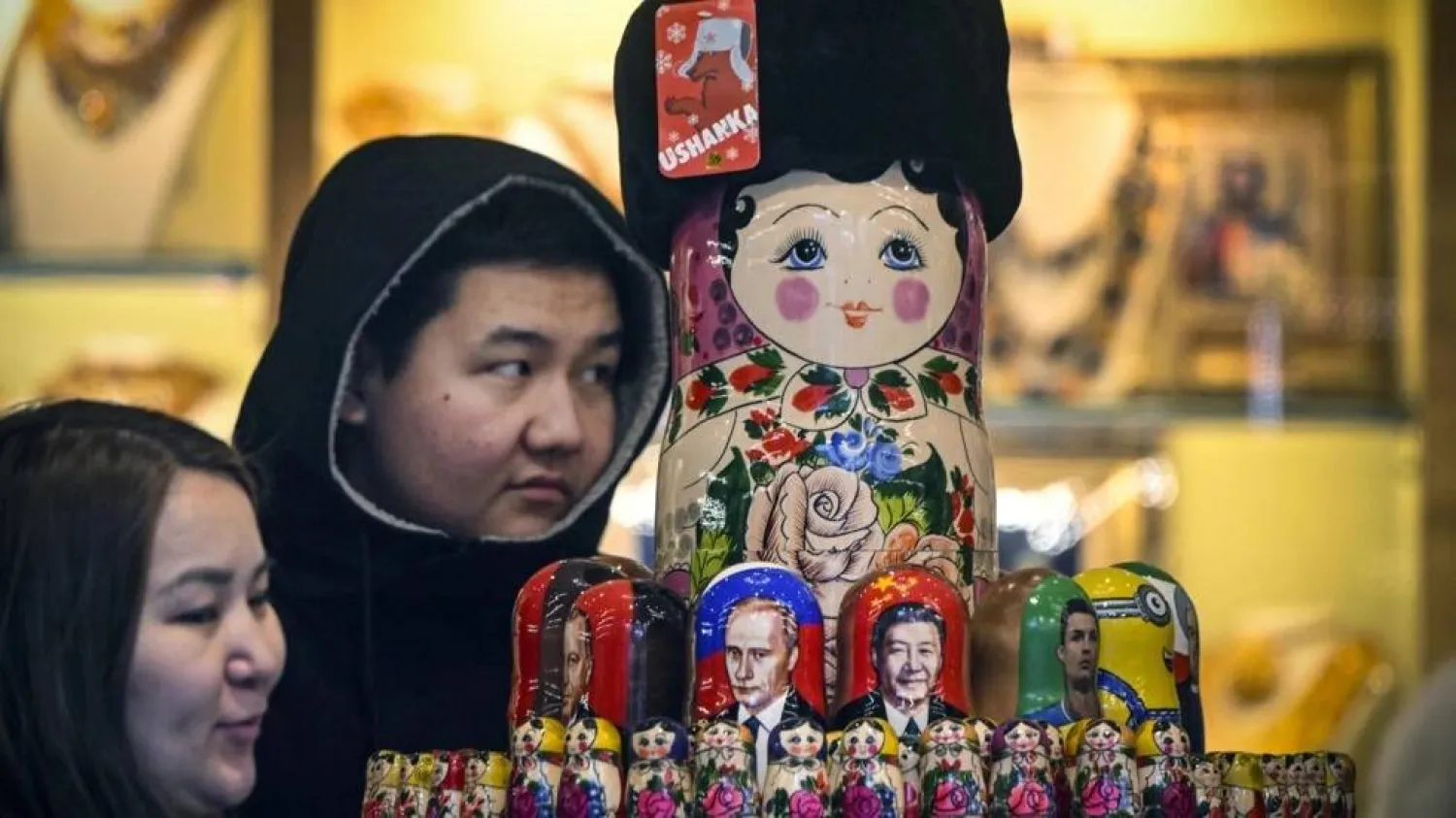
US Sanctions Test China's 'No Limits' Friendship with Russia

President Vladimir Putin is due to visit Beijing in May. Alexander NEMENOV / AFP
TT

US Sanctions Test China's 'No Limits' Friendship with Russia

President Vladimir Putin is due to visit Beijing in May. Alexander NEMENOV / AFP

Chinese banks are tightening scrutiny over trade with Russia for fear of incurring strict new US sanctions over the Ukraine war, testing the "no limits" friendship between the two countries.
China's trade with Russia has hit record highs in recent years, drawing accusations that it is helping buoy its longtime ally's economy, with President Vladimir Putin due to visit Beijing in May, said AFP.
But Washington's recent vow to go after financial institutions that help Moscow fund the conflict has tested the boundaries of Beijing's bonhomie -- and left its banks fearful of getting cut off themselves.
An executive order by President Joe Biden in December permits secondary sanctions on foreign banks that deal with Russia's war machine, allowing the US Treasury to cut them out of the dollar-led global financial system.
Since then, several Chinese banks have halted or slowed transactions with Russian clients, according to eight people from both countries involved in cross-border trade.
"At the moment, it's tough to get money in from Russia," said one Chinese clothing wholesaler as he sat outside his store at a cavernous trade center in downtown Beijing this week.
"The banks don't give a reason... but it's probably due to the threat (of sanctions) from America," he said, as a handful of Russian visitors browsed shelves of Chinese electronics, leather bags and tea.
Traders said banks are imposing extra checks on cross-border settlements to rule out any risk of exposure to sanctions -- screening that can take months and has jacked up costs, sparking cash flow crises at smaller import-export businesses.
Another business owner told AFP on condition of anonymity they had been forced to close their China operations and return to Russia as they "cannot get any money from customers".
The traders declined to be identified due to the sensitivity of discussing Beijing and Moscow's trading relationship.
The payment hold-ups have coincided with a fall in Chinese exports to Russia during March and April, down from a surge early in the year.
"Even though the sanctions were imposed to (hinder) the export of certain items from China, they have some impact on ordinary trade," Pavel Bazhanov, a lawyer serving Russian businesses in China, told AFP.
The slowdown in payment processing contrasts "starkly" with the rapid handling of yuan-denominated transactions in the past, he said.
'Better safe than sorry'
Trade between China and Russia has boomed since the Ukraine invasion and hit $240 billion in 2023, according to Beijing's customs figures.
But reports that Russian companies were struggling to clear payments with Chinese banks first emerged in the Russian media at the start of the year.
The Kremlin admitted the problem in February, with spokesperson Dmitry Peskov later slamming "unprecedented" US pressure on China.
Beijing has not publicly acknowledged the delays but its foreign ministry told AFP it opposed "unilateral and illegal US sanctions".
Behind the scenes, however, Chinese banks are ensuring they do not put targets on their backs, analysts said.
"Finding out whether the payments are related to the Russian military-industrial complex... is creating a considerable challenge for Chinese companies and banks," said Alexander Gabuev, director of the Carnegie Russia Eurasia Center in Berlin.
"They are operating on better-be-safe-than-sorry principles, which reduces the volume of transactions," he told AFP.
Mending US ties
President Xi Jinping and Putin have made much of their countries' "no limits" friendship, and the Russian leader told a business forum last month a visit to China had been planned for May.
But slowing domestic growth in China has created incentives for Beijing not to invite further damage to its economy, the Wilson Center's William Pomeranz said.
Other experts said the banks' newfound caution reflected Beijing's desire to manage its rivalry with the United States ahead of this year's election.
Ties between the world's two largest economies have steadied in recent months after years-long spats over trade, technology and other issues.
Chinese officials may have directed banks to scrutinize Russia payments to ensure they do not create "a wedge issue in the US election", said Wang Yiwei, head of the Institute of International Affairs at Renmin University of China.
"China would not be stupid enough" to let a major bank fund Russia's war, Shanghai-based international relations scholar Shen Dingli said.
"(They) won't give the US the option to impose full sanctions."
No greenbacks
Part of the solution could be a move long touted by countries keen to shield themselves from US sanctions: financial systems independent of the US dollar, experts said.
Alexandra Prokopenko, a former advisor at Russia's Central Bank, told AFP that Moscow's wartime pivot to Asia has seen the "fine-tuning of a system for cross-border payments in national currencies (yuan and rubles)".
The system allows banks to skip traditional financial infrastructure like the SWIFT messaging system, insulating them against the effects of sanctions, she said.
Current payment glitches show that approach is "not a panacea", Prokopenko told AFP.
But "Moscow and Beijing are quite adept at adapting processes to an ever-changing environment," she said.


Netanyahu Vows to Eliminate Iran Threat ‘Once and for All’

10 November 2026, Israel, Jerusalem: Caretaker Israeli Prime Minister Benjamin Netanyahu delivers a speech on the sidelines of the opening session of the new Knesset. (dpa)
TT

Netanyahu Vows to Eliminate Iran Threat ‘Once and for All’

10 November 2026, Israel, Jerusalem: Caretaker Israeli Prime Minister Benjamin Netanyahu delivers a speech on the sidelines of the opening session of the new Knesset. (dpa)

Israel's caretaker prime minister Benjamin Netanyahu on Saturday reiterated his calls for a national unity government with his opponent Gadi Eisenkot, as well as his vow to eliminate the threat from Iran.

A meeting with Eisenkot on Thursday "only strengthened the conviction that it is essential to form a national unity government" to guarantee Israel's security, Netanyahu said in a video statement, adding that such a government could "eliminate the Iranian threat once and for all".


Ukraine’s Zelenskiy Escalates Criticism of SpaceX Over Speed Caps

Ukraine's President Volodymyr Zelenskiy holds a press briefing in Copenhagen November 10, 2026. (AFP)
TT

Ukraine’s Zelenskiy Escalates Criticism of SpaceX Over Speed Caps

Ukraine's President Volodymyr Zelenskiy holds a press briefing in Copenhagen November 10, 2026. (AFP)

Ukraine's President Volodymyr Zelenskiy ‌escalated his criticism of SpaceX on Saturday, saying speed restrictions on its military-grade Starshield satellite terminals had dangerous political implications and undermined critical air defenses.

Zelenskiy said Starshield terminals operating in temporarily Russian-occupied territories of Ukraine had been limited to a maximum speed of 161 kph for the past five days, hampering Ukraine's military capabilities.

The Ukrainian Defense Ministry has raised the issue with SpaceX at the ‌institutional level, ‌Zelenskiy said.

"The restrictions have now ‌been ⁠in place for ⁠five days. They say it is some kind of technical issue. We do not believe that is the case," Zelenskiy told reporters in remarks released by his office on Saturday.

"If you impose restrictions there, you are already partially recognizing the temporarily ⁠occupied territories as not ours. And ‌that is why I ‌believe we have the right to raise this ‌issue and restore the speed – so that there ‌are no restrictions at all."

Zelenskiy said the speed restrictions made it more difficult for Ukrainian air defense units to intercept Russian jet-powered drones and made Ukrainian cities ‌more vulnerable. He said he had ordered his top military and foreign ministry ⁠officials ⁠to address the issue and seek clarification.

SpaceX has pushed back against the allegations, denying that it introduced new restrictions or made any changes to its satellite operations.

It is the second such outage in recent weeks. In mid-October, Ukrainian officials said that SpaceX limited the speed of Starlink and its Starshield communication systems to about 160 kph (100 mph) amid tensions with US President Donald Trump's administration over Ukrainian attacks on Russian oil refineries. Service was then restored on October 24.


UN Official Urges Iran, US to Let Fertilizers Through Hormuz Strait

Jorge Moreira da Silva, Executive Director of UNOPS (United Nations Office for Project Services), and coordinator of the UN Strait of Hormuz Task Force established by the UN Secretary-General, speaks during an interview with AFP on the sidelines of the 31st United Climate Change Conference (COP31), at the media center located on the Antalya Expo Center in Antalya on November 14, 2026. (AFP)
TT

UN Official Urges Iran, US to Let Fertilizers Through Hormuz Strait

Jorge Moreira da Silva, Executive Director of UNOPS (United Nations Office for Project Services), and coordinator of the UN Strait of Hormuz Task Force established by the UN Secretary-General, speaks during an interview with AFP on the sidelines of the 31st United Climate Change Conference (COP31), at the media center located on the Antalya Expo Center in Antalya on November 14, 2026. (AFP)

Iran and the United States should "immediately" allow fertilizer shipments through the Strait of Hormuz to ease the crisis in some of the most vulnerable countries, a senior UN official said Saturday.

Jorge Moreira da Silva, head of the UN Office for Project Services, told the COP31 climate talks in the Turkish resort city of Antalya that the lack of fertilizers could push millions into poverty.

The Iranian blockade of the vital waterway, which started after the joint US-Israeli attack against Iran in late February, has choked shipping in the region and beyond. The US blockade of Iranian ports has further complicated matters.

While Iran and the United States are still trying to negotiate an end to the conflict, Moreira da Silva said he had the same message for both countries.

"They should continue their negotiations about the comprehensive deal -- but that deal should not avoid an immediate, exceptional, limited, and time-bound solution for the fertilizers," he said.

"Basically, what we need is five vessels a day with fertilizers," he added.

- Millions at risk -

Moreira da Silva heads up the UN task force dedicated to facilitating the safe passage of fertilizers during the crisis.

Before the conflict, a third of the world's fertilizers passed through the Strait of Hormuz, and since the blockades, their prices had risen by 30 percent, he said.

"But what I think is not sufficiently recognized is the disproportionate impact on the most vulnerable countries," he added.

Sudan's finance minister recently told him that the price of food there had doubled in six months, he added. In Nepal, they had told him that farmers could no longer afford to buy fertilizers.

"So, it's very important that we are aware that countries such as Mozambique, Kenya, Sudan, Somalia, Nepal, Bangladesh, Sri Lanka are facing very significant impact."

The effects of this shortage could be catastrophic, he warned.

"If we continue missing the planting seasons in different parts of the world we may have 45 million people facing severe and acute food insecurity," he said.

"We may have 30 million people being forced into poverty."

The UN had a system ready to get fertilizer shipments moving within seven to 10 days, he said.