Survivors Hunt for the Missing Days after Afghanistan Floods

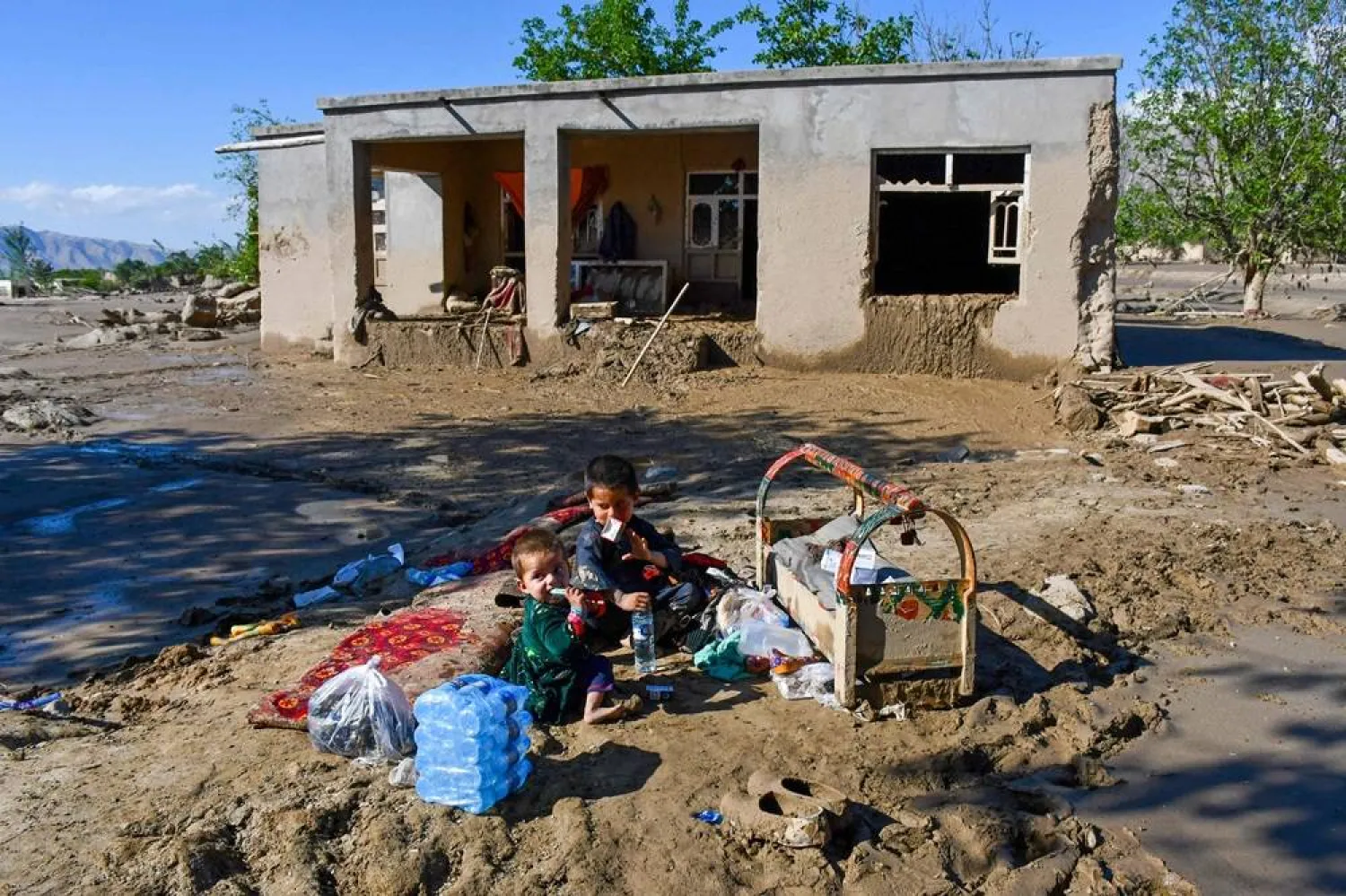
Afghans sit at their damaged house after floods in Burka district of Baghlan province on May 12, 2024. (AFP)
TT

Survivors Hunt for the Missing Days after Afghanistan Floods

Afghans sit at their damaged house after floods in Burka district of Baghlan province on May 12, 2024. (AFP)

Survivors of flash floods in Afghanistan were still searching for the missing on Monday, days after torrents of water ripped through villages, killing hundreds.

Heavy rains sparked flash flooding in multiple Afghan provinces on Friday, killing more than 300 people in Baghlan alone, UN agencies and Taliban officials said.

Rescue and aid workers have been struggling to reach some of the worst-affected areas with the World Health Organization echoing Taliban government and nonprofit warnings that the death toll could rise significantly.

Samiullah Omari had found the bodies of seven of his relatives, but his uncle and uncle's grandson were still missing.

"We have been searching but we haven't found them," the 24-year-old day laborer told AFP in his village of Fulool.

For kilometers around, mud covers everything, with cars, uprooted trees and limbs of livestock jutting out from the thick brown sludge where homes once stood.

Neither Omari nor his 70-year-old father have ever seen "such havoc-wreaking floods", he said.

The WHO has warned of rising cases of water-borne diseases in flood-affected regions.

In a country with a health system already on its knees, some health facilities were rendered non-operational by the flooding, which damaged or destroyed thousands of homes and swamped agricultural land.

"The full extent of the damage is not yet known, and the country lacks the necessary resources to manage a disaster of this magnitude," the WHO said in a situation report on Sunday.

'Nothing left'

The United Nations agency said it had delivered seven metric tons of medical aid to northern Afghanistan and deployed mobile health teams.

Omari and dozens of other villagers took refuge in a house on higher ground.

"God protected us along with 60-70 people and we survived it," he said, but his house and all his belongings were washed away.

All that was left were the clothes on his back.

"We hope shelter will be provided for us," Omari said, adding that women and children had been "scattered" to other areas to stay with relatives.

All that Bibi Shirin, 35, found from her family's home and food shop was a carpet caught in a tree.

"There was nothing left," she said, tears in her eyes.

Amanullah, who like many Afghans goes by one name, said families had been sleeping in the open air since the destruction.

"We have an urgent need for tents," the patriarch of a family of 25 people told AFP.

"Where should we go, where should we live, there are no tents, no food... we don't have any life left, or the means to start over," said the 60-year-old, who watched the waters engulf his home and livestock, a precious commodity in a country where 80 percent of the more than 40 million people depend on agriculture to survive.

Ghulam Rasool Qani, a 45-year-old tribal elder in Fulool, said 150 dead had already been found in his and neighboring villages.

"We still can't say the exact number of dead and injured from this area because at every moment, our list of victims rises."

'Start over'

Getting aid to the area has been a challenge for rescuers.

Qani said he saw military helicopters the night of the flood, but they were forced to turn back due to poor weather. Helicopters, medical teams and some NGOs later reached the area, braving washed-out roads for hours to reach the isolated village.

Tents had been set up near the village to provide medical aid, as government officials surveyed the damage.

The Taliban public health ministry said on Monday that where roads had been blocked, helicopters had evacuated injured people to neighboring provinces.

"Our teams are on the ground," said Masood Ahmadi, head of the Baghlan health department, adding some non-governmental organizations were also at the scene but lamenting that more had so far "only called and promised to help".

Mohibullah Mohaqiq, 66, held onto hope, even as tears streamed down his face over the loss of all he'd built in Fulool.

"I will rebuild these ruins and make this area green again," he said.

"I trust in this, and I trust that my compatriots will stand with me shoulder by shoulder."


Netanyahu Vows to Eliminate Iran Threat ‘Once and for All’

10 November 2026, Israel, Jerusalem: Caretaker Israeli Prime Minister Benjamin Netanyahu delivers a speech on the sidelines of the opening session of the new Knesset. (dpa)
TT

Netanyahu Vows to Eliminate Iran Threat ‘Once and for All’

10 November 2026, Israel, Jerusalem: Caretaker Israeli Prime Minister Benjamin Netanyahu delivers a speech on the sidelines of the opening session of the new Knesset. (dpa)

Israel's caretaker prime minister Benjamin Netanyahu on Saturday reiterated his calls for a national unity government with his opponent Gadi Eisenkot, as well as his vow to eliminate the threat from Iran.

A meeting with Eisenkot on Thursday "only strengthened the conviction that it is essential to form a national unity government" to guarantee Israel's security, Netanyahu said in a video statement, adding that such a government could "eliminate the Iranian threat once and for all".


Ukraine’s Zelenskiy Escalates Criticism of SpaceX Over Speed Caps

Ukraine's President Volodymyr Zelenskiy holds a press briefing in Copenhagen November 10, 2026. (AFP)
TT

Ukraine’s Zelenskiy Escalates Criticism of SpaceX Over Speed Caps

Ukraine's President Volodymyr Zelenskiy holds a press briefing in Copenhagen November 10, 2026. (AFP)

Ukraine's President Volodymyr Zelenskiy ‌escalated his criticism of SpaceX on Saturday, saying speed restrictions on its military-grade Starshield satellite terminals had dangerous political implications and undermined critical air defenses.

Zelenskiy said Starshield terminals operating in temporarily Russian-occupied territories of Ukraine had been limited to a maximum speed of 161 kph for the past five days, hampering Ukraine's military capabilities.

The Ukrainian Defense Ministry has raised the issue with SpaceX at the ‌institutional level, ‌Zelenskiy said.

"The restrictions have now ‌been ⁠in place for ⁠five days. They say it is some kind of technical issue. We do not believe that is the case," Zelenskiy told reporters in remarks released by his office on Saturday.

"If you impose restrictions there, you are already partially recognizing the temporarily ⁠occupied territories as not ours. And ‌that is why I ‌believe we have the right to raise this ‌issue and restore the speed – so that there ‌are no restrictions at all."

Zelenskiy said the speed restrictions made it more difficult for Ukrainian air defense units to intercept Russian jet-powered drones and made Ukrainian cities ‌more vulnerable. He said he had ordered his top military and foreign ministry ⁠officials ⁠to address the issue and seek clarification.

SpaceX has pushed back against the allegations, denying that it introduced new restrictions or made any changes to its satellite operations.

It is the second such outage in recent weeks. In mid-October, Ukrainian officials said that SpaceX limited the speed of Starlink and its Starshield communication systems to about 160 kph (100 mph) amid tensions with US President Donald Trump's administration over Ukrainian attacks on Russian oil refineries. Service was then restored on October 24.


UN Official Urges Iran, US to Let Fertilizers Through Hormuz Strait

Jorge Moreira da Silva, Executive Director of UNOPS (United Nations Office for Project Services), and coordinator of the UN Strait of Hormuz Task Force established by the UN Secretary-General, speaks during an interview with AFP on the sidelines of the 31st United Climate Change Conference (COP31), at the media center located on the Antalya Expo Center in Antalya on November 14, 2026. (AFP)
TT

UN Official Urges Iran, US to Let Fertilizers Through Hormuz Strait

Jorge Moreira da Silva, Executive Director of UNOPS (United Nations Office for Project Services), and coordinator of the UN Strait of Hormuz Task Force established by the UN Secretary-General, speaks during an interview with AFP on the sidelines of the 31st United Climate Change Conference (COP31), at the media center located on the Antalya Expo Center in Antalya on November 14, 2026. (AFP)

Iran and the United States should "immediately" allow fertilizer shipments through the Strait of Hormuz to ease the crisis in some of the most vulnerable countries, a senior UN official said Saturday.

Jorge Moreira da Silva, head of the UN Office for Project Services, told the COP31 climate talks in the Turkish resort city of Antalya that the lack of fertilizers could push millions into poverty.

The Iranian blockade of the vital waterway, which started after the joint US-Israeli attack against Iran in late February, has choked shipping in the region and beyond. The US blockade of Iranian ports has further complicated matters.

While Iran and the United States are still trying to negotiate an end to the conflict, Moreira da Silva said he had the same message for both countries.

"They should continue their negotiations about the comprehensive deal -- but that deal should not avoid an immediate, exceptional, limited, and time-bound solution for the fertilizers," he said.

"Basically, what we need is five vessels a day with fertilizers," he added.

- Millions at risk -

Moreira da Silva heads up the UN task force dedicated to facilitating the safe passage of fertilizers during the crisis.

Before the conflict, a third of the world's fertilizers passed through the Strait of Hormuz, and since the blockades, their prices had risen by 30 percent, he said.

"But what I think is not sufficiently recognized is the disproportionate impact on the most vulnerable countries," he added.

Sudan's finance minister recently told him that the price of food there had doubled in six months, he added. In Nepal, they had told him that farmers could no longer afford to buy fertilizers.

"So, it's very important that we are aware that countries such as Mozambique, Kenya, Sudan, Somalia, Nepal, Bangladesh, Sri Lanka are facing very significant impact."

The effects of this shortage could be catastrophic, he warned.

"If we continue missing the planting seasons in different parts of the world we may have 45 million people facing severe and acute food insecurity," he said.

"We may have 30 million people being forced into poverty."

The UN had a system ready to get fertilizer shipments moving within seven to 10 days, he said.