Zelenskiy Visits Kharkiv Region as Russian Pressure Mounts in East

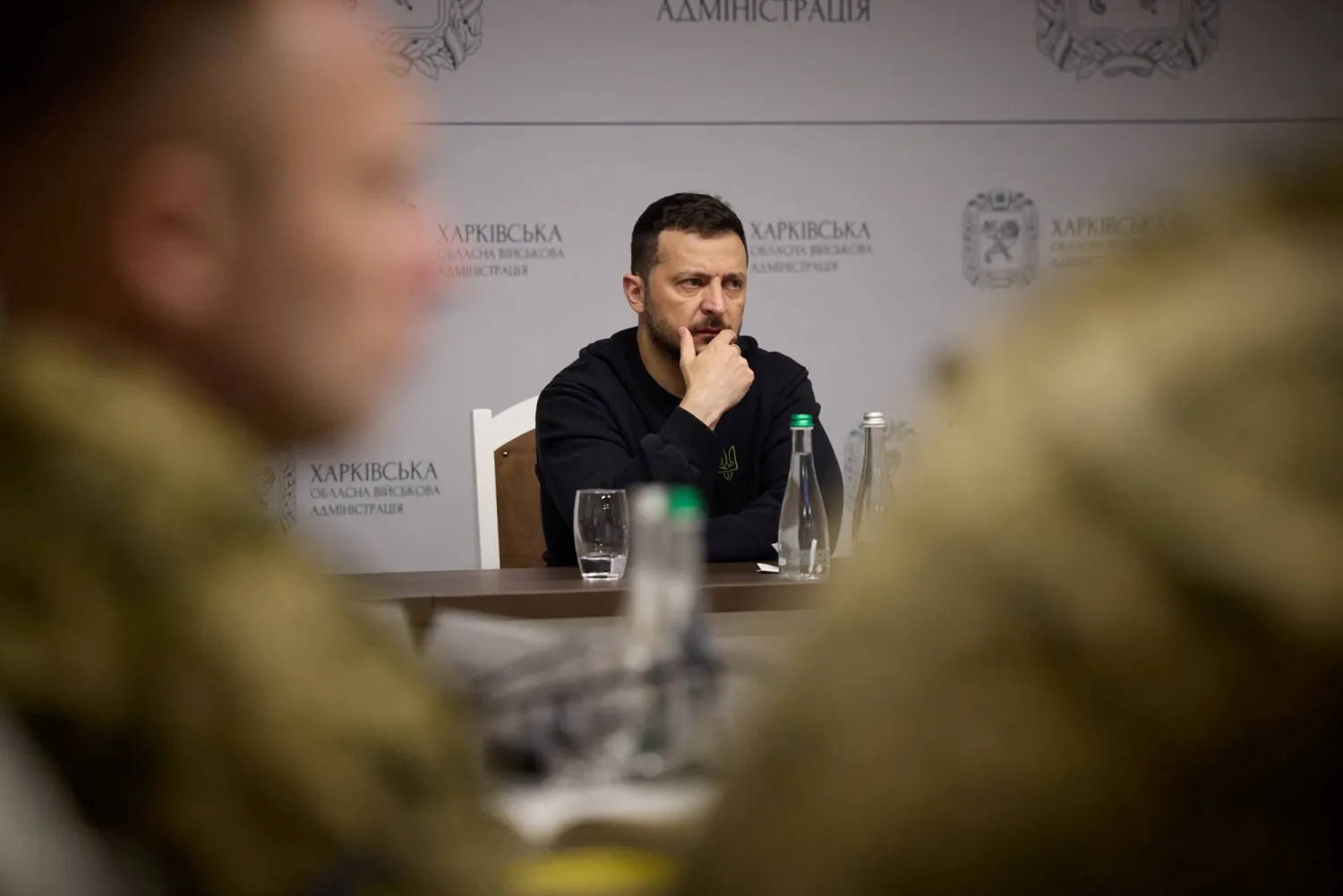
Ukraine's President Volodymyr Zelenskiy attends a meeting with top military officials as he visits Kharkiv region, amid Russia's attack on Ukraine May 16, 2024 in this handout image. Ukrainian Presidential Press Service/Handout via REUTERS
TT

Zelenskiy Visits Kharkiv Region as Russian Pressure Mounts in East

Ukraine's President Volodymyr Zelenskiy attends a meeting with top military officials as he visits Kharkiv region, amid Russia's attack on Ukraine May 16, 2024 in this handout image. Ukrainian Presidential Press Service/Handout via REUTERS

President Volodymyr Zelenskiy visited the northeastern city of Kharkiv on Thursday to boost morale and reinforce Ukraine's troops in the region where Russian forces are trying to press their new offensive beyond the border areas.
Moscow has made inroads of at least several kilometers into the north of Kharkiv region since Friday, forcing Kyiv's outmanned troops to try to hold the line on a new front as Russia mounts more pressure on the front in the east.
"The direction remains extremely difficult - we are strengthening our units," Zelenskiy said after holding a meeting in the city with his top commander and senior military leaders.
The Ukrainian leader, who has cancelled all his upcoming foreign trips as the battlefield situation deteriorates, met wounded soldiers recovering at a medical facility and posed for photographs with troops at another location, Reuters reported.
Apart from inflicting devastation on frontline settlements and dealing a blow to Kyiv's morale, Russia's Kharkiv push is a headache for Ukrainian war planners whose troops are already stretched over a more than 1,000 kilometer line.
Ukraine's military said late on Wednesday that its forces fighting near the town of Kupiansk were pulling back to more "advantageous positions". Kupiansk lies more than 85 km southeast of the city of Kharkiv.
In a statement on Thursday, the General Staff said Russia was directing its most intense assaults on the fronts near the cities of Pokrovsk and Kramatorsk in the eastern Donetsk region, where Russia's offensive has been unrelenting for months.
"Intensive combat action continues along nearly the whole front line. The occupiers are most active on the Kramatorsk and Pokrovsk fronts," it said in its battlefield readout.
Russian President Vladimir Putin said on Wednesday that Moscow's forces were improving their positions "every day" along the front in Ukraine in all directions and that the advance was going to plan.
UKRAINIAN DILEMMAS
After reporting fighting in the northern districts of the border town of Vovchansk, some 45 kms from the city of Kharkiv, the Ukrainian General Staff said its troops had launched a counterattack to hit back at the invaders.
Kyiv, whose shortages of manpower have been compounded by delays to Western arms supplies, has warned that Russia may be preparing for a big offensive in the coming weeks. It has flagged a Russian buildup of small units near its Sumy region.
Pasi Paroinen, an analyst with the Black Bird Group, told Reuters that Moscow's Kharkiv push looked aimed at drawing in Kyiv's limited reserves into battle before the main summer offensive begins.
"If Ukraine overcommits in Kharkiv and Sumy, they may preserve some territory there, perhaps prevent Kharkiv civilians from suffering artillery bombardments, perhaps even push back the enemy back to the border," he said.
"But it may cost them the war, if the reserves are not available to respond to crises during the Russian summer offensive."
Kharkiv, Ukraine's second largest city which is home to some 1.3 million people, has been pounded for months by airstrikes that defenders struggle to stop with depleted air defenses covering a city just 30 km from the border.
Russian forces have pressed two main thrusts into the region, including one towards Vovchansk, the town 5 km (3 miles) from the border and the other towards the village of Lyptsi, which lies about 17 km from the northern outskirts of Kharkiv.
"The enemy's plans to penetrate deeper into the town of Vovchansk and gain a foothold there were thwarted," the Ukrainian General Staff said in a statement.
Ukraine has scrambled to evacuate civilians from the town and other border areas and about 8,000 people have left their homes so far.
Ukrainian Interior Minister Ihor Klymenko accused Russian forces of killing a resident in Vovchansk who tried to escape on foot and refused to obey their orders.
Serhii Bolvinov, head of the investigative department of the regional police, said in televised comments that Russian troops taken up to 40 civilians captive.
Reuters was unable to immediately verify Klymenko or Bolvinov's claims.
Describing the situation in Vovchansk as under control, the Ukrainian military said its defensive actions had forced Russian troops to reduce the tempo of their push into the north of the region.
Russia says it has taken control of 12 villages since it launched its attack. Russia's defense ministry said on Thursday its forces had made deep advances into Ukraine's defenses and inflicted personnel and hardware losses near Vovchansk and Lyptsi.
Oleh Syniehubov, Kharkiv's regional governor, said Russian troops had struck a village near Vovchansk with cluster munitions, injuring six people.


Netanyahu Vows to Eliminate Iran Threat ‘Once and for All’

10 November 2026, Israel, Jerusalem: Caretaker Israeli Prime Minister Benjamin Netanyahu delivers a speech on the sidelines of the opening session of the new Knesset. (dpa)
TT

Netanyahu Vows to Eliminate Iran Threat ‘Once and for All’

10 November 2026, Israel, Jerusalem: Caretaker Israeli Prime Minister Benjamin Netanyahu delivers a speech on the sidelines of the opening session of the new Knesset. (dpa)

Israel's caretaker prime minister Benjamin Netanyahu on Saturday reiterated his calls for a national unity government with his opponent Gadi Eisenkot, as well as his vow to eliminate the threat from Iran.

A meeting with Eisenkot on Thursday "only strengthened the conviction that it is essential to form a national unity government" to guarantee Israel's security, Netanyahu said in a video statement, adding that such a government could "eliminate the Iranian threat once and for all".


Ukraine’s Zelenskiy Escalates Criticism of SpaceX Over Speed Caps

Ukraine's President Volodymyr Zelenskiy holds a press briefing in Copenhagen November 10, 2026. (AFP)
TT

Ukraine’s Zelenskiy Escalates Criticism of SpaceX Over Speed Caps

Ukraine's President Volodymyr Zelenskiy holds a press briefing in Copenhagen November 10, 2026. (AFP)

Ukraine's President Volodymyr Zelenskiy ‌escalated his criticism of SpaceX on Saturday, saying speed restrictions on its military-grade Starshield satellite terminals had dangerous political implications and undermined critical air defenses.

Zelenskiy said Starshield terminals operating in temporarily Russian-occupied territories of Ukraine had been limited to a maximum speed of 161 kph for the past five days, hampering Ukraine's military capabilities.

The Ukrainian Defense Ministry has raised the issue with SpaceX at the ‌institutional level, ‌Zelenskiy said.

"The restrictions have now ‌been ⁠in place for ⁠five days. They say it is some kind of technical issue. We do not believe that is the case," Zelenskiy told reporters in remarks released by his office on Saturday.

"If you impose restrictions there, you are already partially recognizing the temporarily ⁠occupied territories as not ours. And ‌that is why I ‌believe we have the right to raise this ‌issue and restore the speed – so that there ‌are no restrictions at all."

Zelenskiy said the speed restrictions made it more difficult for Ukrainian air defense units to intercept Russian jet-powered drones and made Ukrainian cities ‌more vulnerable. He said he had ordered his top military and foreign ministry ⁠officials ⁠to address the issue and seek clarification.

SpaceX has pushed back against the allegations, denying that it introduced new restrictions or made any changes to its satellite operations.

It is the second such outage in recent weeks. In mid-October, Ukrainian officials said that SpaceX limited the speed of Starlink and its Starshield communication systems to about 160 kph (100 mph) amid tensions with US President Donald Trump's administration over Ukrainian attacks on Russian oil refineries. Service was then restored on October 24.


UN Official Urges Iran, US to Let Fertilizers Through Hormuz Strait

Jorge Moreira da Silva, Executive Director of UNOPS (United Nations Office for Project Services), and coordinator of the UN Strait of Hormuz Task Force established by the UN Secretary-General, speaks during an interview with AFP on the sidelines of the 31st United Climate Change Conference (COP31), at the media center located on the Antalya Expo Center in Antalya on November 14, 2026. (AFP)
TT

UN Official Urges Iran, US to Let Fertilizers Through Hormuz Strait

Jorge Moreira da Silva, Executive Director of UNOPS (United Nations Office for Project Services), and coordinator of the UN Strait of Hormuz Task Force established by the UN Secretary-General, speaks during an interview with AFP on the sidelines of the 31st United Climate Change Conference (COP31), at the media center located on the Antalya Expo Center in Antalya on November 14, 2026. (AFP)

Iran and the United States should "immediately" allow fertilizer shipments through the Strait of Hormuz to ease the crisis in some of the most vulnerable countries, a senior UN official said Saturday.

Jorge Moreira da Silva, head of the UN Office for Project Services, told the COP31 climate talks in the Turkish resort city of Antalya that the lack of fertilizers could push millions into poverty.

The Iranian blockade of the vital waterway, which started after the joint US-Israeli attack against Iran in late February, has choked shipping in the region and beyond. The US blockade of Iranian ports has further complicated matters.

While Iran and the United States are still trying to negotiate an end to the conflict, Moreira da Silva said he had the same message for both countries.

"They should continue their negotiations about the comprehensive deal -- but that deal should not avoid an immediate, exceptional, limited, and time-bound solution for the fertilizers," he said.

"Basically, what we need is five vessels a day with fertilizers," he added.

- Millions at risk -

Moreira da Silva heads up the UN task force dedicated to facilitating the safe passage of fertilizers during the crisis.

Before the conflict, a third of the world's fertilizers passed through the Strait of Hormuz, and since the blockades, their prices had risen by 30 percent, he said.

"But what I think is not sufficiently recognized is the disproportionate impact on the most vulnerable countries," he added.

Sudan's finance minister recently told him that the price of food there had doubled in six months, he added. In Nepal, they had told him that farmers could no longer afford to buy fertilizers.

"So, it's very important that we are aware that countries such as Mozambique, Kenya, Sudan, Somalia, Nepal, Bangladesh, Sri Lanka are facing very significant impact."

The effects of this shortage could be catastrophic, he warned.

"If we continue missing the planting seasons in different parts of the world we may have 45 million people facing severe and acute food insecurity," he said.

"We may have 30 million people being forced into poverty."

The UN had a system ready to get fertilizer shipments moving within seven to 10 days, he said.