


Iran's President, Foreign Minister Die in Helicopter Crash

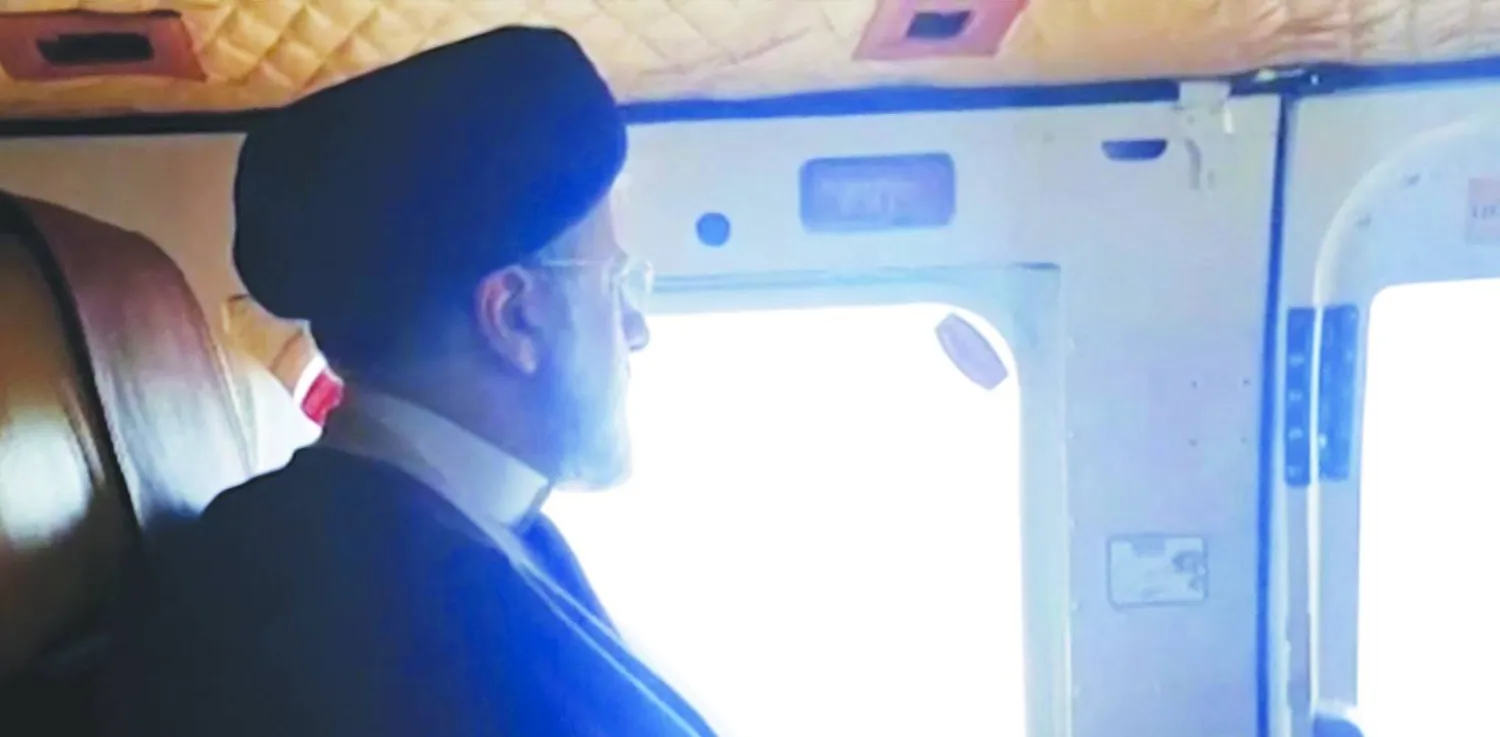
This grab taken from handout video footage released by the IRINN Iranian state television network on May 19, 2024 shows Iran's President Ebrahim Raisi on board a helicopter in the Jofa region of the western province of East Azerbaijan. (Photo by IRINN / AFP)
TT

Iran's President, Foreign Minister Die in Helicopter Crash

This grab taken from handout video footage released by the IRINN Iranian state television network on May 19, 2024 shows Iran's President Ebrahim Raisi on board a helicopter in the Jofa region of the western province of East Azerbaijan. (Photo by IRINN / AFP)

Iranian President Ebrahim Raisi, a hardliner seen as a potential successor to Supreme Leader Ali Khamenei, was killed when his helicopter crashed in poor weather in mountains near the Azerbaijan border, officials and state media said on Monday.

The charred wreckage of the helicopter which crashed on Sunday carrying Raisi, Foreign Minister Hossein Amir-Abdollahian and six other passengers and crew was found early on Monday after an overnight search in blizzard conditions.

Supreme Leader Khamenei, who holds ultimate power with a final say on foreign policy and Iran's nuclear program, said First Vice President Mohammad Mokhber, would take over as interim president, the official IRNA news agency reported.

"I announce five days of public mourning and offer my condolences to the dear people of Iran," Khamenei said in a statement. Mokhber, like Raisi, is seen as close to Khamenei.

The crash comes at a time of growing dissent within Iran over an array of political, social and economic crises. Iran's clerical rulers face international pressure over Tehran's disputed nuclear program and its deepening military ties with Russia during the war in Ukraine.

Since Iran's ally Hamas attacked Israel on Oct. 7, provoking Israel's assault on Gaza, conflagrations involving Iran-aligned groups have erupted throughout the Middle East.

A long "shadow war" between Iran and Israel broke into the open last month with tit-for-tat exchanges of drone and missile fire. An Israeli official, who requested anonymity, told Reuters it was not involved in the crash.

Under the country's constitution, a new presidential election must be held within 50 days.

Any candidate must first be vetted by the Guardian Council, a hardline watchdog that has often disqualified even prominent conservative and moderate officials, meaning the overall thrust of Iranian policy would be unlikely to change.

'ONE HARDLINER DIES, ANOTHER TAKES OVER'

Government loyalists packed into mosques and squares to pray for Raisi, but most shops remained open and the authorities made little effort to interrupt ordinary life.

"He was a hard working president. His legacy will endure as long as we are alive," said Mohammad Hossein Zarrabi, 28, a member of the volunteer Basij religious militia in the city of Qom.

But other Iranians showed little sorrow.

"Who cares. One hardliner dies, another takes over and our misery continues," said Reza, 47, a shopkeeper in the central desert city of Yazd who did not give his full name, fearing reprisals. "We're too busy with economic and social issues to worry about such news."

Footage from Iranian state television showed wreckage scattered on a foggy hillside, while separate images from IRNA showed Red Crescent workers carrying a covered body on a stretcher. All those aboard the helicopter were killed, a senior Iranian official had earlier told Reuters.

Deputy Foreign Minister Ali Bagheri Kani was appointed as acting foreign minister following the death of Amir-Abdollahian, IRNA said.

State media reported that images from the site showed the US-made Bell 212 helicopter slammed into a mountain peak, although there was no official word on the cause of the crash. The dead also included the governor of East Azerbaijan Province and a senior imam from Tabriz city.

Iran was a major buyer of Bell helicopters under the US-backed Shah before the 1979 revolution, though the exact origin of the aircraft that crashed was not clear. Decades of sanctions have made it hard for Iran to obtain parts or upgrade its aircraft.

The helicopter went down in Varzeqan region north of Tabriz, as Raisi returned from an official visit to the border with Azerbaijan, in Iran's northwest, to inaugurate the Qiz-Qalasi Dam, a joint project.

BLOODY CRACKDOWN

Since taking office, Raisi, 63, ordered a tightening of morality laws, oversaw a bloody crackdown on anti-government protests and pushed hard in nuclear talks with world powers.

In Iran's dual political system, split between the clerical establishment and the government, it is Raisi's 85-year-old mentor Khamenei, supreme leader since 1989, who holds decision-making power on all major policies.

Raisi's victory in a closely managed election in 2021 brought all branches of power under the control of hardliners, after eight years when the presidency had been held by pragmatist Hassan Rouhani and a nuclear deal negotiated with powers including Washington.

However, Raisi's standing may have been dented by the widespread protests against clerical rule following the death of 22-year-old Kurdish woman Mahsa Amini in morality police custody, and a failure to turn around Iran's economy, hamstrung by Western sanctions.

Though far from being a foregone conclusion in Iran's opaque politics, Raisi, a middle-ranking cleric, had been widely seen as a leading candidate to succeed Khamenei.

"There's no other candidate right now (with) that kind of a platform and that's why the presidential elections in Iran, however they unfold, will be the first decider about what comes next," said Vali Nasr, professor of Middle East Studies and International Affairs at John Hopkins School of Advanced International Studies.

MESSAGES OF CONDOLENCE

Messages of condolences flooded in from Iran's regional neighbors and allies, including the leaders of Saudi Arabia, Syria, Egypt, the United Arab Emirates, Qatar, Jordan, Iraq and Pakistan.

Russian President Vladimir Putin called Raisi "a true friend of Russia". The Kremlin said he had spoken to Mokhber by phone and both stressed "mutual intention to further strengthen Russian-Iranian interaction".

Indian Prime Minister Narendra Modi said he was "deeply shocked and saddened".

There was less reaction from Western capitals, though the European Union and Japan expressed condolences.

Iran-backed armed group Hamas, fighting Israeli forces in Gaza with Tehran's support, issued a statement expressing sympathy to the Iranian people for "this immense loss".

Lebanon's Iran-backed Hezbollah party and the Houthi militias in Yemen also issued statements praising Raisi.



Indonesia Says Proposed Gaza Peacekeeping Force Could Total 20,000 Troops

Israeli military vehicles drive past destruction in Gaza, as seen from the Israeli side of the Israel-Gaza border in southern Israel, January 21, 2026. REUTERS/Amir Cohen/File Photo
TT

Indonesia Says Proposed Gaza Peacekeeping Force Could Total 20,000 Troops

Israeli military vehicles drive past destruction in Gaza, as seen from the Israeli side of the Israel-Gaza border in southern Israel, January 21, 2026. REUTERS/Amir Cohen/File Photo

A proposed multinational peacekeeping force for Gaza could total about 20,000 troops, with Indonesia estimating it could contribute up to 8,000, President Prabowo Subianto’s spokesman said on Tuesday.

The spokesman said, however, that no deployment terms or areas of operation had been agreed.

Prabowo has been invited to Washington later this month for the first meeting of US President Donald Trump's Board of Peace. The Southeast Asian country last year committed to ready 20,000 troops for deployment for a Gaza peacekeeping force, but it has said it is awaiting more details about the force's mandate before confirming deployment.

"The total number is approximately 20,000 (across countries) ... it is not only Indonesia," presidential spokesman Prasetyo Hadi told journalists on Tuesday, adding that the exact number of troops had not been discussed yet but Indonesia estimated it could offer up to 8,000, Reuters reported.

"We are just preparing ourselves in case an agreement is reached and we have to send peacekeeping forces," he said.

Prasetyo also said there would be negotiations before Indonesia paid the $1 billion being asked for permanent membership of the Board of Peace. He did not clarify who the negotiations would be with, and said Indonesia had not yet confirmed Prabowo's attendance at the board meeting.

Separately, Indonesia's defense ministry also denied reports in Israeli media that the deployment of Indonesian troops would be in Gaza's Rafah and Khan Younis.

"Indonesia's plans to contribute to peace and humanitarian support in Gaza are still in the preparation and coordination stages," defence ministry spokesman Rico Ricardo Sirat told Reuters in a message.

"Operational matters (deployment location, number of personnel, schedule, mechanism) have not yet been finalised and will be announced once an official decision has been made and the necessary international mandate has been clarified," he added.


Iran Offers Clemency to over 2,000 Convicts, Excludes Protest-related Cases

FILE - In this photo obtained by The Associated Press, Iranians attend an anti-government protest in Tehran, Iran, Jan. 9, 2026. (UGC via AP, File)
TT

Iran Offers Clemency to over 2,000 Convicts, Excludes Protest-related Cases

FILE - In this photo obtained by The Associated Press, Iranians attend an anti-government protest in Tehran, Iran, Jan. 9, 2026. (UGC via AP, File)

Iran's supreme leader Ali Khamenei granted pardons or reduced sentences on Tuesday to more than 2,000 people, the judiciary said, adding that none of those involved in recent protests were on the list.

The decision comes ahead of the anniversary of the Iranian revolution, which along with other important occasions in Iran has traditionally seen the supreme leader sign off on similar pardons over the years.

"The leader of the Islamic revolution agreed to the request by the head of the judiciary to pardon or reduce or commute the sentences of 2,108 convicts," the judiciary's Mizan Online website said.

The list however does not include "the defendants and convicts from the recent riots", it said, quoting the judiciary's deputy chief Ali Mozaffari.

Protests against the rising cost of living broke out in Iran in late December before morphing into nationwide anti-government demonstrations that peaked on January 8 and 9.

Tehran has acknowledged that more than 3,000 people died during the unrest, including members of the security forces and innocent bystanders, and attributed the violence to "terrorist acts".

Iranian authorities said the protests began as peaceful demonstrations before turning into "foreign-instigated riots" involving killings and vandalism.

International organizations have put the toll far higher.

The US-based Human Rights Activists News Agency (HRANA) says it has verified 6,964 deaths, mostly protesters.


Macron Says Wants ‘European Approach’ in Dialogue with Putin

Russian President Vladimir Putin attends a meeting with Moscow Mayor Sergei Sobyanin at the Kremlin in Moscow, Russia February 9, 2026. (Sputnik/Vyacheslav Prokofyev/Pool via Reuters)
TT

Macron Says Wants ‘European Approach’ in Dialogue with Putin

Russian President Vladimir Putin attends a meeting with Moscow Mayor Sergei Sobyanin at the Kremlin in Moscow, Russia February 9, 2026. (Sputnik/Vyacheslav Prokofyev/Pool via Reuters)

French President Emmanuel Macron has said he wants to include European partners in a resumption of dialogue with Russian leader Vladimir Putin nearly four years after Moscow's invasion of Ukraine.

He spoke after dispatching a top adviser to Moscow last week, in the first such meeting since Russia launched its full-scale invasion of Ukraine in February 2022.

"What did I gain? Confirmation that Russia does not want peace right now," he said in an interview with several European newspapers including Germany's Suddeutsche Zeitung.

"But above all, we have rebuilt those channels of discussion at a technical level," he said in the interview released on Tuesday.

"My wish is to share this with my European partners and to have a well-organized European approach," he added.

Dialogue with Putin should take place without "too many interlocutors, with a given mandate", he said.

Macron said last year he believed Europe should reach back out to Putin, rather than leaving the United States alone to take the lead in negotiations to end Russia's war against Ukraine.

"Whether we like Russia or not, Russia will still be there tomorrow," Suddeutsche Zeitung quoted the French president as saying.

"It is therefore important that we structure the resumption of a European discussion with the Russians, without naivety, without putting pressure on the Ukrainians -- but also so as not to depend on third parties in this discussion."

After Macron sent his adviser Emmanuel Bonne to the Kremlin last week, Russia's Foreign Minister Sergei Lavrov on Thursday said Putin was ready to receive the French leader's call.

"If you want to call and discuss something seriously, then call," he said in an interview to state-run broadcaster RT.

The two presidents last spoke in July, in their first known phone talks in over two-and-a-half years.

The French leader tried in a series of phone calls in 2022 to warn Putin against invading Ukraine and travelled to Moscow early that year.

He kept up phone contact with Putin after the invasion but talks had ceased after a September 2022 phone call.