
Female White House Chef Duo Has Dished up Culinary Diplomacy at State Dinners for Nearly a Decade

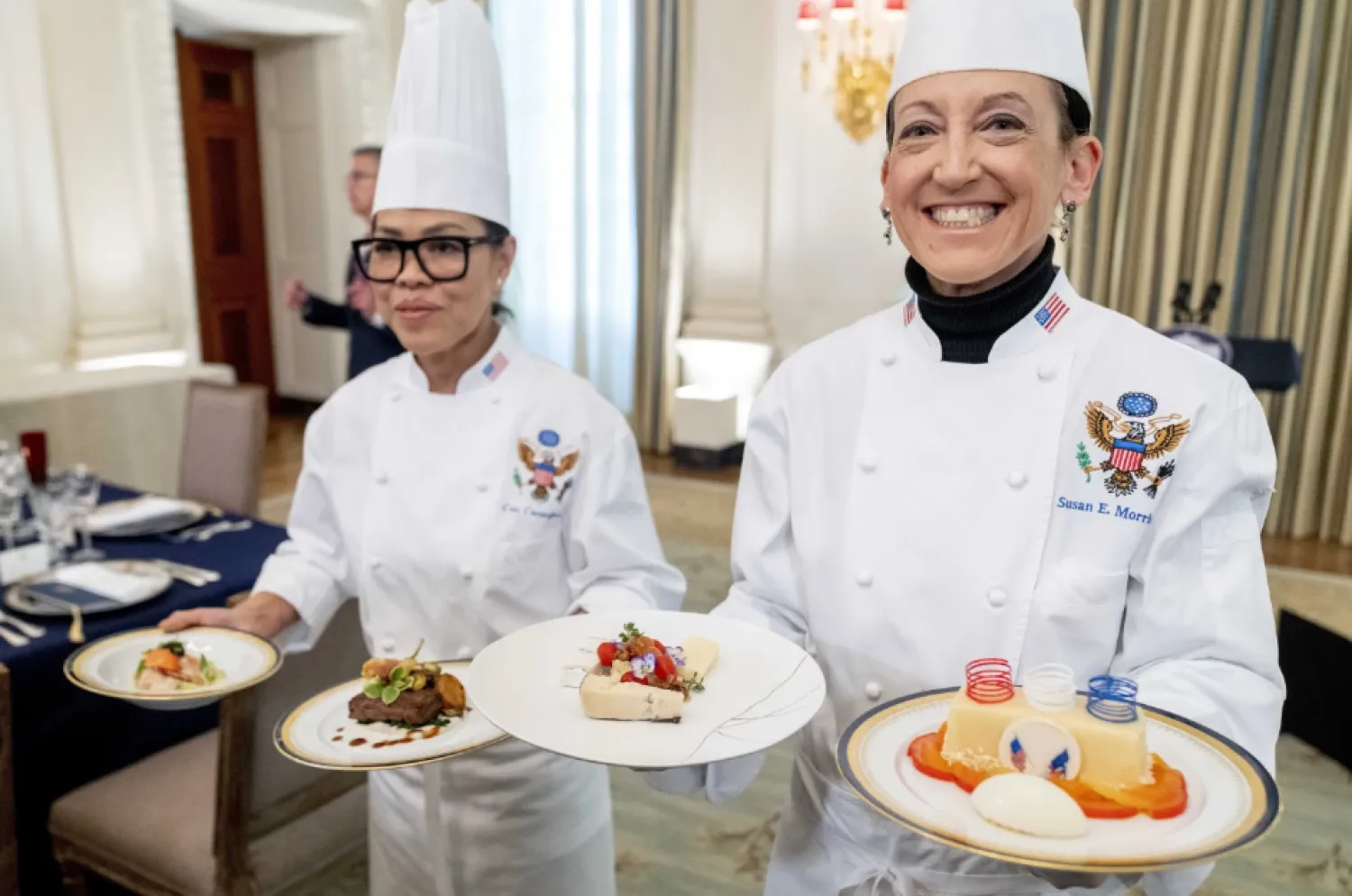
 Demale chef duo of Cris Comerford and Susie Morrison who take care of the culinary diplomacy at the White House - The AP
Demale chef duo of Cris Comerford and Susie Morrison who take care of the culinary diplomacy at the White House - The AP
TT

Female White House Chef Duo Has Dished up Culinary Diplomacy at State Dinners for Nearly a Decade

 Demale chef duo of Cris Comerford and Susie Morrison who take care of the culinary diplomacy at the White House - The AP
Demale chef duo of Cris Comerford and Susie Morrison who take care of the culinary diplomacy at the White House - The AP

A house-cured smoked salmon, red grapefruit, avocado and cucumber starter. Dry-aged rib eye beef in a sesame sabayon sauce. Salted caramel pistachio cake under a layer of matcha ganache.

While President Joe Biden and his guest of honor at a White House state dinner chew over foreign policy, the female chef duo of Cris Comerford and Susie Morrison take care of the culinary diplomacy. They pulled off the above menu for Japan's leader in April, and they'll have a new array of delicacies for Kenya's president on Thursday night.

Comerford, the White House executive chef, and Morrison, the executive pastry chef, are the first women to hold those posts, forming a duo that has tantalized the taste buds of guests at 1600 Pennsylvania Ave. with their culinary creations for nearly a decade. Comerford is also the first person of color to be executive chef.

“Both are just exceptional examples of success in their field,” said Bill Yosses, who was the executive pastry chef for seven years before his departure in 2014 cleared the way for Morrison to be promoted. “They excel at what they do.”

Comerford and Morrison get to do it again Thursday when Biden and his wife, first lady Jill Biden, host the administration's sixth state dinner, for Kenyan President William Ruto and his wife, Rachel. It will be the first such honor for an African head of state since 2008 and the first for Kenya since 2003.

A lavish state dinner is a tool of US diplomacy, a high honor reserved for America's longstanding and closest allies. In the case of Kenya, Biden wants to elevate a relationship that he sees as critical to security in Africa and far beyond.

Jill Biden planned to preview the dinner setup for the news media on Wednesday afternoon.

State dinner planning is done by the first lady's staff and the White House social office, and starts months in advance. Ideas are kicked around before the chefs propose a few different menus. The meals are prepared, plated as they would be served and tasted by the social secretary and the first lady, who makes the final call on what will be served.

The menus change, but the overarching goal has stayed the same, The AP reported.

“We're trying to showcase American food, American regions, American farmers,” while incorporating small tributes to the guest of honor, Yosses said. “It would be rare that we would really try to imitate something from the guest's country.”

Ingredients for April's state dinner for Japanese Prime Minister Fumio Kishida and his wife, Yuko, came from California, Maryland, Oregon and Ohio. The wines were from Oregon and Washington state.

At the media preview for that glitzy event, Comerford explained that the diets of the Bidens and the visiting dignitaries are factored into the preparations, along with those of other guests.

“When we formulate and we create the state dinner menu, we take into consideration all the principals and most of our guests,” she said. “We also take into consideration the season because this is the perfect time for some beautiful bounties right now, with the spring coming up, with all the morels and the mushrooms, and Susie's cherries and all the stuff she has on her plate.”

The chefs contact their regular purveyors to find out what's in season, and go from there.

The salmon appetizer served in April was inspired by the California roll, which Comerford said was invented by a Japanese chef.

Morrison's dessert highlighted Japan's gift of cherry trees to the United States, many of which are planted in Washington, and its matcha tea. She decorated the pistachio cake with sugary mini cherry blossoms.

“We wanted to bring a little bit of the cherry blossoms that are here on the Tidal Basin right here to our dessert in order for everyone to enjoy the cherry blossoms that we enjoy every year,” she said.

Serving dinner to hundreds of guests at once comes down to timing. Thursday's event will be held in an expansive pavilion put up on the South Grounds of the White House.

Sam Kass, who was an assistant chef during President Barack Obama's administration, said tradition holds that the president is the first one served and that plates are cleared away when he is finished eating.

“You have to have a service that is so efficient and quick to get those plates out so that the last table has a chance to eat,” he said.

Comerford, 61, sharpened her culinary skills while working at hotels in Chicago and restaurants in Washington before the White House brought her on in 1995 as an assistant chef. A naturalized US citizen and Filipino native, she was named executive chef in 2005. Her responsibilities include designing and executing menus for state dinners, social events, holiday functions, receptions and official luncheons.

Morrison, 57, started at the executive mansion as a contract pastry employee in 1995 while she was working at a hotel in northern Virginia. She was named an assistant pastry chef in 2002 and became the executive pastry chef in November 2014 — just in time to sweat over the details of that year's gingerbread White House for the holiday season.

The pair has worked together at the White House for nearly 30 years.

Yosses recalled at least one instance where the honoree's wishes dictated the menu selections.

In 2015, China's Xi Jinping wanted a very American menu, “which I think was a polite way for him to say that he didn't think we could do Chinese food very well," Yosses said.

The Chinese leader was served butter-poached Maine lobster and grilled Colorado lamb.



The Coming End of ISS, Symbol of An Era of Global Cooperation

The International Space Station will be guided back to Earth in 2030, marking the end of its three-decade mission. NASA / GETTY IMAGES NORTH AMERICA/AFP/File
TT

The Coming End of ISS, Symbol of An Era of Global Cooperation

The International Space Station will be guided back to Earth in 2030, marking the end of its three-decade mission. NASA / GETTY IMAGES NORTH AMERICA/AFP/File

When the International Space Station comes back to Earth in 2030, it will mark the end of three decades of peaceful international cooperation -- and an era when space became central to our daily lives.

Since November 2000, there have always been several humans on board the football field-sized scientific laboratory, whipping around the planet at eight kilometers per second.

With a new crew of astronauts set to blast off for the station as soon as next week, some of those who have helped the station from the ground are nostalgic about its looming demise.

"The ISS is a cathedral to human cooperation and collaboration across borders, languages and cultures," John Horack, the former manager of NASA's Science and Mission Systems Office, told AFP.

"For more than 25 years, we have had people in space, 24/7/365," added Horack, who now holds the Neil Armstrong Chair in aerospace policy at Ohio State University.

"It is a testament to how we can 'figure it out' rather than 'fight it out' when we wish to interact with each other."

The ISS was first proposed in the aftermath of the Cold War, illustrating a newfound spirit of cooperation between space race rivals Russia and the United States.

While many ties between Russia and the West have been severed over Moscow's war in Ukraine, cooperation has continued on board the space station.

"The history of human spaceflight is first and foremost the space race," Lionel Suchet of France's space agency CNES told AFP.

"This is a very interesting moment in the evolution of space exploration," said Suchet, who coordinated several early ISS projects after witnessing its predecessor, the Mir space station, de-orbiting in 2001.

Back to Earth

However, the ISS is getting old and its equipment is outdated.

NASA announced last year it had selected Elon Musk's SpaceX to build a vehicle that can push the station back into Earth's atmosphere in 2030, where it will break up.

"This large rocket engine will slow down the ISS, and enable it to have a precise re-entry over the Pacific Ocean, far from land, people or any other potential hazards," Horack explained.

Several spacecraft and telescopes -- including Mir -- have met a similar fate, splashing down at an isolated spot in the ocean called Point Nemo.

After 2030, the only space station orbiting Earth will be China's Tiangong.

For the future, the US is focusing more on space stations built and operated by private companies.

"We are moving into an era where space stations have a much more commercial dimension," similar to what has already happened with rockets and satellites, Horack said.

National space agencies would then need to pay these companies to stay on board.

Several companies, including Jeff Bezos's Blue Origin and Axiom Space, are already working on plans to build the first commercial space station.

Suchet emphasized that "the business model will still be largely institutional because countries are always interested in sending astronauts into low-Earth orbit".

Scientific research and exploration also remain an "objective of all humanity", he added, pointing to treaties that govern how nations are supposed to act in space.

Whether these treaties will hold once humans make it to the Moon -- the US and China both have plans to build lunar bases -- remains to be seen.

'Quite sad'

For Horack, the end of the ISS could be seen as "quite sad".

His children "had a lifetime of going out into the backyard to watch the ISS fly over".

But the end of this era will mark the opening of another, he added.

"We must grow as humans in our space-faring capacity, in our exploration of space, and in the use of space to generate social, economic, educational and quality of life outcomes for all people everywhere."

He finished by quoting the former head of the European Space Agency, Jean-Jacques Dordain: "If you want to go fast, go alone. If you want to go far, go together."


NASA's Juno finds Jupiter is a tiny bit smaller than previously thought

An enhanced-color image, using raw data from the JunoCam instrument aboard NASA's Juno spacecraft, shows the planet Jupiter, with a shadow of its moon Ganymede on the left, released by NASA on April 21, 2022. NASA/JPL-Caltech/SwRI/MSSS/Image processing by Thomas Thomopoulos/Handout via REUTERS
TT

NASA's Juno finds Jupiter is a tiny bit smaller than previously thought

An enhanced-color image, using raw data from the JunoCam instrument aboard NASA's Juno spacecraft, shows the planet Jupiter, with a shadow of its moon Ganymede on the left, released by NASA on April 21, 2022. NASA/JPL-Caltech/SwRI/MSSS/Image processing by Thomas Thomopoulos/Handout via REUTERS

Jupiter, without a doubt, is the biggest planet in our solar system. But it turns out that it is not quite as large - by ever so small an amount - as scientists had previously thought.

Using new data obtained by NASA's robotic Juno spacecraft, scientists have obtained the most precise measurements to date of Jupiter's size and shape. This is important information to gain a fuller understanding of this gas giant, including studying its complex interior structure.

The Juno observations showed that Jupiter has an equatorial diameter of 88,841 miles (142,976 km), which is about 5 miles (8 km) smaller than previous measurements had indicated. The observations also showed that Jupiter's diameter from north pole to south pole is 83,067 miles (133,684 km), about 15 miles (24 km) smaller than previously estimated, Reuters reported.

The planet, like our own, is not a perfect sphere, but rather a bit flattened - and, based on the new data, slightly more so than previously known. Jupiter is about 7% larger at the equator than at the poles. For comparison, Earth's equator is only 0.33% larger than its diameter at the poles.

The previous measurements of Jupiter were based on data gathered by NASA's Voyager and Pioneer robotic spacecraft in the late 1970s. Juno, launched in 2011, has been orbiting Jupiter since 2016, transmitting raw data back to Earth. NASA extended the Juno mission in 2021, giving scientists the opportunity to carry out the type of observations needed in order to fine-tune the measurements of its size and shape, including traveling behind Jupiter from Earth's point of view.

"When Juno passed behind Jupiter from Earth's perspective, its radio signal traveled through the planet's atmosphere before reaching Earth," said planetary scientist Eli Galanti of the Weizmann Institute of Science in Israel, lead author of the study published this week in the journal Nature Astronomy.

"Measuring how the signal changed due to Jupiter's atmospheric composition, density and temperature allowed us to probe the atmosphere and determine the planet's size and shape with high precision. Interestingly, this geometrical configuration did not occur during Juno's prime mission, so these experiments were not originally planned," Galanti said.

Earth, which is the third from the sun among the solar system's eight planets, is a relatively small rocky world.

Jupiter, fifth from the sun, is so immense that all the other planets could fit inside it, including more than 1,300 Earths. Jupiter is composed primarily of hydrogen and helium, with traces of other gases. Strong winds seen as stripes and a few storms dominate Jupiter's colorful outward appearance.

Juno has been collecting data about Jupiter's atmosphere, interior structure, internal magnetic field and magnetosphere, the region around the planet created by its internal magnetism.

Precise new measurements of Jupiter are helpful to scientists because its radius - a measure that is half its diameter - is a fundamental reference used in models of the planet's interior and its atmospheric structure.

"Jupiter is the largest planet in the solar system and contains most of its planetary mass, so understanding its composition and internal structure is central to understanding how the solar system formed and evolved. Jupiter likely formed early, and strongly influenced the distribution of material, the growth of other planets and the delivery of volatiles to the inner solar system, including Earth," Galanti said.

Volatiles are substances like water, carbon dioxide and ammonia that evaporate easily. The delivery of these to the inner solar system, where the four rocky planets reside, was essential because volatiles, Galanti said, "supplied Earth with water and key ingredients for its atmosphere and for life."


Saudi Media Forum Discusses State of Arab Media, Global Ambitions

Diplomats and media industry experts highlighted the key dimensions of “soft power.” (SPA)
TT

Saudi Media Forum Discusses State of Arab Media, Global Ambitions

Diplomats and media industry experts highlighted the key dimensions of “soft power.” (SPA)

Diplomats and media industry experts shed light on “soft power” and how it can be leveraged to build national reputations and shape public awareness of contemporary international issues, as the Saudi Media Forum hosted candid discussions on the reality of the Arab media sector and the requirements for elevating its global impact.

During the second day of the forum, held in Riyadh, participants offered frank assessments of the challenges facing Arab media and the steps needed for it to meet the demands of the current phase and extend its influence internationally.

Panels and workshops explored a wide range of topics, including the role of citizen journalism in shaping the news agenda, the challenges of keeping pace with digital infrastructure amid rapid content industry transformations, and the craft of producing high-quality journalistic storytelling in an era of technological abundance and fragmented content trends.

Confronting Fake News and Disinformation

A session titled “Diplomacy of Influence: Media and Image-Making” examined the role of media in shaping perceptions and enhancing states’ soft power, with the participation of several ambassadors accredited to Saudi Arabia.

Diaa Al-Din Bamakhrama, Djibouti’s Ambassador and Dean of the Diplomatic Corps in the Kingdom, said Saudi Arabia offers a prominent model of influence diplomacy through its hosting of international forums and its investment in culture and sports, particularly football, which has helped project Saudi presence across the globe.

“In an increasingly interconnected world that has become a small village, false and fabricated narratives fall quickly and cannot withstand the flow of information and facts,” Bamakhrama said, noting that digital media has made exposing falsehoods faster, and that only truthful narratives can build lasting trust with public opinion.

Spain’s Ambassador to the Kingdom Javier Carbajosa Sánchez stressed that the relationship between media and diplomacy is historic and has grown more complex and influential in the age of modern communications and social media.

Media, he said, has never been merely a transmitter, but an active and influential force, adding that political work cannot be separated from managing media presence.

For his part, Dr. Suhel Ajaz Khan, the Indian Ambassador to Saudi Arabia, said that image-building and perception management lie at the heart of public and cultural diplomacy.

He explained that delivering the right message to the right audience is the key to influence, with art and national cuisine among the most effective soft-power tools.

He added that cultural diplomacy relies on activating soft-power instruments such as arts, music, cinema, and cuisine to enhance human connection and build bridges between peoples.

In Saudi Arabia, he noted, the Indian community, alongside Indian cinema and food culture, plays a major role in shaping perceptions and strengthening partnerships—sometimes with an impact exceeding that of formal diplomatic efforts.

In confronting fake news and digital disinformation, Khan stressed the need for swift, honest, and direct diplomacy to present facts before rumors spread.

South African Ambassador Mogobo David Magabe highlighted mutual respect and dialogue as fundamental pillars of diplomacy, pointing out that the main challenges today are the spread of disinformation and the accelerated pace of modern media, which contrasts with diplomacy’s traditionally gradual, long-term relationship-building approach.

A Candid Look at Arab Media

In a separate dialogue session on the realities of Arab media and the requirements for expanding its global reach, Saudi journalist Jameel Altheyabi said local Arab media is largely inward-looking, driven by a mindset focused on domestic audiences with limited consideration for the global sphere.

He described Arab media as often emotional, with varying approaches to content and engagement across the region.

Writer and journalist Mamoun Fandy said that stories produced in the Arab world are viewed internationally through the lens of their origin and nature, as global audiences apply their own standards of credibility, accuracy, and sourcing.

He added that the Arab world can generate distinctive journalistic stories capable of shaping global discourse through exclusivity and originality, expressing regret that many official Arab institutions still prefer foreign outlets to convey their narratives to the world.