


Colombia’s Congress Votes to Ban Bullfights, Dealing a Blow to the Centuries-Old Tradition 

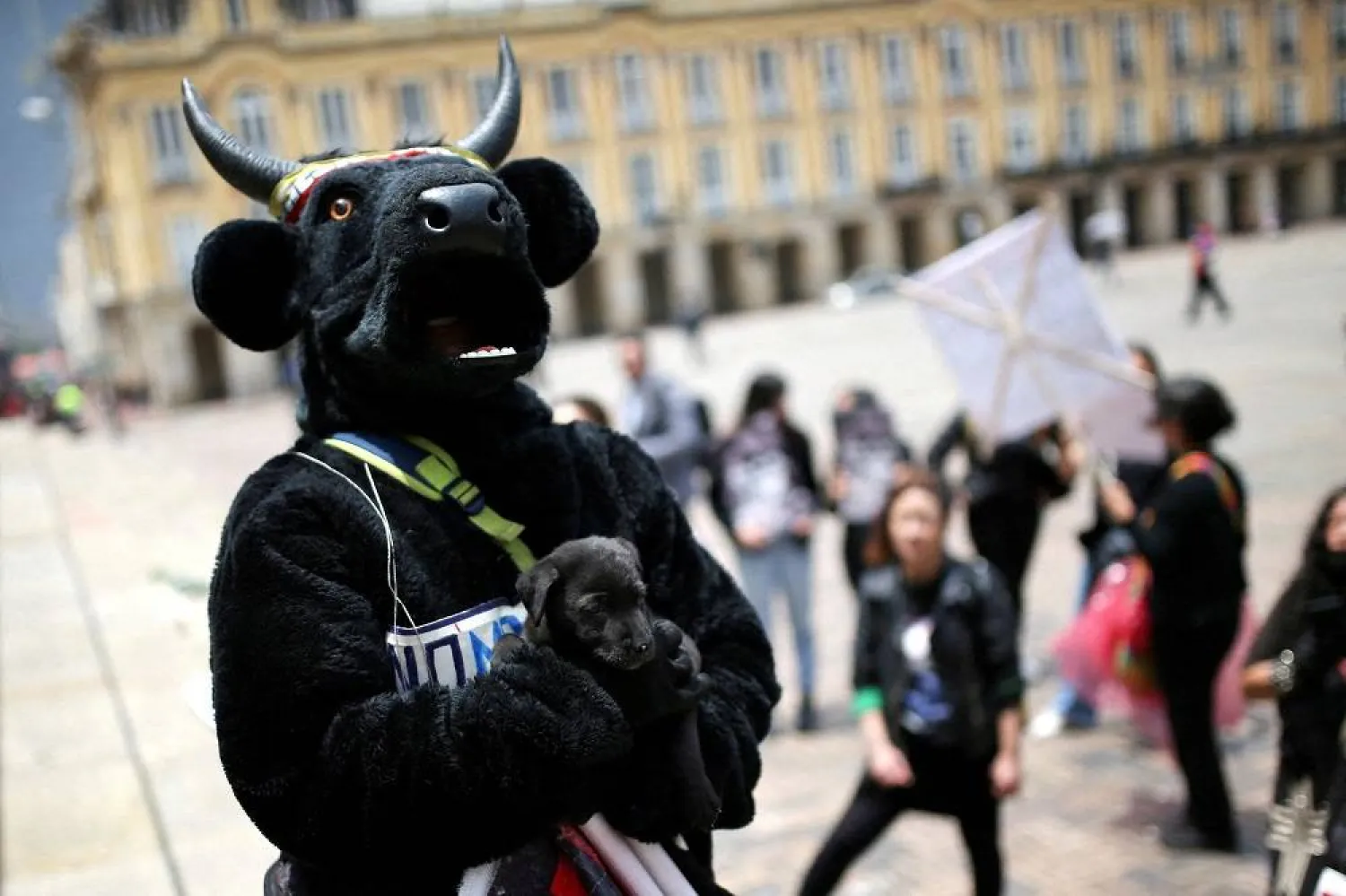
An animal rights activist holds a puppy while taking part in a demonstration demanding the approval of a law that prohibits bullfights, cockfights and events where animals are abused, in Bogota, Colombia, October 5, 2022. (Reuters)
TT

Colombia’s Congress Votes to Ban Bullfights, Dealing a Blow to the Centuries-Old Tradition 

An animal rights activist holds a puppy while taking part in a demonstration demanding the approval of a law that prohibits bullfights, cockfights and events where animals are abused, in Bogota, Colombia, October 5, 2022. (Reuters)

Colombia’s congress voted Tuesday to ban bullfights in the South American nation, delivering a serious blow to a centuries-old tradition that has inspired famous songs and novels but has become increasingly controversial in the countries where it is still practiced.

The bill calls for the banning of bullfights in a three-year span, making the tradition illegal by the start of 2028. The new law now needs to be signed by President Gustavo Petro, who has been a longtime opponent of these events.

Bullfighting originated in the Iberian Peninsula and is still legal in a handful of countries, including Spain, France, Portugal, Peru, Ecuador and Mexico.

It was once a popular event, broadcast live by multiple television networks. But the tradition has come under increased scrutiny as views change about animal welfare, and many find it unacceptable to see an animal suffer for entertainment's sake.

“This ban is a huge victory for organizations that have worked to transform society and reject violence against animals," said Terry Hurtado, an animal rights activist and city council member in Cali, who has been leading protests against bullfights since the 1990s. “I feel relieved that bulls and horses (which also participate in some bullfights) in Colombia will no longer be tortured, and that children will no longer be exposed to this spectacle.”

In bullfights, a matador faces bulls that are bred to be aggressive. The matador taunts the bull with a red cape and kills the animal with the blow of a sword after it has been injured with lances and daggers, and is tired of charging at the matador in a circular arena.

In Colombia, where bullfights have been held since colonial times, less than two dozen municipalities continue to hold these events, although the annual bullfights in the city of Manizales still draw tens of thousands of spectators.

Bullfighting aficionados described the ban as an assault on the freedoms of minorities as well as a problem for cities where these events draw thousands of visitors.


Riyadh Art Unveils Tuwaiq Sculpture 2026

The exhibition site on Tahlia Street was strategically chosen for its historical legacy of innovation to provide a conceptual framework for the works. SPA
TT

Riyadh Art Unveils Tuwaiq Sculpture 2026

The exhibition site on Tahlia Street was strategically chosen for its historical legacy of innovation to provide a conceptual framework for the works. SPA

The Royal Commission for Riyadh City, via its Riyadh Art program, has launched the Tuwaiq Sculpture 2026 exhibition on Prince Mohammed bin Abdulaziz Street (Tahlia).

Open to the public from February 9 to 22, the exhibition showcases 25 new artworks themed "Traces of What Will Be," exploring transformation and urban renewal.

The sculptures were crafted during a live phase from January 10 to February 5, during which artists from 18 countries used local stone and recycled metals, allowing the public to witness the creative process firsthand.

The exhibition site on Tahlia Street was strategically chosen for its historical legacy of innovation to provide a conceptual framework for the works.

Overseen by a panel of international experts, the exhibition serves as an interactive cultural platform featuring workshops and panel discussions to foster community engagement.

All 2026 pieces will join Riyadh Art's permanent collection, which has hosted over 170 artists since 2019 and already installed more than 60 sculptures across the city to integrate contemporary art into Riyadh's urban fabric.


Syrian Culture Minister Applauds Saudi Pavilion at Damascus Book Fair

The 2026 Damascus International Book Fair is held from February 6 to 16 - SPA
TT

Syrian Culture Minister Applauds Saudi Pavilion at Damascus Book Fair

The 2026 Damascus International Book Fair is held from February 6 to 16 - SPA

Syrian Minister of Culture Mohammed Yassin Saleh visited the Kingdom’s pavilion at the 2026 Damascus International Book Fair, held from February 6 to 16, where the Kingdom is serving as the Guest of Honor.

He commended the efforts of the Literature, Publishing and Translation Commission in showcasing the rich diversity of the Saudi cultural and literary scene. The pavilion features exhibitions of manuscripts, a Saudi fashion corner, and archaeological replicas, SPA reported.

The minister reviewed the commission's Tarjim translation initiative and Saudi literature comics.

This participation at the 2026 Damascus International Book Fair showcases Saudi creativity and fosters cultural dialogue, supporting Saudi Vision 2030’s goals of knowledge exchange and cultural leadership.


Saudi Arabia, Syria Underline Depth of their Cultural Ties

Syrian President al-Sharaa receives the Saudi minister of culture and the accompanying delegation at the Conference Palace in Damascus on Thursday. (SPA)
TT

Saudi Arabia, Syria Underline Depth of their Cultural Ties

Syrian President al-Sharaa receives the Saudi minister of culture and the accompanying delegation at the Conference Palace in Damascus on Thursday. (SPA)

Saudi Arabia and Syria underlined the strength of their cultural relationship during high-level meetings held in Damascus on Thursday, on the sidelines of the opening of the Damascus International Book Fair 2026, where the Kingdom is participating as guest of honor.

Syrian President Ahmad al-Sharaa received Saudi Minister of Culture Prince Badr bin Abdullah bin Farhan at the Conference Palace in the capital.

Earlier the same day, Prince Badr met with his Syrian counterpart, Minister of Culture Mohammad Yassin Saleh, during an official visit to attend the fair. T

he Saudi minister congratulated Syria on hosting the exhibition and expressed his wishes for continued prosperity, progress, and stability for the Syrian government and people.

Both meetings highlighted the depth of cultural relations between the two countries, the importance of expanding joint cultural cooperation across various fields, and the alignment of positions on issues of mutual interest in a way that serves both nations.

The Saudi delegation included senior officials and advisers, among them representatives from the Royal Court, the Ministry of Culture, and the King Abdulaziz Public Library, reflecting broad institutional engagement in the visit.

In the evening, Prince Badr attended the opening ceremony of the fair’s special session, held under the patronage and in the presence of al-Sharaa. The event drew wide official and cultural participation, including Arab ministers, political and intellectual figures, and a distinguished group of writers and cultural figures.

In a post on the X platform, Prince Badr thanked “our brothers in Syria for their generous hospitality and their efforts in organizing the Damascus International Book Fair.”

The minister also inaugurated the Kingdom’s pavilion at the fair in the presence of the Syrian minister of culture and the Qatari minister of culture.

Saudi Arabia’s guest-of-honor participation continues until Feb. 16 and reflects its growing prominence and leadership in the Arab and global cultural landscape.

This participation aligns with Saudi Vision 2030, which places culture at the heart of national development, viewing it as a space for dialogue, a bridge for civilizational communication, and a tool for strengthening ties among Arab peoples.

The Saudi Literature, Publishing and Translation Commission is leading the Kingdom’s participation, highlighting the development of the cultural sector and reaffirming the central role of books as carriers of knowledge and awareness.

The Saudi pavilion boasts a comprehensive cultural program featuring intellectual seminars, poetry evenings, a manuscript exhibition, traditional Saudi fashion displays, hospitality corners, archaeological replicas, and performing arts that express the depth of the Kingdom’s cultural heritage.

On the sidelines of the visit, Prince Badr, accompanied by Minister Saleh, toured the National Museum of Damascus, which houses rare artifacts spanning prehistoric eras, ancient Syrian civilizations, classical and Islamic periods, as well as traditional and modern art.