
Panama Prepares to Evacuate First Island in Face of Rising Sea Level

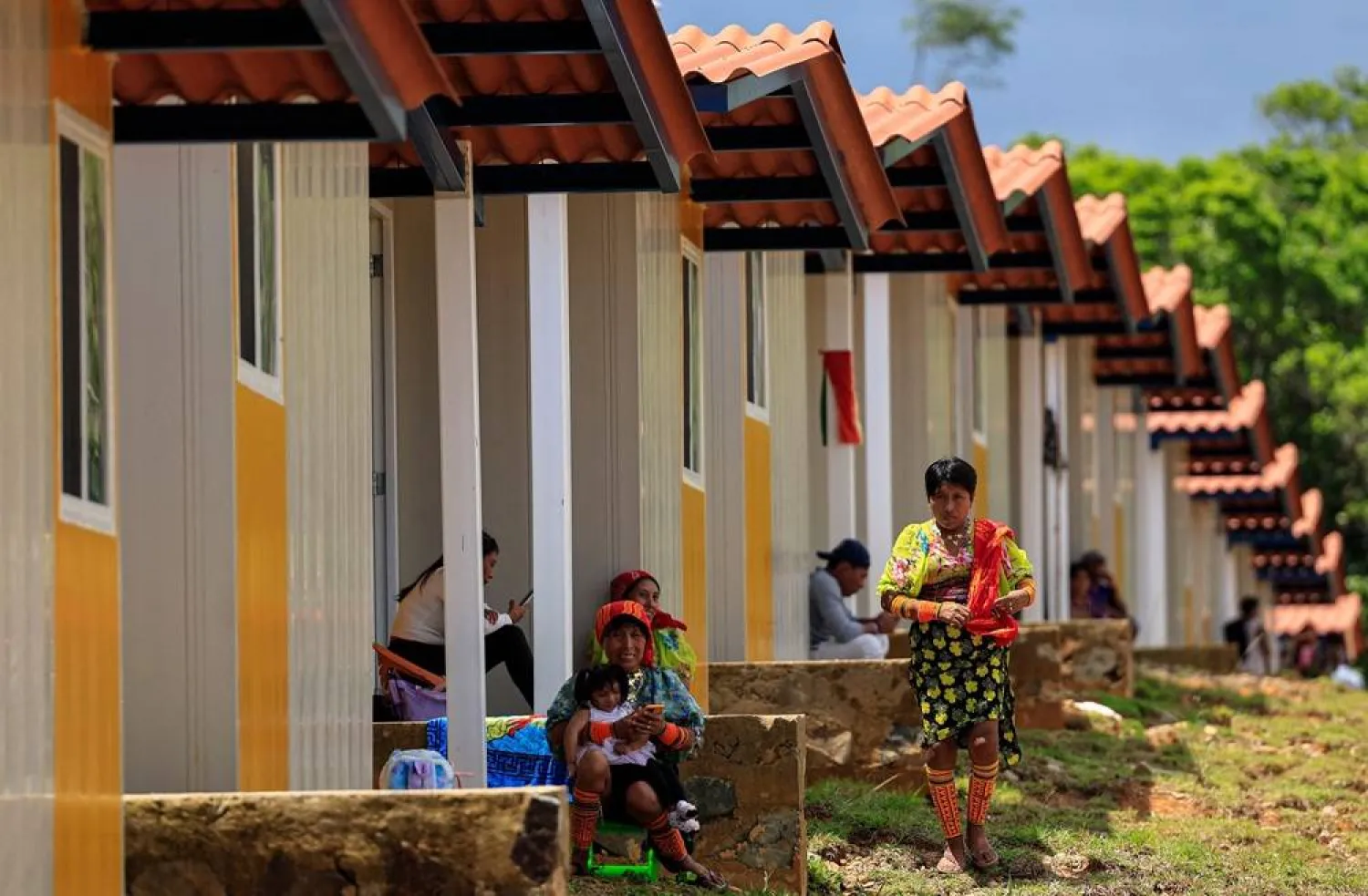
Indigenous Gunas sit outside their new homes in Nuevo Carti, Guna Yala Comarca, on the Caribbean coast in mainland Panama, on May 29, 2024. (AFP)
TT

Panama Prepares to Evacuate First Island in Face of Rising Sea Level

Indigenous Gunas sit outside their new homes in Nuevo Carti, Guna Yala Comarca, on the Caribbean coast in mainland Panama, on May 29, 2024. (AFP)

On a tiny island off Panama’s Caribbean coast, about 300 families are packing their belongings in preparation for a dramatic change. Generations of Gunas who have grown up on Gardi Sugdub in a life dedicated to the sea and tourism will trade that next week for the mainland’s solid ground.

They go voluntarily — sort of.

The Gunas of Gardi Sugdub are the first of 63 communities along Panama’s Caribbean and Pacific coasts that government officials and scientists expect to be forced to relocate by rising sea levels in the coming decades.

On a recent day, the island’s Indigenous residents rowed or sputtered off with outboard motors to fish. Children, some in uniforms and others in the colorful local textiles called "molas," chattered as they hustled through the warren of narrow dirt streets on their way to school.

"We’re a little sad, because we’re going to leave behind the homes we’ve known all our lives, the relationship with the sea, where we fish, where we bathe and where the tourists come, but the sea is sinking the island little by little," said Nadín Morales, 24, who prepared to move with her mother, uncle and boyfriend.

Gardi Sugdub is one of about 50 populated islands in the archipelago of the Guna Yala territory. It is only about 400 yards (366 meters) long and 150 yards (137 meters) wide. From above, it’s roughly a prickly oval surrounded by dozens of short docks where residents tie up their boats.

Every year, especially when the strong winds whip up the sea in November and December, water fills the streets and enters the homes. Climate change isn't only leading to a rise in sea levels, but it's also warming oceans and thereby powering stronger storms.

The Gunas have tried to reinforce the island’s edge with rocks, pilings and coral, but seawater keeps coming.

"Lately, I’ve seen that climate change has had a major impact," Morales said. "Now the tide comes to a level it didn’t before, and the heat is unbearable."

The Guna’s autonomous government decided two decades ago that they needed to think about leaving the island, but at that time it was because the island was getting too crowded. The effects of climate change accelerated that thinking, said Evelio López, a 61-year-old teacher on the island.

He plans to move with relatives to the new site on the mainland that the government developed at a cost of $12 million. The concrete houses sit on a grid of paved streets carved out of the lush tropical jungle just over a mile (2 kilometers) from the port, where an eight-minute boat ride carries them to Gardi Sugdub.

Leaving the island is "a great challenge, because more than 200 years of our culture is from the sea, so leaving this island means a lot of things," López said. "Leaving the sea, the economic activities that we have there on the island, and now we’re going to be on solid ground, in the forest. We’re going to see what the result is in the long run."

Steven Paton, director of the Smithsonian Institution’s physical monitoring program in Panama, said that the upcoming move "is a direct consequence of climate change through the increase in sea level."

"The islands on average are only a half-meter above sea level, and as that level rises, sooner or later the Gunas are going to have to abandon all of the islands almost surely by the end of the century or earlier."

"All of the world's coasts are being affected by this at different speeds," Paton said.

Residents of a small coastal community in Mexico moved inland last year after storms continued to take away their homes. Governments are being forced to take action, from the Italian lagoon city of Venice to the coastal communities of New Zealand.

A recent study by Panama’s Environmental Ministry’s Climate Change directorate, with support from universities in Panama and Spain, estimated that by 2050, Panama would lose about 2.01% of its coastal territory to increases in sea levels.

Panama estimates that it will cost about $1.2 billion to relocate the 38,000 or so inhabitants who will face rising sea levels in the short- and medium-term, said Ligia Castro, climate change director for the Environmental Ministry.

On Gardi Sugdub, women who make the elaborately embroidered molas worn by Guna women hang them outside their homes when finished, trying to catch the eye of visiting tourists.

The island and others along the coast have benefitted for years from year-round tourism.

Braucilio de la Ossa, the deputy secretary of Carti, the port facing Gardi Sugdub, said that he planned to move with his wife, daughter, sister-in-law and mother-in-law. Some of his wife’s relatives will stay on the island.

He said the biggest challenge for those moving would be the lifestyle change of moving from the sea inland even though the distance is relatively small.

"Now that they will be in the forest their way of living will be different," he said.


Olympic Tourists in Cortina Can Explore the Dolomites with the New ‘Uber Snowmobile’ Service

 The peaks of the Dolomites are seen from the Cortina Sliding Centre during the Milano Cortina 2026 Winter Olympic Games in Cortina d'Ampezzo on February 5, 2026. (AFP)
The peaks of the Dolomites are seen from the Cortina Sliding Centre during the Milano Cortina 2026 Winter Olympic Games in Cortina d'Ampezzo on February 5, 2026. (AFP)
TT

Olympic Tourists in Cortina Can Explore the Dolomites with the New ‘Uber Snowmobile’ Service

 The peaks of the Dolomites are seen from the Cortina Sliding Centre during the Milano Cortina 2026 Winter Olympic Games in Cortina d'Ampezzo on February 5, 2026. (AFP)
The peaks of the Dolomites are seen from the Cortina Sliding Centre during the Milano Cortina 2026 Winter Olympic Games in Cortina d'Ampezzo on February 5, 2026. (AFP)

The peaks of the Dolomites are seen from the Cortina Sliding Centre during the Milano Cortina 2026 Winter Olympic Games in Cortina d'Ampezzo on February 5, 2026. (AFP)

For one month starting on Saturday, Olympic spectators keen for a side trip to a UNESCO World Heritage Site can use Uber to reserve a ride on a snowmobile along the snow-covered road to the base of the Three Peaks of Lavaredo.

The dramatic, jagged limestone pinnacles stand just 23 kilometers (14.3 miles) from the Cortina venues where athletes are competing in the 2026 Winter Olympics and Paralympics.

One of the Olympic torchbearers, Giulia Baffetti, runs snowmobiling tours through Cortina-based winter activities outfit Snowdreamers. The company partnered with Uber, the official ride-hailing sponsor for the Games, to offer free tours on the weekends in February to people in town.

"Uber Snowmobile" tours, which can only be booked through Uber, include a ride in an Uber transfer bus for up to eight people from Cortina to the spot where riders mount their snowmobiles for departure. Tourgoers then follow the instructor, who leads the line of snowmobiles.

The first slots offered went fast, but Uber spokesperson Caspar Nixon said Friday that it planned to add more.

The three peaks are a magical place, Baffetti said, and this is a way for more people to experience it. Hikers and climbers flock there in the warmer months. In the winter, it’s a prime spot for cross-country skiing, snowshoeing and sledding. Snowmobiling is allowed in a limited area in order to protect the environment.

"We want to give an experience to the tourists, so they can feel the mountains in a different way," she said.

The Associated Press took the one-hour tour on Thursday, ahead of the Saturday launch, along with one other person. Helmets are essential, while heated handgrips are a most welcome feature. And that red button? Passengers can push it to stop the snowmobile if it veers off course or they feel unsafe.

The adrenaline-filled ride reaches speeds up to 40 kph (25 mph) when zooming past snow-covered trees, and drivers are instructed to slow when coming upon cross-country skiers and sledders. Deer and wolves are sometimes seen along the 7-kilometer (4.3-mile) route up to the base of the peaks.

Also visible on Thursday was the southernmost of the three Lavaredo peaks, rising sharply out of the fog. While the Dolomites are breathtaking from Cortina — and on Friday, the sun shone and the view was clear from town — they are even more impressive up close.

The route back includes a short loop around Lake Antorno. Before traversing all the ups and downs, the snowmobile instructor leading the tour offers a reminder about that red button.

Saher Deeb, an Israeli tourist, was along for the ride Thursday, one day after his 29th birthday. It was his first time on a snowmobile, and he was all smiles as he climbed off at the end.

"It was perfect," he said.


French Duo Finish Walking from France to Shanghai After 1.5 Years

 Performers throw molten iron to create sparks during a performance on the Bund promenade along the Huangpu river, ahead of the upcoming Lunar New Year of the Horse in Shanghai on February 2, 2026. (AFP)
Performers throw molten iron to create sparks during a performance on the Bund promenade along the Huangpu river, ahead of the upcoming Lunar New Year of the Horse in Shanghai on February 2, 2026. (AFP)
TT

French Duo Finish Walking from France to Shanghai After 1.5 Years

 Performers throw molten iron to create sparks during a performance on the Bund promenade along the Huangpu river, ahead of the upcoming Lunar New Year of the Horse in Shanghai on February 2, 2026. (AFP)
Performers throw molten iron to create sparks during a performance on the Bund promenade along the Huangpu river, ahead of the upcoming Lunar New Year of the Horse in Shanghai on February 2, 2026. (AFP)

Two French adventurers reached the end of an epic walk from France to Shanghai on Saturday, after nearly a year and a half crossing 16 countries almost entirely on foot.

Loic Voisot and Benjamin Humblot embraced as they stood by the river on the Bund promenade, the financial hub's distinctive skyline glittering in the background.

Voisot and Humblot set off from Annecy in September 2024.

"We were thinking about this moment almost every day for more than a year now, so it's a really strong feeling," Humblot said of reaching their destination.

Hanging out after work one day, the two friends realized they both yearned for a "great adventure".

They wanted to visit China -- but without flying, which they believe is too harmful to the environment.

A plan to set out on foot was hatched, and except for a stretch in Russia which was done by bus for safety reasons, 518 days and around 12,850 kilometers (7,980 miles) later they took the last steps to completing it.

Around 50 people gathered at the start point for the last 10km stretch of their odyssey, many local people who have been following them on social media.

Along the way their numbers swelled, as media, French residents of Shanghai and others joined.

"If your dreams are crazy, just take it step by step and sometimes you will not succeed, but sometimes you will," said Voisot.

Asked what he would do first now the walk was over, he joked: "Sleep a lot!"


Annual Orchids Show Brings Vivid Color to Chicago Winter

Orchids adorn a Volkswagen Beetle as finishing touches are placed on the 12th annual Chicago Botanic Garden Orchid Show, Friday, Feb. 6, 2026, in Glencoe, Ill. (AP)
TT

Annual Orchids Show Brings Vivid Color to Chicago Winter

Orchids adorn a Volkswagen Beetle as finishing touches are placed on the 12th annual Chicago Botanic Garden Orchid Show, Friday, Feb. 6, 2026, in Glencoe, Ill. (AP)

A soft layer of white snow blankets the grounds of the Chicago Botanic Garden. The air is chilly, the sky gray.

Inside, however, the air is warm and lights illuminate more than 10,000 vividly colored orchids. Staff members move in and out of greenhouses, preparing to open the garden’s 12th annual Orchid Show on Saturday.

This year’s theme is “Feelin’ Groovy" with several installations calling back to the 1970s, including a yellow Volkswagen Beetle filled with orchids.

“It’s just a really great way to get out of the winter cold and come into our greenhouses,” said Jodi Zombolo, associate vice president of visitor events and programs. “I think people are really looking for something to kind of bring happiness and something that they will enjoy and find whimsy in.”

The orchid family is one of the largest in the plant world and some of the species in the show are rare, exhibits horticulturist Jason Toth said. One example is the Angraecum sesquipedale, also known as Darwin’s orchid, on display in the west gallery.

Toth said the orchid led Darwin to correctly conclude that pollinators have adapted in order to reach down the flower's very long end.

"It has a great story and it’s quite remarkable-looking,” said Toth.

Elsewhere, massive, gnarly roots dangle from purple, pink and yellow Vanda orchids in the south greenhouse. These epiphytic orchids grow on the surface of trees instead of in soil.

“I think everyone’s tired of the winter,” said Toth. “So having some kind of flower show at this point is what we’re all craving. And 'Orchids' fits the bill.”

The show is expected to draw 85,000 visitors this year.