Boeing's 1st Astronaut Flight Called Off at Last Minute in Latest Setback

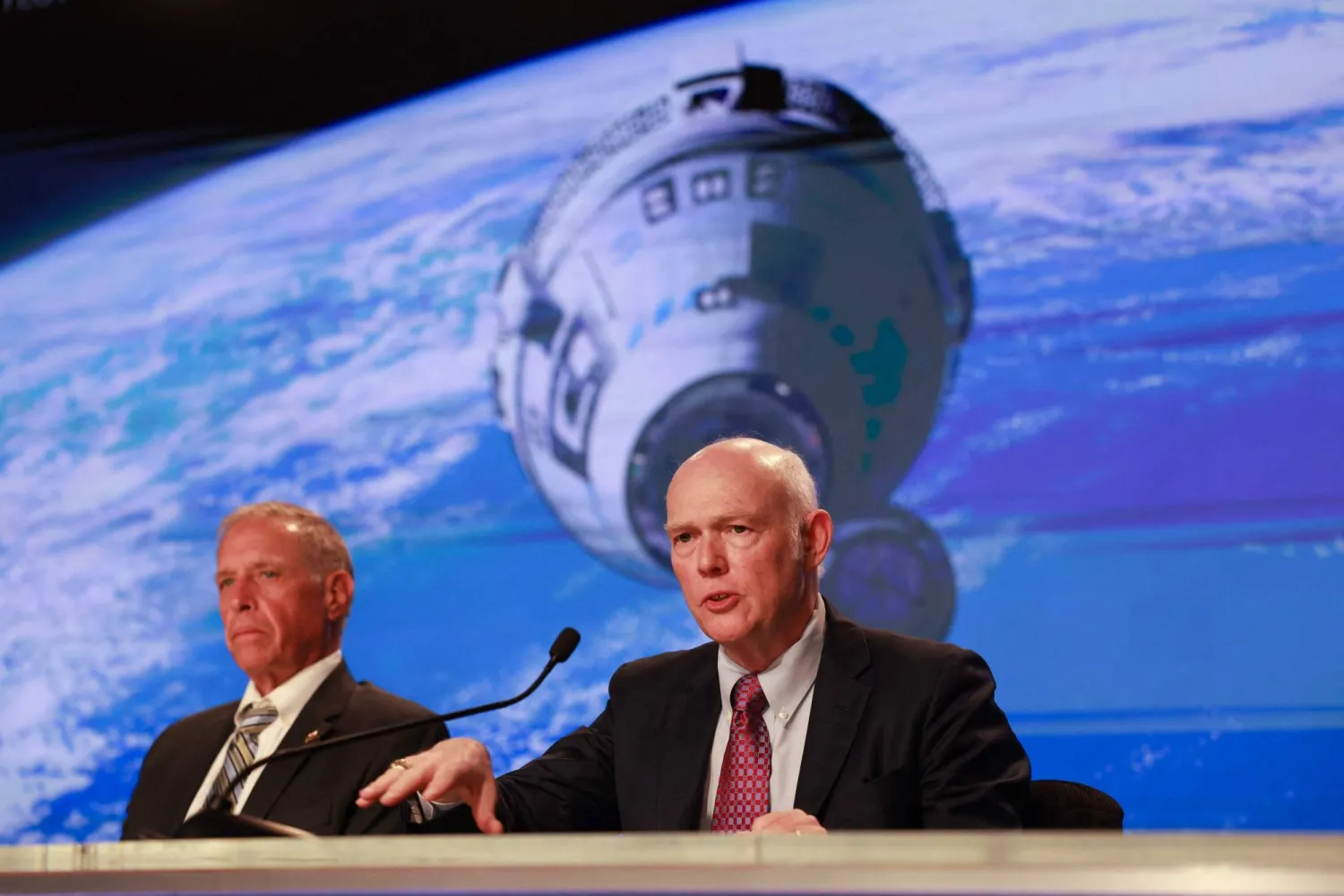
CAPE CANAVERAL, FLORIDA - JUNE 01: (L-R) Mark Nappi, vice president and program manager of Boeing's Commercial Crew Program, and Tory Bruno, the president and CEO for United Launch Alliance, hold a press conference after the launch of Boeing's Starliner spacecraft was scrubbed on June 01, 2024, in Cape Canaveral, Florida. Joe Raedle/Getty Images/AFP
TT

Boeing's 1st Astronaut Flight Called Off at Last Minute in Latest Setback

CAPE CANAVERAL, FLORIDA - JUNE 01: (L-R) Mark Nappi, vice president and program manager of Boeing's Commercial Crew Program, and Tory Bruno, the president and CEO for United Launch Alliance, hold a press conference after the launch of Boeing's Starliner spacecraft was scrubbed on June 01, 2024, in Cape Canaveral, Florida. Joe Raedle/Getty Images/AFP

Last-minute computer trouble nixed Saturday’s launch attempt for Boeing’s first astronaut flight, the latest in a string of delays over the years.
Two NASA astronauts were strapped in the company’s Starliner capsule when the countdown automatically was halted at 3 minutes and 50 seconds by the computer system that controls the final minutes before liftoff, The Associated Press reported.
With only a split second to take off, there was no time to work the latest problem and the launch was called off.
Technicians raced to the pad to help astronauts Butch Wilmore and Suni Williams out of the capsule atop the fully fueled Atlas V rocket at Cape Canaveral Space Force Station. Within an hour of the launch abort, the hatch was reopened.
The team can’t get to the computers to troubleshoot the problem until the rocket is drained of all its fuel, said Tory Bruno, CEO for the rocket maker, United Launch Alliance.
Bruno said one of the three redundant computers located near the rocket at the pad was sluggish. All three must work properly to proceed with a launch, he said.
Depending on what needs to be fixed, the next launch attempt could be as early as Wednesday. If it doesn't blast off this coming week, then that would be it until mid-June in order to move the rocket off the pad and replace batteries.
“This is the business that we're in,” Boeing's Mark Nappi said. “Everything's got to work perfectly.”
It was the second launch attempt. The first try on May 6 was delayed for leak checks and rocket repairs.
NASA wants a backup to SpaceX, which has been flying astronauts since 2020.
Boeing should have launched its first crew around the same time as SpaceX, but its first test flight with no one on board in 2019 was plagued by severe software issues and never made it to the space station.
A redo in 2022 fared better, but parachute problems and flammable later caused more delays. A small helium leak in the capsule's propulsion system last month came on top of a rocket valve issue.
More valve trouble cropped up two hours before Saturday's planned liftoff, but the team used a backup circuit to get the ground-equipment valves working to top off the fuel for the rocket's upper stage. Launch controllers were relieved to keep pushing ahead, but the computer system known as the ground launch sequencer ended the effort.
“Of course, this is emotionally disappointing,” NASA astronaut Mike Fincke, the backup pilot, said from neighboring Kennedy Space Center shortly after the countdown was halted.
But he said delays are part of spaceflight. “We're going to have a great launch in our future.”



Heavy Rains Drench Southern California, Spawn Flash Flooding, Mud Flows

 A car sits buried in mud after flooding Wednesday, Dec. 24, 2025, in Wrightwood, Calif. (AP)
A car sits buried in mud after flooding Wednesday, Dec. 24, 2025, in Wrightwood, Calif. (AP)
TT

Heavy Rains Drench Southern California, Spawn Flash Flooding, Mud Flows

 A car sits buried in mud after flooding Wednesday, Dec. 24, 2025, in Wrightwood, Calif. (AP)
A car sits buried in mud after flooding Wednesday, Dec. 24, 2025, in Wrightwood, Calif. (AP)

Torrential rains unleashed widespread flash flooding and mud flows across Southern California on Wednesday, as authorities warned motorists to stay off roads while urging residents in flood zones to evacuate or shelter in place.

In the rain-soaked mountain resort of Wrightwood, east of Los Angeles, emergency crews spent much of the day answering dozens of rescue calls and pulling drivers to safety from submerged vehicles, San Bernardino County Fire Department spokesperson Christopher Prater said.

No casualties were reported as ‌of Wednesday night, according ‌to Prater.

Aerial video footage posted online by the fire department ‌showed ⁠rivers of ‌mud coursing through inundated cabin neighborhoods.

Downpours measuring an inch (2.54 cm) or more of rain an hour in some areas were spawned by the region's latest atmospheric storm, a vast airborne current of dense moisture siphoned from the Pacific and swept inland over the greater Los Angeles area.

The Christmas Eve storm was expected to persist into Friday, posing unsafe driving conditions during what would normally be a busy holiday travel period, according to the US National Weather Service.

"Life-threatening" storm conditions ⁠were expected to persist through Christmas Day over Southern California, "where widespread flash flooding is underway," the weather service said.

A flash-flood ‌warning was posted across much of Los Angeles County until ‍6 p.m. PST, urging motorists: "Do not ‍attempt to travel unless you are fleeing an area, subject to flooding or under ‍an evacuation order."

Los Angeles city officials urged residents to heed evacuation orders issued for about 130 homes considered especially vulnerable to mudslides and debris flows in areas where last year's wildfires ravaged the community of Pacific Palisades.

The San Bernardino County Sheriff's Department issued an evacuation warning for Wrightwood earlier in the day, but elevated the advisory to a shelter-in-place order as flood conditions worsened. The Angeles Crest Highway, a major traffic route through the San ⁠Gabriel Mountains, was closed in two stretches due to flooding

Wednesday's heavy rainfall was accompanied by strong, gusty winds that officials said were downing trees and power lines. In upper elevations of the Sierra mountains, the storm was expected to dump heavy snow.

NWS meteorologist Ariel Cohen said 4 to 8 inches of rain had fallen in some foothill areas by 9 a.m. PST, and the Los Angeles City News Service reported numerous rockslides in the mountains. Forecasts called for more than a foot (30.48 cm) of rain falling over some lower-terrain mountain areas by week's end.

Forecasters even issued a rare tornado warning for a small portion of east-central Los Angeles County due to heavy thunderstorm activity over the community of Alhambra.

As of Wednesday night, ‌rainfall over the region had subsided, but a second wave of the storm system was due to hit on Thursday, forecasters said.


China's LandSpace Hopes to Complete Rocket Recovery in Mid-2026

Zhuque-3 rocket by China’s private rocket firm LandSpace, takes off from the Jiuquan Satellite Launch Center, China, December 3, 2025, in this screengrab taken from handout drone footage provided by LandSpace. LandSpace/Handout via REUTERS
TT

China's LandSpace Hopes to Complete Rocket Recovery in Mid-2026

Zhuque-3 rocket by China’s private rocket firm LandSpace, takes off from the Jiuquan Satellite Launch Center, China, December 3, 2025, in this screengrab taken from handout drone footage provided by LandSpace. LandSpace/Handout via REUTERS

Chinese rocket developer LandSpace plans to successfully recover a reusable booster in mid-2026, a company executive said in an interview, underscoring the Beijing-based firm's ambition to become China's answer to SpaceX.

The ability to return, recover, and reuse a rocket's engine-packed first stage, or booster, after launch is crucial to reducing costs and making it easier for countries to send satellites into orbit, and to turn space exploration into a commercially viable business similar to civil aviation, Reuters reported.

Earlier this month, privately-owned LandSpace ‌became the first ‌Chinese entity to conduct a full reusable rocket ‌test, when ⁠Zhuque-3 ​blasted off ‌from a remote area in northwest China for its maiden flight, drawing comparisons to US aerospace giant SpaceX.

SECOND ATTEMPT PLANNED

While LandSpace failed to complete the crucial final step of landing and recovering the rocket's engine-packed booster, it hopes to clear this challenge in mid-2026 with a second test flight, Zhuque-3 deputy chief designer Dong Kai told Chinese podcast Tech Early Know in an interview published on Tuesday.

"If the second flight's recovery (stage) succeeds, we ⁠plan that on the fourth flight we will use a reused first stage to launch," Dong said.

So far, ‌the only company that has mastered reusable rocket technology is ‍SpaceX, founded by the world's richest ‍person Elon Musk. SpaceX's Falcon 9 launches around 150 times a year, or roughly ‍three times per week, with its booster reused dozens of times if necessary.

Musk said in October that LandSpace's Zhuque-3 design could allow it to beat the Falcon 9, but went on to state that the Chinese challenger's launch cadence would take more than five years to ​reach that of SpaceX's workhorse model, at which point the US firm would have transitioned to its heavier, new-generation model Starship and "doing over ⁠100 times the annual payload to orbit of Falcon".

INITIAL PUBLIC OFFERING

LandSpace's Dong said that, while the company was already building an engine for a future Starship-like model, he was not optimistic that in five years Falcon 9's work rate could be surpassed, noting that all rocket models in China combined this year totalled only around 100 launches.

"It's very difficult for a single company to reach that kind of frequency. It requires the support of an entire ecosystem," Dong said, adding that LandSpace had 10 launches planned next year for all its models.

Other executives have previously said that the financial cost of a high-frequency testing and launch regimen was crucial to SpaceX's success, and that LandSpace's only ‌hope of amassing enough funds to sustain a similar programme would be by tapping China's capital markets, pointing to plans for an initial public offering next year.


Russia Plans a Nuclear Power Plant on the Moon within a Decade

November's full moon, also known as Beaver Moon, rises over Fort-de-France in the French overseas island of Martinique, on November 5, 2025. (AFP)
TT

Russia Plans a Nuclear Power Plant on the Moon within a Decade

November's full moon, also known as Beaver Moon, rises over Fort-de-France in the French overseas island of Martinique, on November 5, 2025. (AFP)

Russia plans to put ​a nuclear power plant on the moon in the next decade to supply its lunar space program and a joint Russian-Chinese research station as major powers rush to explore the earth's only natural satellite.

Ever since Soviet cosmonaut Yuri Gagarin became the first human to go into space in 1961, Russia has prided itself as ‌a leading power in ‌space exploration, but in recent ‌decades ⁠it ​has fallen ‌behind the United States and increasingly China.

Russia's ambitions suffered a massive blow in August 2023 when its unmanned Luna-25 mission smashed into the surface of the moon while attempting to land, and Elon Musk has revolutionized the launch of space vehicles - once a Russian specialty.

Russia's state space corporation, Roscosmos, ⁠said in a statement that it planned to build a lunar power ‌plant by 2036 and signed a contract ‍with the Lavochkin Association ‍aerospace company to do it.

Roscosmos said the purpose of ‍the plant was to power Russia's lunar program, including rovers, an observatory and the infrastructure of the joint Russian-Chinese International Lunar Research Station.

"The project is an important step towards the creation of ​a permanently functioning scientific lunar station and the transition from one-time missions to a long-term lunar exploration program," ⁠Roscosmos said.

Roscosmos did not say explicitly that the plant would be nuclear but it said the participants included Russian state nuclear corporation Rosatom and the Kurchatov Institute, Russia's leading nuclear research institute.

The head of Roscosmos, Dmitry Bakanov, said in June that one of the corporation's aims was to put a nuclear power plant on the moon and to explore Venus, known as earth's "sister" planet.

The moon, which is 384,400 km (238,855 miles) from our planet, moderates the earth's wobble ‌on its axis, which ensures a more stable climate. It also causes tides in the world's oceans.