Qatar Says Current Gaza Ceasefire Proposal Is Closer in Positions of Both Sideshttps://english.aawsat.com/arab-world/5027665-qatar-says-current-gaza-ceasefire-proposal-closer-positions-both-sides
Qatar Says Current Gaza Ceasefire Proposal Is Closer in Positions of Both Sides
Hana Abdelrahaman al-Rai, a four-year-old child suffering from malnutrition and displaced from Gaza City's eastern suburb of Shujaiya, reacts as she is carried inside a tent in Zawayda in the central Gaza Strip on June 4, 2024. (AFP)
TT
TT
Qatar Says Current Gaza Ceasefire Proposal Is Closer in Positions of Both Sides
Hana Abdelrahaman al-Rai, a four-year-old child suffering from malnutrition and displaced from Gaza City's eastern suburb of Shujaiya, reacts as she is carried inside a tent in Zawayda in the central Gaza Strip on June 4, 2024. (AFP)
Qatar said on Tuesday it delivered an Israeli proposal to Hamas that reflected the positions stated by US President Joe Biden, adding that the paper was now much closer to the positions of both sides.
Qatar, which has been mediating on Gaza between Israel and Hamas, also stressed that there should be a clear position from both parties to reach a ceasefire deal, its foreign ministry spokesperson said in a press briefing.
"We are waiting for a clear Israeli position that represents the entire government in response to the US's Gaza proposal," Majed Al-Ansari added.
Biden on Friday laid out a three-phase ceasefire proposal from Israel to Palestinian group Hamas to end the war in Gaza that has killed tens of thousands and caused a humanitarian crisis.
The offer calls for a ceasefire, the release of Israeli hostages and Palestinian prisoners, and the reconstruction of Gaza.
"The ceasefire deal should immediately end the long suffering of all people in Gaza and the hostages and their families and provide a roadmap for a permanent ceasefire and an end to the crisis", al-Ansari said.
Qatar said that it was still waiting to reach language that was agreed by both parties.
"We are now using our best efforts to finalize an agreement," al-Ansari added.
Israeli Reports Heighten Lebanese Fears of Another Warhttps://english.aawsat.com/arab-world/5336539-israeli-reports-heighten-lebanese-fears-another-war
Israeli Reports Heighten Lebanese Fears of Another War
Israeli heavy machinery bulldozes houses in Mansouri, as seen from Hinniyeh, Southern Lebanon, September 19, 2026. (Reuters)
Israeli reports of military preparations for a possible offensive in South Lebanon have heightened fears among Lebanese officials and residents of another war, amid continuing Israeli attacks, mounting domestic political tensions and uncertainty over Hezbollah’s response to any renewed regional confrontation.
Lebanon faces the prospect of a third war, with concerns that Hezbollah could once again draw the country into a conflict in support of Iran, as it has done in the past.
Israel’s Maariv newspaper reported that the Israeli military was preparing for the possible occupation of three major cities in South Lebanon - Tyre, Sidon and Nabatieh - if war with Iran resumes and Hezbollah joins the fighting.
Israeli assessments believe that Tehran could activate several fronts simultaneously, including Lebanon, it said.
Tel Aviv was taking the possibility of Hezbollah’s involvement seriously, despite assessing the group’s military capabilities as weakened, and was preparing to deploy “extremely heavy firepower,” it added.
The scenarios outlined by Maariv include intensified strikes across large parts of Beirut’s southern suburbs, a naval blockade of the ports of Beirut and Tripoli, and attacks on coastal cities followed by possible ground advances.
Lebanese concerns
Lebanese ministerial sources expressed alarm over the reports, warning that another Israeli offensive could not be ruled out.
“There is no doubt that the situation is worrying. We cannot exclude the possibility of Israel launching another war against Lebanon, particularly if Hezbollah fails to honor its promise, as it has done before, and once again enters the conflict,” the sources told Asharq Al-Awsat.
“Israeli threats are nothing new. Officials in Tel Aviv have repeated them many times, placing us before a genuine danger. Unfortunately, we may reach the point where the plans being discussed in the media are carried out,” they added.
Riad Kahwaji, a researcher specializing in security and defense affairs, said the Maariv report should be taken seriously.
“The threat clearly concerns the entire South, without distinguishing between areas north and south of the Litani River. It extends to the occupation of all of South Lebanon and, inevitably, parts of the western Bekaa if Hezbollah decides to join the fight,” he told Asharq Al-Awsat.
Kahwaji noted that Israel was already preparing for such an operation because it expects Hezbollah to intervene. “Israel fully understands that Hezbollah will enter the confrontation and is preparing for an operation of this kind,” he said.
“Hezbollah has not disappointed the Israelis so far, particularly Benjamin Netanyahu and his government. Each time, it acts as the other side expects, allowing Israel to expand the territory under its occupation,” he remarked.
He warned that any subsequent Israeli withdrawal would take place on Israel’s terms, leaving Lebanon to accept the conditions imposed.
Kahwaji urged the Lebanese government to accelerate efforts to bring all weapons under state control and called on Shiite community leaders to take a decisive position on Hezbollah and its arsenal.
“This threat must serve as an incentive for the Lebanese government to speed up its work and become more active on the issue of bringing weapons under state control,” he noted. “We cannot ignore this threat and wait for disaster to strike again.”
Looking ahead, Kahwaji predicted that another war appeared inevitable after the US elections, citing remarks Saturday by Iranian supreme leader Mojtaba Khamenei reaffirming the unity of regional fronts.
His statement contradicted reports that Hezbollah would stay out of any future confrontation, added Kahwaji.
Al-Rahi calls for Lebanon to stay out of regional conflicts
Amid growing fears of a third war, Lebanese figures have renewed calls to keep the country out of regional confrontations.
Maronite Patriarch Beshara al-Rahi stressed during Sunday Mass that preventing Lebanon from being dragged into another war had become a major national responsibility.
He warned that the Lebanese people could not withstand another conflict and insisted that decisions on war and peace must rest with the state rather than multiple competing authorities.
Al-Rahi also reiterated the need to place weapons exclusively under the control of the state and its legitimate institutions.
The warnings come as Israeli attacks continue across South Lebanon, maintaining military pressure despite concerns over a wider escalation.
Social Affairs Minister Haneen Sayed visited the town of Froun in the Bint Jbeil district to inaugurate a center and hand over several prefabricated housing units intended to shelter displaced families.
While delivering remarks at the inauguration ceremony, Israeli warplanes struck the town of Qoussair with two missiles. Sayed interrupted her speech upon hearing the explosion and recorded the strike on her phone before resuming her address.
She stressed the importance of supporting displaced people, strengthening humanitarian and social assistance, and providing shelters and essential supplies to affected families.
Israeli artillery also shelled the outskirts of Aita al-Jabal, the Baraashit-Kounine area and Bani Hayyan.
Al-Zaidi’s Regional Visits Aim to Reshape Iraq’s Foreign Relationshttps://english.aawsat.com/arab-world/5336531-al-zaidi%E2%80%99s-regional-visits-aim-reshape-iraq%E2%80%99s-foreign-relations
Al-Zaidi’s Regional Visits Aim to Reshape Iraq’s Foreign Relations
Iraqi Prime Minister Ali Al-Zaidi at the headquarters of the Iraqi Intelligence Service on October 29, 2026. (INA)
Iraqi Prime Minister Ali al-Zaidi is preparing to visit Kuwait and Bahrain this week as part of a diplomatic drive to reshape relations with neighboring countries, following trips to Saudi Arabia, Jordan, Syria, Türkiye and Iran, according to a government source.
Political assessments in Baghdad suggest his visits to Saudi Arabia and Jordan were aimed at building trust with both countries’ leaders following a series of attacks by armed factions operating in Iraq.
Al-Zaidi offered assurances that such attacks would not happen again, as efforts to bring weapons under state control continue despite opposition from some factions and attempts to delay implementation. The process is expected to be completed by June 2027.
In Türkiye, talks focused on the transit of Iraqi oil through the port of Ceyhan, the Development Road project and longstanding water disputes.
Old disputes and new prospects
As political circles await the upcoming Gulf visits, reports indicate that longstanding disputes between Baghdad and Kuwait will dominate one set of talks, while minority issues will feature on the Bahrain agenda.
An informed source told reporters that discussions would address maritime border demarcation, the Mubarak al-Kabeer Port project and its impact on Iraq’s Grand Faw Port, alongside security concerns and regional stability.
The source added that the Bahrain visit would focus on de-escalation to maintain security in the region, noting that Al-Zaidi had previously discussed the agenda for both trips with leaders of Iraq’s Coordination Framework alliance.
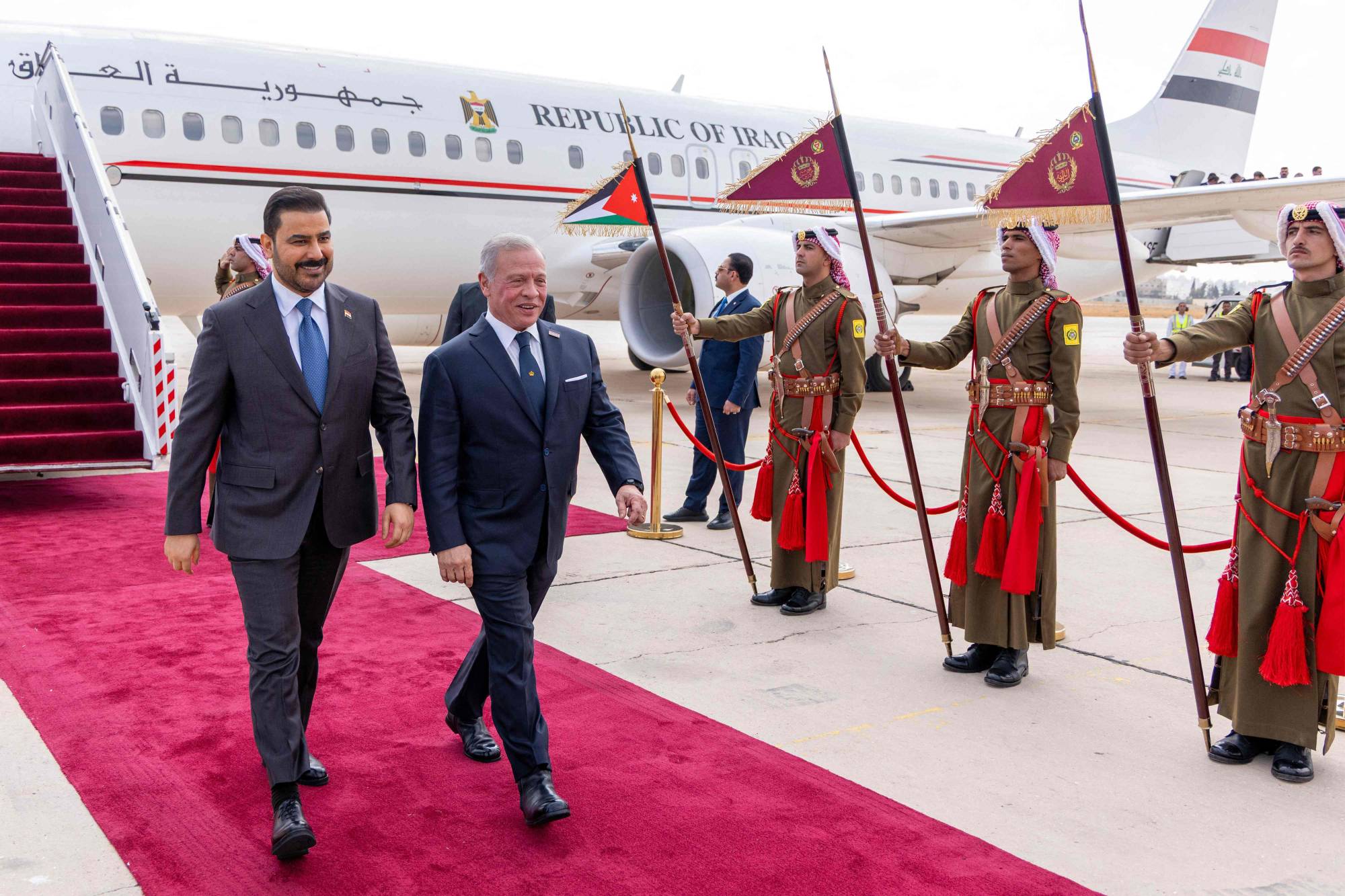
The prime minister’s recent diplomatic engagements included a July 28, 2026, visit to Türkiye, where he met President Recep Tayyip Erdogan, followed by talks with Prince Mohammed bin Salman, Saudi Crown Prince and Prime Minister, on October 14 and Jordan’s King Abdullah II on October 26.
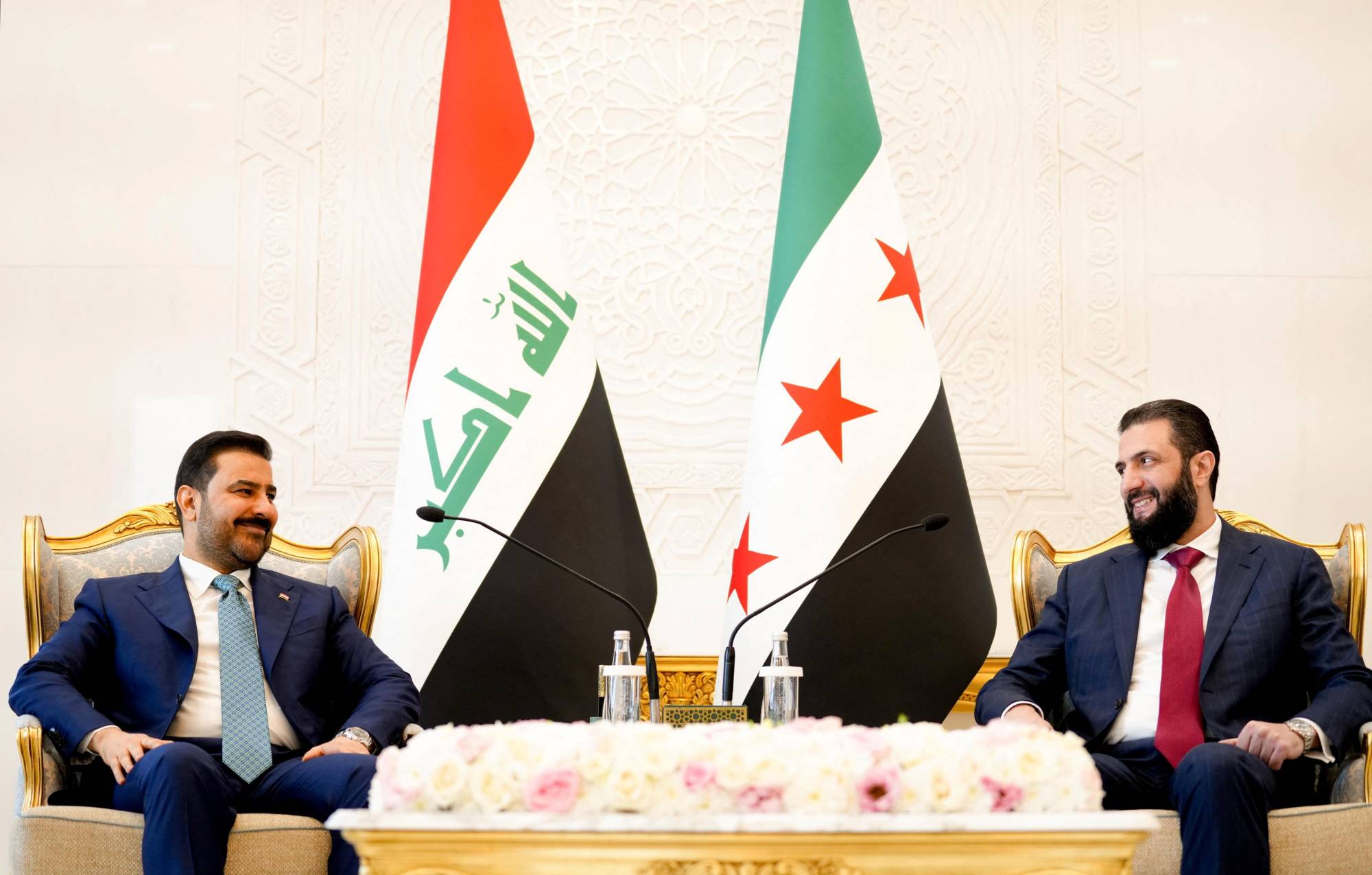
On October 28, he traveled to Damascus for talks with Syrian President Ahmad Al-Sharaa on bilateral relations and ways to strengthen political, economic and security cooperation.
Iraq's Prime Minister Ali Al-Zaidi meets Syrian President Ahmad Al-Sharaa in Damascus, Syria, October 28, 2026. (Iraqi Prime Minister's Media Office/Handout via Reuters)
Pivotal visits
The Syria trip was particularly significant, marking the first by an Iraqi prime minister since the overthrow of Bashar Al-Assad’s regime in 2024 and the establishment of a new administration under Al-Sharaa, developments followed by political and sectarian complications.
According to observers, the meeting helped ease mutual concerns and address shared challenges, particularly border security amid the presence of ISIS cells on both sides of the frontier.
The two leaders also discussed the possibility of restarting the Iraqi oil pipeline through Syria’s port of Baniyas.
Al-Zaidi’s visit to Iran, meanwhile, appeared to extend beyond bilateral relations, fueling speculation in Iraqi political circles that he may have conveyed firm US messages to Tehran, particularly as the trip followed his visit to Washington in July.
Regional alignments and political settlements
Former Iraqi lawmaker and Azm Alliance leader Haidar Al-Mulla told Asharq Al-Awsat that Iraq remained more affected by regional conflicts than capable of influencing their outcome.
“The region is experiencing a state of conflict, and Iraq has no influence over this international equation. It is not part of the equation of political settlements but is affected by what is happening,” he said.
He described the prime minister’s diplomatic outreach as a positive step toward keeping Iraq out of competing regional blocs.
This handout picture released by the Jordanian Royal Palace shows Jordan's King Abdullah II receiving Iraq's Prime Minister Ali Al-Zaidi in Amman on October 26, 2026. (Jordanian Royal Palace / AFP)
“The prime minister’s shuttle visits are positive steps that put the state on the right path,” he noted.
“Iraq intends to open channels of dialogue with its Arab and non-Arab neighbors. This is a positive step that distances us from the alignments currently taking shape in the region.”
Essam Al-Faili, a political science professor at Al-Mustansiriya University, told Asharq Al-Awsat that Al-Zaidi was seeking balanced relations with countries across the region, drawing on Iraq’s geopolitical importance and economic potential to expand its international engagement.
“Al-Zaidi wants to establish strategic relations with Arab countries primarily through shared economic interests,” he said.
“He recognizes Iraq’s importance to the Gulf states, which could eventually contribute to its reintegration into the Gulf system.”
Al-Faili argued that Iraq should contribute to regional stability in the postwar period, particularly as competing alliances and political blocs have become more pronounced.
He said the prime minister was determined to distance Baghdad from such alignments and had succeeded in curbing the influence of Iran’s regional proxies.
“This ultimately sends a message to the Gulf states that Iraqi decision-making will carry weight, helping strengthen relations with all Arab countries,” he remarked.
Israeli Strikes Kill Three People in Gaza, Medics Sayhttps://english.aawsat.com/arab-world/5336513-israeli-strikes-kill-three-people-gaza-medics-say
The sun sets over the ruins of the Sheikh Radwan neighborhood of Gaza City on October 31, 2026. (AFP)
TT
TT
Israeli Strikes Kill Three People in Gaza, Medics Say
The sun sets over the ruins of the Sheikh Radwan neighborhood of Gaza City on October 31, 2026. (AFP)
Israeli strikes killed at least three Palestinians and wounded several others in the Gaza Strip on Monday, the territory's health officials said.
Medics said two people were killed and six others wounded in two separate airstrikes in Khan Younis, south of the enclave, while a third person was killed in an Israeli airstrike in the town of Al-Mussadar.
The Israeli military didn't immediately comment on any of the attacks.
Israel, which says the Hamas group has been rearming and launching attacks in violation of a year-old ceasefire, has stepped up strikes on the group in recent weeks.
Hamas has denied trying to carry out attacks or rebuild its arsenal and accuses Israel of undermining the Gaza peace deal.
Last year's US-brokered ceasefire calls for eventual reconstruction of the territory. But little progress has been made as negotiators have failed to agree on terms for Hamas to disarm or Israel to withdraw its troops, who control about two-thirds of the territory where they have ordered residents out.
Nearly all of the more than 2 million residents live in the remaining third of the enclave among war ruins, mostly in makeshift tents and damaged buildings, still under effective control of Hamas.
At least 1,580 Palestinians have been killed in Israeli attacks in Gaza since the ceasefire, according to the territory's health officials, while Israel says four soldiers have been killed.
Palestinian authorities say more than 74,000 people have been killed in Israel's assault on Gaza, launched after Hamas-led fighters killed about 1,200 people in southern Israel on October 7, 2023.
لم تشترك بعد
انشئ حساباً خاصاً بك لتحصل على أخبار مخصصة لك ولتتمتع بخاصية حفظ المقالات وتتلقى نشراتنا البريدية المتنوعة