

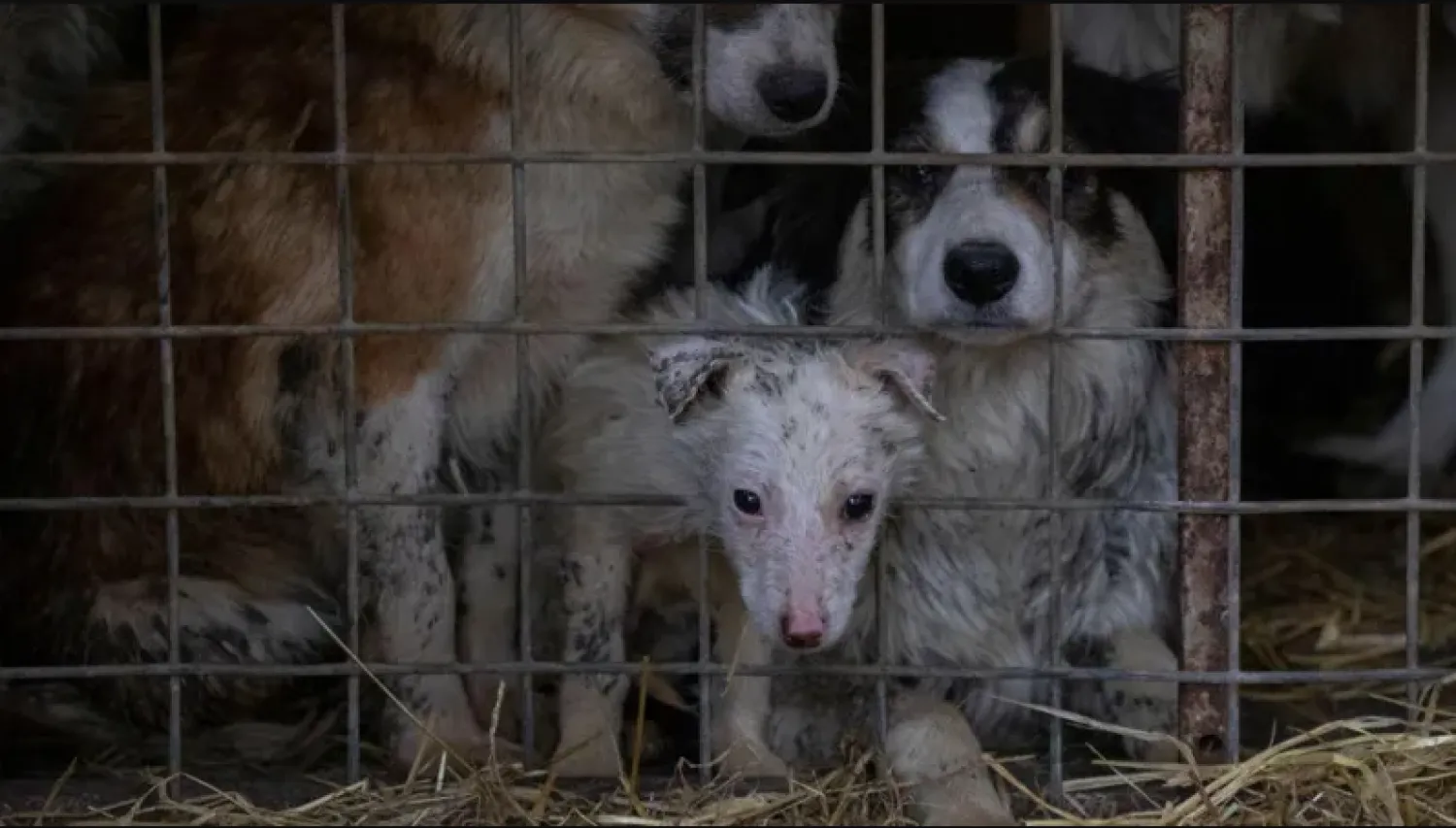

Woman Jailed over Neglect of 191 Dogs

Most of the dogs were kept in crates and cages in a remote Devon field, the court heard - RSPCA
TT

Woman Jailed over Neglect of 191 Dogs

Most of the dogs were kept in crates and cages in a remote Devon field, the court heard - RSPCA

A woman who kept 191 dogs in "pitiful" conditions in Devon has been jailed.

Diana Curtis, 66, of Peters Marland, had kept the dogs in crates and cages in a remote field near Chittlehamholt and in kennels near Chulmleigh Cross, Exeter Crown Court heard, BBC reported.

Curtis had previously pleaded guilty to seven counts of causing unnecessary suffering to animals.

She was jailed for 25 months and handed a lifetime ban from owning animals.

Two animals had to be put down, while others were found with scars, infected wounds and missing ears, probably caused by fighting, the court was told.

The RSPCA said three other puppies also died because of their ill health.

Sentencing, Judge James Adkin said pictures showed the dogs were in "a truly pitiful condition".

"You put yourself and your own feelings before the animals causing them considerable suffering," he said.

The court heard Curtis moved 99 dogs to a remote field with no water or electricity supply near Chittlehamholt.

Other dogs were kept in kennels in Chulmleigh Cross.

Local farmer Bill Bowen tipped off police because of the noise of the barking animals, the court was told.

RSPCA inspectors said they found dogs kept in cramped conditions standing on top of one another to drink water.

Curtis later turned up in a lorry with another 92 dogs inside, the court heard.

The court heard she had already been banned from keeping animals after being convicted in December 2023 of ill-treating horses, chickens and ducks.

For those offences, she was jailed for 16 weeks, suspended for 12 months, and told to pay £10,000 costs.

Mr Bowen said he spent more than two hours on the phone to police after he and his daughter discovered the dogs in the field.

He said it was a shocking sight to see with many of the dogs looking ill.

"Three days later it snowed really heavily and a lot of those dogs would have died in that snow," Mr Bowen said.



Warming Climate Threatens Greenland’s Ancestral Way of Life

Musher Nukaaraq Lennert Olsen offers some dry food to his dogs after a ride near the "dog town" ofSisimiut, Greenland on January 31, 2026. (AFP)
TT

Warming Climate Threatens Greenland’s Ancestral Way of Life

Musher Nukaaraq Lennert Olsen offers some dry food to his dogs after a ride near the "dog town" ofSisimiut, Greenland on January 31, 2026. (AFP)

Standing in his boat with binoculars in hand, hunter Malik Kleist scans the horizon for seals. But this February, the sea ice in southwestern Greenland has yet to freeze, threatening traditional livelihoods like his.

"Normally the seals are on the ice or in the more calm waters. But today we had to sail all the way into the fjords to find them," the 37-year-old tells AFP.

The Arctic region is on the frontline of global warming, heating up four times faster than the rest of the planet since 1979, according to a 2022 study in scientific journal Nature, causing the sea ice to retreat.

Seals rely on pack ice to give birth, to rest and for protection.

Hunters increasingly have to sail farther along the jagged coast of Sisimiut, navigating into the fjords for several hours to find them.

Traditionally, hunters' boats would head straight out to sea, slowly pushing through the ice and creating holes that attract seals coming up for air.

But without any ice, "it's too windy and the waves are too big," Kleist says.

Last year was exceptionally warm in the vast autonomous territory, with several temperature records beaten, according to the Danish Meteorological Institute (DMI).

In December, the Summit Station, located at the height of Greenland's ice sheet, recorded an average temperature of -30.9 degrees C (-23.6 Fahrenheit), 8.1C higher than the December average during the period 1991-2020.

"It affects everything we do. Because normally around November, December the ice comes. And this year there's no ice, so it affects our living a lot," Kleist says.

- Financial woes -

For the same reason, the government has also had to postpone the annual winter musk ox hunt that was due to start on January 31.

There wasn't enough snow and ice to transport the massive animals that roam the Arctic tundra back from Kangerlussuaq where they are predominantly found, around 165 kilometers (103 miles) away. Greenland has no roads connecting its towns.

That has left some Sisimiut hunters with less income than usual.

"This time of year there is not much to hunt. So we rely on musk ox meat and skin," Kleist says.

"Many of my fellow hunters are struggling with money right now."

Every part of the animal, from the fur to the meat, is either used or sold.

The summer hunting season has therefore gained importance, enabling Greenlanders to fill their freezers to get them through the winter months, he tells AFP over a steaming bowl of fish stew.

The shorter winter season has also impacted another key activity in Greenland, one that has become increasingly important to the tourism sector: dogsled tours.

In the Sisimiut neighborhood where the dogs are kept, their thunderous barking mounts as Nukaaraq Olsen, a 21-year-old musher, attaches them to the sled.

Raring to get going, his 18 dogs are hard to hold back. Twenty minutes later, the group bounds off.

But the road is bumpy, and several times Olsen has to get up to manually push the sled, stuck on the tundra's rocks in patches where there is no ice.

"This year we had a lot of hot, warm days, even though it's December or January," he says.

Other parts of the route are no longer safe to use, due to repeated melting and freezing of snowfall which causes uneven layers, he explains.

- Dehydrated dogs -

The dogs' health is also affected by the changing climate.

They are used to quenching their thirst with snow, but with little or no snowfall, they can easily get dehydrated. Mushers have to take that into account when caring for their animals.

Many have even had to get rid of their dogs, the business of maintaining them no longer profitable with the dogsled season shrinking to just two months, says Emilie Andersen-Ranberg, a researcher at the University of Copenhagen who runs a dog clinic in Sisimiut.
Others, such as 72-year-old Johanne Bech, are finding novel ways to adapt.

She plans to put wheels on her sled to continue running dogsled tours during the summer period.

That solution is growing in popularity, as "the window with snow is getting more and more narrow," the veterinarian says.

Over the past 20 years, the number of sleddogs has been halved from 25,000 to 13,000, according to a 2024 article from the University of Greenland in 2024.

Yet Johanne Bech remains optimistic about the future.

"I hope this is just for a short time, so we can go back to a little more stable snow or more ice in the future."


January Was Fifth Hottest on Record despite Cold Snap

This handout photo taken on February 7, 2026 and received on February 10 from Japan's Ministry of Defense shows members of the Japan Ground Self-Defense Force's 5th Infantry Regiment, stationed in Aomori Prefecture, carrying out snow removal work in a town within Aomori Prefecture. (Photo by Handout / Japan's Ministry of Defense / AFP)
TT

January Was Fifth Hottest on Record despite Cold Snap

This handout photo taken on February 7, 2026 and received on February 10 from Japan's Ministry of Defense shows members of the Japan Ground Self-Defense Force's 5th Infantry Regiment, stationed in Aomori Prefecture, carrying out snow removal work in a town within Aomori Prefecture. (Photo by Handout / Japan's Ministry of Defense / AFP)

The planet experienced its fifth-hottest January on record despite a cold snap that swept across the United States and Europe, the EU's climate monitor said Tuesday.

The Northern Hemisphere was hit by severe cold waves in the final weeks of January as a polar jet stream blew icy air into Europe and North America, according to the Copernicus Climate Change Service.

But monthly temperatures were above average over much of the globe, including in large parts of the Arctic and western North America, according to Copernicus.

"January 2026 delivered a stark reminder that the climate system can sometimes simultaneously deliver very cold weather in one region, and extreme heat in another," said Samantha Burgess, strategic lead for climate at the European Centre for Medium-Range Weather Forecasts (ECMWF).

The average global temperature in January was 1.47C above preindustrial times.

Europe endured its coldest January since 2010, with an average temperature of 2.34C, the service said.

The United States, meanwhile, was hit by a monster winter storm that dumped snow and crippling ice from New Mexico to Maine. It was linked to more than 100 deaths.

The planet remains in an extended run of human-driven warming, with 2024 setting a record high, 2023 ranking second 2025 now third warmest.


Beirut's 'Mother of Cats' Who Rescues Felines

Diana Abadi, known as "the mother of cats," sits with felines waiting for adoption at her small pet food and plant shop in Hadath, in Beirut's southern suburbs known as Dahiyeh, in Lebanon, Saturday, Feb. 7, 2026. (AP Photo/Bilal Hussein)
TT

Beirut's 'Mother of Cats' Who Rescues Felines

Diana Abadi, known as "the mother of cats," sits with felines waiting for adoption at her small pet food and plant shop in Hadath, in Beirut's southern suburbs known as Dahiyeh, in Lebanon, Saturday, Feb. 7, 2026. (AP Photo/Bilal Hussein)

Diana Abadi is known in the southern suburbs of Beirut as the “Mother of Cats.”

For the past 12 years, she has turned her home and shop into a refuge for abandoned felines who now number between 50 and 70, and she often sleeps beside the cats as she cares for them full time.

Abadi began by taking in a single kitten.

Word spread, and residents started bringing her injured and unwanted animals, especially during periods of crisis. At its peak, the shelter housed more than 150 cats, especially during the COVID-19 pandemic and the recent Israel-Hezbollah war, when fear and displacement led many people to abandon their pets.

Her plant and pet food shop in the southern suburbs known as Dahiyeh serves as both her livelihood and the cats’ shelter. Among those currently in her care are Joujou, 13, the oldest, as well as cats named Loulou, Fluffy, Emma and Panda.

One of the most challenging cases involves a cat that was completely blind when abandoned. A woman offered to cover the animal’s expenses if Abadi would take him in. After months of treatment, the cat has partially regained vision in one eye.

Social media has recently helped improve adoption rates, reducing the number of cats under Abadi's care. Rising costs, however, threaten the shelter’s future. Monthly rent has climbed to $800, up from $250 before the war, forcing Abadi to cover most expenses herself.

“These are living beings,” she said. “I don’t take holidays or Sundays off.”