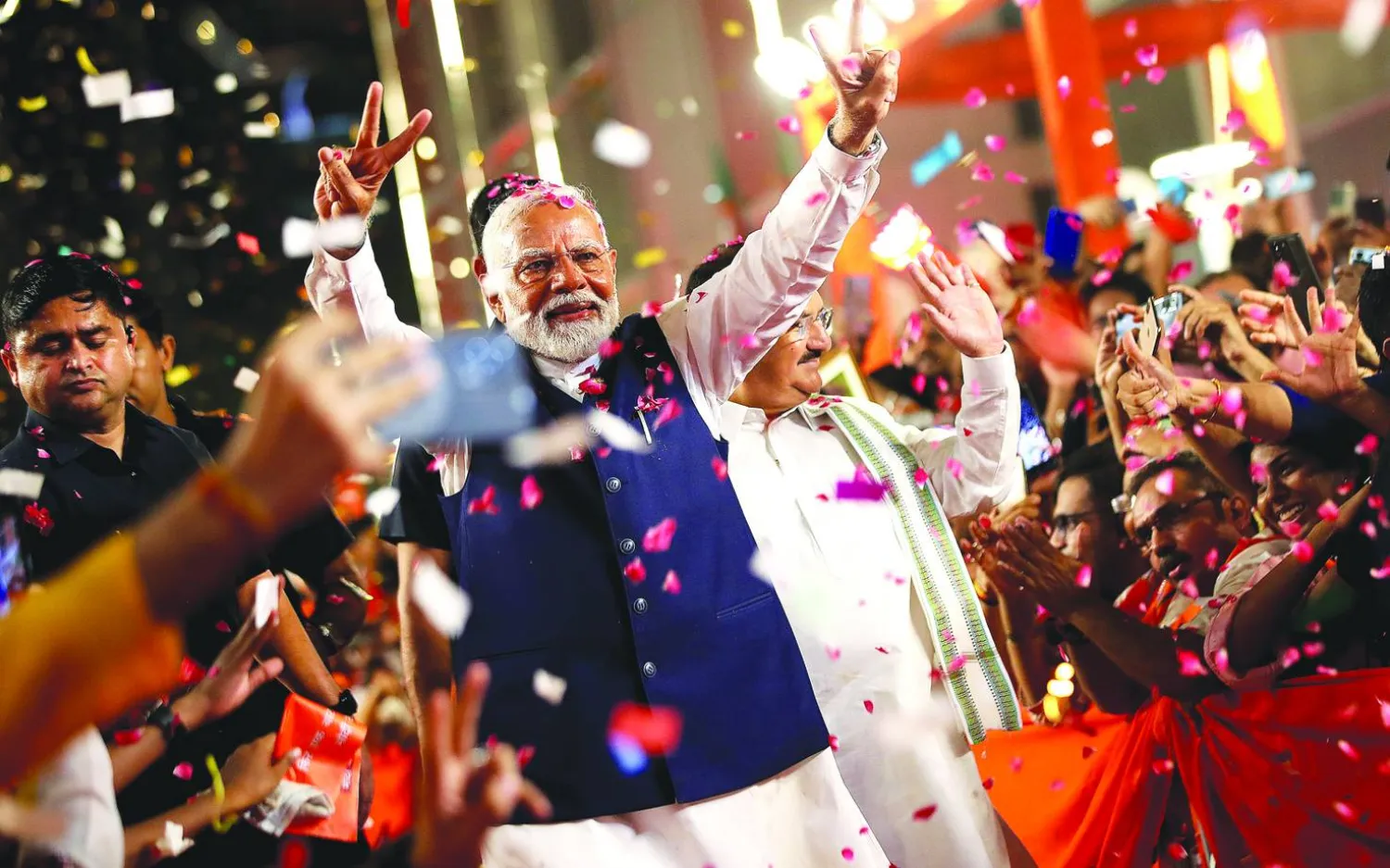
India's Modi Sworn in as PM For Third Term, Faces Coalition Challenges

Bharatiya Janata Party (BJP) leader and Indian Prime Minister Narendra Modi (C)  arrives at the party headquarters to deliver a victory speech, in New Delhi, India, 04 June 2024. EPA/HARISH TYAGI
Bharatiya Janata Party (BJP) leader and Indian Prime Minister Narendra Modi (C) arrives at the party headquarters to deliver a victory speech, in New Delhi, India, 04 June 2024. EPA/HARISH TYAGI
TT

India's Modi Sworn in as PM For Third Term, Faces Coalition Challenges

Bharatiya Janata Party (BJP) leader and Indian Prime Minister Narendra Modi (C)  arrives at the party headquarters to deliver a victory speech, in New Delhi, India, 04 June 2024. EPA/HARISH TYAGI
Bharatiya Janata Party (BJP) leader and Indian Prime Minister Narendra Modi (C) arrives at the party headquarters to deliver a victory speech, in New Delhi, India, 04 June 2024. EPA/HARISH TYAGI

Narendra Modi was sworn in as India's prime minister on Sunday for a third term, after a shock election setback that will test his ability to ensure policy certainty in a coalition government in the world's most populous nation.
President Droupadi Murmu administered the oath of office to Modi at a ceremony at the Rashtrapati Bhavan, the president's palace in New Delhi, attended by thousands of dignitaries, including the leaders of seven regional countries, Bollywood stars and industrialists, Reuters reported.
"Honored to serve Bharat," Modi posted on X, minutes before he was sworn in, referring to India's name in Indian languages.
Supporters cheered, clapped and chanted "Modi, Modi" as the 73-year old leader, dressed in a white kurta tunic and blue half jacket, was called to take his oath.
Modi was followed by senior ministers in the previous government: Rajnath Singh, Amit Shah, Nitin Gadkari, Nirmala Sitharaman, Subrahmanyam Jaishankar, and Piyush Goyal, among others. Their portfolios were expected to be announced after the swearing-in.
Midway through the inauguration, news came that at least nine people were killed and 33 injured when a bus carrying Hindu pilgrims plunged into a gorge after a suspected militant attack in the federal territory of Jammu and Kashmir, drawing criticism of the security situation from the opposition Congress party.
Modi, who started as a publicist of the Hindu nationalist Rashtriya Swayamsevak Sangh, the ideological parent of his Bharatiya Janata Party, is only the second person after independence leader Jawaharlal Nehru to serve a third straight term as prime minister.
Modi secured the third term in after multi-stage election that concluded on June 1 with the support of 14 regional parties in his BJP-led National Democratic Alliance. In the previous two terms his party had won an outright majority.
The outcome is seen as a big setback to the popular leader as surveys and exit polls had predicted BJP would secure even more seats than in 2019.
COALITION CHALLENGES
Modi delivered world beating growth and lifted India's global standing, but appeared to have missed a step at home as a lack of enough jobs, high prices, low incomes and religious faultlines pushed voters to rein him in.
When Modi was the chief minister of the western state of Gujarat from 2001 to 2014 the BJP enjoyed strong majorities, allowing him to govern decisively.
Modi's new term as prime minister, therefore, is likely to be fraught with challenges in building consensus on contentious political and policy issues in the face of different interests of regional parties and a stronger opposition, analysts say.
Some analysts worry that the fiscal balance in the world's fastest growing economy could also come under pressure due to demands for higher development funds for states ruled by the NDA's regional partners and a possible push by the BJP to spend more on welfare to woo back lost voters.
While the broad focus on building infrastructure, manufacturing and technology could continue, "contentious reforms could be delayed", said Samiran Chakraborty, Chief Economist, India, at Citi Research.
"The BJP’s major coalition partners are politically unpredictable, sometimes working with the BJP and sometimes working against them," added Rick Rossow, the Chair in US-India Policy Studies at the Center for Strategic and International Studies in Washington.
"The larger parties that will be a part of his coalition are mostly agnostic on national-level issues and should not be applying a brake on economic reforms or security ties with the United States, Japan, and other key partners," he said.
Modi, whose election campaign was marked by religious rhetoric and criticism of the opposition for allegedly favoring India's 200 million minority Muslims, has adopted a more conciliatory tone since the result.
"We have won the majority ... but to run the country it is unanimity that is crucial ... we will strive for unanimity," he said on Friday after the NDA formally named him coalition head.



Danish Foreign Minister to Visit NATO Allies Over Greenland

Denmark's Foreign Minister Lars Lokke Rasmussen reacts, following his and Greenland's Foreign Minister Vivian Motzfeldt meeting with US Senators Angus King (I-ME), Lisa Murkowski (R-AK), Ruben Gallego (D-AZ) and a press conference, in Washington DC, US, January 14, 2026. (Reuters)
TT

Danish Foreign Minister to Visit NATO Allies Over Greenland

Denmark's Foreign Minister Lars Lokke Rasmussen reacts, following his and Greenland's Foreign Minister Vivian Motzfeldt meeting with US Senators Angus King (I-ME), Lisa Murkowski (R-AK), Ruben Gallego (D-AZ) and a press conference, in Washington DC, US, January 14, 2026. (Reuters)

Denmark's foreign minister is to visit fellow NATO members Norway, the UK and Sweden to discuss the alliance's Arctic security strategy, his ministry announced Sunday.

Foreign Minister Lars Lokke Rasmussen will visit Oslo on Sunday, travel to London on Monday and then to Stockholm on Thursday.

The diplomatic tour follows US President Donald Trump's threat to punish eight countries -- including the three Rasmussen is visiting -- with tariffs over their opposition to his plan to seize control of Greenland, an autonomous Danish territory.

Trump has accused Denmark, Norway, Sweden, France, Germany, the UK, the Netherlands and Finland of playing a "very dangerous game" after they sent a few dozen troops to the island as part of a military drill.

"In an unstable and unpredictable world, Denmark needs close friends and allies," Rasmussen stated in a press release.

"Our countries share the view that we all agree on the need to strengthen NATO's role in the Arctic, and I look forward to discussing how to achieve this," he said.

An extraordinary meeting of EU ambassadors has been called in Brussels for Sunday afternoon.

Denmark, "in cooperation with several European allies", recently joined a declaration on Greenland stating that the mineral-rich island is part of NATO and that its security is a "shared responsibility" of alliance members, the ministry statement added.

Since his return to the White House for a second term, Trump has made no secret of his desire to annex Greenland, defending the strategy as necessary for national security and to ward off supposed Russian and Chinese advances in the Arctic.


Iran Considers ‘Gradually’ Restoring Internet After Shutdown

10 January 2026, Iran, Tehran: A police station is set on fire during protests in Tehran in response to worsening economic conditions. ZUMA Press Wire/dpa
TT

Iran Considers ‘Gradually’ Restoring Internet After Shutdown

10 January 2026, Iran, Tehran: A police station is set on fire during protests in Tehran in response to worsening economic conditions. ZUMA Press Wire/dpa

Iranian authorities have said they are considering "gradually" restoring internet access after imposing a sweeping communications shutdown across the country more than a week ago, local media reported. 

On Sunday morning, AFP was able to connect to the internet from its Tehran office, though the vast majority of internet providers and mobile internet remain cut. 

It was not immediately clear why the limited connection was possible. 

Outgoing international calls have been possible since Tuesday, and text messaging was restored Saturday morning. 

Late Saturday, the Tasnim news agency reported "the relevant authorities announced that internet access would also be gradually restored", but gave no further details. 

Citing an unnamed "informed source", the agency said local messaging applications "will soon be activated" on Iran's domestic intranet. 

The unprecedented communications blackout was imposed as calls proliferated for anti-government demonstrations initially triggered by the country's economic malaise. 

For days, text messages and international phone calls -- and at times even local calls -- were cut off. 

Iran has since been relying on its intranet, which has supported local media websites, ride-hailing apps, delivery service and banking platforms. 

State television has since Saturday been promoting local messaging applications including Rubika -- which was largely unavailable earlier this week. 

Even before the blackout, popular applications such as Instagram, Facebook, X, Telegram and YouTube had been blocked in Iran for years, requiring VPN connections to bypass the restrictions. 

The protests, which began on December 28, have been widely seen as the biggest challenge to the Iranian leadership since the months-long demonstrations that followed the 2022 death in custody of Mahsa Amini. 

But the latest demonstrations appear to have subsided in recent days. 

Iranian officials have not given an exact death toll for the protests, but Norway-based rights group Iran Human Rights (IHR) reported that 3,428 people were verified to have been killed by security forces, while warning the actual toll could be several times higher. 

Other estimates place the toll at more than 5,000 -- and possibly as high as 20,000, IHR said. 

The opposition Iran International channel based outside the country has said at least 12,000 people were killed during the protests, citing senior government and security sources. 

Iran's judiciary has completely rejected that figure. 

Iranian officials have said the demonstrations were peaceful before turning into "riots" that included vandalism of public property. 

Authorities have blamed foreign influence, namely from Iran's foes the United States and Israel. 

On Saturday, supreme leader Ali Khamenei said "a few thousand" people had been killed by what he called "agents" of the two countries who instigated the unrest. 


Pakistan Security Forces Kill 12 Militants, Thwarting Attempted Hostage-taking in Southwest

File photo: Pakistani Army and security officials stand guard as the opposition party Pakistan Tehrik-e-Insaft (PTI) continue their protest for the third day demanding release of former Prime Minister Imran Khan, in Islamabad, Pakistan, 06 October 2024. EPA/SOHAIL SHAHZAD
TT

Pakistan Security Forces Kill 12 Militants, Thwarting Attempted Hostage-taking in Southwest

File photo: Pakistani Army and security officials stand guard as the opposition party Pakistan Tehrik-e-Insaft (PTI) continue their protest for the third day demanding release of former Prime Minister Imran Khan, in Islamabad, Pakistan, 06 October 2024. EPA/SOHAIL SHAHZAD

Pakistani security forces killed at least 12 militants and thwarted an attempted hostage-taking in southwestern Pakistan after assailants attacked a police station, the military said Friday.

In a statement, it said the attackers also targeted two banks and looted millions of rupees (dollars) during the assault in Kharan district of Balochistan province a day earlier. The militants attempted to seize hostages at the police station, but a swift response by security forces forced them to retreat, it said.

The military identified the assailants as “Fitna al-Hindustan,” a phrase the government uses for the outlawed Baloch Liberation Army, or BLA, and other separatist groups. It claimed the attackers, including those killed in the shootouts with security forces, were backed by India, though it provided no evidence. India has repeatedly denied Pakistan’s accusations that it supports separatists in Balochistan or Pakistani Taliban fighters.

Pakistan's Interior Minister Mohsin Naqvi in a statement praised the security forces for killing the militants and foiling the attacks by the insurgents in Kharan, reported The Associated Press.

Balochistan, Pakistan’s largest but least populated province, has long been the scene of insurgency by separatist groups, along with attacks by the Pakistani Taliban. The BLA, which the United States designated a terrorist organization in 2019, has been behind numerous attacks targeting security forces and civilians across the province in recent years.