G7 Leaders Agree to Lend Ukraine Billions Backed by Russia’s Frozen Assets

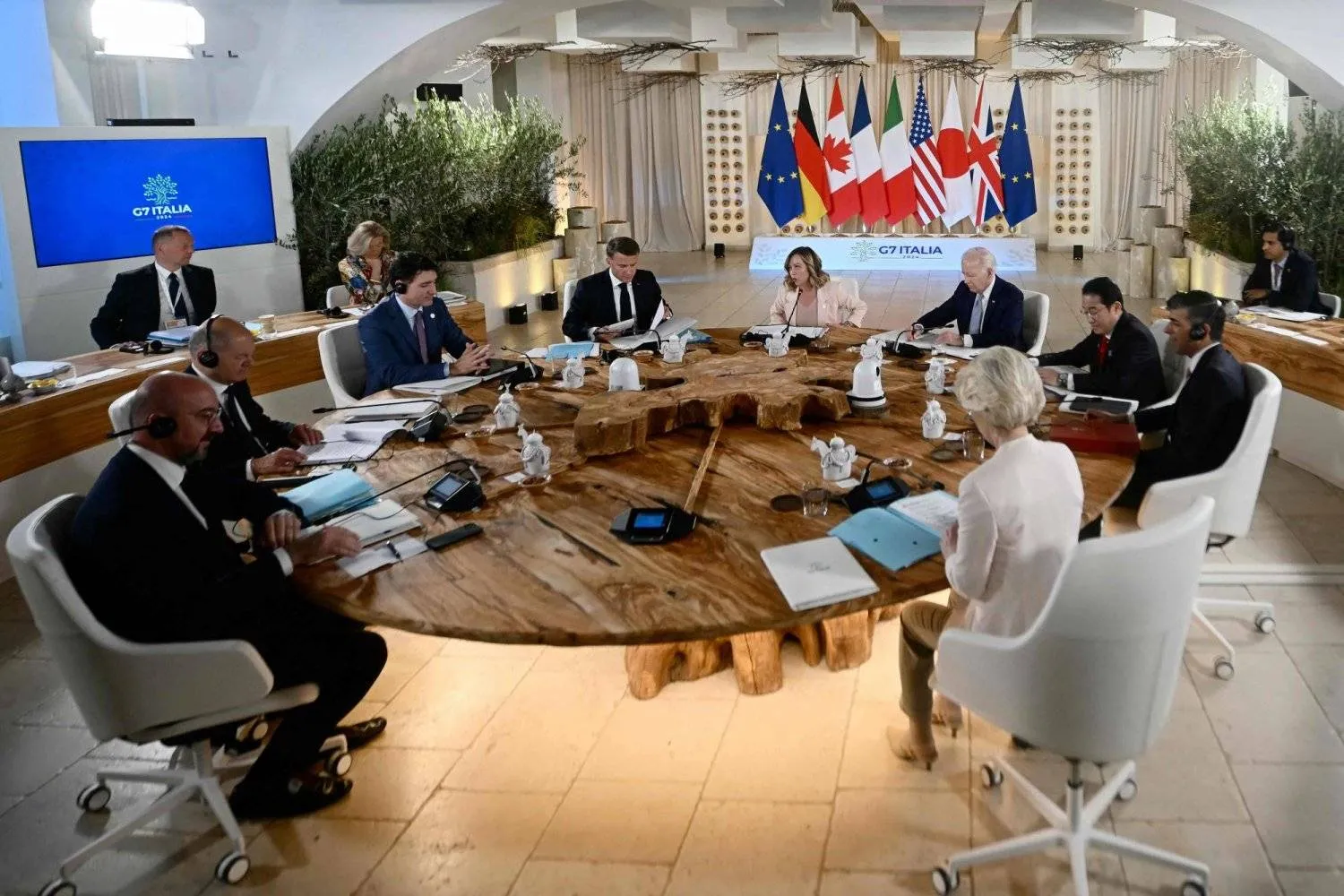
A number of world leaders during the G7 summit (AFP)
TT

G7 Leaders Agree to Lend Ukraine Billions Backed by Russia’s Frozen Assets

A number of world leaders during the G7 summit (AFP)

Leaders of the Group of Seven wealthy democracies have agreed to engineer a $50 billion loan to help Ukraine in its fight for survival. Interest earned on profits from Russia’s frozen central bank assets would be used as collateral.

Details of the deal were being hashed out by G7 leaders at their summit in Italy. The money could reach Kyiv before the end of the year, according to US and French officials.

President Joe Biden told reporters at a news conference Thursday that the move was part of a “historic agreement.” Ukraine's president, Volodymyr Zelenskyy, said providing a loan through Russia's assets "is a vital step forward in providing sustainable support for Ukraine in winning this war."

Here's how the plan would work:

Where would the money come from? Most of the money would be in the form of a loan mostly guaranteed by the US government, backed by profits being earned on roughly $260 billion in immobilized Russian assets. The vast majority of that money is held in European Union nations.

A French official said the loan could be “topped up” with European money or contributions from other countries.

A US official who spoke on the condition of anonymity to preview the agreement said the G7 leaders' official statement due out Friday will leave the door open to trying to confiscate the Russian assets entirely.

Why not just give Ukraine the frozen assets? That's much harder to do.

For more than a year, officials from multiple countries have debated the legality of confiscating the money and sending it to Ukraine.

The US and its allies immediately froze whatever Russian central bank assets they had access to when Moscow invaded Ukraine in 2022. That basically was money being held in banks outside Russia.

The assets are immobilized and cannot be accessed by Moscow, but they still belong to Russia.

While governments can generally freeze property or funds without difficulty, turning them into forfeited assets that can be used for the benefit of Ukraine requires an extra layer of judicial procedure, including a legal basis and adjudication in a court.

The EU instead has set aside the profits being generated by the frozen assets. That pot of money is easier to access.

Separately, the US this year passed a law called the REPO Act — short for the Rebuilding Economic Prosperity and Opportunity for Ukrainians Act — that allows the Biden administration to seize $5 billion in Russian state assets in the US and use them for the benefit of Kyiv. That arrangement is being worked out.

How could the loan be used and how soon? It will be up to technical experts to work through the details.

Ukraine will be able to spend the money in several areas, including for military, economic and humanitarian needs and reconstruction, the US official said.

Biden's national security adviser, Jake Sullivan, said the goal is “to provide the necessary resources to Ukraine now for its economic energy and other needs so that it's capable of having the resilience necessary to withstand Russia's continuing aggression.”

Another goal is to get the money to Ukraine quickly.

The French official, who was not authorized to be publicly named according to French presidential policy, said the details could be worked out "very quickly and in any case, the $50 billion will be disbursed before the end of 2024.”

Beyond the costs of the war, the needs are great.

The World Bank’s latest damage assessment of Ukraine, released in February, estimates that costs for reconstruction and recovery of the nation stand at $486 billion over the next 10 years.

The move to unlock Russia's assets comes after there was a long delay in Washington by Congress in approving military aid for Ukraine.

At an Atlantic Council event previewing the G7 summit, a former US ambassador to Ukraine, John Herbst, said “the fact that American funding is not quite reliable is a very important additional reason to go that route.”

Who would be on the hook in the case of a default? If Russia regained control of its frozen assets or if the immobilized funds were not generating enough interest to pay back the loan, "then the question of burden-sharing arises,” according to the French official.

Max Bergmann, director of the Europe, Russia and Eurasia Program at the Center for Strategic and International Studies, said last week that there were worries among European finance ministers that their countries “will be left holding the bag if Ukraine defaults.”

Some nations are critical of the plan to seize Russian assets.

Chinese Embassy spokesman Liu Pengyu told The Associated Press that the US is "fueling the fight and inciting confrontation.”

“We urge the US to immediately stop slapping illegal unilateral sanctions and play a constructive role in ending the conflict and restoring peace.”


Netanyahu Vows to Eliminate Iran Threat ‘Once and for All’

10 November 2026, Israel, Jerusalem: Caretaker Israeli Prime Minister Benjamin Netanyahu delivers a speech on the sidelines of the opening session of the new Knesset. (dpa)
TT

Netanyahu Vows to Eliminate Iran Threat ‘Once and for All’

10 November 2026, Israel, Jerusalem: Caretaker Israeli Prime Minister Benjamin Netanyahu delivers a speech on the sidelines of the opening session of the new Knesset. (dpa)

Israel's caretaker prime minister Benjamin Netanyahu on Saturday reiterated his calls for a national unity government with his opponent Gadi Eisenkot, as well as his vow to eliminate the threat from Iran.

A meeting with Eisenkot on Thursday "only strengthened the conviction that it is essential to form a national unity government" to guarantee Israel's security, Netanyahu said in a video statement, adding that such a government could "eliminate the Iranian threat once and for all".


Ukraine’s Zelenskiy Escalates Criticism of SpaceX Over Speed Caps

Ukraine's President Volodymyr Zelenskiy holds a press briefing in Copenhagen November 10, 2026. (AFP)
TT

Ukraine’s Zelenskiy Escalates Criticism of SpaceX Over Speed Caps

Ukraine's President Volodymyr Zelenskiy holds a press briefing in Copenhagen November 10, 2026. (AFP)

Ukraine's President Volodymyr Zelenskiy ‌escalated his criticism of SpaceX on Saturday, saying speed restrictions on its military-grade Starshield satellite terminals had dangerous political implications and undermined critical air defenses.

Zelenskiy said Starshield terminals operating in temporarily Russian-occupied territories of Ukraine had been limited to a maximum speed of 161 kph for the past five days, hampering Ukraine's military capabilities.

The Ukrainian Defense Ministry has raised the issue with SpaceX at the ‌institutional level, ‌Zelenskiy said.

"The restrictions have now ‌been ⁠in place for ⁠five days. They say it is some kind of technical issue. We do not believe that is the case," Zelenskiy told reporters in remarks released by his office on Saturday.

"If you impose restrictions there, you are already partially recognizing the temporarily ⁠occupied territories as not ours. And ‌that is why I ‌believe we have the right to raise this ‌issue and restore the speed – so that there ‌are no restrictions at all."

Zelenskiy said the speed restrictions made it more difficult for Ukrainian air defense units to intercept Russian jet-powered drones and made Ukrainian cities ‌more vulnerable. He said he had ordered his top military and foreign ministry ⁠officials ⁠to address the issue and seek clarification.

SpaceX has pushed back against the allegations, denying that it introduced new restrictions or made any changes to its satellite operations.

It is the second such outage in recent weeks. In mid-October, Ukrainian officials said that SpaceX limited the speed of Starlink and its Starshield communication systems to about 160 kph (100 mph) amid tensions with US President Donald Trump's administration over Ukrainian attacks on Russian oil refineries. Service was then restored on October 24.


UN Official Urges Iran, US to Let Fertilizers Through Hormuz Strait

Jorge Moreira da Silva, Executive Director of UNOPS (United Nations Office for Project Services), and coordinator of the UN Strait of Hormuz Task Force established by the UN Secretary-General, speaks during an interview with AFP on the sidelines of the 31st United Climate Change Conference (COP31), at the media center located on the Antalya Expo Center in Antalya on November 14, 2026. (AFP)
TT

UN Official Urges Iran, US to Let Fertilizers Through Hormuz Strait

Jorge Moreira da Silva, Executive Director of UNOPS (United Nations Office for Project Services), and coordinator of the UN Strait of Hormuz Task Force established by the UN Secretary-General, speaks during an interview with AFP on the sidelines of the 31st United Climate Change Conference (COP31), at the media center located on the Antalya Expo Center in Antalya on November 14, 2026. (AFP)

Iran and the United States should "immediately" allow fertilizer shipments through the Strait of Hormuz to ease the crisis in some of the most vulnerable countries, a senior UN official said Saturday.

Jorge Moreira da Silva, head of the UN Office for Project Services, told the COP31 climate talks in the Turkish resort city of Antalya that the lack of fertilizers could push millions into poverty.

The Iranian blockade of the vital waterway, which started after the joint US-Israeli attack against Iran in late February, has choked shipping in the region and beyond. The US blockade of Iranian ports has further complicated matters.

While Iran and the United States are still trying to negotiate an end to the conflict, Moreira da Silva said he had the same message for both countries.

"They should continue their negotiations about the comprehensive deal -- but that deal should not avoid an immediate, exceptional, limited, and time-bound solution for the fertilizers," he said.

"Basically, what we need is five vessels a day with fertilizers," he added.

- Millions at risk -

Moreira da Silva heads up the UN task force dedicated to facilitating the safe passage of fertilizers during the crisis.

Before the conflict, a third of the world's fertilizers passed through the Strait of Hormuz, and since the blockades, their prices had risen by 30 percent, he said.

"But what I think is not sufficiently recognized is the disproportionate impact on the most vulnerable countries," he added.

Sudan's finance minister recently told him that the price of food there had doubled in six months, he added. In Nepal, they had told him that farmers could no longer afford to buy fertilizers.

"So, it's very important that we are aware that countries such as Mozambique, Kenya, Sudan, Somalia, Nepal, Bangladesh, Sri Lanka are facing very significant impact."

The effects of this shortage could be catastrophic, he warned.

"If we continue missing the planting seasons in different parts of the world we may have 45 million people facing severe and acute food insecurity," he said.

"We may have 30 million people being forced into poverty."

The UN had a system ready to get fertilizer shipments moving within seven to 10 days, he said.