


Perfectly Preserved Centuries-Old Cherries Unearthed at George Washington’s Mount Vernon

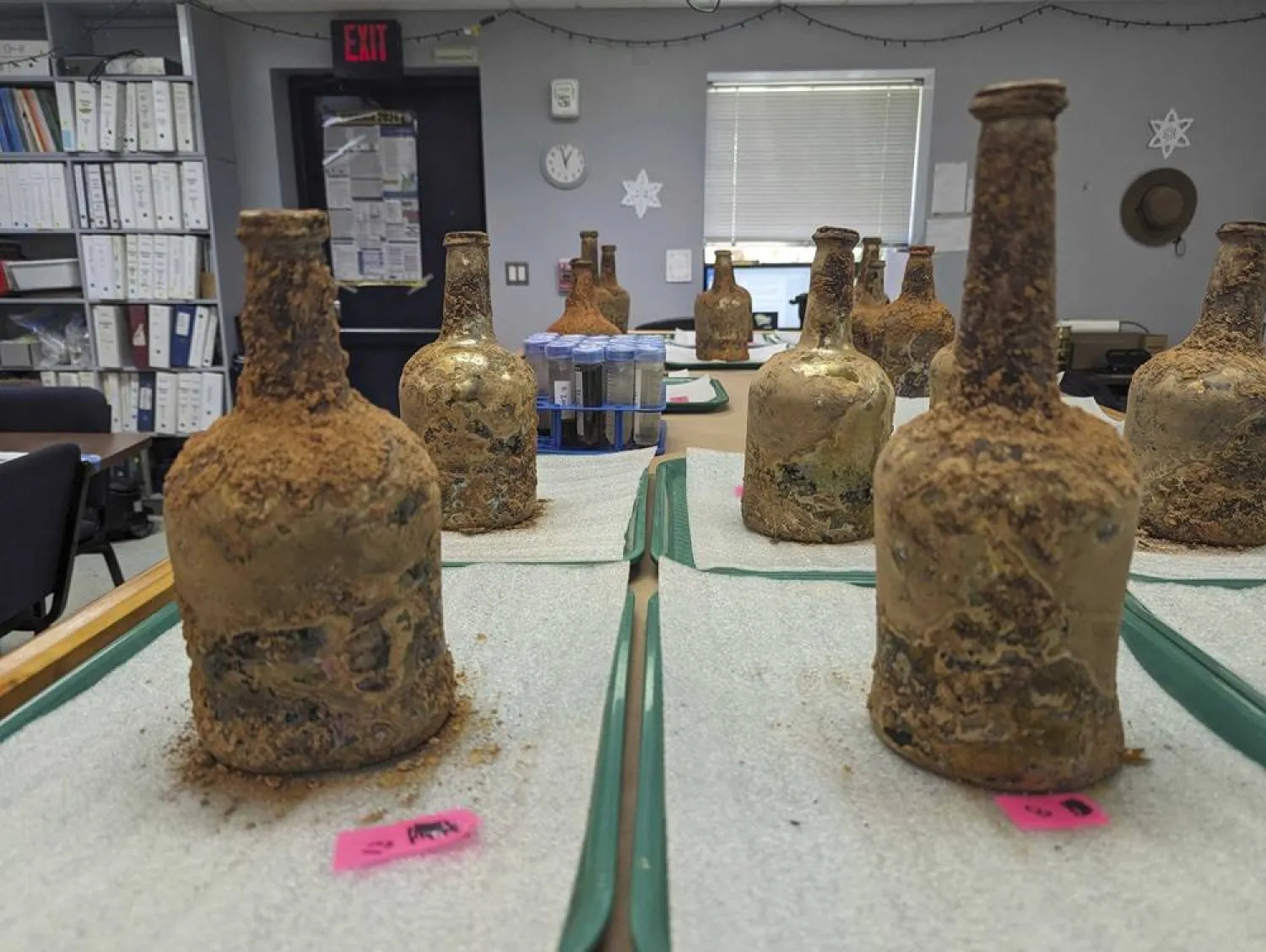
18th century artifacts found underneath George Washington's residence in Mount Vernon, Va., Monday, June 17, 2024. (AP Photo/Nathan Ellgren)
TT

Perfectly Preserved Centuries-Old Cherries Unearthed at George Washington’s Mount Vernon

18th century artifacts found underneath George Washington's residence in Mount Vernon, Va., Monday, June 17, 2024. (AP Photo/Nathan Ellgren)

George Washington never did cut down the cherry tree, despite the famous story to the contrary, but he did pack away quite a few bottles of the fruit at his Mount Vernon home.

Dozens of bottles of cherries and berries — impossibly preserved in storage pits uncovered from the cellar of his mansion on the banks of the Potomac River — were discovered during an archaeological dig connected to a restoration project.

Jason Boroughs, Mount Vernon's principal archaeologist, said the discovery of so much perfectly preserved food from more than 250 years ago is essentially unprecedented.

"Finding what is essentially fresh fruit, 250 years later, is pretty spectacular," Boroughs said in an interview. "All the stars sort of have to align in the right manner for that to happen."

Whole pieces of fruit, recognizable as cherries, were found in some of the bottles. Other bottles held what appear to be gooseberries or currants, though testing is underway to confirm that.

Mount Vernon is partnering with the US Department of Agriculture, which is conducting DNA testing on the fruit. They are also examining more than 50 cherry pits recovered from the bottles to see if any of them can be planted.

"It's kind of a longshot," said Benjamin Gutierrez, a USDA plant geneticist, of the chances of using a cherry pit to grow a tree. Seeds preserve best when they are dry, and most of the samples found at Mount Vernon were waterlogged. A couple of pits tested initially were not viable as seeds.

Still, he said the bottles are a remarkable find. In addition to DNA testing, he said chemical testing may be able to show if particular spices were used to preserve the fruits.

Records at Mount Vernon show that George and Martha Washington were fond of cherries, at least when mixed with brandy. Martha Washington's recipe for a "cherry bounce" cocktail survives, and Washington wrote that he took a canteen of cherry bounce with him on a trip across the Alleghenies in 1784.

These cherries, though, were most likely bottled to be eaten simply as cherries, Boroughs said.

The quality of the preservation reflect a high caliber of work. Slaves ran the plantation's kitchen. The kitchen was overseen by an enslaved woman named Doll, who came to Mount Vernon in 1758 with Martha Washington, according to the estate.

"The enslaved folks who were taking care of the trees, picking the fruit, working in the kitchen, those would have been the folks that probably would have overseen and done this process," Boroughs said. "It’s a highly skilled process. Otherwise they just wouldn’t have survived this way."

The bottles were found only because Mount Vernon is doing a $40 million revitalization project of the mansion that they expect to be completed by the nation's 250th birthday in 2026.

"When we do archaeology, it’s destructive," Boroughs said. "So unless we have a reason to disturb those resources, we tend not to."

"In this case, because of these needed structural repairs to the mansion, the ground was going to be disturbed. So we looked there first," he continued. "We didn’t expect to find all this."

They know the bottles predate 1775 because that's when an expansion of the mansion led to the area being covered over with a brick floor.

Mount Vernon announced back in April, at the start of its archaeological work, that it had found two bottles. As the dig continued, the number increased to 35 in six distinct storage pits. Six of the bottles were broken, with the other 29 intact. Twelve held cherries, 16 held the other berries believed to be currants and gooseberries, and one larger bottle held both cherries and other berries.

Boroughs believes they have now uncovered all the cherries and berries that survived.

"There is a lot of information that we’re excited to get from these bottles," he said.


Mounted New York Police Officer and His Horse Corner Suspected Purse Snatcher in Manhattan

A view shows the downtown Manhattan skyline in New York City, US, July 22, 2025. (Reuters)
TT

Mounted New York Police Officer and His Horse Corner Suspected Purse Snatcher in Manhattan

A view shows the downtown Manhattan skyline in New York City, US, July 22, 2025. (Reuters)

A New York City police officer on horseback nabbed a suspected purse snatcher after chasing her through the streets of Manhattan at full gallop — a wild scene evoking the clip-clopping past of a city where lights, sirens and squad cars are the norm.

The late Wednesday morning pursuit began when the victim reported the theft. The officer — whose name has not been released — and his horse quickly took up the chase that was captured on his bodycam and also by a television news crew that happened to be in the area for an unrelated story.

The officer repeatedly screamed at the suspect to stop running, but she refused while denying she had taken the purse.

The brief hoof chase went along sidewalks, under scaffolding, between parked cars and across streets before the woman was stopped by a pedestrian and then detained by the officer.

The woman was charged with larceny and providing false information. Authorities said she had been convicted of murder in the April 2000 fatal shooting of a cab driver and had served time in prison before being released. She is currently on lifetime parole.

No injuries were reported in the chase.


Back on Earth, Artemis II Crew Still Finding their Footing

HOUSTON, TEXAS - APRIL 16: Artemis II Commander Reid Wiseman, Pilot Victor Glover, Mission Specialist Christina Koch, and Mission Specialist Jeremy Hansen speak during a press conference at the NASA Johnson Space Center on April 16, 2026 in Houston, Texas. Danielle Villasana/Getty Images/AFP
TT

Back on Earth, Artemis II Crew Still Finding their Footing

HOUSTON, TEXAS - APRIL 16: Artemis II Commander Reid Wiseman, Pilot Victor Glover, Mission Specialist Christina Koch, and Mission Specialist Jeremy Hansen speak during a press conference at the NASA Johnson Space Center on April 16, 2026 in Houston, Texas. Danielle Villasana/Getty Images/AFP

Nearly a week after their Pacific splashdown, the astronauts who crewed the Artemis II mission that flew around the Moon told reporters Thursday they have yet to fully grasp the magnitude of the moment.

"It's been a week of medical testing, physical testing, doctors, science objectives," mission commander Reid Wiseman said during a press conference at NASA's Johnson Space Center in Houston.

"We have not had that decompression," he added.

The 50-year-old led fellow Americans Victor Glover and Christina Koch, and Canadian crewmate Jeremy Hansen, on a mission that took them farther into space than anyone has ever gone before.

Adjusting to life on Earth is taking a beat, AFP reported.

"Tomorrow will be one week, and I just was trying to live in a little hole for one week, been off social media, not on the news. So, no, I don't know," Glover, who piloted the mission, told reporters.

Nonetheless, he said his children and neighbors have clued him in to the excitement.

Artemis II was the first crewed mission to venture to the Moon's orbit since 1972, and the only one in history to include a woman, or a Black astronaut, or a non-American. Their voyage was broadcast live by US space agency NASA, and the media coverage of the launch and return to Earth was watched by millions of people.

For Koch, waking up to the reality means remembering gravity has taken hold.

"In the first few days, I thought I was floating. I truly thought I was floating, and I had to convince myself I wasn't," Koch said.

Their mission lasted almost 10 days, but NASA has ambitions to return to the Moon for longer visits to establish a base in preparation for future missions to Mars.

The United States is targeting a lunar landing in 2028, before the end of President Donald Trump's term and a deadline set by rivals in China.


Hidden Cave, Hippo Bones Under Welsh Castle May Rewrite History

Previous small-scale excavations at Pembroke Castle have already uncovered evidence of early humans and animals. PHOTO: UNIVERSITY OF ABERDEEN
TT

Hidden Cave, Hippo Bones Under Welsh Castle May Rewrite History

Previous small-scale excavations at Pembroke Castle have already uncovered evidence of early humans and animals. PHOTO: UNIVERSITY OF ABERDEEN

A prehistoric hidden cave and hippo bones found beneath a Welsh castle could transform understanding of ancient life in Britain, researchers said Thursday, calling the site a "once-in-a-lifetime discovery".

Previous small-scale excavations at Pembroke Castle have already uncovered evidence of early humans and animals, including a now extinct hippopotamus that roamed Wales 120,000 years ago.

A major five-year archaeological project led by the University of Aberdeen will investigate the "enormous" cave, accessed via a spiral staircase from the 11th Century castle, AFP reported.

"There is no other site like it in Britain -- it is a once-in-a-lifetime discovery," said Rob Dinnis, who will lead the project.

The cave, previously thought to have been emptied by the Victorians, is now described as "one of the most important prehistoric archives in Britain".

"Despite the limited work done so far, we can already say that Wogan Cavern is a truly remarkable site," Dinnis said in a statement.

"Not only is there extremely rare evidence for early Homo sapiens, there are also hints at even earlier human occupation, probably by Neanderthals."

"We have also found hippo bones, which probably date to the last interglacial period, around 120,000 years ago," he added.

Earlier finds have revealed bones of mammoth, woolly rhinoceros, reindeer and wild horse, alongside stone tools and evidence of human occupation across multiple periods.

With larger-scale excavation due to resume in May, the researchers hope to gain "insights into past climate change, extinct species, and the multiple periods when humans called the cave their home".

They said the site could chart a long sequence of human activity, from hunter-gatherers after the last Ice Age around 11,500 years ago to some of Britain's earliest Homo sapiens between 45,000 and 35,000 years ago, and possibly even earlier Neanderthal presence.

"Wogan Cavern provides a unique chance to use all the scientific techniques now available to archaeologists," said professor Kate Britton of the University of Aberdeen.

"Because the bones are well preserved, we can learn a lot about past environments and ecosystems," she added.

At Pembroke Castle, staff say the discovery adds a new dimension to the site's long history as a medieval fortress and birthplace of Henry VII in 1457.

"This is incredibly exciting news for everyone at the castle," said castle manager Jon Williams.

"We are thrilled that work on this wonderful cave will continue."
