Actor Donald Sutherland Dies at 88

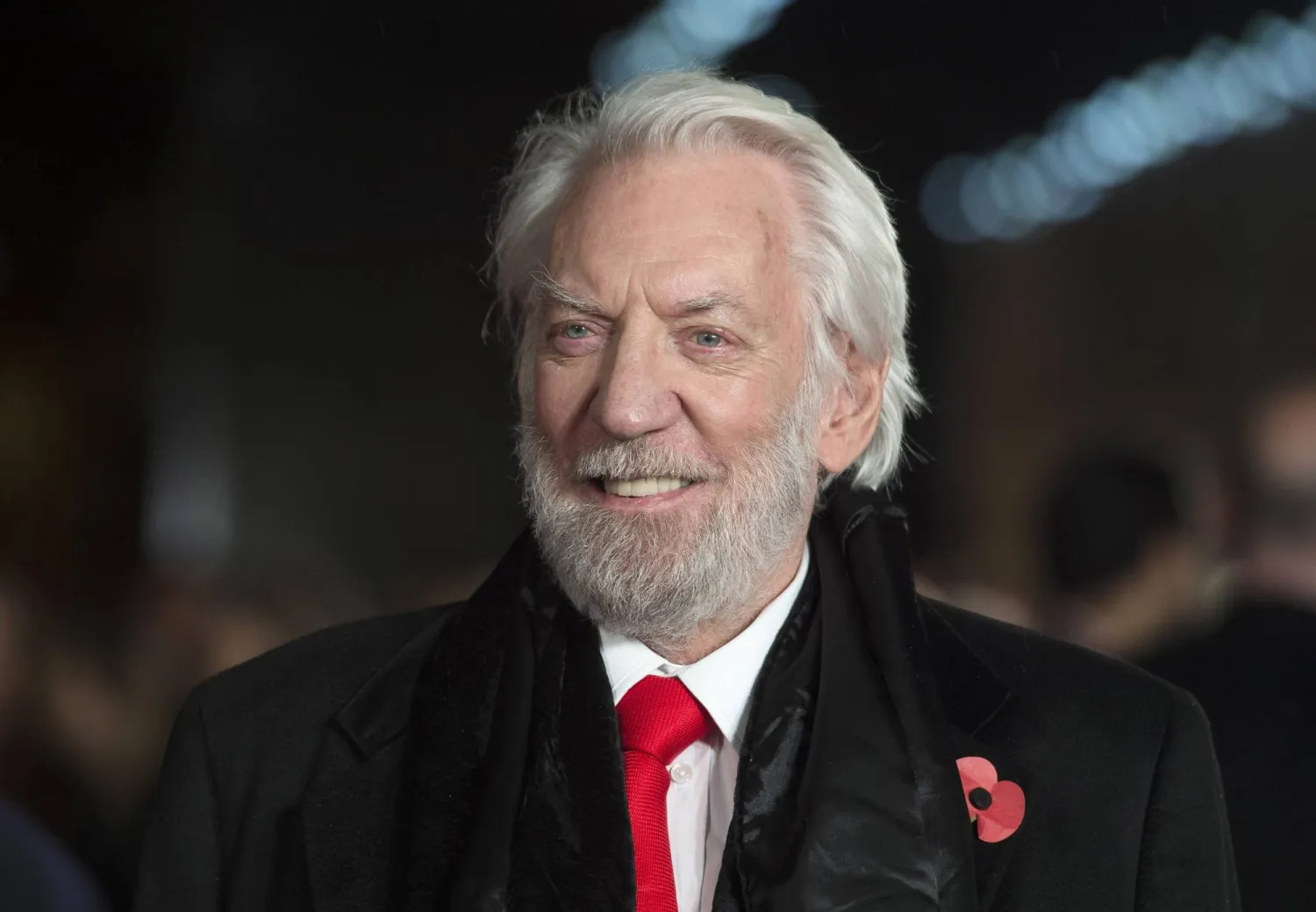
Canadian actor Donald Sutherland arrives for the UK premiere of The Hunger Games: Mockingjay - Part 2  in Leicester Square, Central London, Britain, 05 November 2015 (reissued 20 June 2024). EPA/WILL OLIVER
Canadian actor Donald Sutherland arrives for the UK premiere of The Hunger Games: Mockingjay - Part 2 in Leicester Square, Central London, Britain, 05 November 2015 (reissued 20 June 2024). EPA/WILL OLIVER
TT

Actor Donald Sutherland Dies at 88

Canadian actor Donald Sutherland arrives for the UK premiere of The Hunger Games: Mockingjay - Part 2  in Leicester Square, Central London, Britain, 05 November 2015 (reissued 20 June 2024). EPA/WILL OLIVER
Canadian actor Donald Sutherland arrives for the UK premiere of The Hunger Games: Mockingjay - Part 2 in Leicester Square, Central London, Britain, 05 November 2015 (reissued 20 June 2024). EPA/WILL OLIVER

Donald Sutherland, the prolific film and television actor whose long career stretched from "M.A.S.H." to “The Hunger Games,” has died. He was 88.
Kiefer Sutherland, the actor's son, confirmed his father's death Thursday, The Associated Press reported.
“I personally think one of the most important actors in the history of film,” Kiefer Sutherland said on X. “Never daunted by a role, good, bad or ugly. He loved what he did and did what he loved, and one can never ask for more than that.”
The tall and gaunt Canadian actor with a grin that could be sweet or diabolical was known for offbeat characters like Hawkeye Pierce in Robert Altman's "M.A.S.H.," the hippie tank commander in "Kelly's Heroes" and the stoned professor in "Animal House."
Before transitioning into a long career as a respected character actor, Sutherland epitomized the unpredictable, antiestablishment cinema of the 1970s .
Over the decades, Sutherland showed his range in more buttoned-down — but still eccentric — parts in Robert Redford's "Ordinary People" and Oliver Stone's "JFK." More, recently, he starred in the “Hunger Games” films. He never retired, working regularly up until his death. A memoir, “Made Up, But Still True,” was due out in November.
"I love to work. I passionately love to work," Sutherland told Charlie Rose in 1998. "I love to feel my hand fit into the glove of some other character. I feel a huge freedom — time stops for me. I'm not as crazy as I used to be, but I'm still a little crazy."
Sutherland career as a leading man peaked in the 1970s, when he starred in films by the era's top directors — even if they didn't always do their best work with him. Sutherland, who frequently said he considered himself at the service of a director's vision, worked with Federico Fellini (1976's "Fellini's Casanova"), Bernardo Bertolucci (1976's "1900"), Claude Chabrol (1978's "Blood Relatives") and John Schlesinger (1975's "The Day of the Locust").
One of his finest performances came as a detective in Alan Pakula's "Klute" (1971). It was during filming on "Klute" that he met Fonda, with whom he had a three-year-long relationship that began at the end of his second marriage to actor Shirley Douglas. Having been married in 1966, he and Douglas divorced in 1971.
Sutherland had twins with Douglas in 1966: Rachel and Kiefer, who was named after Warren Kiefer, the writer of Sutherland's first film, "Castle of the Living Dead."
In 1974, the actor began living with actress Francine Racette, with whom he remained ever after. They had three children: Roeg, born in 1974 and named after the director Nicolas Roeg ("Don't Look Now"); Rossif, born in 1978 and named after the director Frederick Rossif; and Angus Redford, born in 1979 and named after Robert Redford.
It was Redford who, to the surprise of some, cast Sutherland as the father in his directorial debut, 1980's "Ordinary People." Redford's drama about a handsome suburban family destroyed by tragedy won four Oscars, including best picture.
Sutherland was overlooked by the academy throughout most of his career. He was never nominated but was presented with an honorary Oscar in 2017. He did, though, win an Emmy in 1995 for the TV film "Citizen X" and was nominated for seven Golden Globes (including for his performances in "M.A.S.H." and "Ordinary People"), winning two — again for "Citizen X" and for the 2003 TV film "Path to War."
"Ordinary People" also presaged a shift in Sutherland's career toward more mature and sometimes less offbeat characters.
His New York stage debut in 1981, though, went terribly. He played Humbert Humbert in Edward Albee's adaptation of Vladimir Nabokov's "Lolita," and the reviews were merciless; it closed after a dozen performances.
A down period in the '80s followed, thanks to failures like the 1981 satire "Gas" and the 1984 comedy "Crackers."
But Sutherland continued to work steadily. He had a brief but memorable role in Oliver Stone's "JFK" (1991). He again played a patriarch for Redford in his 1993 movie "Six Degrees of Separation." He played track coach Bill Bowerman in 1998's "Without Limits."
In the last decade, Sutherland increasingly worked in television, most memorably in HBO's "Path to War," in which he played President Lyndon Johnson's Secretary of Defense Clark Clifford.



Perry Bamonte, Keyboardist and Guitarist for The Cure, Dies at 65

Perry Bamonte of The Cure performs at North Island Credit Union Amphitheater on May 20, 2023 in Chula Vista, California. (Getty Images/AFP)
TT

Perry Bamonte, Keyboardist and Guitarist for The Cure, Dies at 65

Perry Bamonte of The Cure performs at North Island Credit Union Amphitheater on May 20, 2023 in Chula Vista, California. (Getty Images/AFP)

Perry Bamonte, keyboardist and guitarist in The Cure, has died at 65, the English indie rock band confirmed through their official website on Friday.

In a statement, the band wrote that Bamonte died "after a short illness at home" on Christmas Day.

"It is with enormous sadness that ‌we confirm ‌the death of our ‌great ⁠friend and ‌bandmate Perry Bamonte who passed away after a short illness at home over Christmas," the statement said, adding he was a "vital part of The Cure story."

The statement said Bamonte was ⁠a full-time member of The Cure since 1990, ‌playing guitar, six-string bass, ‍and keyboards, and ‍performed in more than 400 shows.

Bamonte, ‍born in London, England, in 1960, joined the band's road crew in 1984, working alongside his younger brother Daryl, who worked as tour manager for The Cure.

Bamonte first worked as ⁠an assistant to co-founder and lead vocalist, Robert Smith, before becoming a full member after keyboardist Roger O'Donnell left the band in 1990.

Bamonte's first album with The Cure was "Wish" in 1992. He continued to work with them on the next three albums.

He also had various acting ‌roles in movies: "Judge Dredd,About Time" and "The Crow."


First Bond Game in a Decade Hit by Two-month Delay

'007 First Light' depicts a younger Bond earning his license to kill. Ina FASSBENDER / AFP
TT

First Bond Game in a Decade Hit by Two-month Delay

'007 First Light' depicts a younger Bond earning his license to kill. Ina FASSBENDER / AFP

A Danish video game studio said it was delaying the release of the first James Bond video game in over a decade by two months to "refine the experience".

Fans will now have to wait until May 27 to play "007 First Light" featuring Ian Fleming's world-famous spy, after IO Interactive said on Tuesday it was postponing the launch to add some final touches.

"007 First Light is our most ambitious project to date, and the team has been fully focused on delivering an unforgettable James Bond experience," the Danish studio wrote on X.

Describing the game as "fully playable", IO Interactive said the two additional months would allow their team "to further polish and refine the experience", giving players "the strongest possible version at launch".

The game, which depicts a younger Bond earning his license to kill, is set to feature "globe-trotting, spycraft, gadgets, car chases, and more", IO Interactive added.

It has been more than a decade since a video game inspired by Bond was released. The initial release date was scheduled for March 27.


Movie Review: An Electric Timothee Chalamet Is the Consummate Striver in Propulsive ‘Marty Supreme’

 Timothee Chalamet attends the premiere of "Marty Supreme" at Regal Times Square on Tuesday, Dec. 16, 2025, in New York. (AP)
Timothee Chalamet attends the premiere of "Marty Supreme" at Regal Times Square on Tuesday, Dec. 16, 2025, in New York. (AP)
TT

Movie Review: An Electric Timothee Chalamet Is the Consummate Striver in Propulsive ‘Marty Supreme’

 Timothee Chalamet attends the premiere of "Marty Supreme" at Regal Times Square on Tuesday, Dec. 16, 2025, in New York. (AP)
Timothee Chalamet attends the premiere of "Marty Supreme" at Regal Times Square on Tuesday, Dec. 16, 2025, in New York. (AP)

“Everybody wants to rule the world,” goes the Tears for Fears song we hear at a key point in “Marty Supreme,” Josh Safdie’s nerve-busting adrenaline jolt of a movie starring a never-better Timothee Chalamet.

But here’s the thing: everybody may want to rule the world, but not everybody truly believes they CAN. This, one could argue, is what separates the true strivers from the rest of us.

And Marty — played by Chalamet in a delicious synergy of actor, role and whatever fairy dust makes a performance feel both preordained and magically fresh — is a striver. With every fiber of his restless, wiry body. They should add him to the dictionary definition.

Needless to say, Marty is a New Yorker.

Also needless to say, Chalamet is a New Yorker.

And so is Safdie, a writer-director Chalamet has called “the street poet of New York.” So, where else could this story be set?

It’s 1952, on Manhattan’s Lower East Side. Marty Mauser is a salesman in his uncle’s shoe store, escaping to the storeroom for a hot tryst with his (married) girlfriend. This witty opening sequence won’t be the only thing recalling “Uncut Gems,” co-directed by Safdie with his brother Benny before the two split for solo projects. That film, which feels much like the precursor to “Marty Supreme,” began as a trip through the shiny innards of a rare opal, only to wind up inside Adam Sandler’s colon, mid-colonoscopy.

Sandler’s Howard Ratner was a New York striver, too, but sadder, and more troubled. Marty is young, determined, brash — with an eye always to the future. He’s a great salesman: “I could sell shoes to an amputee,” he boasts, crassly. But what he’s plotting to unveil to the world has nothing to do with shoes. It’s about table tennis.

How likely is it that this Jewish kid from the Lower East Side can become the very face of a sport in America, soon to be “staring at you from the cover of a Wheaties box?”

To Marty, perfectly likely. Still, he knows nobody in the US cares about table tennis. He’s so determined to prove everyone wrong, starting at the British Open in London, that when there’s a snag obtaining cash for his trip, he brandishes a gun at a colleague to get it.

Shaking off that sorta-armed robbery thing, Marty arrives in London, where he fast-talks his way into a suite at the Ritz. Here, he spies fellow guest Kay Stone (Gwyneth Paltrow, in a wise, stylish return to the screen), a former movie star married to an insufferable tycoon (“Shark Tank” personality Kevin O’Leary, one of many nonactors here.)

Kay’s skeptical, but Marty finds a way to woo her. Really, all he has to say is: “Come watch me.” Once she sees him play, she’s sneaking into his room in a lace corselet.

This would be a good time to stop and consider Chalamet’s subtly transformed appearance. He is stick-thin — duh, he never stops moving. His mustache is skimpy. His skin is acne-scarred — just enough to erase any movie-star sheen. Most strikingly, his eyes, behind the round spectacles, are beady — and smaller. Definitely not those movie-star eyes.

But then, nearly all the faces in “Marty Supreme” are extraordinary. In a movie with more than 100 characters, we have known actors (Fran Drescher, Abel Ferrara); nonacting personalities (O’Leary, and an excellent Tyler Okonma (Tyler, The Creator) as Marty’s friend Wally); and exciting newcomers like Odessa A’Zion as Marty’s feisty girlfriend Rachel.

There are also a slew of nonactors in small parts, plus cameos from the likes of David Mamet and even high wire artist Philippe Petit. The dizzying array makes one curious how it all came together — is casting director Jennifer Venditti taking interns? Production notes tell us that for one hustling scene at a bowling alley, young men were recruited from a sports trading-card convention.

Elsewhere on the creative team, composer Daniel Lopatin succeeds in channeling both Marty’s beating heart and the ricochet of pingpong balls in his propulsive score. The script by Safdie and cowriter Ronald Bronstein, loosely based on real-life table tennis hustler Marty Reisman, beats with its own, never-stopping pulse. The same breakneck aesthetic applies to camera work by Darius Khondji.

Back now to London, where Marty makes the finals against Japanese player Koto Endo (Koto Kawaguchi, like his character a deaf table tennis champion). “I’ll be dropping a third atom bomb on them,” he brags — not his only questionable World War II quip. But Endo, with his unorthodox paddle and grip, prevails.

After a stint as a side act with the Harlem Globetrotters, including pingpong games with a seal — you’ll have to take our word for this, folks, we’re running low on space — Marty returns home, determined to make the imminent world championships in Tokyo.

But he's in trouble — remember he took cash at gunpoint? Worse, he has no money.

So Marty’s on the run. And he’ll do anything, however messy or dangerous, to get to Japan. Even if he has to totally debase himself (mark our words), or endanger friends — or abandon loyal and brave Rachel.

Is there something else for Marty, besides his obsessive goal? If so, he doesn’t know it yet. But the lyrics of another song used in the film are instructive here: “Everybody’s got to learn sometime.”

So can a single-minded striver ultimately learn something new about his own life?

We'll have to see. As Marty might say: “Come watch me.”