Iran's Presidential Candidates Talk Economic Policies in 2nd Live Debate Ahead of June 28 Vote

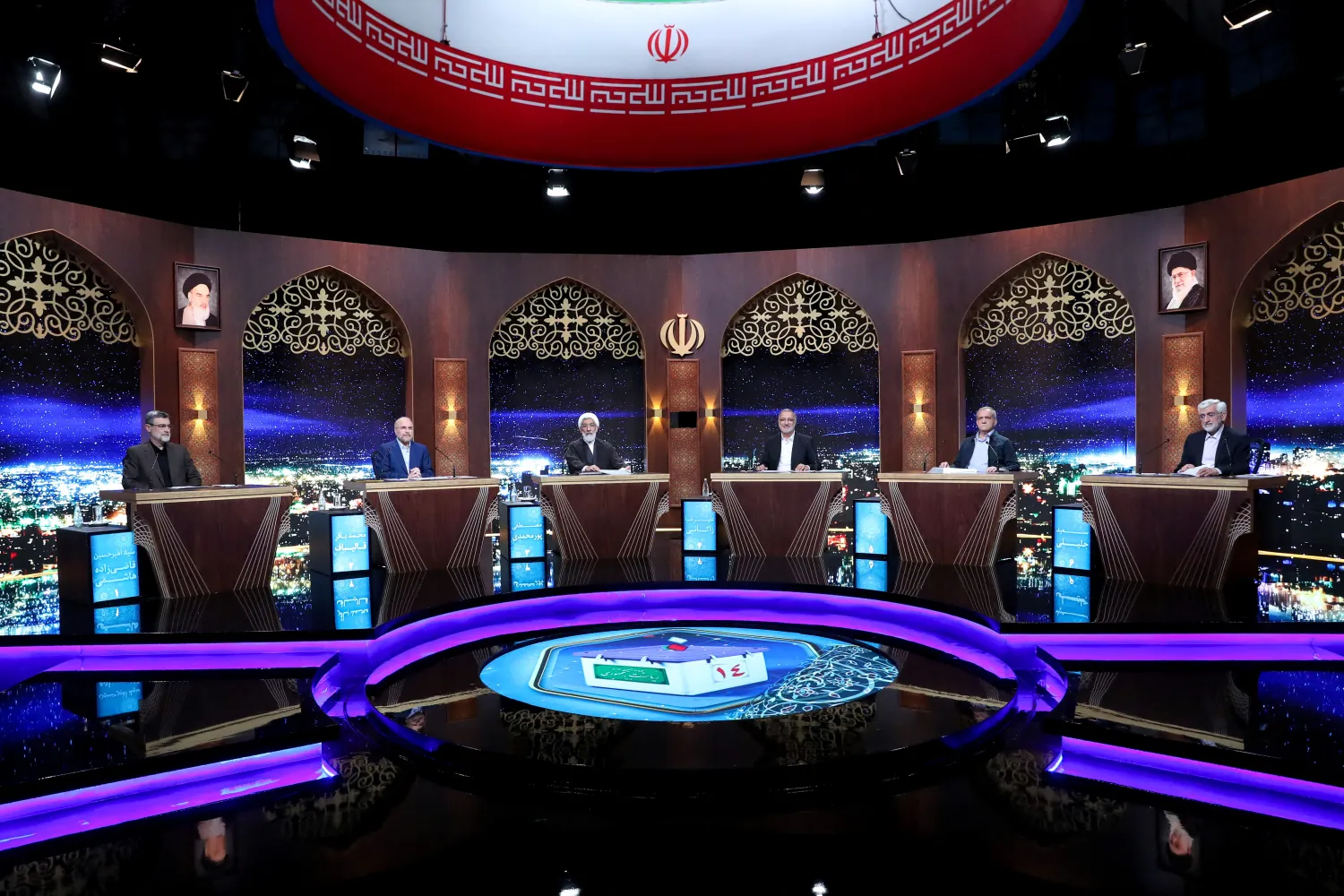
Iranian presidential candidates attend an election debate at a television studio in Tehran, Iran June 20, 2024. Morteza Fakhri Nezhad/IRIB/WANA (West Asia News Agency)/Handout via REUTERS
TT

Iran's Presidential Candidates Talk Economic Policies in 2nd Live Debate Ahead of June 28 Vote

Iranian presidential candidates attend an election debate at a television studio in Tehran, Iran June 20, 2024. Morteza Fakhri Nezhad/IRIB/WANA (West Asia News Agency)/Handout via REUTERS

In the second live debate on state television, six presidential candidates on Thursday discussed Iran's economic problems ahead of the country's June 28 election following a helicopter crash last month that killed President Ebrahim Raisi and seven others.
It was the second of five debates planned in the days before the vote in a shortened campaign to replace Raisi, a hardline protégé of Supreme Leader Ali Khamenei once floated as a possible successor to the 85-year-old cleric, said The Associated Press.
Like the first debate, the second one also related to economics with the candidates discussing their proposals for Iran’s spiraling economy which is struggling under sanctions imposed by the United States and other Western nations.
The candidates also discussed inflation, the budget deficit, fuel consumption subsidies and education. They all promised to try to get the sanctions lifted and to introduce reforms, but none offered concrete details.
“Negotiation is a method of struggle," said prominent candidate Mohammad Bagher Qalibaf, 62, with regards to getting the Western sanctions on Iran lifted. Qalibaf is a former Tehran mayor with close ties to the country’s paramilitary Revolutionary Guard.
He emphasized the destructiveness of the sanctions on the economy and said that Iranians have a right to a good life, not just an ordinary life.
Iran’s vice president, Amir Hossein Qazizadeh Hashemi, 53, said he will continue Raisi’s unfinished administration and vowed to develop the tourism industry.
Regarding the health sector and the emigration of doctors and nurses abroad, Qalibaf said there should be a fundamental change in the way health workers are paid to increase the motivation to stay.
Many doctors and nurses reportedly have left Iran in recent years over its deepening economic woes and poor working conditions. Qalibaf's call for more pay for health workers was repeated by the other candidates.
All the candidates said they believe the Education Ministry is the most important part of the government because “the next generation of the country is raised in this ministry.” Qalibaf said the ministry's budget must be increased.
The one pro-reform candidate, Masoud Pezeshkian, who is backed by pro-reform figures such as former President Mohammad Khatami and former foreign minister Mohammad Javad Zarif, thinks the economic crisis can be resolved by solving party differences inside the country as well as external factors.
The June 28 election comes at a time of heightened tensions between Iran and the West over Tehran’s rapidly advancing nuclear program, its arming of Russia in that country’s war on Ukraine and its wide-reaching crackdowns on dissent.
Iran’s support of militia proxy forces throughout the wider Middle East, meanwhile, has been increasingly in the spotlight as Iran-backed Yemen’s Houthi militants attack ships in the Red Sea over the Israel-Hamas war in the Gaza Strip.



Top Trump Iran Negotiator Says Visits US Aircraft Carrier in Middle East

US Special Envoy Steve Witkoff delivers a press conference upon the signing of the declaration on deploying post-ceasefire force in Ukraine, during the so-called "Coalition of the Willing" summit, at the Elysee Palace in Paris, France, January 6, 2026. (Reuters)
TT

Top Trump Iran Negotiator Says Visits US Aircraft Carrier in Middle East

US Special Envoy Steve Witkoff delivers a press conference upon the signing of the declaration on deploying post-ceasefire force in Ukraine, during the so-called "Coalition of the Willing" summit, at the Elysee Palace in Paris, France, January 6, 2026. (Reuters)

US President Donald Trump's lead Iran negotiator Steve Witkoff on Saturday said he visited the USS Abraham Lincoln aircraft carrier currently in the Arabian Sea, with Washington and Tehran due to hold further talks soon.

"Today, Adm. Brad Cooper, Commander of US Naval Forces Central Command, Jared Kushner, and I met with the brave sailors and Marines aboard the USS Abraham Lincoln, her strike group, and Carrier Air Wing 9 who are keeping us safe and upholding President Trump's message of peace through strength," said Witkoff in a social media post.

Iranian Foreign Minister Abbas Araghchi said on Saturday he hoped talks with the United States would resume soon, while reiterating Tehran's red lines and warning against any American attack.


Israel’s Netanyahu Expected to Meet Trump in US on Wednesday and Discuss Iran

Israeli Prime Minister Benjamin Netanyahu delivers a speech during a special session to mark the 77th anniversary of the Knesset's establishment and the 60th anniversary of the dedication of the current building at the Knesset, the Israeli parliament, in Jerusalem, 02 February 2026. (EPA)
TT

Israel’s Netanyahu Expected to Meet Trump in US on Wednesday and Discuss Iran

Israeli Prime Minister Benjamin Netanyahu delivers a speech during a special session to mark the 77th anniversary of the Knesset's establishment and the 60th anniversary of the dedication of the current building at the Knesset, the Israeli parliament, in Jerusalem, 02 February 2026. (EPA)

Israeli Prime Minister Benjamin Netanyahu is expected to meet US President Donald Trump on Wednesday in Washington, where they will discuss negotiations with Iran, Netanyahu's office said on Saturday.

Iranian and US officials held indirect nuclear ‌talks in the ‌Omani capital ‌Muscat ⁠on Friday. ‌Both sides said more talks were expected to be held again soon.

A regional diplomat briefed by Tehran on the talks told Reuters Iran insisted ⁠on its "right to enrich uranium" ‌during the negotiations with ‍the US, ‍and that Tehran's missile capabilities ‍were not raised in the discussions.

Iranian officials have ruled out putting Iran's missiles - one of the largest such arsenals in the region - up ⁠for discussion, and have said Tehran wants recognition of its right to enrich uranium.

"The Prime Minister believes that any negotiations must include limiting ballistic missiles and halting support for the Iranian axis," Netanyahu's office said in a ‌statement.


Italy FM Rules Out Joining Trump’s ‘Board of Peace’

Italy's Minister for Foreign Affairs Antonio Tajani speaks to the press during the EPP Leaders’ meeting, in Zagreb, Croatia, 30 January 2026. (EPA)
TT

Italy FM Rules Out Joining Trump’s ‘Board of Peace’

Italy's Minister for Foreign Affairs Antonio Tajani speaks to the press during the EPP Leaders’ meeting, in Zagreb, Croatia, 30 January 2026. (EPA)

Italy will not take part in US President Donald Trump's "Board of Peace", Italian Foreign Minister Antonio Tajani said Saturday, citing "insurmountable" constitutional issues.

Trump launched his "Board of Peace" at the World Economic Forum in Davos in January and some 19 countries have signed its founding charter.

But Italy's constitution bars the country from joining an organization led by a single foreign leader.

Prime Minister Giorgia Meloni, a Trump ally, last month noted "constitutional problems" with joining, but suggested Trump could perhaps reopen the framework "to meet the needs not only of Italy, but also of other European countries".

Tajani appeared Saturday to rule that out.

"We cannot participate in the Board of Peace because there is a constitutional limit," he told the ANSA news agency.

"This is insurmountable from a legal standpoint," he said, the day after meeting US Secretary of State Marco Rubio and US Vice President JD Vance at the Olympics in Milan.

Although originally meant to oversee Gaza's rebuilding, the board's charter does not limit its role to the Palestinian territory and appears to want to rival the United Nations.