

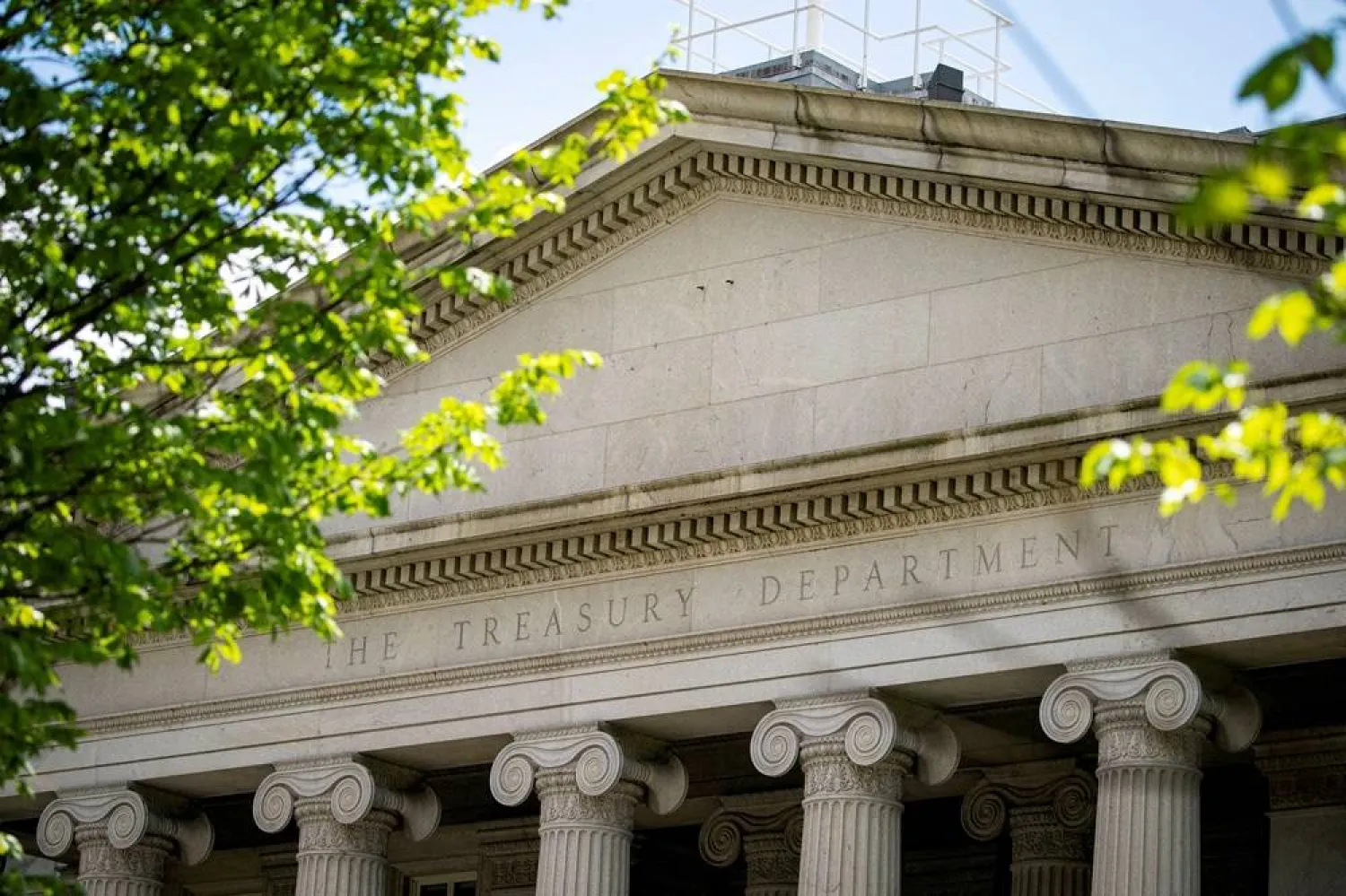

US Slaps Sanctions on Network It Accuses of Moving Billions for Iran’s Military

The Treasury Department is pictured in Washington, US, April 25, 2021. (Reuters)
TT

US Slaps Sanctions on Network It Accuses of Moving Billions for Iran’s Military

The Treasury Department is pictured in Washington, US, April 25, 2021. (Reuters)

The United States on Tuesday imposed sanctions on nearly 50 entities and people it accused of moving billions of dollars for Iran's military.

The US Treasury Department in a statement said those targeted on Tuesday constitute a "shadow banking network" used by Iran's Ministry of Defense and Armed Forces Logistics (MODAFL) and Iranian Revolutionary Guard Corps (IRGC), both of which are under US sanctions.

The network helped the MODAFL and IRGC - which earn money notably from the sale of oil and petrochemicals - gain access to the international financial system and process the equivalent of billions of dollars since 2020, the Treasury said.

The Treasury said the revenue generated by the MODAFL and IRGC through networks of Iranian exchange houses and foreign cover companies supported the provision of weapons and funding to Iran's proxy groups, including Yemen's Houthi militias, and the transfer of drones to Russia for use in the war against Ukraine.

Washington has issued rafts of sanctions targeting Iranian drones and the Houthis, who have been launching drone and missile strikes in shipping lanes since November in what they say is solidarity with Palestinians in Israel's war in Gaza.

"We continue to work with allies and partners, as well as the global financial industry, to increase vigilance against the movement of funds supporting terrorism," Deputy Treasury Secretary Wally Adeyemo said in the statement.

Iran's mission to the United Nations in New York did not immediately comment on the action.

Tuesday's action targeted dozens of companies in Hong Kong, the United Arab Emirates and Marshall Islands, as well as Iran and Türkiye-based firms.

The Treasury said the MODAFL Supply Division uses exchange houses in Iran that manage numerous cover companies registered in jurisdictions such as Hong Kong or the UAE to launder revenue, including from oil sales conducted by Sahara Thunder, which the US imposed sanctions on in April.

The Treasury at the time accused Sahara Thunder of being a front company that oversees MODAFL's commercial activities in support of the IRGC and Russia's war in Ukraine, playing a key role in Iran's design, development, manufacture and sale of thousands of drones.

The move freezes the US assets of banned companies and individuals, and generally bars Americans from dealing with them. Those that engage in certain transactions with them also risk being hit with sanctions.


Iran Says France's Move to Expel Two Iranian Diplomats 'Illegal'

Iranian Foreign Ministry spokesperson Esmaeil Baqaei (Archive photo – MEHR)
TT

Iran Says France's Move to Expel Two Iranian Diplomats 'Illegal'

Iranian Foreign Ministry spokesperson Esmaeil Baqaei (Archive photo – MEHR)

Iran's foreign ministry said on Monday that France's decision to expel two Iranian diplomats in response to Tehran's ban on two French diplomats was "illegal".

"The action that France took is an illegal action in response to Iran's legal action, and is in no way helpful to bilateral relations," ministry spokesman Esmaeil Baqaei said at a weekly press conference.

Last week, Baqaei said two French diplomats who were briefly arrested in Iran in July over "interference" in Iran's internal affairs "would not be permitted to return".

French Foreign Minister Jean-Noel Barrot responded by saying that two Iranian diplomats in France would be expelled "in the coming days".

Barrot said the French move was a consequence of "intolerable" treatment of the French diplomats, who were briefly detained last month in Tehran.

He said the pair had been targeted by Iranian officials "in flagrant violation of diplomatic immunity".

They had also suffered "an extremely serious act of intimidation" at the hands of Iran's security service, he added.

Baqaei had previously said Paris should apologize for the actions of the French diplomats, which he said had violated the Vienna Convention.


Iran’s Currency Hits New Record Low as US Prepares to Announce More Sanctions

People walk in the Grand Bazaar in Tehran, Iran, August 23, 2026. Majid Asgaripour/WANA (West Asia News Agency) via Reuters
TT

Iran’s Currency Hits New Record Low as US Prepares to Announce More Sanctions

People walk in the Grand Bazaar in Tehran, Iran, August 23, 2026. Majid Asgaripour/WANA (West Asia News Agency) via Reuters

Iran’s currency hit a new record low Monday as Washington prepared to announce new sanctions it said would be an “economic D-Day” and would add further pressure on an economy already battered by previous sanctions and a US naval blockade.

The rial dropped to 2.02 million to the US dollar as trading opened on informal currency markets. Iran’s official Central Bank rate stood at around 1.5 million rial to the dollar, but the informal rate is what most Iranians pay.

The currency had already been under pressure before the US and Israel attacked Iran on Feb. 28, with double-digit inflation and negative growth, but has been hitting new record lows as nearly six months of war have taken an even greater toll.

Still, US President Donald Trump has been unable to win concessions from Iran, which continues to keep a firm grip on shipping through the Strait of Hormuz, the key waterway through which a fifth of the world’s traded oil transited freely before the war began.

Iranian attacks and threats have severely hampered that traffic during the war.


Iran Dismisses US Threat of 'Economic D-day'

FILE - Iran's Ambassador to the International Atomic Energy Agency, IAEA, Kazem Gharibabadi, waits for the start of the IAEA board of governors meeting at the International Center in Vienna, Austria, Nov. 21, 2019. (AP Photo/Ronald Zak, file)
TT

Iran Dismisses US Threat of 'Economic D-day'

FILE - Iran's Ambassador to the International Atomic Energy Agency, IAEA, Kazem Gharibabadi, waits for the start of the IAEA board of governors meeting at the International Center in Vienna, Austria, Nov. 21, 2019. (AP Photo/Ronald Zak, file)

Iran on Monday dismissed Washington's declaration of a massive economic pressure campaign, saying it disproved US claims to have dismantled Tehran's military and nuclear capabilities.

"Your narrative doesn't add up: you say that Iran's military power has been 'dismantled', 100% of its military factories 'destroyed' and its nuclear program 'buried'," Kazem Gharibabadi, deputy foreign minister, said in a post on X.

Yet, he added, "there is a need for 'the largest financial invasion in history' and the mobilization of 'all institutions and powers' of the United States! Is this a victory or an admission of America's defeat?"

Earlier, US Treasury Secretary Scott Bessent wrote in the Financial Times that Washington was launching the "single greatest financial offensive marshalled against an adversary" -- calling it an "economic D-Day".

Bessent posted on X that the measure came after the United States "dismantled Iran's military capabilities, destroyed nearly 100 percent of its military factories, and buried its nuclear program."

He is scheduled to explain the new US sanctions on Iran on Monday.

Meanwhile, Iran's foreign ministry warned countries against joining the US economic campaign. Spokesman Esmaeil Baqaei said taking part would "definitely have its own consequences".

The United States and Israel triggered the Middle East war with a massive wave of strikes against Iran on February 28, triggering Iranian retaliation across the region.

An April 8 ceasefire ended nearly 40 days of intense bombardment, but control over the Strait of Hormuz soon emerged as a key flashpoint in the conflict.

Iran has controlled the vital energy conduit since the war began. Reopening the strait, vital for global oil and gas supplies, has become a US priority, but Tehran insists the waterway will remain closed until Washington lifts its naval blockade on Iranian ports, removes oil sanctions and unfreezes Iranian assets abroad.

Last week, US President Donald Trump announced that Washington would ramp up economic pressure on Iran "on an unprecedented scale."

Washington has urged other governments, including Beijing, to join efforts to further isolate Iran's economy.

In an article published on Monday in Iran's Ettela'at newspaper, Tehran's Foreign Minister Abbas Araghchi said relations with China "have taken on deeper, more structural, and more comprehensive dimensions."

Iran has faced US and international sanctions since the 1979 Iranian revolution.

Trump has repeatedly pursued a "maximum pressure" policy of economic sanctions against Iran, reinstating the approach after returning to office in January 2025 following a similar campaign during his first term.

Iran has repeatedly dismissed the sanctions policy as a failure, insisting that economic pressure and threats will not force it to change course.