


Some Kenyans Combat the Threat of Logging with Hidden Beehives

Kenya has 54,430 hectares (134,500 acres) of mangroves remaining - The AP
TT

Some Kenyans Combat the Threat of Logging with Hidden Beehives

Kenya has 54,430 hectares (134,500 acres) of mangroves remaining - The AP

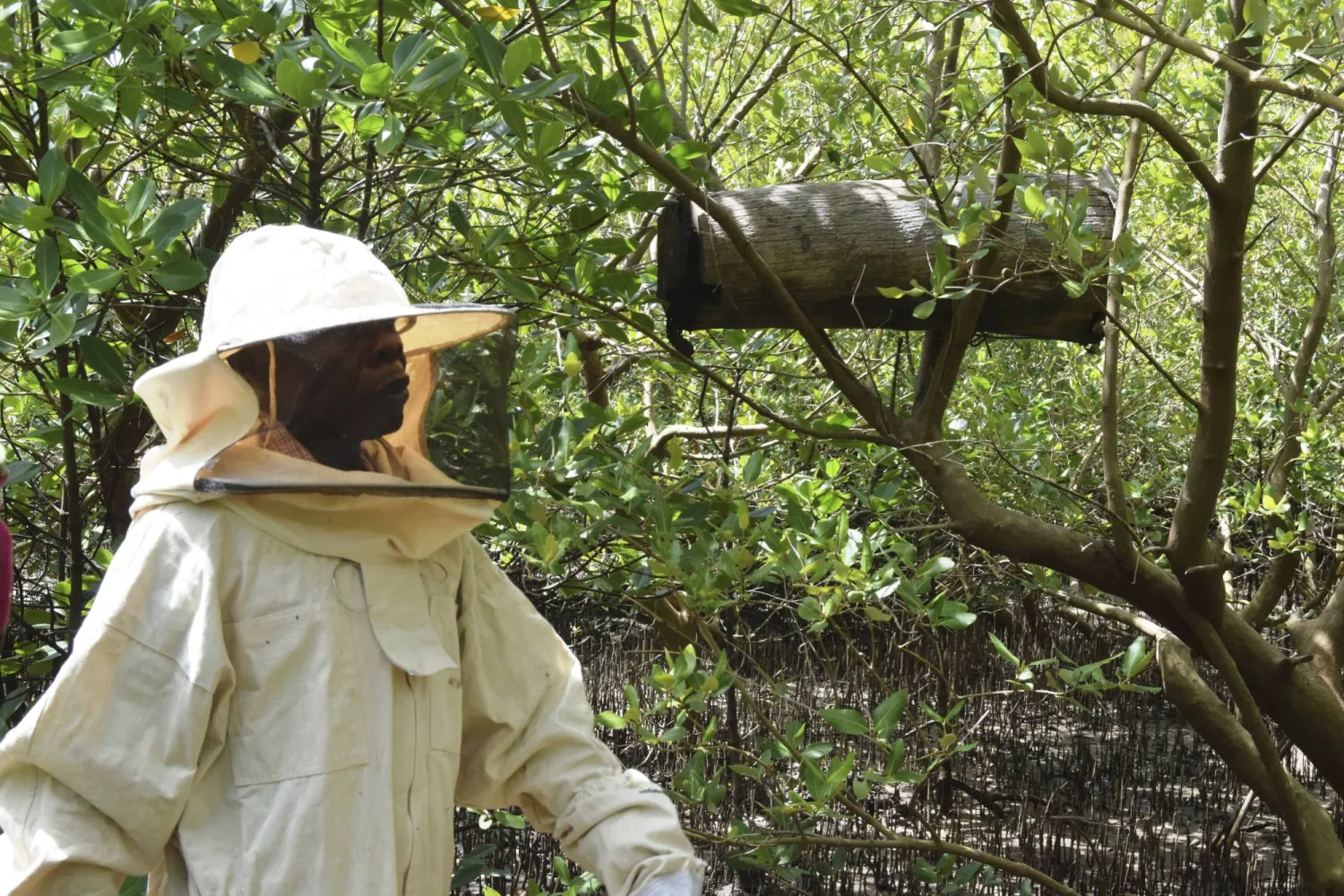
Dressed in protective clothing and armed with a smoker, Peter Nyongesa walked through the mangroves to monitor his beehives along the Indian Ocean coastline.

The 69-year-old Nyongesa recalled how he would plead unsuccessfully with loggers to spare the mangroves or cut only the mature ones while leaving the younger ones intact.

“But they would retort that the trees do not belong to anyone but God,” he said.

So he has turned to deterring the loggers with bees, hidden in the mangroves and ready to sting.

Their hives now dot a section of coastline in Kenya's main port city of Mombasa in an effort to deter people who chop mangroves for firewood or home construction. It's part of a local conservation initiative, The AP reported.

“When people realize that something is beneficial to them, they do not consider the harm that comes with it,” Nyongesa said of the loggers.

Mangroves, which thrive in salty water, help in preventing erosion and absorbing the impact of severe weather events such as cyclones.

But more than half of the world’s mangrove ecosystems are at risk of collapse, according to the first global mangrove assessment for the International Union for Conservation of Nature Red List of Ecosystems released in May.

Mangroves are threatened by illegal logging, climate change and rising seas, pollution and urban development. According to a Kenya environment ministry report in 2018, about 40% of mangroves along the Indian Ocean coast are degraded.

In Mombasa county, it’s estimated that almost 50% of the total mangrove area there — 1,850 hectares (4,570 acres) — is degraded.

Such overall degradation has slowed in Kenya, which in 2017 developed a 10-year plan to have community conservation efforts manage mangroves. But the efforts have been incomplete because of inadequate resources.

Communities are doing what they can. James Kairo, a research scientist at the Kenya Marine and Fisheries Research Institute, said initiatives such as beekeeping are helping. Their honey also brings in community income.

“Mangrove honey is also classified as top quality and medicinal," he added. “This could be due to the environment that mangroves thrives in" and what they absorb from their surroundings.

Nyongesa now has 11 beehives and harvests about 8 liters (2 gallons) of honey per hive every three months. Each liter earns him $6, a valuable source of income.

When Nyongesa started beekeeping 25 years ago, he didn't know anything about the threat to mangroves or how his bees could help.

He became involved in 2019, when he joined a local conservation group called Tulinde Mikoko, Swahili for Let’s Protect Mangroves. The group adopted his beekeeping as a community initiative along with mangrove planting. Members also serve as custodians of the mangroves and try to stop loggers.

The group has concealed beehives in the top branches of mangroves as silent guardians. The bees are meant to attack unsuspecting loggers.

“We positioned them at the peak where they can’t be spotted with ease,” said Bibiana Nanjilula, the Tulinde Mikoko founder. “As such, when the loggers start cutting down whichever tree, the bees will attack due to the noise."

The group hopes the tactic is working but has found it hard to measure its effects in the relatively difficult to access areas.

The bees also play a crucial role as pollinators. As they forage among the mangrove flowers, they transfer pollen from one flower to another, facilitating plants' reproduction.

“The healthier the mangroves are, probably the more productive the honey production will be," said Jared Bosire, project manager for the UNEP-Nairobi Convention, who said they encourage the integration of livelihoods with conservation. The office is a project of the United Nations Environment Program, based in Nairobi.

Kenya has 54,430 hectares (134,500 acres) of mangroves remaining, and they contribute $85 million per year to the national economy, according to a report by the Global Mangrove Alliance in 2022.



New Post Box with King Charles III Cypher Delivered to Antarctic

Kirsten Shaw (left) and Aurelia Reichardt with the new postbox (BAS) 
TT

New Post Box with King Charles III Cypher Delivered to Antarctic

Kirsten Shaw (left) and Aurelia Reichardt with the new postbox (BAS) 

Scientists working at a remote British research station in Antarctica have received a new Royal Mail post box in time for Christmas – thanks to the King.

Kirsten Shaw, a station support assistant who runs the British Antarctic Territory Post Office at Rothera Research Station, wrote to the monarch asking for a replacement for the base’s previous hand-painted replica box.

The Royal Household was “touched by the story of the team working in one of the most remote places on earth” and teamed up with Royal Mail to arrange the gift of one of its famous red lamppost boxes, featuring the King’s cypher.

The post box was delivered by the UK’s polar research vessel RRS Sir David Attenborough, along with the first major drop of supplies to the base following the continent’s long, dark winter, the British Antarctic Survey (BAS) said.

Aurelia Reichardt, station leader at Rothera, described the present as “having a piece of home with us.”

“It’s such an honor for the station to be gifted a real Royal Mail post box,” she said. “It’s given the community here a real boost – and it’s a great reminder to take the time to reach out to loved ones, even when work gets hectic.”

Reichardt also said, “For our team, who are working in such a remote place, it’s like having a piece of home with us.”

Earlier this year, the King recorded a personal message for researchers in Antarctica, expressing the “greatest admiration for the critically important work you do,” to coincide with the 24 hours of darkness they experience on June 21 – the southern hemisphere’s shortest day.

Shaw, who is responsible for getting mail in and out of Rothera and also across to other BAS stations and science field camps, said: “Being in Antarctica is incredible, but it’s full of extremes.”

She added, “So I think it’s a special thing to send post back home, to communicate your experiences. It’s a moment of your life that you put down on paper and give to someone else.”


Egypt Reveals Restored Colossal Statues of Pharaoh in Luxor

Visitors watch the two giant reassembled alabaster statues of Pharoah Amenhotep III, in the southern city of Luxor, Egypt, Sunday, Dec. 14, 2025. (AP Photo/Amr Nabil)
TT

Egypt Reveals Restored Colossal Statues of Pharaoh in Luxor

Visitors watch the two giant reassembled alabaster statues of Pharoah Amenhotep III, in the southern city of Luxor, Egypt, Sunday, Dec. 14, 2025. (AP Photo/Amr Nabil)

Egypt on Sunday revealed the revamp of two colossal statues of a prominent pharaoh in the southern city of Luxor, the latest in the government’s archaeological events that aim at drawing more tourists to the country.

The giant alabaster statues, known as the Colossi of Memnon, were reassembled in a renovation project that lasted about two decades. They represent Amenhotep III, who ruled ancient Egypt about 3,400 years ago.

“Today we are celebrating, actually, the finishing and the erecting of these two colossal statues,” Mohamed Ismail, secretary-general of the Supreme Council of Antiquities, told The Associated Press ahead of the ceremony.

Attempts to revive a prestigious temple Ismail said the colossi are of great significance to Luxor, a city known for its ancient temples and other antiquities.

They’re also an attempt to “revive how this funerary temple of king Amenhotep III looked like a long time ago,” Ismail said.

Amenhotep III, one of the most prominent pharaohs, ruled during the 500 years of the New Kingdom, which was the most prosperous time for ancient Egypt.

The pharaoh, whose mummy is showcased at a Cairo museum, ruled between 1390–1353 BC, a peaceful period known for its prosperity and great construction, including his mortuary temple, where the Colossi of Memnon are located, and another temple, Soleb, in Nubia.

The colossi were toppled by a strong earthquake in about 1200 BC that also destroyed Amenhotep III’s funerary temple, said Mohamed Ismail, secretary-general of the Supreme Council of Antiquities.

They were fragmented and partly quarried away, with their pedestals dispersed.

Some of their blocks were reused in the Karnak temple, but archaeologists brought them back to rebuild the colossi, according to the Antiquities Ministry.

In late 1990s, an Egyptian German mission, chaired by German Egyptologist Hourig Sourouzian, began working in the temple area, including the assembly and renovation of the colossi.

“This project has in mind ... to save the last remains of a once-prestigious temple,” she said.

The statues show Amenhotep III seated with hands resting on his thighs, with their faces looking eastward toward the Nile and the rising sun. They wear the nemes headdress surmounted by the double crowns and the pleated royal kilt, which symbolizes the pharaoh’s divine rule.

Two other small statues on the pharaoh’s feet depict his wife, Tiye.

The colossi — 14.5 meters (48 feet) and 13.6 meters (45 feet) respectively — preside over the entrance of the king’s temple on the western bank of the Nile.

The 35-hectare (86-acre) complex is believed to be the largest and richest temple in Egypt and is usually compared to the temple of Karnak, also in Luxor.

The colossi were hewn in Egyptian alabaster from the quarries of Hatnub, in Middle Egypt. They were fixed on large pedestals with inscriptions showing the name of the temple, as well as the quarry.

Unlike other monumental sculptures of ancient Egypt, the colossi were partly compiled with pieces sculpted separately, which were fixed into each statue’s main monolithic alabaster core, the ministry said.

Sunday’s unveiling in Luxor came just six weeks after the inauguration of the long-delayed Grand Egyptian Museum, the centerpiece of the government’s bid to boost the country’s tourism industry. The mega project is located near the famed Giza Pyramids and the Sphinx.

“This site is going to be a point of interest for years to come,” said Tourism and Antiquities Minister Sherif Fathy, who attended the unveiling ceremony. “There are always new things happening in Luxor.”

A record number of about 15.7 million tourists visited Egypt in 2024, contributing about 8% of the country’s GDP, according to official figures.

Fathy has said about 18 million tourists are expected to visit the country this year, with authorities hoping for 30 million visitors annually by 2032.


National Wildlife Center Launches 2nd Phase to Regulate Unlicensed Species in Saudi Arabia

National Wildlife Center Launches 2nd Phase to Regulate Unlicensed Species in Saudi Arabia
TT

National Wildlife Center Launches 2nd Phase to Regulate Unlicensed Species in Saudi Arabia

National Wildlife Center Launches 2nd Phase to Regulate Unlicensed Species in Saudi Arabia

The National Center for Wildlife (NCW) has launched the second phase of its initiative to regulate the status of unlicensed wildlife species in the Kingdom, representing one of the most prominent national efforts to control wildlife possession, document ownership, and ensure that all practices related to housing, breeding, and trading comply with the Environmental Law and its implementing regulations, according to SPA.

The regularization period extends until the end of February 2026 and targets those who keep or handle wildlife on a large scale, including private collections (farms) containing more than 10 species, facilities engaged in breeding and housing wildlife, and businesses involved in selling wildlife products or derivatives.

This phase follows the success of the first, which focused on regulating the status of falcons, and reinforces the Kingdom's role in curbing illegal practices that could harm natural environments or threaten the survival of wildlife species. The initiative reflects a growing national commitment to protecting biodiversity and developing a more regulated system for managing wildlife within the Kingdom.

The regulation aims to build an accurate database of wildlife, enhance monitoring, and improve housing standards in accordance with environmental and health considerations.

The NWC emphasizes that this step aligns with national efforts to protect wildlife, support ecosystem sustainability, and address the challenges of illegal wildlife trafficking. It calls on all owners and relevant facilities to take advantage of the grace period, review the regulations through the "Fitri" platform, and contribute to a safer and more balanced ecosystem