


Bangladesh Factories, Banks Reopen as Curfew Is Eased After Protests Taper Off 

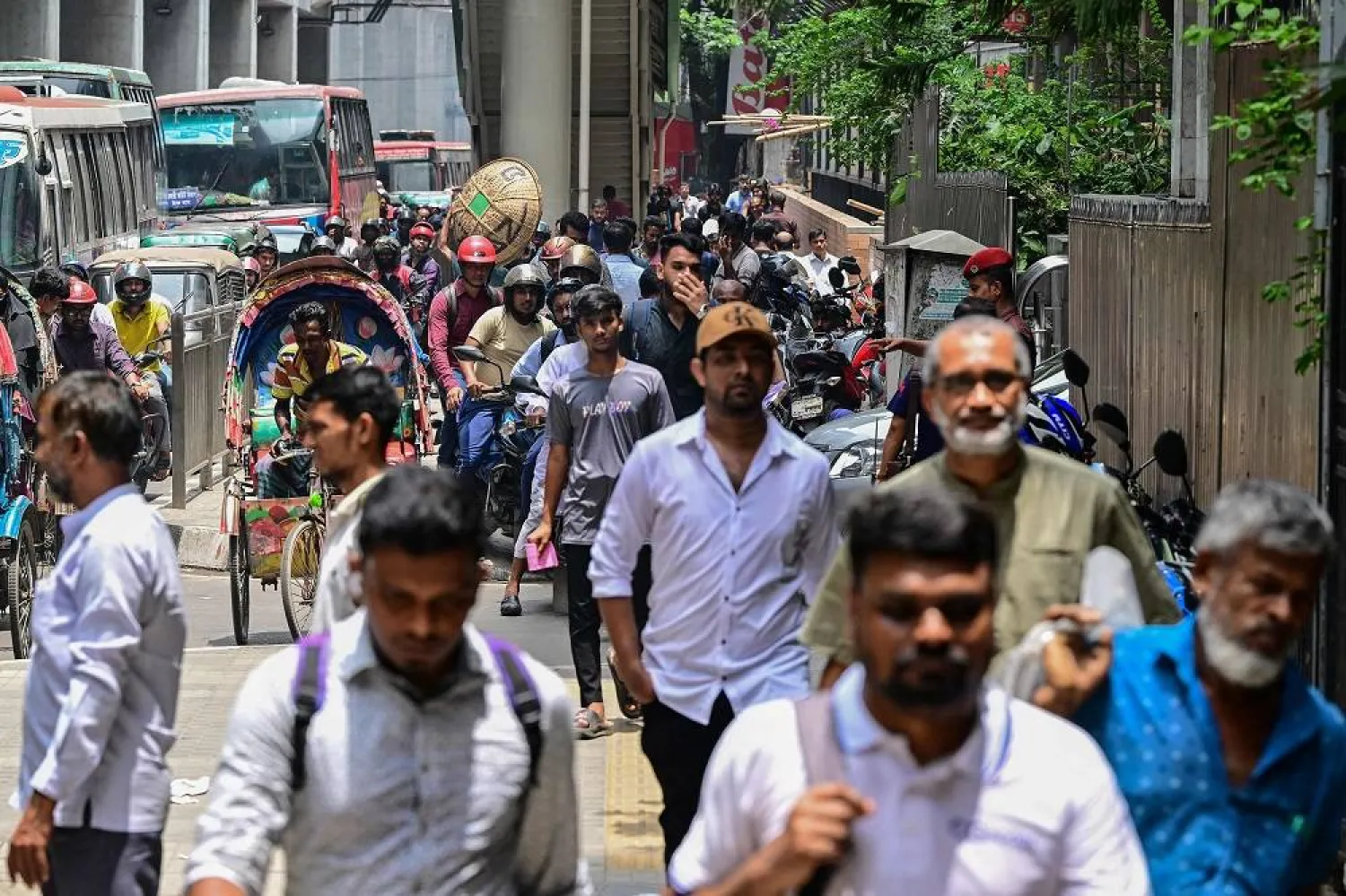
Commuters are seen moving along a road in Dhaka on July 24, 2024, after authorities eased a curfew imposed to contain deadly clashes sparked by student protests over civil service employment quotas. (AFP)
TT

Bangladesh Factories, Banks Reopen as Curfew Is Eased After Protests Taper Off 

Commuters are seen moving along a road in Dhaka on July 24, 2024, after authorities eased a curfew imposed to contain deadly clashes sparked by student protests over civil service employment quotas. (AFP)

Rush-hour traffic returned to the streets of the Bangladeshi capital Dhaka on Wednesday, as a curfew was eased after four days of nationwide shutdown that followed deadly protests led by university students against quotas in government jobs.

Offices reopened and broadband internet was largely restored, although social media continued to be suspended, days after the clashes between protesters and security forces killed almost 150 people.

The country has been relatively calm since Sunday, when the Supreme Court ruled in favor of an appeal from Prime Minister Sheikh Hasina's government and directed that 93% of jobs should be open to candidates on merit.

Bangladesh's mainstay garment and textiles industries, which supply to major Western brands, also began reopening some factories after a pause in production during the curfew.

"All our factories are open today. Everything is going smoothly," said S.M. Mannan, president of the Bangladesh Garment Manufacturers and Exporters Association.

The stock exchange opened too, as well as banks, after remaining shut the past two days.

Residents of Dhaka were out on the streets, some making their way to offices as public buses also began running in some places.

"It was a hassle to reach the office on time," said Shamima Akhter, who works at a private firm in the capital. "Some roads are still blocked for security reasons. Don't know when everything will get normal."

Local news websites, which had stopped updating since Friday, were back online too.

Bangladesh authorities had shut mobile internet and deployed the army on the streets during the curfew that was imposed from midnight on Saturday.

The government said curfew restrictions would be relaxed for seven hours on Wednesday and Thursday, and offices would also be open from 11 a.m. to 3 p.m.

STUDENT DEMANDS

Analysts say the student action has given fresh impetus to Hasina's critics, months after she won a fourth-straight term in power in January in a national election boycotted by the main opposition party.

"The informal federation of government critics appears deeper and wider than before the election, which presents a serious challenge to the ruling party," said Geoffrey Macdonald at the United States Institute of Peace.

Hasina, 76, is the daughter of Sheikh Mujibur Rahman, the founding father of Bangladesh, who led the country's movement for independence from Pakistan.

The earlier 56% job quotas included a 30% reservation for families of veterans of the 1971 independence war, which critics said favored supporters of Hasina's Awami League.

Hasina's government had scrapped the quotas in 2018, but a high court ruling reinstated them last month.

Students were furious because quotas left fewer than half of state jobs open on merit amid an unemployment crisis, particularly in the private sector, making government sector jobs with their regular wage hikes and perks especially prized.

Hasina has blamed her political opponents for the violence and her government said on Tuesday that it would heed the Supreme Court ruling.

The main opposition Bangladesh Nationalist Party has denied any involvement in the violence and accused Hasina of authoritarianism and a crackdown on her critics, charges denied by her government.

Protesting students have given the government a fresh 48-hour ultimatum to fulfil four other conditions of an eight-point list of demands, and said they would announce their next steps on Thursday.

"We want the government to meet our four-point demand, including restoration of internet, withdrawal of police from campuses, and opening universities (which have been closed for a week)," protest coordinator Nahid Islam said.



Russia's FSB Says Ukraine's SBU Was behind Assassination Attempt on Top General

In this image made from video and provided by the Russian Defense Ministry Press Service, on June 23, 2023, Lt. Gen. Vladimir Alexeyev speaks to servicemen in an undisclosed location. (Russian Defense Ministry Press Service via AP)
TT

Russia's FSB Says Ukraine's SBU Was behind Assassination Attempt on Top General

In this image made from video and provided by the Russian Defense Ministry Press Service, on June 23, 2023, Lt. Gen. Vladimir Alexeyev speaks to servicemen in an undisclosed location. (Russian Defense Ministry Press Service via AP)

Russia's Federal Security Service said on Monday that the men suspected of shooting one of the country's most senior military intelligence officer had confessed that they were carrying out orders from the Security Service of Ukraine (SBU).

Ukraine has denied any involvement in Friday's attempted assassination of Lieutenant General Vladimir Alexeyev, deputy head of Russia's ‌GRU military ‌intelligence service. Alexeyev has regained ‌consciousness ⁠after surgery, reported Reuters.

Russia ‌said that the suspected shooter, a Ukrainian-born Russian citizen named by Moscow as Lyubomir Korba, had been questioned after he was extradited from Dubai. A suspected accomplice, Viktor Vasin, has also been questioned.

The FSB said in ⁠a statement that both Korba and Vasin had "confessed their ‌guilt" and given details ‍of the shooting which ‍they said was "committed on behalf of ‍the Security Service of Ukraine."

The FSB did not provide any evidence that Reuters was able to immediately verify. It was not possible to contact the men while they were in detention in Russia. The SBU could ⁠not be reached for immediate comment on the FSB statement.

The FSB said Korba was recruited by the SBU in August 2025 in Ternopil, western Ukraine, underwent training in Kyiv and was paid monthly in crypto-currency. For killing Alexeyev, Korba was promised $30,000 by the SBU, the FSB said.

The FSB said Polish intelligence was involved in his recruitment. ‌Poland could not be reached for immediate comment.


Venezuela's Machado Says Ally 'Kidnapped' after His Release

Venezuelan political leader Juan Pablo Guanipa gestures after their release outside Zona 7 prison in Caracas on February 8, 2026.  (Photo by Juan BARRETO / AFP)
Venezuelan political leader Juan Pablo Guanipa gestures after their release outside Zona 7 prison in Caracas on February 8, 2026. (Photo by Juan BARRETO / AFP)
TT

Venezuela's Machado Says Ally 'Kidnapped' after His Release

Venezuelan political leader Juan Pablo Guanipa gestures after their release outside Zona 7 prison in Caracas on February 8, 2026.  (Photo by Juan BARRETO / AFP)
Venezuelan political leader Juan Pablo Guanipa gestures after their release outside Zona 7 prison in Caracas on February 8, 2026. (Photo by Juan BARRETO / AFP)

Venezuela's Nobel peace laureate Maria Corina Machado said on Monday that armed men "kidnapped" a close ally shortly after his release by authorities, following ex-leader Nicolas Maduro's capture.

The country's Public Prosecutor's Office confirmed later that same day that former National Assembly vice president Juan Pablo Guanipa, 61, was again taken into custody and to be put under house arrest, arguing that he violated the conditions of his release.

Guanipa would be placed under house arrest "in order to safeguard the criminal process," the office said in a statement on Monday. The conditions of Guanipa's release have yet to be made public.

Machado claimed that her close ally had been "kidnapped" in the capital Caracas by armed men "dressed in civilian clothes" who took him away by force.

"We demand his immediate release," she wrote on social media platform X.

The arrest came after his release from prison on Sunday along with two other opposition figures, and as lawmakers prepared to vote Tuesday on a historic amnesty law covering charges used to lock up dissidents in almost three decades of socialist rule, reported AFP.

Shortly after his release, Guanipa visited several detention centers in Caracas, where he met with relatives of political prisoners and spoke to the press.

Guanipa had appeared earlier Sunday in a video posted on his X account, showing what looked like his release papers.

"Here we are, being released," Guanipa said in the video, adding that he had spent "10 months in hiding, almost nine months detained here" in Caracas.

- 'Let's go to an electoral process' -

Speaking to AFP later on Sunday, he had called on the government to respect the 2024 presidential election, which opposition candidate Edmundo Gonzalez Urrutia was widely considered to have won. Maduro claimed victory and remained in power till January.

"Let's respect it. That's the basic thing, that's the logical thing. Oh, you don't want to respect it? Then let's go to an electoral process," Guanipa said.

The opposition ally of Machado was arrested in May 2025, in connection with an alleged conspiracy to undermine legislative and regional elections that were boycotted by the opposition.

He was charged with terrorism, money laundering and incitement to violence and hatred.

Guanipa had been in hiding prior to his arrest. He was last seen in public in January 2025, when he accompanied Machado to an anti-Maduro rally.

Following Maduro's capture by US special forces on January 3, authorities have started to slowly release political prisoners. Rights groups estimate that around 700 people are still waiting to be freed.

A former Machado legal advisor, Perkins Rocha, was also freed on Sunday. So was Freddy Superlano, who once won a gubernatorial election in Barinas, a city that is the home turf of the iconic late socialist leader Hugo Chavez.

"We hugged at home," Rocha's wife Maria Constanza Cipriani wrote on X, with a photo of them.

Machado, who was awarded the 2025 Nobel Peace Prize for her efforts to advance democracy in Venezuela, had initially celebrated Guanipa's release.

"My dear Juan Pablo, counting down the minutes until I can hug you! You are a hero, and history will ALWAYS recognize it. Freedom for ALL political prisoners!!" she wrote on X on Sunday.

NGO Foro Penal said it had confirmed the release of 35 prisoners on Sunday. It said that since January 8 nearly 400 people arrested for political reasons have been freed thus far.

Lawmakers gave their initial backing to a draft amnesty last week which covered the types of crimes used to lock up dissidents during 27 years of socialist rule.

But Venezuela's largest opposition coalition denounced "serious omissions" in the proposed amnesty measures on Friday.

Meanwhile, relatives of prisoners are growing increasingly impatient for their loved ones to be freed.

Acting president Delcy Rodriguez, who was Maduro's vice president, is pushing the amnesty bill as a milestone on the path to reconciliation.

Rodriguez took power in Venezuela with the blessing of US President Donald Trump, who is eyeing American access to what are the world's largest proven oil reserves.

As part of its reforms, Rodriguez's government has taken steps towards opening up the oil industry and restoring diplomatic ties with Washington, which were severed by Maduro in 2019.


SKorea Grounds Aging Attack Choppers after Fatal Training Crash

South Korean military officials secure the site where an AH-1S Cobra attack helicopter crashed in Gapyeong, South Korea, February 9, 2026. Yonhap via REUTERS
TT

SKorea Grounds Aging Attack Choppers after Fatal Training Crash

South Korean military officials secure the site where an AH-1S Cobra attack helicopter crashed in Gapyeong, South Korea, February 9, 2026. Yonhap via REUTERS

South Korea grounded an aging fleet of military helicopters on Monday after a chopper crashed during a training exercise and killed two people on board.

The AH-1S Cobra was training for emergency landings when it "crashed due to an unidentified cause" in Gapyeong county west of Seoul, the army said in a statement.

Two service members were taken to hospital and later pronounced dead, AFP reported.

Photos in local media showed the helicopter's crumpled fuselage lying on a rocky river bank.

"Following the accident, the Army has suspended operations of all aircraft of the same model" and is investigating the cause, the forces said.

The AH-1S Cobra is a US-made, single-engine anti-tank attack helicopter.

Some of those used by South Korea's military are more than 30 years old. It is not clear how many are currently in service.

The country's defense acquisition agency said in 2022 that the Army's Cobra helicopters were "scheduled to be retired" as domestically developed light-armed choppers started flying.