Philippine Tanker Carrying 1.4 Mln Liters of Oil Capsizes off Manila

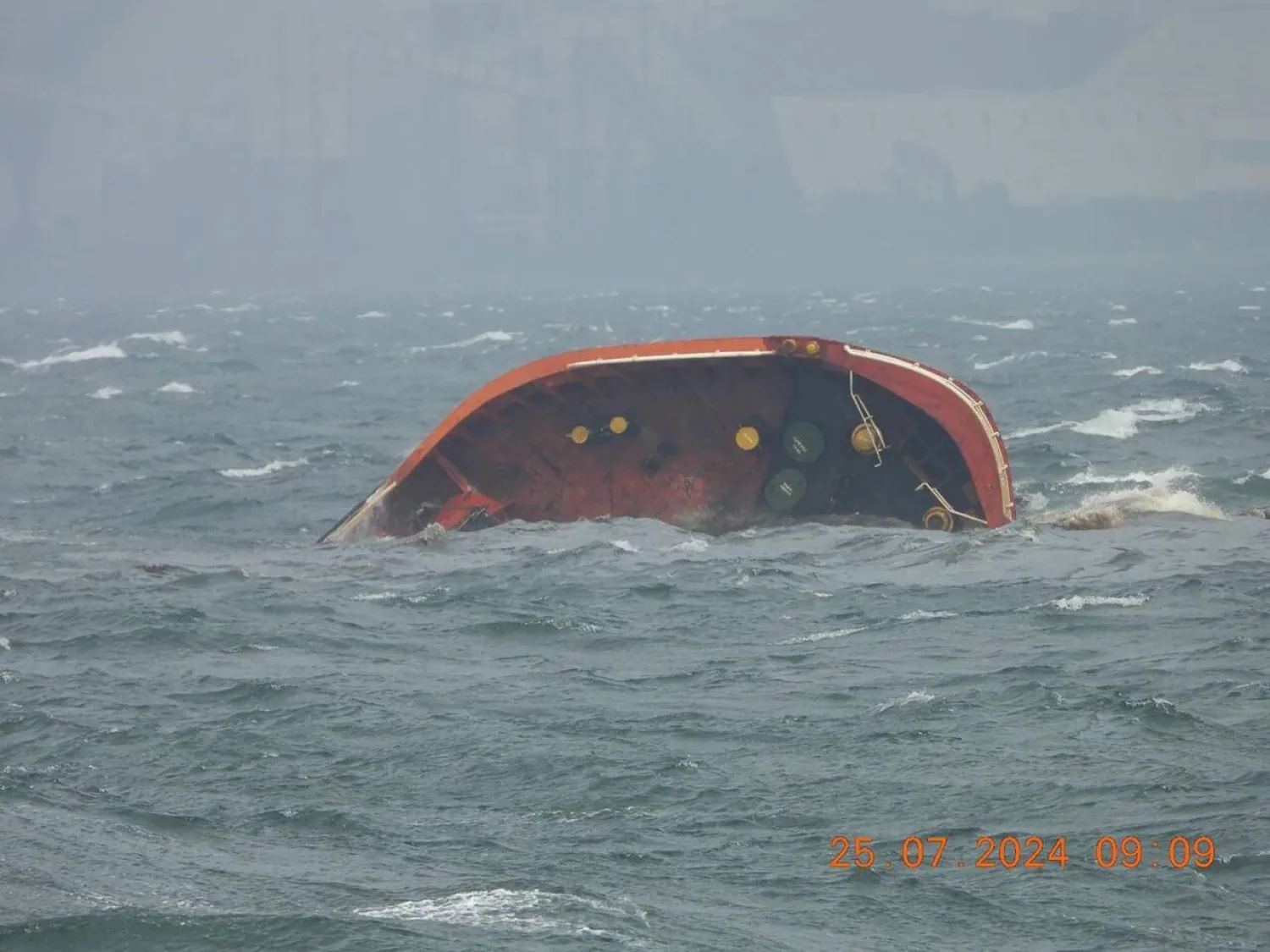
A handout photo from the Philippine Coast Guard shows part of MT Terra Nova oil tanker after it capsized in Manila Bay. Handout / Philippine Coast Guard (PCG)/AFP
TT

Philippine Tanker Carrying 1.4 Mln Liters of Oil Capsizes off Manila

A handout photo from the Philippine Coast Guard shows part of MT Terra Nova oil tanker after it capsized in Manila Bay. Handout / Philippine Coast Guard (PCG)/AFP

A Philippine-flagged tanker carrying 1.4 million liters of industrial fuel oil capsized and sank off Manila on Thursday, authorities said, as they raced to contain a spill.
The MT Terra Nova was heading for the central city of Iloilo when it capsized in Manila Bay, nearly seven kilometers (4.3 miles) off Limay municipality in Bataan province, near the capital, in the early hours, said Agence France Presse.
The vessel went down as heavy rains fueled by Typhoon Gaemi and the seasonal monsoon have lashed Manila and surrounding regions in recent days.
An oil spill stretching several kilometers has been detected in the busy waterway.
"We are racing against time and we will try to do our best to contain it immediately and stop the fuel from leaking," Philippine Coast Guard spokesman Rear Admiral Armando Balilo said at a briefing.
He warned that if all the oil in the tanker were to leak, it would be the biggest spill in Philippine history.
"There is a big danger that Manila will be affected, even the shoreline of Manila, if the fuel will leak, because it is within Manila Bay," Balilo said.
Thousands of fishermen and tour operators are dependent on the waters for their livelihoods.
Transport Secretary Jaime Bautista said 16 of the 17 crew members had been rescued from the stricken vessel.
A search was underway for the missing crew member, but Bautista said strong winds and high waves were hampering response efforts.
Four of the crew were receiving medical treatment.
A photo released by the coast guard showed the MT Terra Nova almost entirely submerged in rough seas.
Investigation ordered
An oil slick stretching about 3.7 kilometers was being carried by a "strong current" in an easterly, north-easterly direction, the coast guard said in a report.
Coast guard Commandant Admiral Ronnie Gavan said he ordered a probe into the incident.
Marine environmental protection personnel have been mobilized to help contain the slick.
"It will definitely affect the marine environment," Balilo said, describing the amount of oil on the ship as "enormous".
One of the worst oil spills in the Philippines was in February 2023, when a tanker carrying 800,000 liters of industrial fuel oil sank off the central island of Mindoro.
Diesel fuel and thick oil from that vessel contaminated the waters and beaches along the coast of Oriental Mindoro province, devastating the fishing and tourism industries.
The oil dispersed over hundreds of kilometers of waters famed for having some of the most diverse marine life in the world.
In 2006, a tanker sank off the central island of Guimaras spilling tens of thousands of gallons of oil that destroyed a marine reserve, ruined local fishing grounds and covered stretches of coastline in black sludge.



Iran Says Strike Hit Close to Its Bushehr Nuclear Facility, Killing a Guard and Damaging a Building

Iran's Bushehr nuclear reactor (Reuters)
TT

Iran Says Strike Hit Close to Its Bushehr Nuclear Facility, Killing a Guard and Damaging a Building

Iran's Bushehr nuclear reactor (Reuters)

Iran’s atomic agency says an airstrike has hit near its Bushehr nuclear facility, killing a security guard and damaging a support building. It is the fourth time the facility has been targeted during the war.

The agency announced Saturday’s attack on social media.

The US AP’s military pressed ahead Saturday in a frantic search for a missing pilot after Iran shot down an American warplane, as Iran called on people to turn the pilot in, promising a reward.

The plane, identified by Iran as a US F-15E Strike Eagle, was one of two attacked on Friday, with one service member rescued and at least one missing. It was the first time the United States lost aircraft in Iranian territory during the war, now in its sixth week, and could mark a new turning point in the campaign.

The conflict, launched by the US and Israel on Feb. 28, has rippled across the region. It has so far killed thousands, upended global markets, cut off key shipping routes, spiked fuel prices and shows no signs of slowing as Iran responds to US and Israeli airstrikes with attacks across the region.


Trump Seeks $152 Mn to Revive Alcatraz as Federal Prison

FILE PHOTO: A view of Alcatraz prison complex located on Alcatraz Island in San Francisco Bay near San Francisco, California, US July 17, 2025. REUTERS/Carlos Barria/File Photo
TT

Trump Seeks $152 Mn to Revive Alcatraz as Federal Prison

FILE PHOTO: A view of Alcatraz prison complex located on Alcatraz Island in San Francisco Bay near San Francisco, California, US July 17, 2025. REUTERS/Carlos Barria/File Photo

US President Donald Trump asked Congress on Friday for $152 million to begin rebuilding the notorious Alcatraz prison, pressing ahead with his vision to return the former island lockup to active use.

The funding request, included in the White House's proposed 2027 budget, would cover the first year of converting the San Francisco Bay site into what officials describe as a "state-of-the-art secure prison facility."

Trump has pushed for reopening Alcatraz since last year, portraying it as a symbol of a tougher approach to crime, said AFP.

In a social media post at the time, he called for a "substantially enlarged and rebuilt" facility to house the country's most dangerous offenders.

The proposal comes as part of a broader Justice Department budget that emphasizes prison investment and law enforcement, though such requests are ultimately subject to approval by Congress.

Political news outlet Axios, citing administration officials, reported that any "supermax" prison complex at the site would have to be built from scratch -- putting the total cost at somewhere around $2 billion.

Alcatraz, which opened as a federal penitentiary in 1934, was once considered among the most secure prisons in the United States due to its isolated island location and the strong currents surrounding it.

It held a relatively small number of prisoners, including high-profile inmates such as Al Capone.

The island fortress entered American cultural lore after a 1962 escape by three inmates, which became an inspiration for the film "Escape from Alcatraz" starring Clint Eastwood.

It was closed in 1963 after officials determined it was too costly to maintain.

According to the Federal Bureau of Prisons, operating expenses were nearly three times higher than at other federal facilities, largely because all supplies -- including fresh water -- had to be transported to the island.

Since the early 1970s, Alcatraz has been managed by the National Park Service as part of the Golden Gate National Recreation Area and has become one of San Francisco's most popular tourist attractions, drawing more than a million visitors annually.

The White House argues that rebuilding the site would help modernize the federal prison system and expand capacity for high-risk inmates.

But critics have questioned both the practicality and cost of the plan, noting that the island's infrastructure would likely require extensive reconstruction.

Feasibility studies have already been conducted by federal agencies to assess whether a modern correctional facility could be established on the site, though no final decision has been made.

Any move to proceed could face political resistance given competing budget priorities and the site's current status as a major tourism and historical landmark.


French, Japanese Ships Cross Strait of Hormuz in First Since War

A cargo ship in the Gulf, near the Strait of Hormuz, as seen from northern Ras al-Khaimah, near the border with Oman’s Musandam governance, amid the US-Israeli conflict with Iran, in United Arab Emirates, March 11, 2026. (Reuters)
TT

French, Japanese Ships Cross Strait of Hormuz in First Since War

A cargo ship in the Gulf, near the Strait of Hormuz, as seen from northern Ras al-Khaimah, near the border with Oman’s Musandam governance, amid the US-Israeli conflict with Iran, in United Arab Emirates, March 11, 2026. (Reuters)

One French- and another Japanese-owned vessel are among a handful of vessels to have crossed the war-torn Strait of Hormuz, maritime tracking data showed Friday.

The passage, a vital maritime route for oil and liquified natural gas, has been virtually blocked by Iran since the start of the war, said AFP.

But both ships made the crossing on Thursday, according to ship tracking company Marine Traffic's website.

The Maltese-flagged Kribi belonging to the French maritime transport group CMA CGM crossed the waterway to leave the Gulf on Thursday afternoon, Marine Traffic's data showed.

By early Friday, it was off Muscat, Oman, still broadcasting the message "owner France" on its transponder system in the field usually used to give the destination.

The vessel's navigation data showed it had crossed via an Iranian-approved route through its waters, dubbed the "Tehran Toll Booth" by leading shipping journal Lloyd's List.

- Southern route -

In addition, three tankers -- including one co-owned by a Japanese company -- crossed the Strait of Hormuz on Thursday by taking an alternative, southern route.

They hugged close to the shore of Oman's Musandam Peninsula -- a first in nearly three weeks according to Lloyd's List.

Before the war, which started more than a month ago, about a fifth of global oil and liquefied natural gas (LNG) passed through the Strait.

All three ships signaled they were an "OMANI SHIP" in the message broadcast by their transponder as they crossed the strait.

The Sohar LNG, which was empty when crossing, is co-owned by Japanese shipping company Mitsui O.S.K.

That makes it the first Japanese vessel to exit the Gulf since the start of the war, according to a company statement quoted by Japanese media.

The Hong-Kong flagged New Vision, which crossed the strait on March 1 right after the war started, is expected in the French port of Le Havre on Saturday evening.

Since the conflict started however, that has dwindled to a trickle as Iran selectively attacks ships and energy facilities throughout the Gulf in retaliation for US and Israeli attacks.

A few commercial ships crossing the Strait of Hormuz recently have passed through the Iranian-approved route in the north of the waterway.

- Down to a trickle -

Just 221 commodities vessels have crossed the Strait of Hormuz since March 1, some more than once, according to Kpler data up to Friday morning.

In peacetime, the same waterway handles around 120 daily transits, according to Lloyd's List.

Of the vessels that made the crossing, 60 percent either came from Iran or were heading there.

It was not clear from the data how many had been cleared to make the crossing by Tehran.

But it did show that, among the 118 crossings by ships carrying cargo, 37 had left the Gulf carrying crude oil.

Most of those oil tankers -- 30 of them -- came from Iran or sailed under the Iranian flag. And most ships carrying Iranian oil did not specify their destination on their transponder.

Of those who did, all but one reported they were heading to China.

In the early days of the war, transponder data showed dozens of ships broadcasting messages such as "Chinese crew" or "Chinese owner" in the field usually used for their destination.

This appeared to be an attempt by the ships to avoid being targeted by Iran.