


FBI Says Trump Was Indeed Struck by Bullet during Assassination Attempt

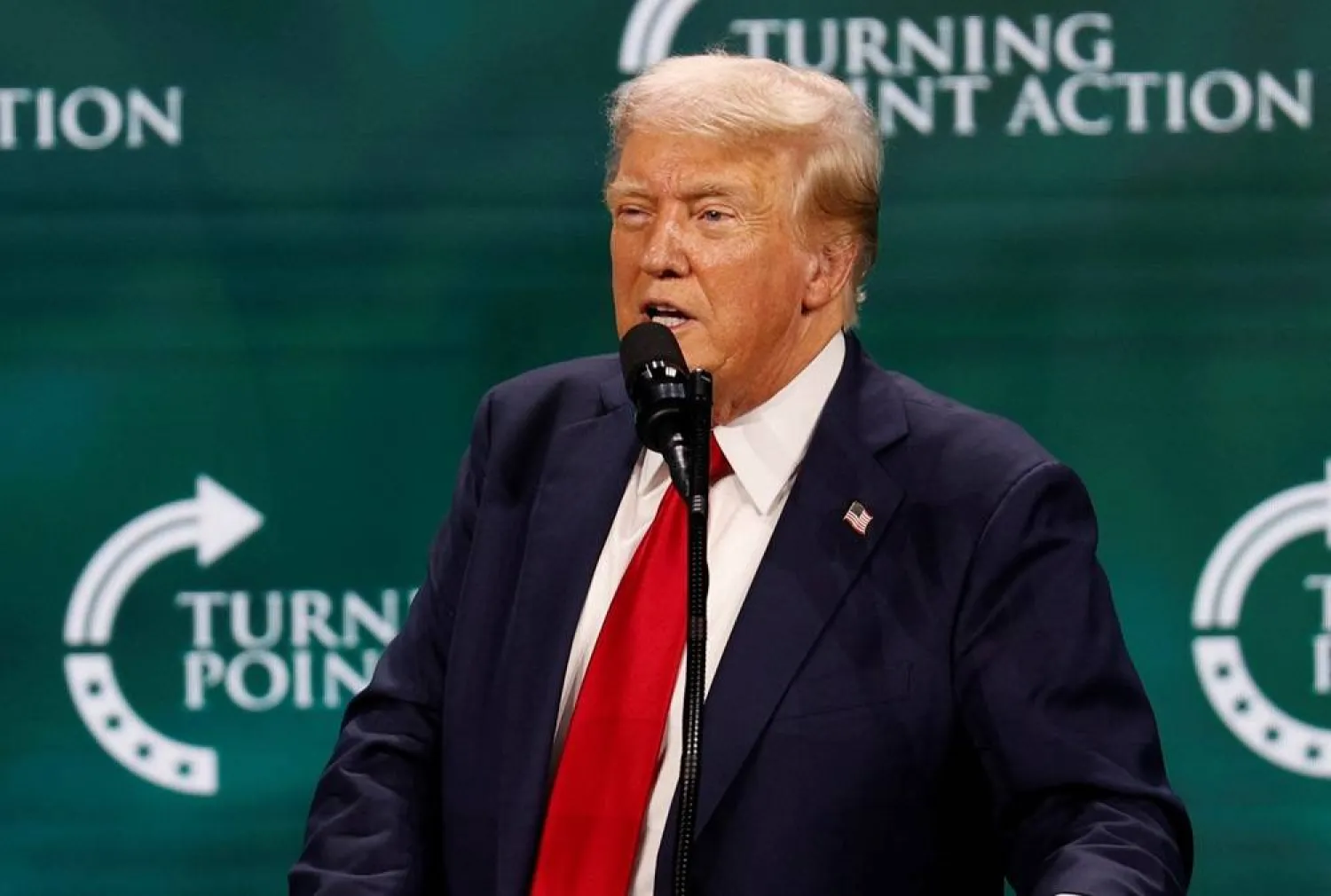
Republican presidential nominee and former US President Donald Trump speaks at Turning Point Action's The Believers Summit 2024 in West Palm Beach, Florida, US, July 26, 2024. (Reuters)
TT

FBI Says Trump Was Indeed Struck by Bullet during Assassination Attempt

Republican presidential nominee and former US President Donald Trump speaks at Turning Point Action's The Believers Summit 2024 in West Palm Beach, Florida, US, July 26, 2024. (Reuters)

Nearly two weeks after Donald Trump’s near assassination, the FBI confirmed Friday that it was indeed a bullet that struck the former president’s ear, moving to clear up conflicting accounts about what caused the former president’s injuries after a gunman opened fire at a Pennsylvania rally.

"What struck former President Trump in the ear was a bullet, whether whole or fragmented into smaller pieces, fired from the deceased subject’s rifle," the agency said in a statement.

The one-sentence statement from the FBI marked the most definitive law enforcement account of Trump’s injuries and followed ambiguous comments earlier in the week from Director Christopher Wray that appeared to cast doubt on whether Trump had actually been hit by a bullet.

The comment drew fury from Trump and his allies and further stoked conspiracy theories that have flourished on both sides of the political aisle amid a dearth of information following the July 13 attack.

Up until now, federal law enforcement agents involved in the investigation, including the FBI and Secret Service, had refused to provide information about what caused Trump’s injuries. Trump’s campaign has also declined to release medical records from the hospital where he was first treated or to make the doctors there available for questions.

Updates have instead come either from Trump himself or from Trump’s former White House doctor, Ronny Jackson, a staunch ally who now represents Texas in Congress. Though Jackson has been treating Trump since the night of the attack, he has come under considerable scrutiny and is not Trump’s primary care physician.

The FBI’s apparent reluctance to immediately vouch for the former president’s version of events has also raised fresh tension between the Republican nominee and the nation’s premier federal law enforcement agency, which he could soon exert control over once again. Trump and his supporters have for years accused federal law enforcement of being weaponized against him, something Wray has consistently denied.

Speaking at an event later Friday in West Palm Beach Florida, Trump drew boos from the crowd when he described the suggestion that he may have been struck by glass or shrapnel instead of a bullet.

"Did you see the FBI today apologized?" he asked. "It just never ends with these people. ... We accept their apology."

Trump appeared Friday for the first time without a bandage on his right ear. Photographs and video showed no sign of continued bleeding, and no distinct holes or gashes.

Questions about the extent and nature of Trump’s wound began immediately after the attack, as his campaign and law enforcement officials declined to answer questions about his condition or the treatment he received after Trump narrowly escaped death in an attempted assassination by a gunman with a high-powered rifle.

Those questions have persisted despite photographs showing the trace of a projectile speeding past Trump’s head as well as Trump’s teleprompter glass intact after the shooting, and the account Trump himself gave in a Truth Social post within hours of the shooting that he had been "shot with a bullet that pierced the upper part of my right ear."

"I knew immediately that something was wrong in that I heard a whizzing sound, shots, and immediately felt the bullet ripping through the skin," he wrote.

Days later, in a speech accepting the nomination at the Republican National Convention in Milwaukee, Trump recounted the scene in detail, while wearing a large gauze bandage over his right ear.

"I heard a loud whizzing sound and felt something hit me really, really hard, on my right ear. I said to myself, ‘Wow, what was that? It can only be a bullet,’" he said.

"If I had not moved my head at that very last instant," Trump said, "the assassin’s bullet would have perfectly hit its mark, and I would not be here tonight."

But the first medical account of Trump’s condition didn’t come until a full week after the shooting, when Jackson released his first letter last Saturday evening. In it, he said the bullet that struck Trump had "produced a 2 cm wide wound that extended down to the cartilaginous surface of the ear." He also revealed Trump had received a CT scan at the hospital.

Federal law enforcement involved in the investigation, including the FBI and Secret Service, had declined to confirm that account. And Wray’s testimony offered apparently conflicting answers on the issue.

"There’s some question about whether or not it’s a bullet or shrapnel that hit his ear," Wray said, before he seemed to suggest it was indeed a bullet.

"I don’t know whether that bullet, in addition to causing the grazing, could have also landed somewhere else," he said.

On Thursday, the FBI sought to clarify matters with a statement affirming that the shooting was an "attempted assassination of former President Trump which resulted in his injury, as well as the death of a heroic father and the injuries of several other victims." The FBI also said Thursday that its Shooting Reconstruction Team continues to examine bullet fragments and other evidence from the scene.

Jackson, who has been treating the former president since the night of the July 13 shooting, told The Associated Press on Thursday that any suggestion Trump’s ear was bloodied by anything other than a bullet was reckless.

"It was a bullet wound," said Jackson. "You can’t make statements like that. It leads to all these conspiracy theories."

In his letter Friday, Jackson insisted "there is absolutely no evidence" Trump was struck by anything other than a bullet and said it was "wrong and inappropriate to suggest anything else."

He wrote that at Butler Memorial Hospital, where the GOP nominee was rushed after the shooting, he was evaluated and treated for a "Gunshot Wound to the Right Ear."

"Having served as an Emergency Medicine physician for over 20 years in the United States Navy, including as a combat physician on the battlefield in Iraq," he wrote, "I have treated many gunshot wounds in my career. Based on my direct observations of the injury, my relevant clinical background, and my significant experience evaluating and treating patients with similar wounds, I completely concur with the initial assessment and treatment provided by the doctors at nurses at Butler Memorial Hospital on the day of the shooting."

The FBI declined to comment on the Jackson letters.

Asked if the campaign would release those hospital records, or allow the doctors who treated him there to speak, Trump campaign spokesperson Steven Cheung blasted the media for asking.

"The media has no shame in engaging in disgusting conspiracy theories," he said. "The facts are the facts, and to question an abhorrent assassination attempt that ultimately cost a life and injured two others is beyond the pale."

In emails last week, he told the AP that "medical readouts" had already been provided.

"It’s sad some people still don’t believe a shooting happened," Cheung said, "even after one person was killed and others were injured."

Anyone who believes the conspiracies, he added, "is either mentally deficient or willfully peddling falsehoods for political reasons."

Sen. Lindsey Graham, R-S.C., a close Trump ally, also urged Wray to correct his testimony in a letter Friday, saying the fact Trump had been hit by a bullet "was made clear in briefings my office received and should not be a point of contention."

"As head of the FBI, you should not be creating confusion about such matters, as it further undercuts the agency’s credibility with millions of Americans," he wrote.

Trump also lashed out at Wray in a post on his Truth Social network, saying it was "No wonder the once storied FBI has lost the confidence of America!"

"No, it was, unfortunately, a bullet that hit my ear, and hit it hard. There was no glass, there was no shrapnel," he wrote.

On Friday, he called Wray’s comments "so damaging to the Great People that work in the FBI."

Jackson has encountered significant scrutiny over the years.

After administering a physical to Trump in 2018, he drew headlines for suggesting that "if he had a healthier diet over the last 20 years, he might live to be 200 years old."

He was reportedly demoted by the Navy after the Department of Defense inspector general released a scathing report on his conduct as a top White House physician that found Jackson had made "sexual and denigrating" comments about a female subordinates and took prescription-strength sleeping medication that prompted worries from his colleagues about his ability to provide proper medical care.

Trump appointed Wray as FBI director in 2017 to replace the fired James Comey. But the then-president swiftly soured on his hire as the bureau continued its investigation into the Russian election interference.

Trump flirted openly with the idea of firing Wray as his term drew to a close, and he lashed out anew after the FBI executed a search warrant at his Mar-a-Lago estate in Florida to recover boxes of classified documents from his presidency.



UK PM's Top Aide Quits over Mandelson-Epstein Scandal

FILE PHOTO: British Prime Minister Keir Starmer talks with Britain's ambassador to the United States Peter Mandelson during a welcome reception at the ambassador's residence on February 26, 2025, in Washington, DC, US. Carl Court/Pool via REUTERS/File Photo
TT

UK PM's Top Aide Quits over Mandelson-Epstein Scandal

FILE PHOTO: British Prime Minister Keir Starmer talks with Britain's ambassador to the United States Peter Mandelson during a welcome reception at the ambassador's residence on February 26, 2025, in Washington, DC, US. Carl Court/Pool via REUTERS/File Photo

British Prime Minister Keir Starmer's chief of staff, Morgan McSweeney, quit on Sunday, saying he took responsibility for advising Starmer to name Peter Mandelson as ambassador to the US despite his known links to Jeffrey Epstein.

After new files revealed the depth of the Labour veteran's relationship with the late sex offender, Starmer is facing what is widely seen as the gravest crisis of his 18 months in power over his decision to send Mandelson to Washington in 2024, Reuters reported.

The loss of McSweeney, 48, a strategist who was instrumental in Starmer's rise to power, is the latest in a series of setbacks, less than two years after the Labour Party won one of the largest parliamentary majorities in modern British history.

With polls showing Starmer is hugely unpopular with voters after a series of embarrassing U-turns, some in his own party are openly questioning his judgment and his future, and it remains to be seen whether McSweeney's exit will be enough to silence critics.

The files released in the US on January 30 sparked a police investigation for misconduct in office over indications that Mandelson leaked market-sensitive information to Epstein when he was a government minister during the global financial crisis in 2009 and 2010.

In a statement, McSweeney said: "The decision to ⁠appoint Peter Mandelson was wrong. He has damaged our party, our country and trust in politics itself.
"When asked, I advised the Prime Minister to make that appointment and I take full responsibility for that advice."

The leader of the opposition Conservative Party, Kemi Badenoch, said the resignation was overdue and that "Keir Starmer has to take responsibility for his own terrible decisions".

Nigel Farage, head of the populist Reform UK party, which is leading in the polls, said he believed Starmer's time would soon be up.

Starmer has spent the last week defending McSweeney, a strategy that could prompt further questions about his own judgment. In a statement on Sunday, Starmer said it had been "an honor" working with him.

Many Labour members of parliament had blamed McSweeney for the appointment of Mandelson and the damage caused by the publication of the exchanges between Epstein ⁠and Mandelson. Others have said Starmer must go.

One Labour lawmaker, speaking on condition of anonymity, said McSweeney's resignation had come too late: "It buys the PM time, but it's still the end of days."

Starmer sacked Mandelson as ambassador in September over his links to Epstein.

The government agreed last week to release virtually all previously private communications between members of his government from the time when Mandelson was being appointed.

That release could come as early as this week, creating a new headache for Starmer just as he hopes to move on. If previously secret messages about how London planned to approach its relationship with Donald Trump are made public, it could damage Starmer's relationship with the US President.

McSweeney had held the role of chief of staff since October 2024, when he was handed the job following the resignation of Sue Gray after a row over pay and donations.

Starmer on Sunday appointed his deputy chiefs of staff, Jill Cuthbertson and Vidhya Alakeson, to serve as joint acting chiefs of staff.


Iran Sentences Nobel Laureate Narges Mohammadi to 7 More Years in Prison

(FILES) A handout photo provided by the Narges Mohammadi Foundation on October 2, 2023 shows an undated, unlocated photo of Iranian rights campaigner Narges Mohammadi. (Photo by Handout / NARGES MOHAMMADI FOUNDATION / AFP)
TT

Iran Sentences Nobel Laureate Narges Mohammadi to 7 More Years in Prison

(FILES) A handout photo provided by the Narges Mohammadi Foundation on October 2, 2023 shows an undated, unlocated photo of Iranian rights campaigner Narges Mohammadi. (Photo by Handout / NARGES MOHAMMADI FOUNDATION / AFP)

Iran sentenced Nobel Peace Prize laureate Narges Mohammadi to over seven more years in prison after she began a hunger strike, supporters said Sunday.

Mohammadi’s supporters cited her lawyer, who spoke to Mohammadi.

The lawyer, Mostafa Nili, confirmed the sentence on X, saying it had been handed down Saturday by a Revolutionary Court in the city of Mashhad. Such courts typically issue verdicts with little or no opportunity for defendants to contest their charges.

“She has been sentenced to six years in prison for ‘gathering and collusion’ and one and a half years for propaganda and two-year travel ban,” he wrote, according to The Associated Press.

She received another two years of internal exile to the city of Khosf, some 740 kilometers (460 miles) southeast of Tehran, the capital, the lawyer added.

Supporters say Mohammadi has been on a hunger strike since Feb. 2. She had been arrested in December at a ceremony honoring Khosrow Alikordi, a 46-year-old Iranian lawyer and human rights advocate who had been based in Mashhad. Footage from the demonstration showed her shouting, demanding justice for Alikordi and others.

Supporters had warned for months before her December arrest that Mohammadi, 53, was at risk of being put back into prison after she received a furlough in December 2024 over medical concerns.

While that was to be only three weeks, Mohammadi’s time out of prison lengthened, possibly as activists and Western powers pushed Iran to keep her free. She remained out even during the 12-day war in June between Iran and Israel.

Mohammadi still kept up her activism with public protests and international media appearances, including even demonstrating at one point in front of Tehran’s notorious Evin prison, where she had been held.

Mohammadi had been serving 13 years and nine months on charges of collusion against state security and propaganda against Iran’s government.

She also had backed the nationwide protests sparked by the 2022 death of Mahsa Amini, which have seen women openly defy the government by not wearing the hijab.

Mohammadi suffered multiple heart attacks while imprisoned before undergoing emergency surgery in 2022, her supporters say. Her lawyer in late 2024 revealed doctors had found a bone lesion that they feared could be cancerous that later was removed.

“Considering her illnesses, it is expected that she will be temporarily released on bail so that she can receive treatment,” Nili wrote.

However, Iranian officials have been signaling a harder line against all dissent since the recent demonstrations. Speaking on Sunday, Iranian judiciary chief Gholamhossein Mohseni-Ejei made comments suggesting harsh prison sentences awaited many.

“Look at some individuals who once were with the revolution and accompanied the revolution," he said. "Today, what they are saying, what they are writing, what statements they issue, they are unfortunate, they are forlorn (and) they will face damage.”


Nigeria's President to Make a Sate Visit to the UK in March

Nigeria’s President Bola Tinubu gives a joint statement with Brazil’s President Luiz Inacio Lula da Silva, at the Planalto presidential palace, in Brasilia, Brazil, Aug. 25, 2025. (AP Photo/Eraldo Peres, File)
TT

Nigeria's President to Make a Sate Visit to the UK in March

Nigeria’s President Bola Tinubu gives a joint statement with Brazil’s President Luiz Inacio Lula da Silva, at the Planalto presidential palace, in Brasilia, Brazil, Aug. 25, 2025. (AP Photo/Eraldo Peres, File)

Nigeria’s president is set to make a state visit to the UK in March, the first such trip by a Nigerian leader in almost four decades, Britain’s Buckingham Palace said Sunday.

Officials said President Bola Tinubu and first lady Oluremi Tinubu will travel to the UK on March 18 and 19, The AP news reported.

King Charles III and Queen Camilla will host them at Windsor Castle. Full details of the visit are expected at a later date.

Charles visited Nigeria, a Commonwealth country, four times from 1990 to 2018 before he became king. He previously received Tinubu at Buckingham Palace in September 2024.m

Previous state visits by a Nigerian leader took place in 1973, 1981 and 1989.

A state visit usually starts with an official reception hosted by the king and includes a carriage procession and a state banquet.

Last year Charles hosted state visits for world leaders including US President Donald Trump, French President Emmanuel Macron and German President Frank-Walter Steinmeier.