


Israeli Army’s Plan to Flood Hamas Tunnels Fails

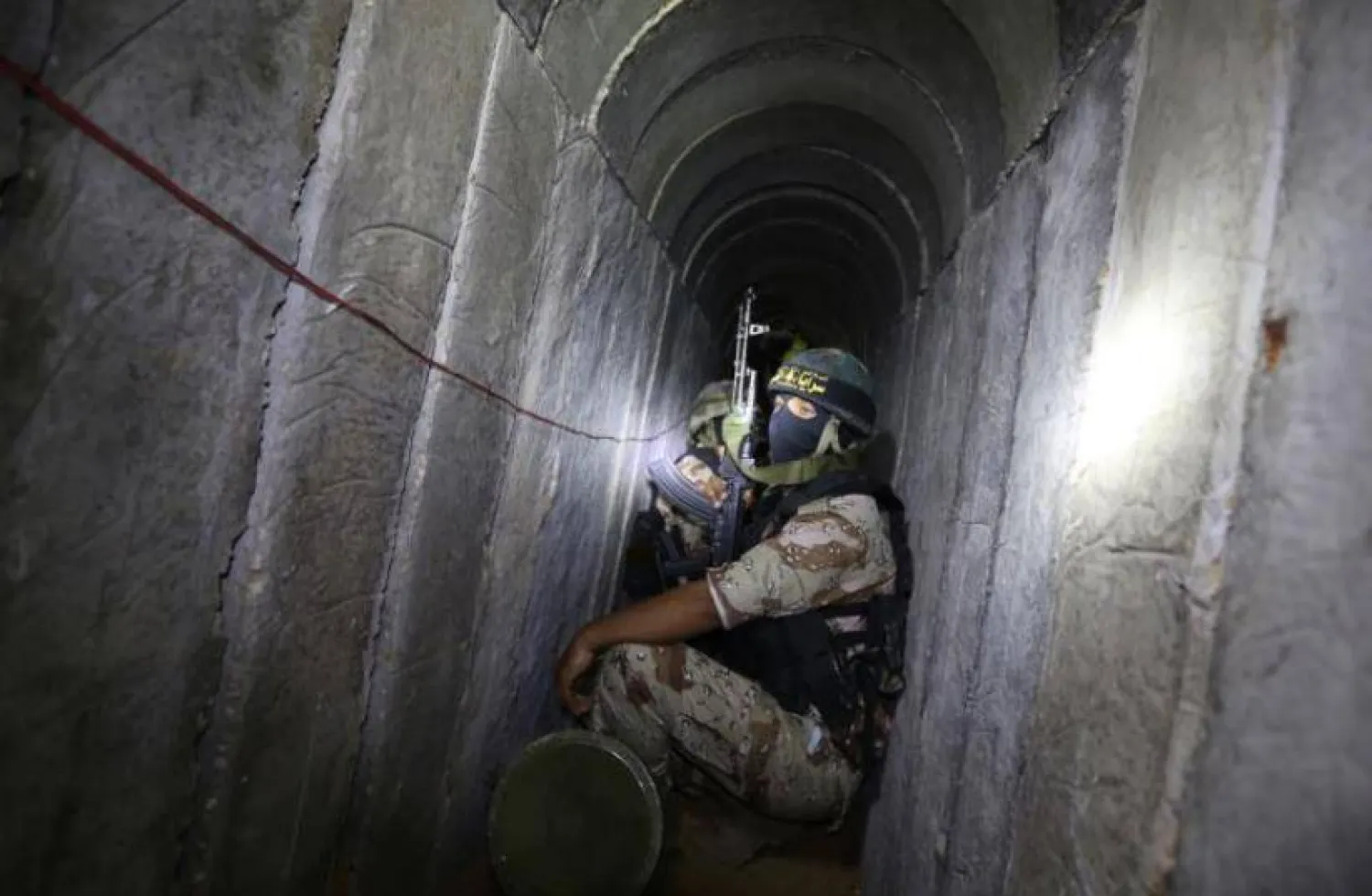
A Palestinian fighter from the Islamic Jihad's armed wing, the Al-Quds Brigades, is seen in a tunnel in the south of the Gaza Strip (AFP)
TT

Israeli Army’s Plan to Flood Hamas Tunnels Fails

A Palestinian fighter from the Islamic Jihad's armed wing, the Al-Quds Brigades, is seen in a tunnel in the south of the Gaza Strip (AFP)

The Israeli media on Saturday renewed talk about the Atlantis system, a significant engineering and technological breakthrough that was supposed to take out the Hamas tunnels and to kill senior Hamas officials, by pumping in seawater at high intensity.

The system was supposed to be the game changer, a new, relatively quick and lethal solution to one of the more complex fronts in the Gaza Strip.

But Israel started by adopting an old and unsuitable plan, continued by ignoring professional advice and the possible danger to the abductees – and ended quietly a few months later, anyone saying whether it achieved anything at all.

Haaretz surveys profiled the Atlantis project – a predictable military failure which no one stopped until it was too late.

“But about half a year after this system was revealed to the public, it turns out that Atlantis is lost; it's no longer in use, and nobody in the army can say what benefit, if any, was gained from this expensive project,” the newspaper wrote.

A Haaretz investigation – based on discussions with a series of different sources, who are closely involved in the development and operation of the system, as well as documents and minutes from closed discussions, in which senior officers and professionals participated– reveals a large number of screw-ups in the way it was handled by the army, and provides a profile of a failure foretold.

For example, it turns out that the system started to operate even before the necessary opinions requested by the army were given; that behind the accelerated activity there was a great deal of pressure imposed from above by the head of Southern Command, Maj. Gen. Yaron Finkelman; and that it was activated while possibly endangering Israelis who were alive when abducted to the Strip.
“The system was activated in at least one central Hamas tunnel that was clearly used by the organization during various stages of the war,” said a defense source who was deeply involved in project Atlantis. “And it's very likely that there were hostages there who served as a human shield.”

The question of how it happened that a project described by the Israeli Army as a “tie breaker” turned into a steadily growing failure has a complex answer.

One of the main causes is the backdrop, Haaretz said. During the first days of the war, says a defense source, “The achievements on the ground against Hamas officials were insignificant. Most of the Hamas forces, mainly the military arm, entered the tunnels and that created pressure on the senior Israeli Army command.”

That's why, says another source who spoke to Haaretz, Finkelman demanded solutions; ways of striking at Hamas activists in the tunnels. “There was frustration because during those stages the forces didn't really think that we'd start to enter all the tunnels,” recalls the source.

“They also began to realize the dimensions of the tunnels that Military Intelligence didn't know about.”

At that time, the Israeli Army was still learning about the tunnels they encountered in the Strip and their scope hundreds of kilometers.

“The army,” he adds, “found itself on the ground realizing that Hamas was below the ground and it had no solution for removing them from there.”

It was actually the renewal of a contingency plan that was proposed in the ground forces years before Finkelman assumed his position.

At the time the purpose was to deal with a different type of tunnel. Its chances of success in dealing with the tunnels that the army found in the Strip beginning on October 7 were low.

But according to defense sources who spoke to Haaretz, Finkelman gave a green light to taking the old plan and adapting it to the new situation.
After the plan received the necessary permits, the Army turned to the Israel Water Authority for assistance.

The authority hastened to mobilize for the mission and formed two groups of civilian experts in several fields. One group was placed in charge of pumping the water into the tunnels, the second was asked to study the subject of water loss through the walls of a tunnel. Both groups got started.
But the Israeli Army didn't wait for the conclusions, and already at this point they embarked on the next stage.

The Southern Command's 162nd division was chosen as the contractor of the operation, and infrastructure work was assigned to the fighters of the Shayetet 13 naval commandos, which for several weeks became a pipeline unit.

The main goal: joining pipes and deploying them in the combat area.

“For a month and a half the Israeli army neutralized an entire division,” says one of the commanders who took part in the project. “It assigned combat soldiers to plumbing jobs and guarding pipes, throughout the Strip, when it had no idea whether the project had any operational feasibility.”

He said, “The Army had no way of knowing whether the system was working, what had happened in the tunnels, what the situation was of the terrorists inside and whether there were hostages who were harmed as a result of the water. To this moment it isn't clear what damage was caused in the tunnels, if any. They simply don't know anything.”

According to a document issued by the experts on the subject, about three weeks after Atlantis began to operate, “The activation wasn't carried out according to the recommendations of the professionals. The pumping wasn't done according to the combat theory that was developed, no findings were gathered and they didn't take the measurements that were described.”

The experts were angry throughout the period. “There was a disconnect between the sources in the field and the accompanying unit on the one hand and the experts who planned the method of operation on the other,” they said.

And in fact, at that time, say professionals, the military lacked the requisite information and data about the tunnels, certainly not how to flood them in a way that would harm those inside or cause them to flee to the surface.

In the course of the project, the Water Authority investigators had a chance to be exposed to the study prepared by a Hamas activist who served in the tunnel system in the past 10 years. Along with his statement that the tunnels became the main system prepared by the organization for a military confrontation with Israel, he described how they were constructed and the logic behind them.



US Says Gaza ‘Phase Two’ Beginning with Goal of Hamas Demilitarization

 A tent camp for displaced Palestinians stretches across the Zeitoun neighborhood of Gaza City, Wednesday, Jan. 14, 2026. (AP)
A tent camp for displaced Palestinians stretches across the Zeitoun neighborhood of Gaza City, Wednesday, Jan. 14, 2026. (AP)
TT

US Says Gaza ‘Phase Two’ Beginning with Goal of Hamas Demilitarization

 A tent camp for displaced Palestinians stretches across the Zeitoun neighborhood of Gaza City, Wednesday, Jan. 14, 2026. (AP)
A tent camp for displaced Palestinians stretches across the Zeitoun neighborhood of Gaza City, Wednesday, Jan. 14, 2026. (AP)

President Donald Trump's envoy said Wednesday that a plan to end the Gaza war was now moving to Phase Two with a goal of disarming Hamas, despite a number of Israeli strikes during the ceasefire.

"We are announcing the launch of Phase Two of the President's 20-Point Plan to End the Gaza Conflict, moving from ceasefire to demilitarization, technocratic governance, and reconstruction," envoy Steve Witkoff wrote on X.

The second phase will also include the setup of a 15-person Palestinian technocratic committee to administer post-war Gaza. Its formation was announced earlier Wednesday by Egypt, a mediator.

Phase Two "begins the full demilitarization and reconstruction of Gaza, primarily the disarmament of all unauthorized personnel."

"The US expects Hamas to comply fully with its obligations, including the immediate return of the final deceased hostage. Failure to do so will bring serious consequences," he said.


Lebanon Arrests Syrian Citizen Suspected of Funding Pro-Assad Fighters

A damaged portrait of Syria's ousted President Bashar al-Assad lies on the ground in the western Syrian port city of Latakia on Dec. 15, 2024. (AFP via Getty Images)
TT

Lebanon Arrests Syrian Citizen Suspected of Funding Pro-Assad Fighters

A damaged portrait of Syria's ousted President Bashar al-Assad lies on the ground in the western Syrian port city of Latakia on Dec. 15, 2024. (AFP via Getty Images)

Lebanese authorities have arrested a Syrian citizen who is suspected of sending money to fighters loyal to former Syrian President Bashar al-Assad in Syria, judicial officials said Wednesday.

Ahmad Dunia was detained in recent days in Lebanon’s region of Jbeil north of Beirut and is being questioned over alleged links to Assad’s maternal cousin Rami Makhlouf as well as a former Syrian army general who left the country after Assad’s fall in December 2024, the officials said.

The officials described Dunia as the “financial arm” of the wealthy Makhlouf, saying he had been sending money to former Assad supporters in Syria who work under the command of ousted Syrian general Suheil al-Hassan who is believed to be in Russia.

The officials said the money was mostly sent to pro-Assad fighters who are active in Syria’s coastal region, where many members of his Alawite minority sect live.

Allegations that Dunia was financing Assad allies was first reported by Qatar’s Al Jazeera TV. He was then arrested by Lebanese security forces, according to officials who spoke on condition of anonymity because they were not authorized to speak to the media.

The arrest came a week after a Syrian security delegation visited Beirut and handed over to officials in Lebanon lists of dozens of names of former members of Assad’s security agencies whom they said are directing anti-government operations in Syria from Lebanon. Dunia’s name was one of those on the list, the officials said.

Since Assad’s fall, there have been several skirmishes between his supporters and the country’s new authorities.

In March last year, violence that began with clashes between armed groups aligned with Assad and the new government’s security forces spiraled into sectarian revenge attacks and massacres that killed hundreds of civilians from the Alawite minority.


Sudan Peace Talks Resume in Cairo as War Nears 3-Year Mark

Displaced women fill water at displaced persons camp in El Obeid, North Kordofan State, Sudan, January 12, 2026. (Reuters)
TT

Sudan Peace Talks Resume in Cairo as War Nears 3-Year Mark

Displaced women fill water at displaced persons camp in El Obeid, North Kordofan State, Sudan, January 12, 2026. (Reuters)

Sudan peace efforts resumed in Cairo on Wednesday as Egypt, the United Nations and the United States called for the warring parties to agree to a nationwide humanitarian truce, as the war between the army and its rival paramilitary nears the three-year mark.

Egyptian Foreign Minister Badr Abdelatty told reporters that Egypt wouldn't accept the collapse of Sudan or its institutions, or any attempt to undermine its unity or divide its territory, describing such scenarios as “red lines.”

Abdelatty said during a joint news conference with Ramtane Lamamra, the UN secretary‑general’s personal envoy for Sudan, that Egypt won't stand idly and won't hesitate to take the necessary measures to help preserve Sudan’s unity.

″There is absolutely no room for recognizing parallel entities or any militias. Under no circumstances can we equate Sudanese state institutions, including the Sudanese army, with any other militias,” he said on the sidelines of the fifth meeting of the Consultative Mechanism to Enhance and Coordinate Peace Efforts.

Lamamra said that the fifth such meeting demonstrated that diplomacy remains a viable path toward peace.

The paramilitary Rapid Support Forces, or RSF, and the military have been at war since April 2023. The conflict that has seen multiple atrocities and pushed Sudan into one of the world’s worst humanitarian crises.

Although repeated attempts at peace talks have failed to end the war, Abdelatty said that there's a regional agreement to secure an immediate humanitarian truce, including certain withdrawals and the establishment of safe humanitarian corridors.

Humanitarian aid Massad Boulos, the US senior adviser for Arab and African Affairs, said Wednesday that more than 1.3 metric tons of humanitarian supplies entered el-Fasher, the capital of North Darfur, on Wednesday, with the help of American-led negotiations, marking the first such delivery since the city was besieged 18 months ago.

“As we press the warring parties for a nationwide humanitarian truce, we will continue to support mechanisms to facilitate the unhindered delivery of assistance to areas suffering from famine, malnutrition, and conflict-driven displacement,” Boulos posted on X.

Egyptian President Abdel Fattah al-Sisi discussed with Boulos the need to increase coordination between both countries to achieve stability in Sudan, with Sisi expressing appreciation to US President Donald Trump’s efforts to end the war.

US and key mediators Saudi Arabia, Egypt and the United Arab Emirates, known as the Quad, proposed a humanitarian truce, which both sides reportedly agreed to, but the conflict has persisted.

“The President emphasized that Egypt will not allow such actions, given the deep connection between the national security of both brotherly countries,” the Egyptian president’s office said in a statement.

The United States has accused the RSF of committing genocide in Darfur during the war, and rights groups said that the paramilitary group committed war crimes during the siege and takeover of el-Fasher, as well as in the capture of other cities in Darfur. The military has also been accused of human rights violations.

Latest wave of violence

The UN Office for the Coordination of Humanitarian Affairs, OCHA, said on Tuesday that at least 19 civilians were killed during ground operations in Jarjira in North Darfur on Monday.

A military-allied Darfur rebel group said that it carried out a joint military operation with the army in Jarjira, saying that the operation liberated the area and its surroundings and forced RSF fighters to flee south.

At least 10 others were killed and nine others injured, also on Monday, in a drone attack that hit Sinja, the capital city of Sennar province, according to OCHA and the Sudan Doctors Network.

Sudan Doctors Network said in a statement that the drone strike was launched by the RSF and hit several areas in the city, describing the attack as the latest crime added “to the long list of grave violations against civilians.”

The group said that civilians are being deliberately targeted in a “full-fledged war crime.”

The Sudan Doctors Network also said that it “holds the Rapid Support Forces fully responsible for this crime and demands an end to their targeting of civilians and the protection of civilian infrastructure.”

Recent violence displaced more than 8,000 people from villages in North Darfur, with some fleeing to safer areas within the province and others crossing into Chad, according to the latest estimate by the International Organization for Migration.