


How Missed Warnings 'Over-tourism' Aggravated Deadly India Landslides

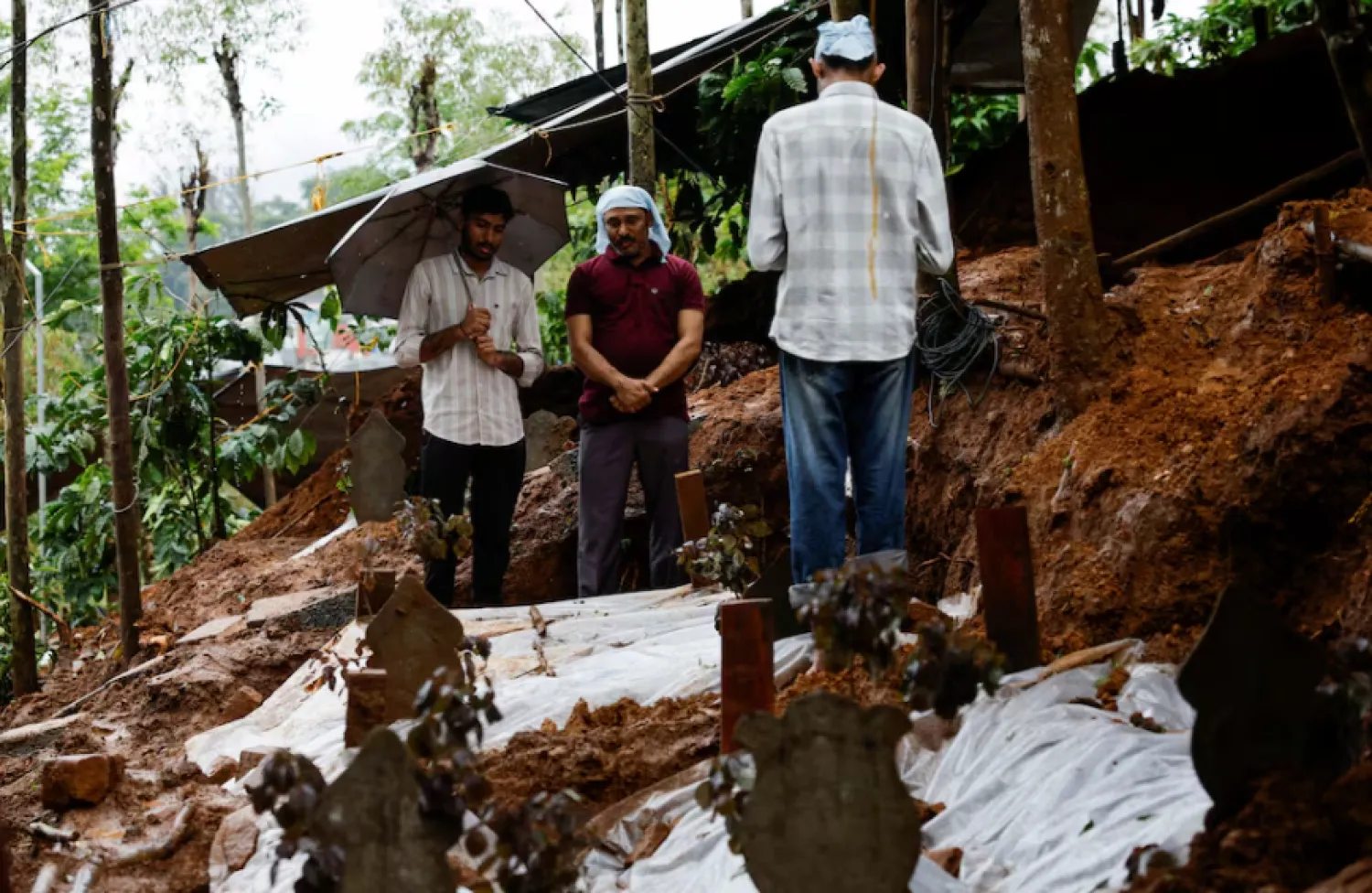
People pray for a departed family member at their grave at a graveyard, after landslides hit several villages in Wayanad district, in Meppadi, in the southern state of Kerala, India, August 2, 2024. REUTERS/Francis Mascarenhas Purchase Licensing Rights
TT

How Missed Warnings 'Over-tourism' Aggravated Deadly India Landslides

People pray for a departed family member at their grave at a graveyard, after landslides hit several villages in Wayanad district, in Meppadi, in the southern state of Kerala, India, August 2, 2024. REUTERS/Francis Mascarenhas Purchase Licensing Rights

With a steeply pitched tiled roof piercing misty green hills in southern India and a stream gushing through rocks nearby, the Stone House Bungalow was one of the most popular resorts in the Wayanad area of Kerala state.

It was empty when two landslides early on Tuesday washed away the 30-year-old stone building: staff and tourists had left after rain flooded its kitchen a few days earlier.

But neighbouring dwellings in Mundakkai village were occupied and 205 people, almost all locals, were killed and scores are missing. Tourists had been warned to leave the day earlier because of the rain,

Local authorities are now counting the cost of the disaster and questioning whether the rapid development of a tourism industry was to blame for the tragedy. Weather-related disasters are not unusual in India, but the landslides in Kerala state this week were the worst since about 400 people were killed in floods there in 2018.

Mundakkai, the area worst affected by the landslides, was home to some 500 local families. It and neighbouring villages housed nearly 700 resorts, homestays and zip-lining stations attracting trekkers, honeymooners and tourists looking to be close to nature, a local official said. Cardamom and tea estates dotted the hills.

Experts said they had seen Tuesday's disaster coming for years and several government reports in the past 13 years had warned that over-development in the ecologically sensitive areas would increase the risk of landslides and other environmental disasters such as floods by blocking natural water flows. The warnings were largely ignored or lost in bureaucratic wrangling.

A fast-growing India is rapidly building infrastructure across the country, especially in its tourist destinations, including the ecologically fragile Himalayan foothills in the north where there has been a rise in cave-ins and landslides.

Just three weeks before the latest disaster, Kerala state Tourism Minister P. A. Mohammed Riyas said in the local legislature in answer to a question that Wayanad was "dealing with an influx of more people than it can handle, a classic example of a place facing the problem of over-tourism".

The area is just six hours by road from Bengaluru, India's tech hub, and is a favoured weekend destination for the city's wealthy IT professionals.

However, officials were unable to share any documentary evidence with Reuters of resorts and tourist facilities flouting building regulations, although they said some had done so.

Noorudheen, part of Stone House's managing staff who goes by one name, said no government or village authority had warned the management against building or operating a resort there, Reuters reported.

There was no sign that the landslides were directly caused by over-development. Residents said regions higher up in the hills were loosened by weeks of heavy rain and an unusually heavy downpour on Monday night led to rivers of mud, water and boulders crashing downhill, sweeping away settlements and people.

But experts said the unbridled development had worsened the situation by removing forest cover that absorbs rain and blocking natural runoffs.

"Wayanad is no stranger to such downpours," said N. Badusha, head of Wayanad Prakruthi Samrakshana Samiti, a local environment protection NGO.

"Unchecked tourism activity in Wayanad is the biggest factor behind worsening such calamities. Tourism has entered ecologically sensitive fragile areas where it was not supposed to be."

SURGE IN TOURISM

Wayanad received more than 1 million domestic and foreign tourists last year, nearly triple the number in 2011 when a federal government report warned against over-development in the broader mountain range the district lies in, without clearly spelling out the consequences.

"The geography is really too fragile to accommodate all that," K. Babu, a senior village council official in Mundakkai, said in his office this week as he coordinated rescue efforts. "Tourism is doing no good to the area...the tourism sector was never this active."

A Wayanad district disaster management report in 2019 warned against "mindless development carried out in recent decades by destroying hills, forests, water bodies and wetlands".

"Deforestation and reckless commercial interventions on land have destabilised the environment," Wayanad's then top official, Ajay Kumar, wrote after landslides in the district that year killed at least 14 people.

Reuters reached out to the Wayanad district head, its disaster management authority, Kerala Chief Minister Pinarayi Vijayan's office and the federal environment ministry seeking comment but there were no responses.

Mundakkai used to be a small village sitting on the eastern slope of one of the forested green hills of the Western Ghats mountain range that runs parallel to nearly the entire length of India's western coast for 1,600 km (1,000 miles).

Rashid Padikkalparamban, a 30-year-old Mundakkai native who lost six family members including his father to the landslides, said that the place came to the attention of outsiders mainly after 2019 and turned it into a major tourist attraction.

"They discovered a beautiful region full of tea and cardamom plantations, and a river that swept through it," he said at a school-turned-relief camp.

Many locals sold their lands to outsiders, who then built tourist retreats in the area, he said.

'GOD'S OWN COUNTRY'

Kerala, a sliver of land between the Western Ghat mountains to the east and the Arabian Sea to the west, is one of the most scenic states in India, and is advertised as "God's Own Country".

But it has witnessed nearly 60% of the 3,782 landslides in India between 2015 and 2022, the federal government told parliament in July 2022.

Studying the ecological sensitivity of the Western Ghats, a federal government-appointed committee said in 2011: "It has been torn asunder by the greed of the elite and gnawed at by the poor, striving to eke out a subsistence. This is a great tragedy, for this hill range is the backbone of the ecology and economy of south India."

The committee, headed by ecologist Madhav Gadgil, recommended barring mining, no new rail lines or major roads or highways in such areas, and restrictions on development in protected areas that it mapped out. For tourism, it said only minimal impact tourism should be promoted with strict waste management, traffic and water use regulations.

State governments, including Kerala, did not accept the report, and a new committee was set up, which in 2013 reduced the overall protected area from 60% of the mountain range to 37%.

But all the states along the mountain range wanted to reduce the protected area even further, minutes of successive meetings until 2019 show. The federal government issued drafts to implement the recommendations for all stakeholders, but is yet to issue a final order.

Gadgil told Reuters his committee had "specifically recommended that in ecologically highly sensitive areas there should be no further human interventions, such as reconstruction".

"The government, of course, decided to ignore our report," he said, because tourism is a cash cow.

Kerala Chief Minister Vijayan dismissed questions about the Gadgil recommendations, telling reporters his focus was on relief and rehabilitation and asking people to not "raise inappropriate propaganda in the face of this tragedy".

While experts bemoan tourism-led development, locals like Mundakkai's Padikkalparamban said it brought jobs to an area that did not have many options earlier.

"After the plantation estates, resorts are the second biggest job-generating sector in the area now," he said.

But K.R. Vancheeswaran, president of the Wayanad Tourism Organisation that has some 60 resorts and homestays as members but none in the vicinity of the landslides, said the industry needed to take some of the blame.

"If human activities are going to be unbearable to nature, nature will unleash its power and we will not be able to withstand it," Vancheeswaran said. "We have had to pay a very, very high price, so let us try to learn from it."



Olympic Tourists in Cortina Can Explore the Dolomites with the New ‘Uber Snowmobile’ Service

 The peaks of the Dolomites are seen from the Cortina Sliding Centre during the Milano Cortina 2026 Winter Olympic Games in Cortina d'Ampezzo on February 5, 2026. (AFP)
The peaks of the Dolomites are seen from the Cortina Sliding Centre during the Milano Cortina 2026 Winter Olympic Games in Cortina d'Ampezzo on February 5, 2026. (AFP)
TT

Olympic Tourists in Cortina Can Explore the Dolomites with the New ‘Uber Snowmobile’ Service

 The peaks of the Dolomites are seen from the Cortina Sliding Centre during the Milano Cortina 2026 Winter Olympic Games in Cortina d'Ampezzo on February 5, 2026. (AFP)
The peaks of the Dolomites are seen from the Cortina Sliding Centre during the Milano Cortina 2026 Winter Olympic Games in Cortina d'Ampezzo on February 5, 2026. (AFP)

The peaks of the Dolomites are seen from the Cortina Sliding Centre during the Milano Cortina 2026 Winter Olympic Games in Cortina d'Ampezzo on February 5, 2026. (AFP)

For one month starting on Saturday, Olympic spectators keen for a side trip to a UNESCO World Heritage Site can use Uber to reserve a ride on a snowmobile along the snow-covered road to the base of the Three Peaks of Lavaredo.

The dramatic, jagged limestone pinnacles stand just 23 kilometers (14.3 miles) from the Cortina venues where athletes are competing in the 2026 Winter Olympics and Paralympics.

One of the Olympic torchbearers, Giulia Baffetti, runs snowmobiling tours through Cortina-based winter activities outfit Snowdreamers. The company partnered with Uber, the official ride-hailing sponsor for the Games, to offer free tours on the weekends in February to people in town.

"Uber Snowmobile" tours, which can only be booked through Uber, include a ride in an Uber transfer bus for up to eight people from Cortina to the spot where riders mount their snowmobiles for departure. Tourgoers then follow the instructor, who leads the line of snowmobiles.

The first slots offered went fast, but Uber spokesperson Caspar Nixon said Friday that it planned to add more.

The three peaks are a magical place, Baffetti said, and this is a way for more people to experience it. Hikers and climbers flock there in the warmer months. In the winter, it’s a prime spot for cross-country skiing, snowshoeing and sledding. Snowmobiling is allowed in a limited area in order to protect the environment.

"We want to give an experience to the tourists, so they can feel the mountains in a different way," she said.

The Associated Press took the one-hour tour on Thursday, ahead of the Saturday launch, along with one other person. Helmets are essential, while heated handgrips are a most welcome feature. And that red button? Passengers can push it to stop the snowmobile if it veers off course or they feel unsafe.

The adrenaline-filled ride reaches speeds up to 40 kph (25 mph) when zooming past snow-covered trees, and drivers are instructed to slow when coming upon cross-country skiers and sledders. Deer and wolves are sometimes seen along the 7-kilometer (4.3-mile) route up to the base of the peaks.

Also visible on Thursday was the southernmost of the three Lavaredo peaks, rising sharply out of the fog. While the Dolomites are breathtaking from Cortina — and on Friday, the sun shone and the view was clear from town — they are even more impressive up close.

The route back includes a short loop around Lake Antorno. Before traversing all the ups and downs, the snowmobile instructor leading the tour offers a reminder about that red button.

Saher Deeb, an Israeli tourist, was along for the ride Thursday, one day after his 29th birthday. It was his first time on a snowmobile, and he was all smiles as he climbed off at the end.

"It was perfect," he said.


French Duo Finish Walking from France to Shanghai After 1.5 Years

 Performers throw molten iron to create sparks during a performance on the Bund promenade along the Huangpu river, ahead of the upcoming Lunar New Year of the Horse in Shanghai on February 2, 2026. (AFP)
Performers throw molten iron to create sparks during a performance on the Bund promenade along the Huangpu river, ahead of the upcoming Lunar New Year of the Horse in Shanghai on February 2, 2026. (AFP)
TT

French Duo Finish Walking from France to Shanghai After 1.5 Years

 Performers throw molten iron to create sparks during a performance on the Bund promenade along the Huangpu river, ahead of the upcoming Lunar New Year of the Horse in Shanghai on February 2, 2026. (AFP)
Performers throw molten iron to create sparks during a performance on the Bund promenade along the Huangpu river, ahead of the upcoming Lunar New Year of the Horse in Shanghai on February 2, 2026. (AFP)

Two French adventurers reached the end of an epic walk from France to Shanghai on Saturday, after nearly a year and a half crossing 16 countries almost entirely on foot.

Loic Voisot and Benjamin Humblot embraced as they stood by the river on the Bund promenade, the financial hub's distinctive skyline glittering in the background.

Voisot and Humblot set off from Annecy in September 2024.

"We were thinking about this moment almost every day for more than a year now, so it's a really strong feeling," Humblot said of reaching their destination.

Hanging out after work one day, the two friends realized they both yearned for a "great adventure".

They wanted to visit China -- but without flying, which they believe is too harmful to the environment.

A plan to set out on foot was hatched, and except for a stretch in Russia which was done by bus for safety reasons, 518 days and around 12,850 kilometers (7,980 miles) later they took the last steps to completing it.

Around 50 people gathered at the start point for the last 10km stretch of their odyssey, many local people who have been following them on social media.

Along the way their numbers swelled, as media, French residents of Shanghai and others joined.

"If your dreams are crazy, just take it step by step and sometimes you will not succeed, but sometimes you will," said Voisot.

Asked what he would do first now the walk was over, he joked: "Sleep a lot!"


Annual Orchids Show Brings Vivid Color to Chicago Winter

Orchids adorn a Volkswagen Beetle as finishing touches are placed on the 12th annual Chicago Botanic Garden Orchid Show, Friday, Feb. 6, 2026, in Glencoe, Ill. (AP)
TT

Annual Orchids Show Brings Vivid Color to Chicago Winter

Orchids adorn a Volkswagen Beetle as finishing touches are placed on the 12th annual Chicago Botanic Garden Orchid Show, Friday, Feb. 6, 2026, in Glencoe, Ill. (AP)

A soft layer of white snow blankets the grounds of the Chicago Botanic Garden. The air is chilly, the sky gray.

Inside, however, the air is warm and lights illuminate more than 10,000 vividly colored orchids. Staff members move in and out of greenhouses, preparing to open the garden’s 12th annual Orchid Show on Saturday.

This year’s theme is “Feelin’ Groovy" with several installations calling back to the 1970s, including a yellow Volkswagen Beetle filled with orchids.

“It’s just a really great way to get out of the winter cold and come into our greenhouses,” said Jodi Zombolo, associate vice president of visitor events and programs. “I think people are really looking for something to kind of bring happiness and something that they will enjoy and find whimsy in.”

The orchid family is one of the largest in the plant world and some of the species in the show are rare, exhibits horticulturist Jason Toth said. One example is the Angraecum sesquipedale, also known as Darwin’s orchid, on display in the west gallery.

Toth said the orchid led Darwin to correctly conclude that pollinators have adapted in order to reach down the flower's very long end.

"It has a great story and it’s quite remarkable-looking,” said Toth.

Elsewhere, massive, gnarly roots dangle from purple, pink and yellow Vanda orchids in the south greenhouse. These epiphytic orchids grow on the surface of trees instead of in soil.

“I think everyone’s tired of the winter,” said Toth. “So having some kind of flower show at this point is what we’re all craving. And 'Orchids' fits the bill.”

The show is expected to draw 85,000 visitors this year.