

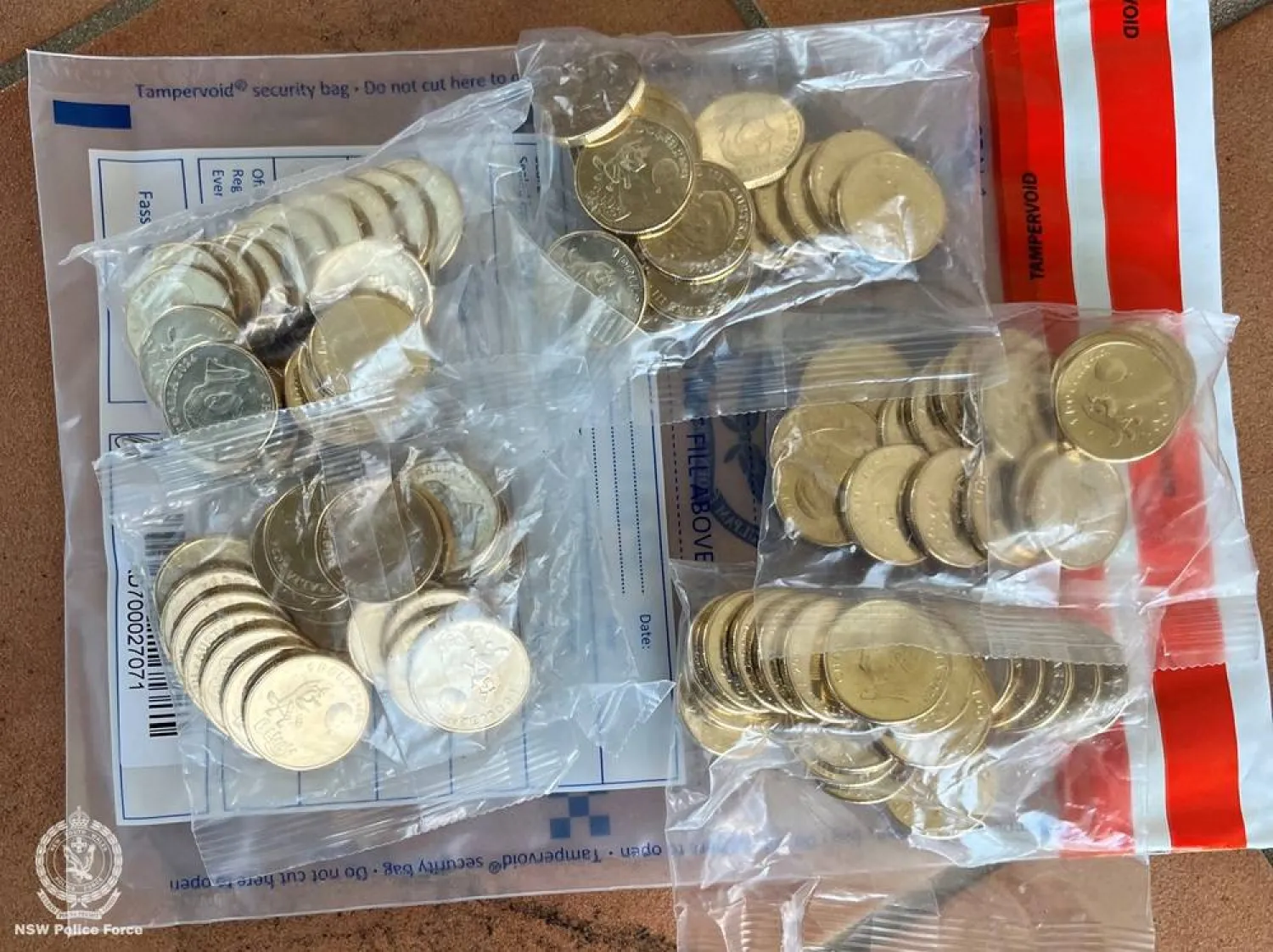

‘Bluey’ Coins Worth $400,000 Stolen by Australian Warehouse Worker, Police Say

This undated handout photo taken by the New South Wales Police Force and released on August 7, 2024 shows bags of seized commemorative Bluey coins at an undisclosed location. (New South Wales Police / AFP)
TT

‘Bluey’ Coins Worth $400,000 Stolen by Australian Warehouse Worker, Police Say

This undated handout photo taken by the New South Wales Police Force and released on August 7, 2024 shows bags of seized commemorative Bluey coins at an undisclosed location. (New South Wales Police / AFP)

An Australian man is set to appear in court on Wednesday after being arrested for the alleged theft of more than A$600,000 ($393,000) worth of commemorative coins linked to the popular children's television show "Bluey", police said.

The 47-year-old is accused of stealing 63,000 unreleased, limited-edition A$1 coins from a secure warehouse in the Sydney suburb of Wetherill Park in June, according to "Strike Force Bandit", a special unit police set up to investigate the theft.

One of last year's most streamed television shows in the United States, the Australian animated show targeted at children is widely loved by adults too and is the 14th highest-rated show of all time, movie tracker website IMDB.com showed.

The coins, produced by the Australian mint, are legal tender and resemble regular A$1 coins albeit with one face featuring the anthropomorphic canine character "Bluey". Police say they are selling online for 10 times their face value.

A similar run of special commemorative coins sell for A$20 each on the mint's website - coins designed to be collectors' items only and not legal tender. One eBay seller was charging almost A$600 for a pack of three.

Detective Superintendent Joseph Doueihi told reporters at a press conference he was not initially aware of the show's popularity.

"The theft of these coins have deprived a lot of young children and members of the community from having access to these coins, so we're doing our absolute best to try to recover these coins and put them back into circulation."

Police said the man worked at the warehouse where the coins were being stored for two days on their way to Brisbane.

They alleged he stole the coins, which weighed 500 kilograms (1102 lb), from the back of a truck with the help of two male accomplices. The coins were then sold online within hours.

A raid on a Sydney house in June recovered 189 coins but Doueihi said the vast bulk of coins are already in circulation. Those who have received one do not need to surrender it to police, he said.



'Cretaceous Kraken' Prowled the Seas During the Age of Dinosaurs

An artist's reconstruction of a finned octopus of the species Nanaimoteuthis haggarti that reached a length estimated at up to 18.6 meters (61.02 feet) and lived about 86 to 72 million years ago during the Cretaceous Period, released on April 23, 2026. Yohei Utsuki/Department of Earth and Planetary Sciences, Hokkaido University/Handout via REUTERS
TT

'Cretaceous Kraken' Prowled the Seas During the Age of Dinosaurs

An artist's reconstruction of a finned octopus of the species Nanaimoteuthis haggarti that reached a length estimated at up to 18.6 meters (61.02 feet) and lived about 86 to 72 million years ago during the Cretaceous Period, released on April 23, 2026. Yohei Utsuki/Department of Earth and Planetary Sciences, Hokkaido University/Handout via REUTERS

The Kraken is a huge tentacled sea monster from Norse folklore that drags ships and sailors down into the deep. During the age of dinosaurs, new research shows, there existed a creature as close to a real-life Kraken as you could possibly get - an enormous octopus that prowled the seas as an apex predator.

Scientists said fossils of beaks - the soft-bodied invertebrate's hard jaw structure - indicate that an octopus species named Nanaimoteuthis haggarti that lived about 86 to 72 million years ago during the Cretaceous Period ranged from 22 to 61 feet (6.6 to 18.6 meters) long.

"These animals were remarkable. With their large bodies, long arms, powerful jaws and advanced behavior, they represent what could be described as a real 'Cretaceous Kraken,'" said paleontologist Yasuhiro Iba of Hokkaido University in Japan, lead author of the research published on Thursday in the journal Science.

"For roughly the past 370 million years, marine ecosystems have been thought to be dominated by large vertebrate predators - first fishes and ⁠sharks, then marine ⁠reptiles and later whales. Our study shows that giant invertebrates, namely octopuses, also functioned as apex predators in the Cretaceous sea," Reuters quoted Iba as saying.

Iba said Nanaimoteuthis haggarti is one of the largest invertebrates on record.

"Until now, the largest-known invertebrate has been the modern giant squid, which can reach about 12 meters (39 feet) in total length," Iba said.

The intense wear observed on the beaks is consistent, the researchers said, with repeated crushing of hard structures such as bones and shells, indicative of a predator that hunted large fish, shelled tentacled creatures, clams and other sizable prey.

"In the largest specimens, about 10% of the ⁠total jaw length appears to have been lost due to wear. This is more severe than what is typically seen in modern octopuses and cuttlefishes that feed on hard prey," Iba said.

The beaks were shaped like those of certain deep-sea octopuses alive today that swim with the help of fins, leading the researchers to conclude that these Cretaceous octopuses also bore fins.

The numerous beak fossils studied in the research came from Japan and Canada's Vancouver Island. The researchers reexamined previously known specimens and discovered new fossils as well.

The researchers also studied the beaks of a close relative called Nanaimoteuthis jeletzkyi that lived about 100 to 72 million years ago. It was not quite as big, ranging from 9 to 25 feet (2.8 to 7.7 meters) long, but also was an active predator.

Because octopuses are soft-bodied animals, they seldom fossilize well. The beak, the only rigid part of the octopus body, is made of a hard and durable material ⁠called chitin, also found in ⁠the exoskeletons of crabs, lobsters and insects.

Guided by modern-day octopus anatomy, the researchers were able to estimate the size of the Cretaceous octopuses based on the dimensions of the beaks.

"Octopuses are not simply biting predators. They use long, flexible arms to capture prey and powerful jaws to process it. As body size increases, their ability to control large prey with their arms and to process it with their jaws also increases," Iba said.

"In addition, octopuses are among the most intelligent invertebrates. In our fossils, the jaws show asymmetric wear, suggesting lateralized behavior - favoring one side over the other, something like handedness. This indicates not only strength, but also advanced and flexible behavior," Iba said.

These octopuses shared the Cretaceous seas with other large predators including marine reptiles called mosasaurs and plesiosaurs that reached up to around 50 feet (15 meters) long as well as sharks rivaling today's great white in size.

"These giant octopuses likely occupied the same ecological tier and may have competed with marine reptiles and sharks within the same ecosystem," Iba said. "Their existence changes how we view ancient oceans. Instead of ecosystems dominated solely by vertebrate predators, we now see that giant invertebrates such as octopuses also occupied the very top of the food web."


Saudi Team Successfully Separates Filipino Conjoined Twins in Highly Complex Surgery

The operation was conducted at King Abdullah Specialist Children’s Hospital in King Abdulaziz Medical City of the Ministry of National Guard in Riyadh. SPA
TT

Saudi Team Successfully Separates Filipino Conjoined Twins in Highly Complex Surgery

The operation was conducted at King Abdullah Specialist Children’s Hospital in King Abdulaziz Medical City of the Ministry of National Guard in Riyadh. SPA

The specialized medical and surgical team of the Saudi Conjoined Twins Program achieved on Thursday a new medical milestone by successfully separating the Filipino conjoined twins Klea and Maurice Ann following a highly complex surgical procedure, considered among the most challenging cases worldwide.

The operation was conducted at King Abdullah Specialist Children’s Hospital in King Abdulaziz Medical City of the Ministry of National Guard in Riyadh.

Advisor at the Royal Court, Supervisor General of the King Salman Humanitarian Aid and Relief Center (KSrelief), and head of the medical and surgical team of the Saudi Conjoined Twins Program Dr. Abdullah Al Rabeeah stated the Filipino twins were separated after 12 hours and 45 minutes from the start of anesthesia.

This marks the completion of the third stage, with the fourth and fifth stages remaining, which are expected to take several more hours and will include reconstruction, cosmetic procedures, and cranial closure.

He added that the operation was carried out with the participation of 30 consultants, specialists, and nursing and technical staff across multiple disciplines, including anesthesia, intensive care, advanced imaging, plastic surgery, and other supporting specialties, ensuring the highest levels of precision and safety throughout all stages of the procedure.

Al Rabeeah noted that this marks the third separation of conjoined twins from the Philippines and the 70th case within the Saudi Conjoined Twins Program, which spans more than 35 years.

The program has covered 27 countries and evaluated 157 cases worldwide, underscoring the Kingdom’s leading role in this rare medical specialty, under the direct support and patronage of Custodian of the Two Holy Mosques King Salman bin Abdulaziz Al Saud and Prince Mohammed bin Salman bin Abdulaziz Al Saud, Saudi Crown Prince and Prime Minister.

Al Rabeeah expressed, on behalf of himself and all members of the medical and surgical team, his deepest gratitude to the Kingdom’s leadership for the continuous support and close follow-up provided to the program.

He also extended his thanks to the surgical team, led by pediatric neurosurgery consultant Dr. Moutasem Azzubi, as well as to all members of anesthesia, plastic surgery, nursing, and technical teams for their efforts, which contributed to the success of the operation and the safety of the twins.

He affirmed that this achievement reflects the Kingdom’s noble humanitarian mission and its position as a global center of excellence in this field.

For their part, the twins’ family expressed their appreciation and gratitude to the Custodian of the Two Holy Mosques and the Crown Prince for the high-quality medical care provided, praising the tremendous efforts exerted by the medical team to ensure the success of the operation.


58-year-old Woman Killed in Bear Attack in Poland

22 April 2026, US, Seattle: Juniper, a Coastal Alaskan Brown Bear pictured on Earth Day at the Woodland Park Zoo. Photo: Shane Srogi/ZUMA Press Wire/dpa
TT

58-year-old Woman Killed in Bear Attack in Poland

22 April 2026, US, Seattle: Juniper, a Coastal Alaskan Brown Bear pictured on Earth Day at the Woodland Park Zoo. Photo: Shane Srogi/ZUMA Press Wire/dpa

A 58-year-old woman was killed by a bear in Southeastern Poland on Thursday, Pawel Giba, press officer for the District State Fire Service Headquarters in Sanok, told AFP.

A report received by the fire department "indicated that in the village of Plonna a woman was allegedly attacked by a bear," he said.

The report was filed by the woman's son.

Three fire squads and police were dispatched to the scene, but "did not proceed with first aid measures due to the extent of the woman's bodily injuries," he added.

Their arrival was delayed by "the difficult terrain and the lack of precise location details".

Upon their arrival, paramedics pronounced the woman dead at the scene.

Currently, "securing activities are underway," and a prosecutor is arriving in the area, according to the spokesman.

Poland has a population of about 100 brown bears, 80 percent of them in Poland's mountainous Bieszczady region, where the latest attack took place, according to Polish government data from 2024.

However, fatal attacks remain extremely rare with the last fatal bear attack in Poland in 2014, according to local media.