Fears of Violence Greet Return of English Football Season

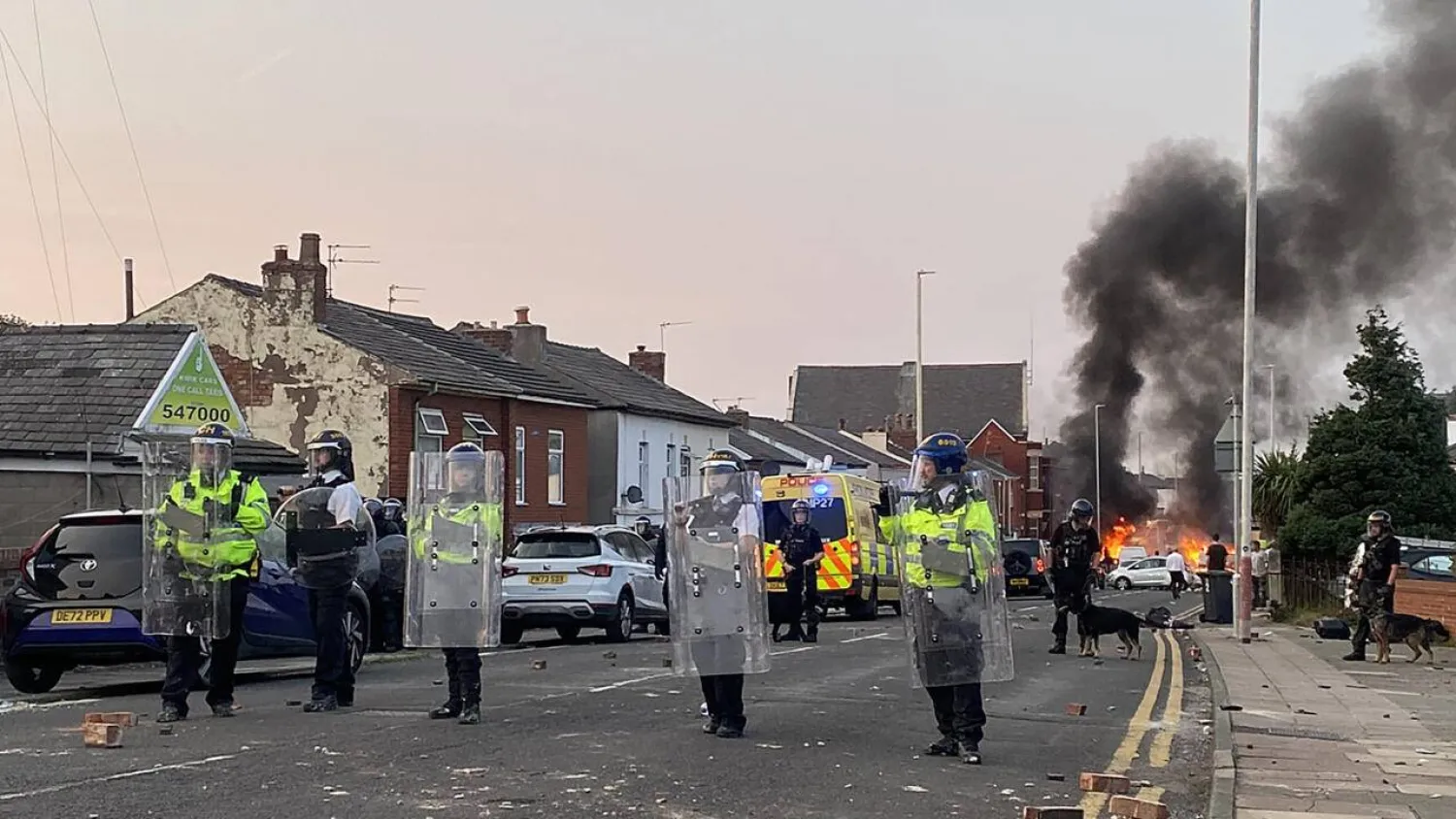
Clashes have erupted in cities across England and Northern Ireland since a mass stabbing in Southport but authorities say far-right elements have fueled the unrest. Roland LLOYD PARRY / AFP
TT

Fears of Violence Greet Return of English Football Season

Clashes have erupted in cities across England and Northern Ireland since a mass stabbing in Southport but authorities say far-right elements have fueled the unrest. Roland LLOYD PARRY / AFP

Authorities are eyeing the start of the English football season this weekend with trepidation, following riots which have rocked towns and cities across the country.
Dozens of teams in the English Football League -- below the high-profile Premier League -- start playing their first games from Saturday afternoon, including in cities that have seen disorder, said AFP.
The unrest followed a knife attack that killed three children. But officials have blamed far-right elements -- some with links to England's decades-old football hooligan scene -- for orchestrating the violence which saw mosques and immigration-linked sites torched and police targeted.
Tommy Robinson, a notorious anti-Muslim agitator with a string of criminal convictions including for football-related offences, has been accused of helping to fuel the unrest through constant social media posts about the events.
Crowds at some gatherings were heard chanting his name -- which is actually a pseudonym borrowed from an infamous Luton Town Football Club hooligan in the 2000s.
The prospect of thousands gathering Saturday for games in towns and cities including Middlesbrough, Hull and London has prompted concern that unrest could flare again after two nights of relative quiet.
More than 80,000 fans are also expected at Wembley on Saturday when Manchester City and Manchester United play for the FA Community Shield.
'Tarnish'
Prime Minister Keir Starmer, an avid football fan, conceded Friday that the start of the new season "added into the mix" of challenges facing police.
"Whatever the challenge, we have to rise to it," he insisted to UK broadcasters.
The UK Football Policing Unit (UKFPU) said forces nationwide were collaborating to ensure that "all relevant intelligence" was shared ahead of the football games.
A UKFPU spokesperson said it was being updated about arrests during the recent unrest and the possibility of banning those people from football stadiums.
Courts make Football Banning Orders after a football-related criminal conviction or following a police request to keep individuals from attending matches and even nearby places in some cases.
They have been extended in recent years to cover convictions for online hate crime linked to the sport and convictions for selling or taking Class A drugs.
Chief Constable Gavin Stephens, who heads the National Police Chiefs' Council (NPCC) overseeing the UKFPU, urged people not to "tarnish football with the violence that we've seen".
"Football brings communities together," he told a media briefing.
"Yes, some of these violent thugs attach themselves to the fringes of it, but not everywhere, not all clubs, and certainly not for the totality of football."
'Crossovers'
Mark Doidge, a Loughborough University academic who has researched UK and European football fan cultures, said English football typically requires "a major police operation" but that officers now have experience.
He downplayed any overlap between recent disorder and fans of the so-called beautiful game, and the notion that English football was being used to recruit people to the far-right.
"Although there are crossovers between the demographics -- some fans are also far-right -- not all fans are, and not all far-right are fans or attend matches," he told AFP.
"There doesn't seem to be any coordinated activity taking place at football, and no protests have been planned for stadiums."
Doidge noted some fans may spontaneously chant or protest about recent events, which could itself prove divisive with other fans and provide an unpredictable element for police.
"If confrontation comes from fans of the same team, then this might be something that they haven't prepared for," he added.
Meanwhile, some football clubs in towns which have seen recent rioting have been spoken out against the troubles.
"We utterly condemn the violent and racist scenes we have seen on the streets of Middlesbrough," Steve Gibson, chairman of the northeast English town's club said in a joint statement with its local MP and mayor this week.
"We in Middlesbrough have a proud and inclusive history. Over the centuries our town and our football club have welcomed people from across the world."



Macron Says Wants ‘European Approach’ in Dialogue with Putin

Russian President Vladimir Putin attends a meeting with Moscow Mayor Sergei Sobyanin at the Kremlin in Moscow, Russia February 9, 2026. (Sputnik/Vyacheslav Prokofyev/Pool via Reuters)
TT

Macron Says Wants ‘European Approach’ in Dialogue with Putin

Russian President Vladimir Putin attends a meeting with Moscow Mayor Sergei Sobyanin at the Kremlin in Moscow, Russia February 9, 2026. (Sputnik/Vyacheslav Prokofyev/Pool via Reuters)

French President Emmanuel Macron has said he wants to include European partners in a resumption of dialogue with Russian leader Vladimir Putin nearly four years after Moscow's invasion of Ukraine.

He spoke after dispatching a top adviser to Moscow last week, in the first such meeting since Russia launched its full-scale invasion of Ukraine in February 2022.

"What did I gain? Confirmation that Russia does not want peace right now," he said in an interview with several European newspapers including Germany's Suddeutsche Zeitung.

"But above all, we have rebuilt those channels of discussion at a technical level," he said in the interview released on Tuesday.

"My wish is to share this with my European partners and to have a well-organized European approach," he added.

Dialogue with Putin should take place without "too many interlocutors, with a given mandate", he said.

Macron said last year he believed Europe should reach back out to Putin, rather than leaving the United States alone to take the lead in negotiations to end Russia's war against Ukraine.

"Whether we like Russia or not, Russia will still be there tomorrow," Suddeutsche Zeitung quoted the French president as saying.

"It is therefore important that we structure the resumption of a European discussion with the Russians, without naivety, without putting pressure on the Ukrainians -- but also so as not to depend on third parties in this discussion."

After Macron sent his adviser Emmanuel Bonne to the Kremlin last week, Russia's Foreign Minister Sergei Lavrov on Thursday said Putin was ready to receive the French leader's call.

"If you want to call and discuss something seriously, then call," he said in an interview to state-run broadcaster RT.

The two presidents last spoke in July, in their first known phone talks in over two-and-a-half years.

The French leader tried in a series of phone calls in 2022 to warn Putin against invading Ukraine and travelled to Moscow early that year.

He kept up phone contact with Putin after the invasion but talks had ceased after a September 2022 phone call.


Seven Killed in Gold Mine Accident in Eastern China, State Media CCTV Reports

Gold mine in China (archive-Reuters)
TT

Seven Killed in Gold Mine Accident in Eastern China, State Media CCTV Reports

Gold mine in China (archive-Reuters)

Seven people were killed in a gold mine accident in China's eastern Shandong province, and authorities were investigating, state-run CCTV reported, sending shares of the mine owner, Zhaojin Mining Industry, down 6% on Tuesday, Reuters said.

The accident occurred on Saturday when a cage fell ‌down a mine ‌shaft, CCTV reported ‌late ⁠on Monday ‌night.

The emergency management and public security departments were investigating the cause of the accident, and whether there had been an attempt to cover it up, the ⁠report added.

The mine is owned by ‌leading gold producer Zhaojin ‍Mining Industry, according ‍to the Qichacha company registry. Shares ‍of the company were down 6.01%, as of 0525 GMT. A person who answered Zhaojin's main phone line told Reuters that the matter was under investigation and ⁠declined to answer further questions.

China's emergency management ministry on Monday held a meeting on preventing accidents during the upcoming Lunar New Year holiday. It announced inspections of mines, chemical companies, and other hazardous operations. Also on Saturday, an explosion at a biotech company ‌in northern China killed eight people.


Still a Long Way to Go in Talks on Ukraine, Russia's Lavrov Says

Russian Foreign Minister Sergei Lavrov attends a meeting with Tanzanian Minister of Foreign Affairs and East African Cooperation Mahmoud Thabit Kombo (not pictured), in Moscow, Russia, 09 February 2026.  EPA/RAMIL SITDIKOV / POOL
Russian Foreign Minister Sergei Lavrov attends a meeting with Tanzanian Minister of Foreign Affairs and East African Cooperation Mahmoud Thabit Kombo (not pictured), in Moscow, Russia, 09 February 2026. EPA/RAMIL SITDIKOV / POOL
TT

Still a Long Way to Go in Talks on Ukraine, Russia's Lavrov Says

Russian Foreign Minister Sergei Lavrov attends a meeting with Tanzanian Minister of Foreign Affairs and East African Cooperation Mahmoud Thabit Kombo (not pictured), in Moscow, Russia, 09 February 2026.  EPA/RAMIL SITDIKOV / POOL
Russian Foreign Minister Sergei Lavrov attends a meeting with Tanzanian Minister of Foreign Affairs and East African Cooperation Mahmoud Thabit Kombo (not pictured), in Moscow, Russia, 09 February 2026. EPA/RAMIL SITDIKOV / POOL

Russian Foreign Minister Sergei Lavrov said that there was no reason to be enthusiastic about US President Donald Trump's pressure on Europe and Ukraine as there was still a long way to go in talks on peace in Ukraine, RIA reported on Tuesday.

Here are ‌some details:

The ‌United States has ‌brokered ⁠talks between Russia and Ukraine ‌on various different drafts of a plan for ending the war in Ukraine, but no deal has yet been reached despite Trump's repeated promises to clinch one.

* "There is still a long way to go," Lavrov ⁠was quoted as saying by Russian news agencies.

* Lavrov said that ‌Trump had put Ukraine ‍and Europe in their places ‍but that such a move was ‍no reason to embrace an "enthusiastic perception" of the situation.

* Russian Deputy Foreign Minister Alexander Grushko said that any deal would have to exclude NATO membership for Ukraine and rule out the deployment of foreign troops in Ukraine, Izvestia ⁠reported.

* At stake is how to end the deadliest war in Europe since World War Two, the future of Ukraine, the extent to which European powers are sidelined and whether or not a peace deal brokered by the United States will endure.

* Russia invaded Ukraine in February 2022 after eight years of fighting in eastern Ukraine, triggering the biggest confrontation between ‌Moscow and the West since the depths of the Cold War.