


As Students Return, US Colleges Brace for a Resurgence in Activism against the War in Gaza

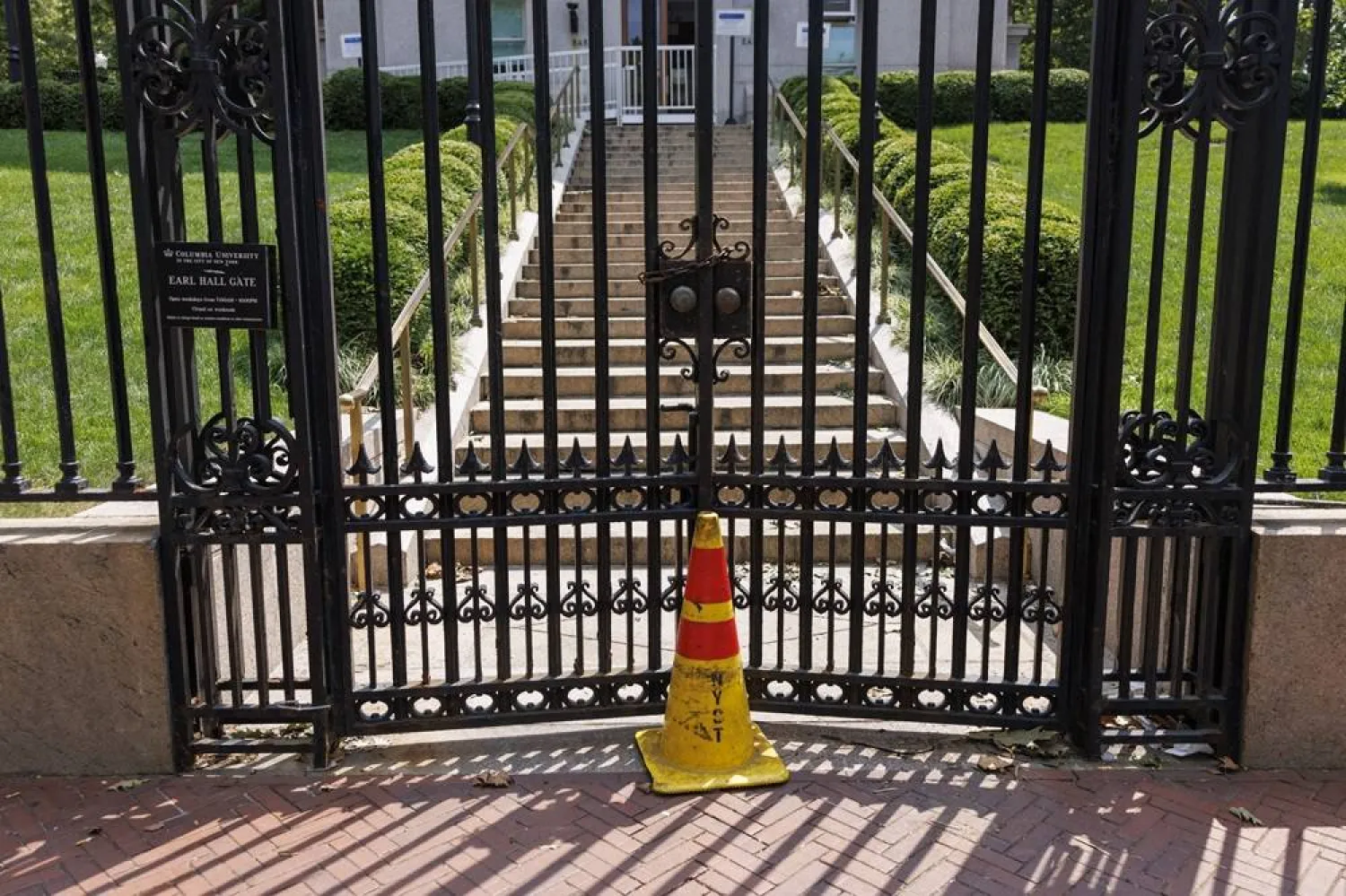
The Earl Hall Gate at Columbia University is locked in New York, New York, USA, 15 August 2024. (EPA)
TT

As Students Return, US Colleges Brace for a Resurgence in Activism against the War in Gaza

The Earl Hall Gate at Columbia University is locked in New York, New York, USA, 15 August 2024. (EPA)

As students return to colleges across the United States, administrators are bracing for a resurgence in activism against the war in Gaza, and some schools are adopting rules to limit the kind of protests that swept campuses last spring.

While the summer break provided a respite in student demonstrations against the Israel-Hamas war, it also gave both student protesters and higher education officials a chance to regroup and strategize for the fall semester.

The stakes remain high. At Columbia University in New York, where the wave of pro-Palestinian tent encampments began, President Minouche Shafik resigned Wednesday after coming under heavy scrutiny for her handling of the demonstrations. Her resignation came just days after the school confirmed that three deans had resigned after officials said they exchanged disparaging texts during a campus discussion about Jewish life and antisemitism.

Some of the new rules imposed by universities include banning encampments, limiting the duration of demonstrations, allowing protests only in designated spaces and restricting campus access to those with university identification. Critics say some of the measures will curtail free speech.

At Harvard University, a draft document obtained by the student newspaper over the summer showed the college was considering prohibitions on overnight camping, chalk messages and unapproved signage.

Many student protesters in the US vow to continue their activism, which has been fueled by Gaza's rising death toll, which surpassed 40,000 on Thursday, according to the territory’s Health Ministry.

Tensions have run high on college campuses since Oct. 7, when Hamas fighters assaulted southern Israel and killed 1,200 people, most of them civilians, and took about 250 hostages.

Mahmoud Khalil, a lead negotiator working on behalf of Columbia student protesters, said he fully expected protests, including possible encampments, to resume in the fall.

“As long as Columbia continues to invest and to benefit from the Israeli apartheid, the students will continue their activism on campus in so many different ways,” he said.

He said about 50 students still face discipline over last spring’s demonstrations after a mediation process that began earlier in the summer stalled. He blamed the impasse on Columbia administrators.

“The university loves to appear that they’re in dialogue with the students. But these are all fake steps meant to assure the donor community and their political class,” said Khalil, a graduate student at Columbia’s School of International and Public Affairs.

The university did not immediately respond to a request for comment Thursday.

The Ivy League school in upper Manhattan was roiled earlier this year by student demonstrations, culminating in scenes of police officers with zip ties and riot shields storming a building occupied by pro-Palestinian protesters. Similar protests swept college campuses nationwide, with many leading to violent clashes with police and more than 3,000 arrests.

Many of the students who were arrested during police crackdowns have had their charges dismissed, but some are still waiting to learn what prosecutors decide. Many have faced fallout in their academic careers, including suspensions, withheld diplomas and other forms of discipline.

Shafik was among the university leaders who were called for questioning before Congress earlier this year. She was heavily criticized by Republicans who accused her of not doing enough to combat concerns about antisemitism on the Columbia campus.

She announced her resignation in an emailed letter to the university community just weeks before the start of classes on Sept. 3. The university on Monday began restricting campus access to people with Columbia IDs and registered guests, saying it wanted to curb “potential disruptions” as the new semester draws near.

“This period has taken a considerable toll on my family, as it has for others in the community,” Shafik wrote in her letter. “Over the summer, I have been able to reflect and have decided that my moving on at this point would best enable Columbia to traverse the challenges ahead.”

Columbia’s Board of Trustees announced that Katrina Armstrong, the CEO of Columbia University Irving Medical Center, will serve as interim president.

Pro-Palestinian protesters first set up tent encampments on Columbia’s campus during Shafik’s congressional testimony in mid-April, when she denounced antisemitism but faced criticism for how she responded to faculty and students accused of bias.

The school sent in police to clear the tents the following day, only for the students to return and inspire a wave of similar protests at campuses across the country as students called for schools to cut financial ties with Israel and companies supporting the war.

Even after the protests were cleared, Columbia decided to cancel its university-wide commencement ceremony, instead opting for a series of smaller, school-based ceremonies.

The campus was mostly quiet this summer, but a conservative news outlet in June published images of what it said were text messages exchanged by administrators while attending a May 31 panel discussion titled “Jewish Life on Campus: Past, Present and Future.”

The officials were removed from their posts, with Shafik saying in a July 8 letter to the school community that the messages were unprofessional and “disturbingly touched on ancient antisemitic tropes.”

Shafik’s critics were quick to cheer the end of her tenure, one of the shortest in school history.

Other prominent Ivy League leaders have stepped down in recent months, in large part due to their response to the volatile protests on campus.

University of Pennsylvania President Liz Magill resigned in December after less than two years on the job. She faced pressure from donors and criticism over testimony at a congressional hearing where she was unable to say under repeated questioning that calls on campus for the genocide of Jews would violate the school’s conduct policy.

And in January, Harvard University President Claudine Gay resigned amid plagiarism accusations and similar criticism over her testimony before Congress.



UK PM's Top Aide Quits over Mandelson-Epstein Scandal

FILE PHOTO: British Prime Minister Keir Starmer talks with Britain's ambassador to the United States Peter Mandelson during a welcome reception at the ambassador's residence on February 26, 2025, in Washington, DC, US. Carl Court/Pool via REUTERS/File Photo
TT

UK PM's Top Aide Quits over Mandelson-Epstein Scandal

FILE PHOTO: British Prime Minister Keir Starmer talks with Britain's ambassador to the United States Peter Mandelson during a welcome reception at the ambassador's residence on February 26, 2025, in Washington, DC, US. Carl Court/Pool via REUTERS/File Photo

British Prime Minister Keir Starmer's chief of staff, Morgan McSweeney, quit on Sunday, saying he took responsibility for advising Starmer to name Peter Mandelson as ambassador to the US despite his known links to Jeffrey Epstein.

After new files revealed the depth of the Labour veteran's relationship with the late sex offender, Starmer is facing what is widely seen as the gravest crisis of his 18 months in power over his decision to send Mandelson to Washington in 2024, Reuters reported.

The loss of McSweeney, 48, a strategist who was instrumental in Starmer's rise to power, is the latest in a series of setbacks, less than two years after the Labour Party won one of the largest parliamentary majorities in modern British history.

With polls showing Starmer is hugely unpopular with voters after a series of embarrassing U-turns, some in his own party are openly questioning his judgment and his future, and it remains to be seen whether McSweeney's exit will be enough to silence critics.

The files released in the US on January 30 sparked a police investigation for misconduct in office over indications that Mandelson leaked market-sensitive information to Epstein when he was a government minister during the global financial crisis in 2009 and 2010.

In a statement, McSweeney said: "The decision to ⁠appoint Peter Mandelson was wrong. He has damaged our party, our country and trust in politics itself.
"When asked, I advised the Prime Minister to make that appointment and I take full responsibility for that advice."

The leader of the opposition Conservative Party, Kemi Badenoch, said the resignation was overdue and that "Keir Starmer has to take responsibility for his own terrible decisions".

Nigel Farage, head of the populist Reform UK party, which is leading in the polls, said he believed Starmer's time would soon be up.

Starmer has spent the last week defending McSweeney, a strategy that could prompt further questions about his own judgment. In a statement on Sunday, Starmer said it had been "an honor" working with him.

Many Labour members of parliament had blamed McSweeney for the appointment of Mandelson and the damage caused by the publication of the exchanges between Epstein ⁠and Mandelson. Others have said Starmer must go.

One Labour lawmaker, speaking on condition of anonymity, said McSweeney's resignation had come too late: "It buys the PM time, but it's still the end of days."

Starmer sacked Mandelson as ambassador in September over his links to Epstein.

The government agreed last week to release virtually all previously private communications between members of his government from the time when Mandelson was being appointed.

That release could come as early as this week, creating a new headache for Starmer just as he hopes to move on. If previously secret messages about how London planned to approach its relationship with Donald Trump are made public, it could damage Starmer's relationship with the US President.

McSweeney had held the role of chief of staff since October 2024, when he was handed the job following the resignation of Sue Gray after a row over pay and donations.

Starmer on Sunday appointed his deputy chiefs of staff, Jill Cuthbertson and Vidhya Alakeson, to serve as joint acting chiefs of staff.


Iran Sentences Nobel Laureate Narges Mohammadi to 7 More Years in Prison

(FILES) A handout photo provided by the Narges Mohammadi Foundation on October 2, 2023 shows an undated, unlocated photo of Iranian rights campaigner Narges Mohammadi. (Photo by Handout / NARGES MOHAMMADI FOUNDATION / AFP)
TT

Iran Sentences Nobel Laureate Narges Mohammadi to 7 More Years in Prison

(FILES) A handout photo provided by the Narges Mohammadi Foundation on October 2, 2023 shows an undated, unlocated photo of Iranian rights campaigner Narges Mohammadi. (Photo by Handout / NARGES MOHAMMADI FOUNDATION / AFP)

Iran sentenced Nobel Peace Prize laureate Narges Mohammadi to over seven more years in prison after she began a hunger strike, supporters said Sunday.

Mohammadi’s supporters cited her lawyer, who spoke to Mohammadi.

The lawyer, Mostafa Nili, confirmed the sentence on X, saying it had been handed down Saturday by a Revolutionary Court in the city of Mashhad. Such courts typically issue verdicts with little or no opportunity for defendants to contest their charges.

“She has been sentenced to six years in prison for ‘gathering and collusion’ and one and a half years for propaganda and two-year travel ban,” he wrote, according to The Associated Press.

She received another two years of internal exile to the city of Khosf, some 740 kilometers (460 miles) southeast of Tehran, the capital, the lawyer added.

Supporters say Mohammadi has been on a hunger strike since Feb. 2. She had been arrested in December at a ceremony honoring Khosrow Alikordi, a 46-year-old Iranian lawyer and human rights advocate who had been based in Mashhad. Footage from the demonstration showed her shouting, demanding justice for Alikordi and others.

Supporters had warned for months before her December arrest that Mohammadi, 53, was at risk of being put back into prison after she received a furlough in December 2024 over medical concerns.

While that was to be only three weeks, Mohammadi’s time out of prison lengthened, possibly as activists and Western powers pushed Iran to keep her free. She remained out even during the 12-day war in June between Iran and Israel.

Mohammadi still kept up her activism with public protests and international media appearances, including even demonstrating at one point in front of Tehran’s notorious Evin prison, where she had been held.

Mohammadi had been serving 13 years and nine months on charges of collusion against state security and propaganda against Iran’s government.

She also had backed the nationwide protests sparked by the 2022 death of Mahsa Amini, which have seen women openly defy the government by not wearing the hijab.

Mohammadi suffered multiple heart attacks while imprisoned before undergoing emergency surgery in 2022, her supporters say. Her lawyer in late 2024 revealed doctors had found a bone lesion that they feared could be cancerous that later was removed.

“Considering her illnesses, it is expected that she will be temporarily released on bail so that she can receive treatment,” Nili wrote.

However, Iranian officials have been signaling a harder line against all dissent since the recent demonstrations. Speaking on Sunday, Iranian judiciary chief Gholamhossein Mohseni-Ejei made comments suggesting harsh prison sentences awaited many.

“Look at some individuals who once were with the revolution and accompanied the revolution," he said. "Today, what they are saying, what they are writing, what statements they issue, they are unfortunate, they are forlorn (and) they will face damage.”


Nigeria's President to Make a Sate Visit to the UK in March

Nigeria’s President Bola Tinubu gives a joint statement with Brazil’s President Luiz Inacio Lula da Silva, at the Planalto presidential palace, in Brasilia, Brazil, Aug. 25, 2025. (AP Photo/Eraldo Peres, File)
TT

Nigeria's President to Make a Sate Visit to the UK in March

Nigeria’s President Bola Tinubu gives a joint statement with Brazil’s President Luiz Inacio Lula da Silva, at the Planalto presidential palace, in Brasilia, Brazil, Aug. 25, 2025. (AP Photo/Eraldo Peres, File)

Nigeria’s president is set to make a state visit to the UK in March, the first such trip by a Nigerian leader in almost four decades, Britain’s Buckingham Palace said Sunday.

Officials said President Bola Tinubu and first lady Oluremi Tinubu will travel to the UK on March 18 and 19, The AP news reported.

King Charles III and Queen Camilla will host them at Windsor Castle. Full details of the visit are expected at a later date.

Charles visited Nigeria, a Commonwealth country, four times from 1990 to 2018 before he became king. He previously received Tinubu at Buckingham Palace in September 2024.m

Previous state visits by a Nigerian leader took place in 1973, 1981 and 1989.

A state visit usually starts with an official reception hosted by the king and includes a carriage procession and a state banquet.

Last year Charles hosted state visits for world leaders including US President Donald Trump, French President Emmanuel Macron and German President Frank-Walter Steinmeier.