


Blinken Visits Gaza Mediators in Pursuit of Ceasefire Deal as Hamas, Israel Signal Challenges

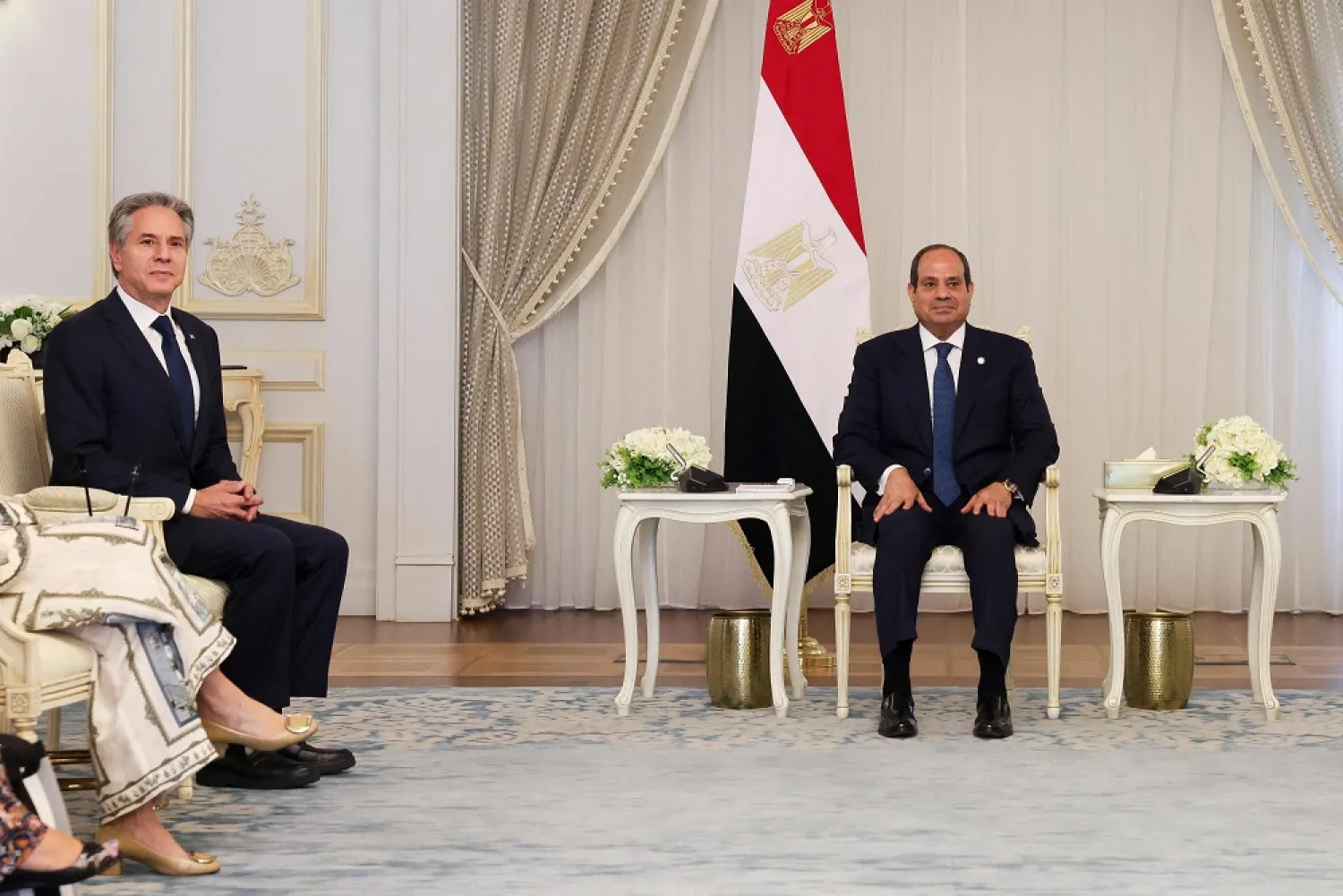
US Secretary of State Antony Blinken (L) meets with Egyptian President Abdel Fattah al-Sisi in El-Alamein on August 20, 2024. (AFP)
TT

Blinken Visits Gaza Mediators in Pursuit of Ceasefire Deal as Hamas, Israel Signal Challenges

US Secretary of State Antony Blinken (L) meets with Egyptian President Abdel Fattah al-Sisi in El-Alamein on August 20, 2024. (AFP)

US Secretary of State Antony Blinken was visiting fellow mediators Egypt and Qatar as he pressed ahead Tuesday with the latest diplomatic mission to secure a ceasefire in the war in Gaza, even as Hamas and Israel signaled that challenges remain.

Egyptian President Abdel Fattah al-Sisi warned on Tuesday of the risk of the Gaza war expanding regionally in a way "difficult to imagine" during a meeting with Blinken, the Egyptian presidency said.

Hamas in a new statement called the latest ceasefire proposal presented to it a "reversal" of what it agreed to previously and accused the US of acquiescing to what it called "new conditions" from Israel. There was no immediate US response.

Israeli Prime Minister Benjamin Netanyahu, meanwhile, told relatives of hostages in Gaza that a key goal is to "preserve our strategic security assets in the face of great pressures from home and abroad." He noted the "capture" of a narrow buffer zone along the Gaza-Egypt border that Israel calls the Philadelphi corridor. Neither Hamas nor Egypt wants an Israeli presence there.

The meeting came as Israel's military said it recovered the bodies of six hostages taken in Hamas’ Oct. 7 attack that started the war, bringing fresh grief for many Israelis who have long pressed Netanyahu to agree to a ceasefire that would bring remaining hostages home.

Blinken's meetings in Egypt and upcoming ones in Qatar come a day after he met in Israel with Netanyahu and said the prime minister had accepted a US proposal to bridge gaps separating Israel and Hamas. Blinken called on the armed group to do the same.

But there still appear to be wide gaps between the two sides, including Israel’s demand for lasting control over strategic corridors in Gaza, which Hamas has rejected.

Pressure to seal a ceasefire deal has been especially urgent after the recent targeted killings of militant leaders of Hamas and Hezbollah in Iran and Lebanon, both blamed on Israel, and vows of retaliation that have sparked fears of a wider regional war.

Israel's military said its forces recovered the bodies in an overnight operation in southern Gaza, without saying when or how the six died. A forum for hostage families said they were kidnapped alive. Hamas says some captives have been killed and wounded in Israeli airstrikes.

The recovery of the remains is a blow to Hamas, which hopes to exchange hostages for Palestinian prisoners, an Israeli withdrawal and a lasting ceasefire. But it was also likely to increase pressure on Israel's government to reach a deal to free dozens of hostages who are still believed to be alive.

The military said it had identified the remains of Chaim Perry, 80; Yoram Metzger, 80; Avraham Munder, 79; Alexander Dancyg, 76; Nadav Popplewell, 51; and Yagev Buchshtav, 35. Metzger, Munder, Popplewell and Buchshtav had family members who were also abducted but freed during a November ceasefire.

Munder's death was confirmed by Kibbutz Nir Oz, the farming community where he was among around 80 residents who were taken captive. It said he died "after enduring months of physical and mental torture." Israeli authorities had previously determined that the other five were deceased.

Netanyahu praised the recovery effort and said "our hearts ache for the terrible loss," and vowed that Israel would make every effort to bring all hostages home, dead or alive.

There were no immediate reports of any casualties among Israelis or Palestinians in the recovery operation.

Hamas is still believed to be holding around 110 hostages captured in the Oct. 7 attack. Israeli authorities estimate around a third of them are dead.

Hamas-led fighters burst through Israel's defenses on Oct. 7 and rampaged across the south, killing some 1,200 people, mostly civilians, and taking around 250 people hostage. Over 100 hostages were released in exchange for Palestinians imprisoned in Israel during a weeklong ceasefire last year.

Israel's retaliatory offensive has killed over 40,000 Palestinians, according to Gaza's Health Ministry, which does not say how many were militants. Air and ground operations have caused widespread destruction and forced the vast majority of Gaza's 2.3 million residents to flee their homes, often multiple times. Aid groups fear the outbreak of diseases like polio.

An Israeli airstrike on Tuesday killed at least 10 people at a school-turned-shelter in Gaza City, in what the military said was a precise strike on a Hamas command center. Another strike killed a mother and her five children in central Gaza.

The Palestinian Civil Defense, first responders operating under the Hamas-run government, said they were still searching for survivors after the strike on the Mustafa Hafez school in Gaza City. It said around 700 people were sheltering at the school when it was hit.

The Israeli military said the strike targeted Hamas militants who had set up a command center inside the school and were planning and launching attacks.

An Israeli airstrike in central Gaza killed five children and their mother, according to the nearby Al-Aqsa Martyrs Hospital, where an Associated Press reporter counted the bodies. The hospital said the father, Alaa Abu Zeid, a schoolteacher, has been in Israeli detention for the last nine months.



Appeal Trial of Tunisia Jailed Prominent Lawyer Starts

People stand outside a closed court during a nationwide strike in Tunis, Tunisia November 22, 2018. REUTERS/Zoubeir Souissi
TT

Appeal Trial of Tunisia Jailed Prominent Lawyer Starts

People stand outside a closed court during a nationwide strike in Tunis, Tunisia November 22, 2018. REUTERS/Zoubeir Souissi

The appeal trial of a prominent Tunisian lawyer jailed on anti-terror charges started on Thursday, after the judge rejected the defense's demand of his provisional release on health grounds.

Ahmed Souab's lawyers and relatives said his health condition had become critical since his jailing in April last year as part of what many said was a crackdown on political dissent.

The court rejected his provisional release and postponed the hearing to February 23, his lawyer, Fedi Snene, told AFP.

Souab -- also a rights advocate and a former judge -- was detained after claiming that judges were under political pressure to hand down hefty sentences last year in a mass trial of critics of President Kais Saied.

He had been a member of the defense team during the high-profile mass trial, and last October he was sentenced to five years in prison in a speedy trial that lasted less than two minutes.

UN Special Rapporteur on human rights defenders Mary Lawlor said on Wednesday Souab had been convicted on "baseless charges" and called for his "immediate release".

Snene rejected accusations against Souab, saying "he should not be in prison".

"He is a well-known man of law, who served for nearly 30 years as a judge before becoming a lawyer," Snene added.

Souab's son, Saeb, told AFP the family had submitted a "substantial medical file" asking the judge for his release pending a verdict.

Saeb said his father suffered a heart attack in 2022 and that his cardiologist had certified that prison conditions could worsen his health.

Souab had accused authorities of putting "a knife to the throat of the judge who was to deliver the verdict" during the mass trial that saw around 40 public figures sentenced to long terms on charges including plotting against the state.


At Least 21 Drown in Nile Boat Sinking in Sudan

At least 21 people drowned when a boat sank in the Nile River in northern Sudan, according to the local state government and eyewitnesses interviewed by AFP. (REUTERS)
TT

At Least 21 Drown in Nile Boat Sinking in Sudan

At least 21 people drowned when a boat sank in the Nile River in northern Sudan, according to the local state government and eyewitnesses interviewed by AFP. (REUTERS)

At least 21 people drowned when a boat sank in the Nile River in northern Sudan, according to the local state government and eyewitnesses interviewed by AFP.

River Nile State said Thursday that 21 bodies had been recovered after the accident, listed their names and warned that some passengers were still missing.

The boat was crossing the river between the villages of Tayba al-Khawad and Deim al-Qarai, according to the local government's statement.

The statement did not explain the cause of the accident.

Eyewitnesses told AFP the boat was carrying 30 people.

The Sudanese Doctors Network said in a statement that six of the boat's passengers survived.

The group said the incident exposes "the fragility of river transport and the absence of basic safety requirements, as well as the complete absence of local authorities and civil defense rescue teams in the early hours of the incident".

Many Sudanese rely on river transport via single-engine boats captained by solo operators.

The country's infrastructure has been collapsing due to a war that has been ongoing for nearly three years.

The war has divided the country between the army and their enemy, the paramilitary Rapid Support Forces, with road closures and a severe deterioration in public services and medical and educational infrastructure.


Syria Affirms Deep Ties with Saudi Arabia

Saudi Ambassador to Damascus Dr. Faisal Al-Mujfel visits the Kingdom’s pavilion, guest of honor at the Damascus International Book Fair (Saudi Embassy account). 
TT

Syria Affirms Deep Ties with Saudi Arabia

Saudi Ambassador to Damascus Dr. Faisal Al-Mujfel visits the Kingdom’s pavilion, guest of honor at the Damascus International Book Fair (Saudi Embassy account). 

Syria has reaffirmed the strength of its relations with Saudi Arabia during a visit by the Saudi ambassador to Damascus, Dr. Faisal Al-Mujfel, to the Saudi pavilion, guest of honor at the 2026 Damascus International Book Fair.

Saudi Arabia’s participation in the fair, held from Feb. 6-16, is led by the Literature, Publishing and Translation Commission.

At the start of the visit, Al-Mujfel met Syria’s Minister of Culture, Mohammad Yassin Saleh, who welcomed the Kingdom’s designation as guest of honor as a clear affirmation of the depth of Saudi-Syrian cultural relations, based on partnership and mutual respect.

Saleh praised Saudi Arabia’s cultural efforts and commended the pavilion for showcasing activities that reflect the richness and diversity of Saudi cultural heritage.

He noted that the Saudi program highlights the Kingdom’s commitment to supporting culture and literature at both the Arab and international levels. The pavilion features a wide range of events, including seminars and poetry evenings, with the participation of leading Saudi writers and intellectuals.

During a guided tour, the Saudi ambassador was briefed on the creative diversity presented at the pavilion. Exhibits include a collection of manuscripts, a section dedicated to traditional Saudi attire, displays of archaeological replicas, and a selection of publications issued by the Literature, Publishing and Translation Commission.

Among the featured works are titles from the “Translate” initiative, the “Saudi Literature Comics” series, and short story collections from Saudi authors, offering visitors insight into the Kingdom’s contemporary literary scene.

The commission is overseeing Saudi Arabia’s participation as guest of honor at the 2026 book fair, presenting what it described as a vibrant cultural experience that celebrates Saudi creativity and promotes dialogue through books.

The program aligns with the Kingdom’s National Culture Strategy under Vision 2030, which emphasizes cultural exchange, knowledge sharing, and constructive dialogue among nations, while reinforcing Saudi Arabia’s role in the Arab and global cultural landscape.

The visit was attended by several Arab diplomats accompanying the Saudi ambassador, including the ambassadors of Bahrain, Oman and Lebanon, as well as the chargé d’affaires of the United Arab Emirates embassy in Damascus.