Israeli Evacuation Orders Cram Palestinians into Shrinking 'Humanitarian Zone' Where Food is Scarce

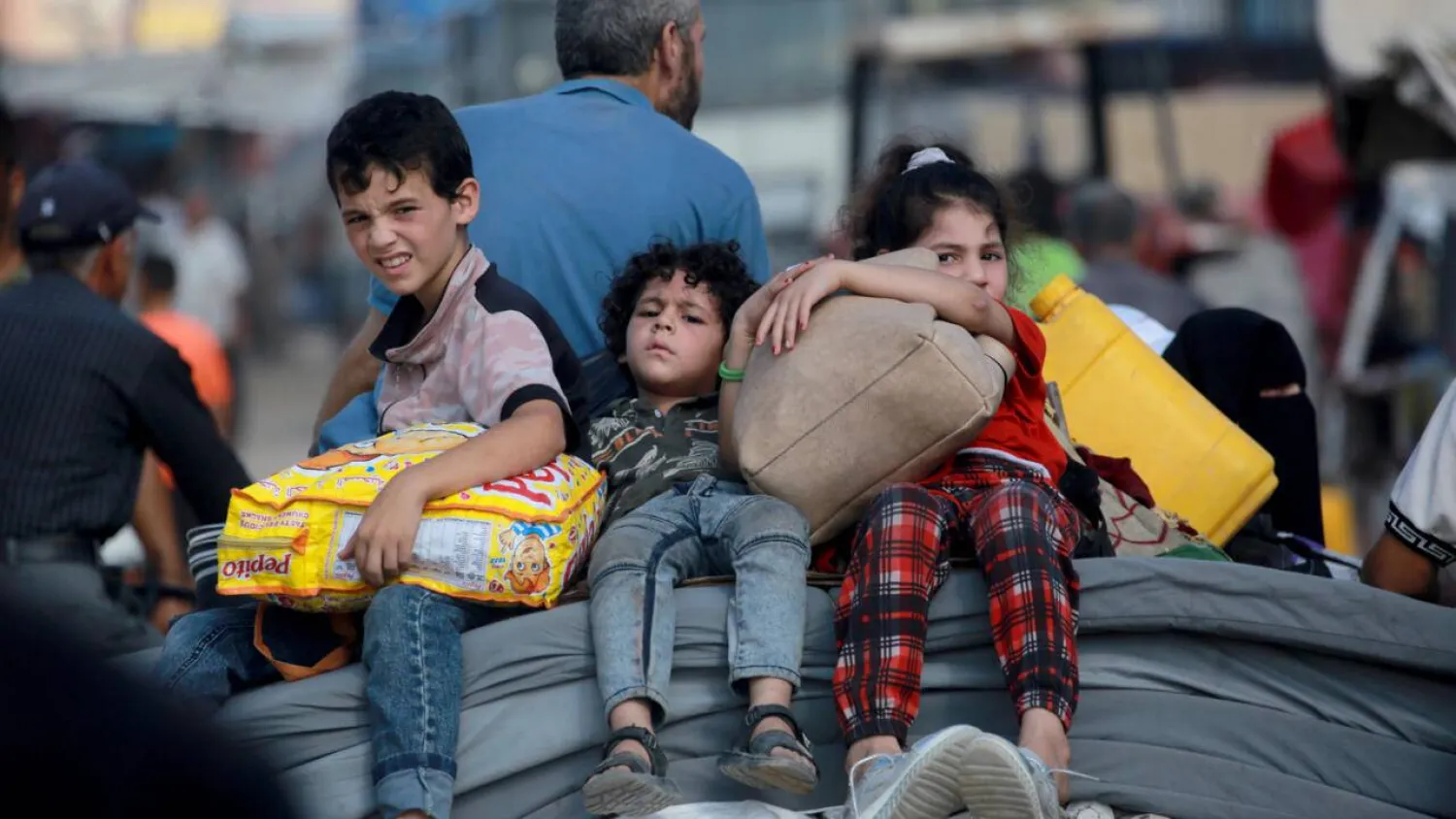
A Palestinian family flees Gaza's main southern city of Khan Yunis in response to an Israeli evacuation order. Bashar TALEB / AFP/File
TT

Israeli Evacuation Orders Cram Palestinians into Shrinking 'Humanitarian Zone' Where Food is Scarce

A Palestinian family flees Gaza's main southern city of Khan Yunis in response to an Israeli evacuation order. Bashar TALEB / AFP/File

Young girls screamed and elbowed each other in a crush of bodies in southern Gaza, trying desperately to reach the front of the food line. Men doled out rice and chicken as fast as they could, platefuls of the nourishment falling to the ground in the tumult.
Nearby, boys waited to fill plastic containers with water, standing for hours among tents packed so tightly they nearly touched.
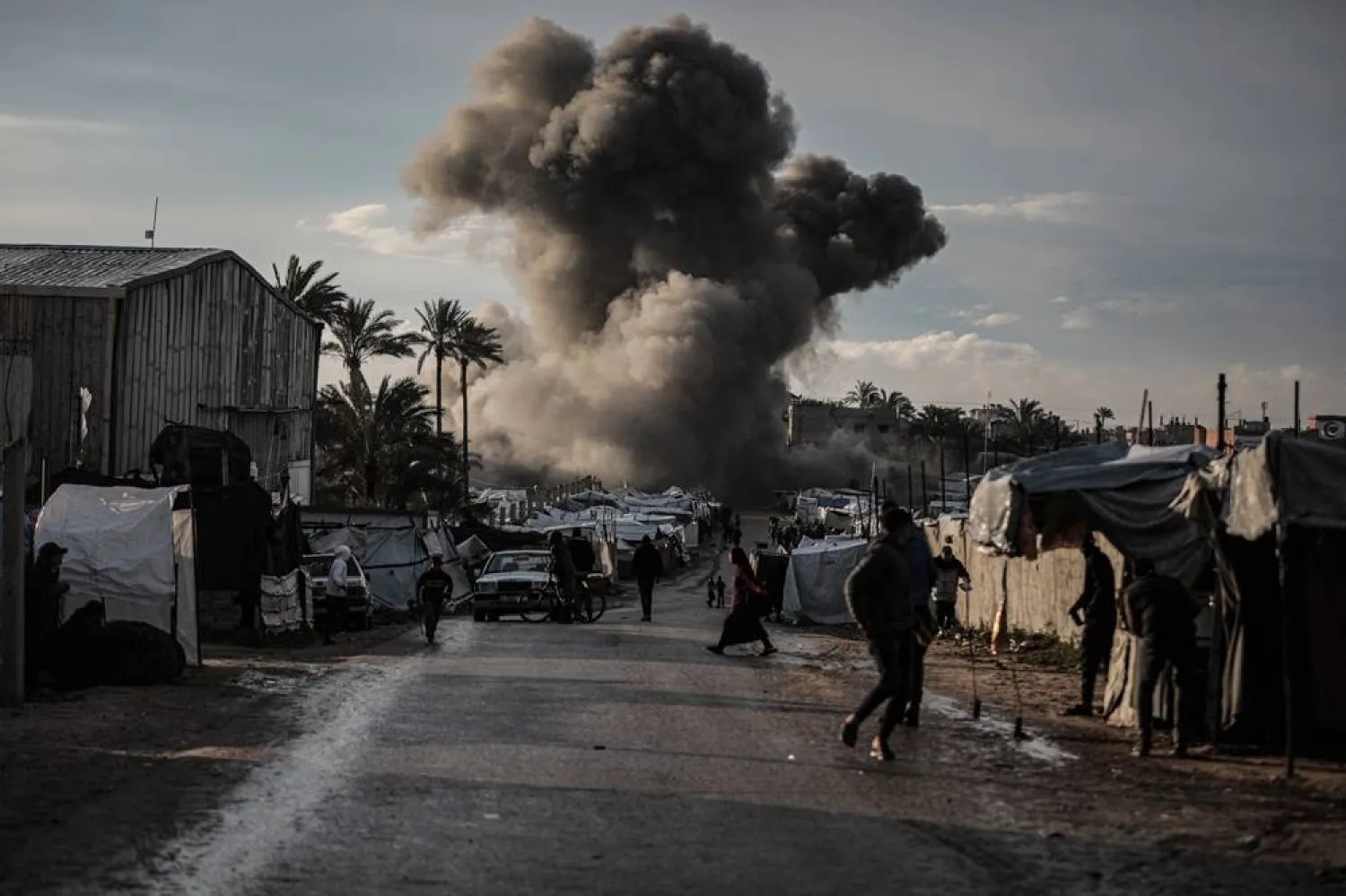
Hunger and desperation were palpable Friday in the tent camp along the Deir al-Balah beachfront, after a month of successive evacuation orders that have pressed thousands of Palestinians into the area that the Israeli military calls a “humanitarian zone.”
The zone has long been crowded by Palestinians seeking refuge from bombardment, but the situation grows more dire by the day, as waves of evacuees arrive and food and water grow scarce. Over the last month, the Israeli military has issued evacuation orders for southern Gaza at an unprecedented pace.
At least 84% of Gaza now falls within the evacuation zone, according to the UN, which also estimates that 90% of Gaza’s 2.1 million residents have been displaced over the course of the war.
Thirteen evacuation orders have been issued since July 22, according to an Associated Press count, significantly reducing the size of the humanitarian zone declared by Israel at the start of the war while pushing more Palestinians into it than ever before. The increased crowding of evacuees can be seen in satellite photos.
“The food that reaches us from the charity is sufficient for the people in our camp,” said Muhammad Al-Qayed, who was displaced from Gaza City and now lives along the beach. “Where do the people who were recently displaced get food from? From where do we provide them?”
Another displaced Palestinian, Adham Hijazi, said: “I have started thinking that if there is no food, I will go and drink seawater to endure it. I am talking seriously. I will drink water and salt.”
The military says the evacuations are necessary because Hamas has launched rockets from within the humanitarian zone. In posts on X, the military’s Arabic-language spokesperson, Avichay Adraee, has instructed Palestinians to flee immediately, saying the military will soon operate “with force” against Hamas militants in the area.
Yasser Felfel, originally displaced from northern Gaza, has watched his camp swell with waves of evacuees.
“There were 32 people in my tent. Now there are almost 50 people, people I don’t know,” he said. “A week ago, there was a lot of food left over. We had breakfast, lunch and dinner. Today, because of the number of people who came here, it is barely enough for lunch.”
In August alone, the evacuation orders have been issued roughly every two days and displaced nearly 250,000 people, the UN said.
“Many people here have been displaced more than 10 times. They’re exhausted and broke," said Georgios Petropoulos, the head of the UN’s Office for the Coordination of Humanitarian Affairs in Gaza.
A pair of satellite photos taken over the last month shows the impact of the orders. The imagery, obtained from PlanetLabs and reviewed by the AP, shows that tent camps along the coast grew more densely packed from July 19 to Aug. 19.
On Aug. 19, tents covered nearly every available sandy patch and were pitched closer to the ocean.
Even Palestinians living in the humanitarian zone Israel declared at the start of the war have been forced to move. On July 22, the military ordered the evacuation of most of the eastern edge of the zone, saying that Hamas had launched rockets at Israel. Then on Aug. 16, the military again shrank the zone, calling on Palestinians living in the center to flee.
The evacuations come as international mediators struggle to bridge differences between Israel and Hamas over a cease-fire agreement that would stop the fighting in Gaza and exchange scores of Israeli hostages for Palestinian prisoners.
The war began on Oct. 7, when Hamas group blew past Israel's border, killing around 1,200 people and taking about 250 others hostage. Israel's retaliatory offensive has now killed over 40,000 people in Gaza and razed the strip's buildings and infrastructure.
Water has been another casualty of the evacuations. The UN says the water supply in Deir al-Balah has decreased by at least 70% since the recent wave of evacuations began, as pumps and desalination plants are caught within evacuation zones.
The lack of clean water is causing skin diseases and other outbreaks. The UN's main health agency has confirmed Gaza's first case of polio in a 10-month-old baby in Deir al-Balah who is now paralyzed in the lower left leg.
Meanwhile, aid groups say it is only growing more difficult to offer help. UN spokesperson Stephane Dujarric said Thursday that the UN World Food Program lost access to its warehouse in central Deir al-Balah because of a recent evacuation order.
Standing in the water line Friday, Abu Mohammad observed the scarcity around him and prayed it would end soon.
“There is no water, there is no food, there is no money, there is no work, there is nothing,” said Mohammad, who has now been displaced seven times.
“We ask God, not the people, for it to end. We no longer have the capacity. Oh world, we no longer have the capacity.”



In a First, Armed Gang in Gaza Forces Displacement of Residents

 A Palestinian woman receives donated food at a community kitchen in Deir al-Balah, central Gaza Strip, Thursday, Dec. 25, 2025. (AP)
A Palestinian woman receives donated food at a community kitchen in Deir al-Balah, central Gaza Strip, Thursday, Dec. 25, 2025. (AP)
TT

In a First, Armed Gang in Gaza Forces Displacement of Residents

 A Palestinian woman receives donated food at a community kitchen in Deir al-Balah, central Gaza Strip, Thursday, Dec. 25, 2025. (AP)
A Palestinian woman receives donated food at a community kitchen in Deir al-Balah, central Gaza Strip, Thursday, Dec. 25, 2025. (AP)

In an unprecedented development, an armed gang active in Gaza City forced inhabitants of residential bloc to evacuate their homes under threat of arms.

Field sources told Asharq Al-Awsat that identified the gang as the “Rami Halas Group”. At dawn on Thursday, its members opened fire in the air in the Hayy al-Tuffah neighborhood in eastern Gaza City. The area is located near Israel’s so-called yellow line that separates Hamas- and Israel-held parts of Gaza.

The gang members came back hours later at noon and demanded that the residents evacuate, giving them until sunset to comply and threatening to shoot anyone who doesn’t.

The sources said the gunmen did not directly approach any of the residents for fear of being attacked. They used loudspeakers to demand that they evacuate to areas a few hundred meters away, claiming these were Israeli orders.

Israeli forces are deployed some 150 meters from the area where the residents were located.

The residents, who had only just returned to their homes after the ceasefire, indeed started to evacuate towards western parts of Gaza City.

The sources said over 240 residents were forced to quit what remains of their damaged homes.

They revealed that Israeli forces had on Tuesday and Wednesday night dropped yellow barrels, devoid of explosives, in those regions. They did not ask residents to evacuate.

The sources said the gang made the evacuation order ahead of Israel’s plan to occupy the area, which had been previously declared as safe.

They accused Israeli forces of resorting to such tactics in recent weeks to further expand the yellow line border and occupy more areas in Gaza.


Syria Says Kills Senior ISIS Leader, Arrests Operative Near Damascus

A photo of a Public Security operation in Aleppo against an ISIS cell (File – Facebook)
TT

Syria Says Kills Senior ISIS Leader, Arrests Operative Near Damascus

A photo of a Public Security operation in Aleppo against an ISIS cell (File – Facebook)

Syrian authorities on Thursday said forces killed a senior leader in the ISIS group and arrested another operative in fresh operations near capital Damascus in coordination with the US-led coalition.

Syrian security and intelligence forces, working in coordination with the international coalition, conducted what the interior ministry described as a "precise security operation" in the Damascus countryside, AFP reported.

"The operation resulted in neutralising the terrorist Mohammad Shahada, known as 'Abu Omar Shaddad', who is considered one of the prominent ISIS leaders in Syria," it added.

"This operation comes as confirmation of the effectiveness of joint coordination between the national security agencies and international partners."

Later Thursday, the interior ministry said security forces "in joint coordination with international coalition forces" arrested "the leader of a terrorist cell affiliated with the ISIS organization" elsewhere near Damascus, seizing weapons and ammunition.

Late Wednesday, authorities said they captured Taha al-Zoubi, also known as Abu Omar Tabiya, an ISIS leader in the Damascus region, along with several of his men, also in a joint operation with the US-led coalition.

The interior ministry also said on Thursday that security forces had arrested three members of an ISIS-affiliated cell in Aleppo province.

A December 13 attack killed two US soldiers and an American civilian. Washington blamed the attack on a lone ISIS gunman in Syria's Palmyra.

In retaliation, US forces conducted strikes targeting scores of ISIS targets in Syria.

The strikes killed five members of the militant group, according to the Syrian Observatory for Human Rights.

In November, during a visit by interim President Ahmed al-Sharaa to Washington, Syria officially joined the US-led coalition against ISIS.


Israeli Settler Attack Injures Palestinian Baby, Five Arrested

Israeli settlers attacked farmers and volunteers harvesting olives on a Palestinian farm in Burin, near Nablus, on November 8, 2025. © Observers
TT

Israeli Settler Attack Injures Palestinian Baby, Five Arrested

Israeli settlers attacked farmers and volunteers harvesting olives on a Palestinian farm in Burin, near Nablus, on November 8, 2025. © Observers

Israeli security forces announced on Thursday the arrest of five Israeli settlers over their alleged involvement in an attack on a Palestinian home that injured a baby girl in the occupied West Bank.

The eight-month-old infant suffered "moderate injuries to the face and head" in the late Wednesday attack, according to the official Palestinian news agency Wafa.

It blamed the attack on "a group of armed settlers", accusing them of "throwing stones at homes and property" in the town of Sair, north of Hebron, AFP reported.

A statement from the Israeli police said that five suspects had been arrested for their "alleged involvement in serious, violent incidents in the village of Sair".

Israeli security forces had received reports of "stones being thrown by Israeli civilians toward a Palestinian home", adding a Palestinian girl was injured.

"The preliminary investigation determined the involvement of several suspects who came from a nearby outpost," the statement said, referring to Israeli settlements not officially recognized by Israeli authorities.

All Israeli settlements in the West Bank are considered illegal by the international community.

Some are also illegal under Israeli law, though many of those are later given official recognition.

Almost none of the perpetrators of previous attacks by settlers have been held to account by the Israeli authorities.

A Telegram group linked to the "Hilltop Youth", a movement of hardline settlers who advocate direct action against Palestinians, posted a video showing property damage in Sair.

More than 500,000 Israelis currently live in settlements in the West Bank, occupied since 1967, as do around three million Palestinians.

Violence involving settlers has risen in recent years, according to the United Nations, and October was the worst month since it began recording such incidents in 2006, with 264 attacks that caused casualties or property damage.

The violence in the West Bank, a territory occupied by Israel since 1967, has surged since Hamas' October 7, 2023 attack, which triggered the Gaza war.

Since the start of the war, Israeli troops and settlers have killed more than 1,000 Palestinians in the West Bank, including many militants as well as dozens of civilians, according to an AFP tally based on figures from the Palestinian health ministry.

According to official Israeli figures, at least 44 Israelis, both soldiers and civilians, have been killed in Palestinian attacks or Israeli military operations in the same period.