


NASA Decides to Keep 2 Astronauts in Space until February, Nixes Return on Troubled Boeing Capsule

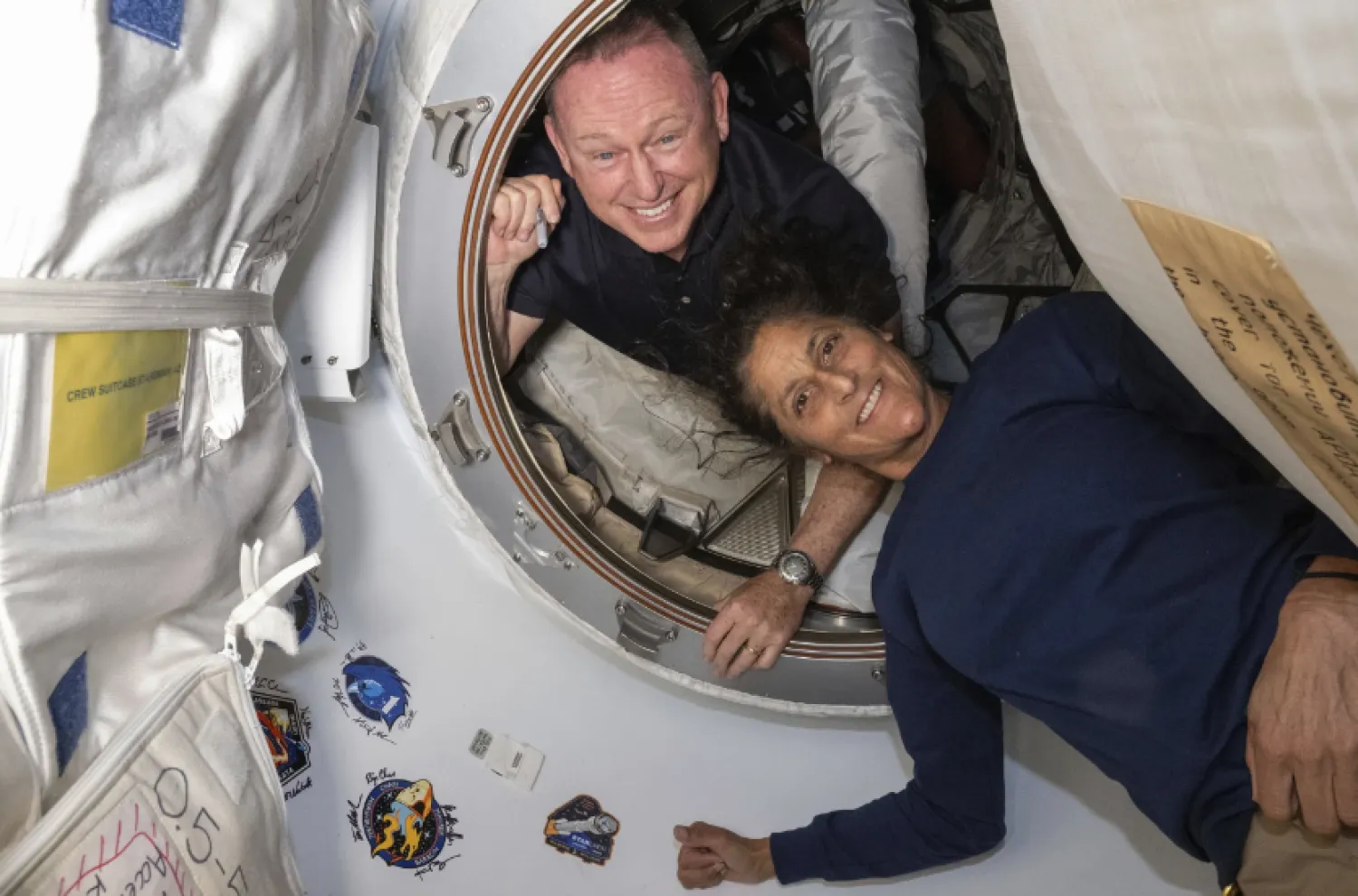
 FILE - In this photo provided by NASA, Boeing Crew Flight Test astronauts Butch Wilmore, left, and Suni Williams pose for a portrait inside the vestibule between the forward port on the International Space Station's Harmony module and Boeing's Starliner spacecraft on June 13, 2024. (NASA via AP, File)
FILE - In this photo provided by NASA, Boeing Crew Flight Test astronauts Butch Wilmore, left, and Suni Williams pose for a portrait inside the vestibule between the forward port on the International Space Station's Harmony module and Boeing's Starliner spacecraft on June 13, 2024. (NASA via AP, File)
TT

NASA Decides to Keep 2 Astronauts in Space until February, Nixes Return on Troubled Boeing Capsule

 FILE - In this photo provided by NASA, Boeing Crew Flight Test astronauts Butch Wilmore, left, and Suni Williams pose for a portrait inside the vestibule between the forward port on the International Space Station's Harmony module and Boeing's Starliner spacecraft on June 13, 2024. (NASA via AP, File)
FILE - In this photo provided by NASA, Boeing Crew Flight Test astronauts Butch Wilmore, left, and Suni Williams pose for a portrait inside the vestibule between the forward port on the International Space Station's Harmony module and Boeing's Starliner spacecraft on June 13, 2024. (NASA via AP, File)

NASA decided Saturday it’s too risky to bring two astronauts back to Earth in Boeing’s troubled new capsule, and they'll have to wait until next year for a ride home with SpaceX. What should have been a weeklong test flight for the pair will now last more than eight months.

The seasoned pilots have been stuck at the International Space Station since the beginning of June. A cascade of vexing thruster failures and helium leaks in the new capsule marred their trip to the space station, and they ended up in a holding pattern as engineers conducted tests and debated what to do about the flight back.

After almost three months, the decision finally came down from NASA’s highest ranks on Saturday. Butch Wilmore and Suni Williams will come back in a SpaceX capsule in February. Their empty Starliner capsule will undock in early September and attempt to return on autopilot with a touchdown in the New Mexico desert, The AP repored.

As Starliner’s test pilots, the pair should have overseen this critical last leg of the journey.

“A test flight by nature is neither safe nor routine,” said NASA Administrator Bill Nelson. The decision "is a result of a commitment to safety.”

Nelson said lessons learned from NASA's two space shuttle accidents played a role. This time, he noted, open dialogue was encouraged rather than crushed.

“This has not been an easy decision, but it is absolutely the right one,” added Jim Free, NASA's associate administrator.

It was a blow to Boeing, adding to the safety concerns plaguing the company on its airplane side. Boeing had counted on Starliner’s first crew trip to revive the troubled spacecraft program after years of delays and ballooning costs. The company had insisted Starliner was safe based on all the recent thruster tests both in space and on the ground.

Boeing did not participate in Saturday's news conference by NASA, but released a statement: “Boeing continues to focus, first and foremost, on the safety of the crew and spacecraft." The company said it is preparing the spacecraft “for a safe and successful return.”

Rand Corp.'s Jan Osburg, a senior engineer who specializes in aerospace and defense, said NASA made the right choice. “But the U.S. is still left with egg on its face due to the Starliner design issues that should have been caught earlier."

Wilmore, 61, and Williams, 58, are both retired Navy captains with previous long-duration spaceflight experience. Before their June 5 launch from Cape Canaveral, Wilmore and Williams said their families bought into the uncertainty and stress of their professional careers decades ago.

During their lone orbital news conference last month, the astronauts said they had trust in the thruster testing being conducted. They had no complaints, they added, and enjoyed pitching in with space station work.

Wilmore's wife, Deanna, said she and their daughters, along with family and friends, “were praying for a safe return on whatever spacecraft that may be." While they are disappointed that he will be away longer, “we know that it's the Lord's plan,” she said via text.

Flight operations director Norm Knight said he talked to the astronauts Saturday and they fully support the decision to postpone their return.

There were few options.

The SpaceX capsule currently parked at the space station is reserved for the four residents who have been there since March. They will return in late September, their routine six-month stay extended a month by the Starliner dilemma. NASA said it would be unsafe to squeeze two more into the capsule, except in an emergency.

The docked Russian Soyuz capsule is even tighter, capable of flying only three — two of them Russians wrapping up a yearlong stint.

So Wilmore and Williams will wait for SpaceX's next taxi flight. It’s due to launch in late September with two astronauts instead of the usual four. NASA is yanking two to make room for Wilmore and Williams on the return flight in late February.

NASA said no serious consideration was given to asking SpaceX for a quick stand-alone rescue. Last year, the Russian Space Agency had to rush up a replacement Soyuz capsule for three men whose original craft was damaged by space junk. The switch pushed their six-month mission to just over a year.

Former Canadian astronaut Chris Hadfield, applauded the decision via X: “Good to err on the side of caution for astronaut lives.” Long missions are “what astronauts work their entire career for. I’d take it in a heartbeat!”

Starliner’s woes began long before its latest flight.

Bad software fouled the first test flight without a crew in 2019, prompting a do-over in 2022. Then parachute and other issues cropped up, including a helium leak in the capsule’s propellant system that nixed a launch attempt in May. The leak eventually was deemed to be isolated and small enough to pose no concern. But more leaks sprouted following liftoff, and five thrusters also failed.

All but one of those small thrusters restarted in flight. But engineers were perplexed by ground testing that showed a thruster seal swelling and obstructing a propellant line. They theorized the seals in orbit may have expanded and then reverted to their normal size. Officials said the results marked the turning point, as their concerns grew.

With all the uncertainty about how the thrusters might perform, “There was too much risk for the crew," Steve Stich, NASA's commercial crew program manager, told reporters.

These 28 thrusters are vital. Besides needed for space station rendezvous, they keep the capsule pointed in the right direction at flight’s end as bigger engines steer the craft out of orbit. Coming in crooked could result in catastrophe.

With the Columbia disaster still fresh in many minds — the shuttle broke apart during reentry in 2003, killing all seven aboard — NASA made an extra effort to embrace open debate over Starliner's return capability.

Despite Saturday's decision, NASA isn’t giving up on Boeing. Nelson said he is “100%” certain that Starliner will fly again.

NASA went into its commercial crew program a decade ago wanting two competing U.S. companies ferrying astronauts in the post-shuttle era. Boeing won the bigger contract: more than $4 billion, compared with SpaceX’s $2.6 billion.

With station supply runs already under its belt, SpaceX aced its first of now nine astronaut flights in 2020, while Boeing got bogged down in design flaws that set the company back more than $1 billion. NASA officials still hold out hope that Starliner’s problems can be corrected in time for another crew flight in another year or so.

'Large-scale' Avalanche Kills Two Skiers in French Alps

Members of the CRS Alpes Grenoble mountain rescue team prepare to board a Securite Civile helicopter (emergency management) after after an avalanche emergency response rescue mission in an off-piste area of the Ecrins massif, French Alps on January 29, 2026. (Photo by JEFF PACHOUD / AFP)
TT

'Large-scale' Avalanche Kills Two Skiers in French Alps

Members of the CRS Alpes Grenoble mountain rescue team prepare to board a Securite Civile helicopter (emergency management) after after an avalanche emergency response rescue mission in an off-piste area of the Ecrins massif, French Alps on January 29, 2026. (Photo by JEFF PACHOUD / AFP)

An avalanche has killed two off-piste ski tourers in the French Alps, a local prosecutor said on Sunday.

According to local rescue services, the two men died when an avalanche was triggered on Saturday afternoon near the village of Saint-Veran, known as the highest village in the French Alps.

The two victims-- one born in 1997 and the other in 1991 -- were part of a group of four unguided skiers when a "large-scale" avalanche swept down the north side of the Tete de Longet mountain peak, Gap prosecutor Marion Lozac'hmeur told AFP.

The other two skiers were unharmed, Lozac'hmeur added.

An autopsy has been ordered as part of an investigation into the cause of death, according to the prosecutor.

Avalanches have already claimed the lives of more than 20 skiers across the French, Swiss and Austrian Alps so far this season.


Olympic Tourists in Cortina Can Explore the Dolomites with the New ‘Uber Snowmobile’ Service

 The peaks of the Dolomites are seen from the Cortina Sliding Centre during the Milano Cortina 2026 Winter Olympic Games in Cortina d'Ampezzo on February 5, 2026. (AFP)
The peaks of the Dolomites are seen from the Cortina Sliding Centre during the Milano Cortina 2026 Winter Olympic Games in Cortina d'Ampezzo on February 5, 2026. (AFP)
TT

Olympic Tourists in Cortina Can Explore the Dolomites with the New ‘Uber Snowmobile’ Service

 The peaks of the Dolomites are seen from the Cortina Sliding Centre during the Milano Cortina 2026 Winter Olympic Games in Cortina d'Ampezzo on February 5, 2026. (AFP)
The peaks of the Dolomites are seen from the Cortina Sliding Centre during the Milano Cortina 2026 Winter Olympic Games in Cortina d'Ampezzo on February 5, 2026. (AFP)

The peaks of the Dolomites are seen from the Cortina Sliding Centre during the Milano Cortina 2026 Winter Olympic Games in Cortina d'Ampezzo on February 5, 2026. (AFP)

For one month starting on Saturday, Olympic spectators keen for a side trip to a UNESCO World Heritage Site can use Uber to reserve a ride on a snowmobile along the snow-covered road to the base of the Three Peaks of Lavaredo.

The dramatic, jagged limestone pinnacles stand just 23 kilometers (14.3 miles) from the Cortina venues where athletes are competing in the 2026 Winter Olympics and Paralympics.

One of the Olympic torchbearers, Giulia Baffetti, runs snowmobiling tours through Cortina-based winter activities outfit Snowdreamers. The company partnered with Uber, the official ride-hailing sponsor for the Games, to offer free tours on the weekends in February to people in town.

"Uber Snowmobile" tours, which can only be booked through Uber, include a ride in an Uber transfer bus for up to eight people from Cortina to the spot where riders mount their snowmobiles for departure. Tourgoers then follow the instructor, who leads the line of snowmobiles.

The first slots offered went fast, but Uber spokesperson Caspar Nixon said Friday that it planned to add more.

The three peaks are a magical place, Baffetti said, and this is a way for more people to experience it. Hikers and climbers flock there in the warmer months. In the winter, it’s a prime spot for cross-country skiing, snowshoeing and sledding. Snowmobiling is allowed in a limited area in order to protect the environment.

"We want to give an experience to the tourists, so they can feel the mountains in a different way," she said.

The Associated Press took the one-hour tour on Thursday, ahead of the Saturday launch, along with one other person. Helmets are essential, while heated handgrips are a most welcome feature. And that red button? Passengers can push it to stop the snowmobile if it veers off course or they feel unsafe.

The adrenaline-filled ride reaches speeds up to 40 kph (25 mph) when zooming past snow-covered trees, and drivers are instructed to slow when coming upon cross-country skiers and sledders. Deer and wolves are sometimes seen along the 7-kilometer (4.3-mile) route up to the base of the peaks.

Also visible on Thursday was the southernmost of the three Lavaredo peaks, rising sharply out of the fog. While the Dolomites are breathtaking from Cortina — and on Friday, the sun shone and the view was clear from town — they are even more impressive up close.

The route back includes a short loop around Lake Antorno. Before traversing all the ups and downs, the snowmobile instructor leading the tour offers a reminder about that red button.

Saher Deeb, an Israeli tourist, was along for the ride Thursday, one day after his 29th birthday. It was his first time on a snowmobile, and he was all smiles as he climbed off at the end.

"It was perfect," he said.


French Duo Finish Walking from France to Shanghai After 1.5 Years

 Performers throw molten iron to create sparks during a performance on the Bund promenade along the Huangpu river, ahead of the upcoming Lunar New Year of the Horse in Shanghai on February 2, 2026. (AFP)
Performers throw molten iron to create sparks during a performance on the Bund promenade along the Huangpu river, ahead of the upcoming Lunar New Year of the Horse in Shanghai on February 2, 2026. (AFP)
TT

French Duo Finish Walking from France to Shanghai After 1.5 Years

 Performers throw molten iron to create sparks during a performance on the Bund promenade along the Huangpu river, ahead of the upcoming Lunar New Year of the Horse in Shanghai on February 2, 2026. (AFP)
Performers throw molten iron to create sparks during a performance on the Bund promenade along the Huangpu river, ahead of the upcoming Lunar New Year of the Horse in Shanghai on February 2, 2026. (AFP)

Two French adventurers reached the end of an epic walk from France to Shanghai on Saturday, after nearly a year and a half crossing 16 countries almost entirely on foot.

Loic Voisot and Benjamin Humblot embraced as they stood by the river on the Bund promenade, the financial hub's distinctive skyline glittering in the background.

Voisot and Humblot set off from Annecy in September 2024.

"We were thinking about this moment almost every day for more than a year now, so it's a really strong feeling," Humblot said of reaching their destination.

Hanging out after work one day, the two friends realized they both yearned for a "great adventure".

They wanted to visit China -- but without flying, which they believe is too harmful to the environment.

A plan to set out on foot was hatched, and except for a stretch in Russia which was done by bus for safety reasons, 518 days and around 12,850 kilometers (7,980 miles) later they took the last steps to completing it.

Around 50 people gathered at the start point for the last 10km stretch of their odyssey, many local people who have been following them on social media.

Along the way their numbers swelled, as media, French residents of Shanghai and others joined.

"If your dreams are crazy, just take it step by step and sometimes you will not succeed, but sometimes you will," said Voisot.

Asked what he would do first now the walk was over, he joked: "Sleep a lot!"