


This Bird Species Was Extinct in Europe. Now It’s Back.

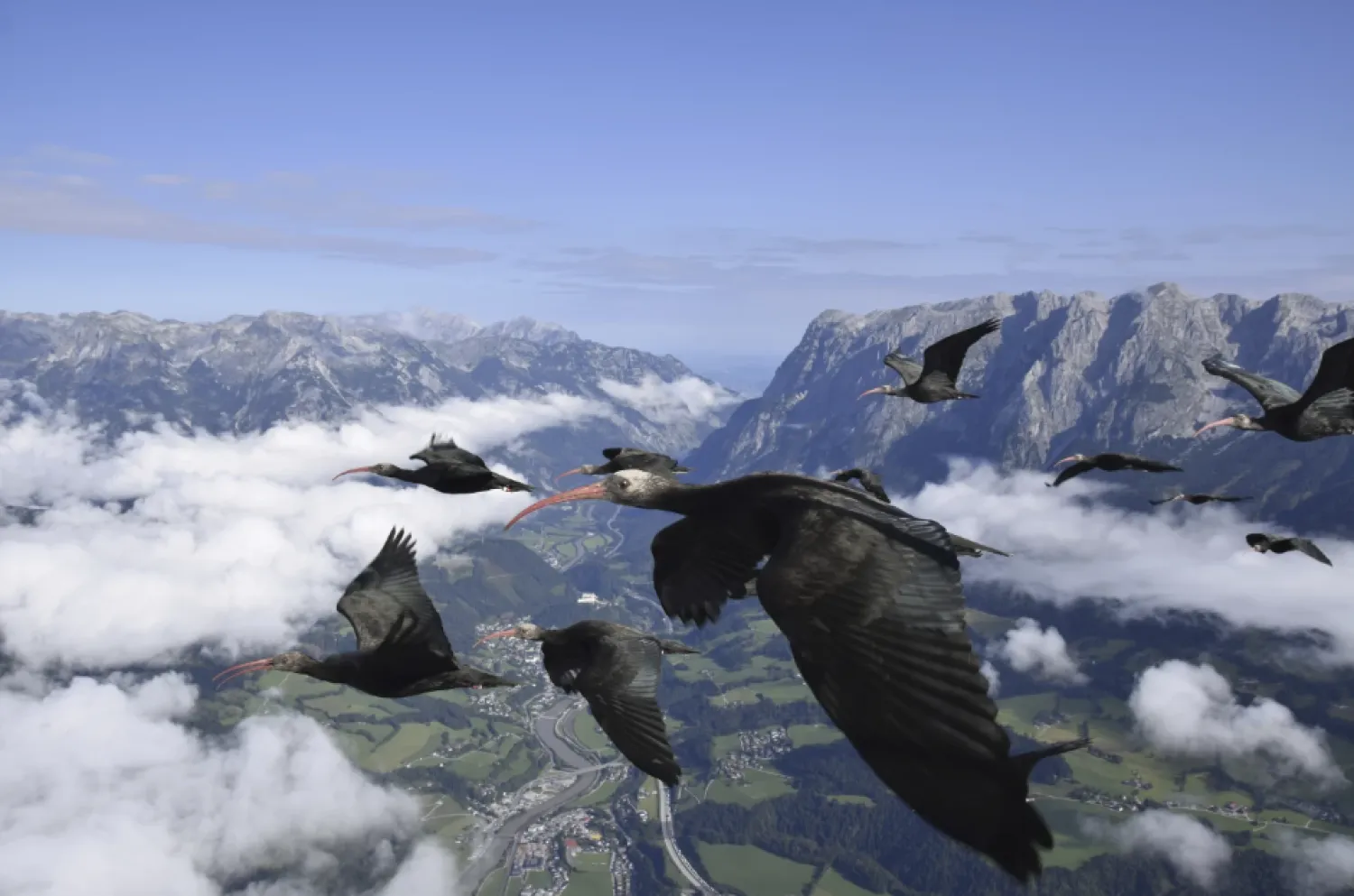
This photo provide by Waldrappteam Conservation & Research shows the migration from Northern Bald Ibis, or the Waldrapp from Seekirchen am Wallersee in Austria to Oasi Laguna di Orbetello in Italy during August and September 2022. (Waldrappteam Conservation & Research via AP)
TT

This Bird Species Was Extinct in Europe. Now It’s Back.

This photo provide by Waldrappteam Conservation & Research shows the migration from Northern Bald Ibis, or the Waldrapp from Seekirchen am Wallersee in Austria to Oasi Laguna di Orbetello in Italy during August and September 2022. (Waldrappteam Conservation & Research via AP)

How do you teach a bird how, and where, to fly? The distinctive northern bald ibis, hunted essentially to extinction by the 17th century, was revived by breeding and rewilding efforts over the last two decades. But the birds — known for their distinctive black-and-iridescent green plumage, bald red head and long curved beak — don’t instinctively know which direction to fly to migrate without the guidance of wild-born elders. So a team of scientists and conservationists stepped in as foster parents and flight instructors, The AP reported.

“We have to teach them the migration route,” said biologist Johannes Fritz.

The northern bald ibis once soared over North Africa, the Arabian Peninsula and much of Europe, including southern Germany's Bavaria. The migratory birds were also considered a delicacy, and the bird, known as the Waldrapp in German, disappeared from Europe, though a few colonies elsewhere survived.

The efforts of Fritz and the Waldrappteam, a conservation and research group based in Austria, brought the Central European population from zero to almost 300 since the start of their project in 2002.

The feat moved the species from a "critically endangered" classification to "endangered" and, Fritz says, is the first attempt to reintroduce a continentally extinct migratory bird species.

But while northern bald ibises still display the natural urge to migrate, they don’t know which direction to fly without the guidance of wild-born elders. The Waldrappteam's early reintroduction attempts were largely unsuccessful because, without teaching the birds the migration route, most disappeared soon after release. Instead of returning to suitable wintering grounds such as Tuscany, Italy, they flew in different directions and ultimately died.

So the Waldrappteam stepped in as foster parents and flight instructors for the Central European population, which was made up of descendants from multiple zoo colonies and released into the wild in the hopes of creating a migratory group. This year marks the 17th journey with human-led migration guides, and the second time they've been forced to pilot a new route to Spain due to climate change.

To prepare them for travel, the chicks are removed from their breeding colonies when they are just a few days old. They are taken to an aviary that's overseen by the foster parents in the hopes of “imprinting” — when the birds will bond with those humans to ultimately trust them along the migration route.

Barbara Steininger, a Waldrapp team foster mother, said she acts like “their bird mom."

“We feed them, we clean them, we clean their nests. We take good care of them and see that they are healthy birds,” she said. "But also we interact with them.”

Steininger and the other foster parents then sit on the back of a microlight aircraft, waving and shouting encouragement through a bullhorn as it flies through the air.

It's a bizarre scene: The aircraft looks like a flying go-kart with a giant fan on the back and a yellow parachute keeping it aloft. Still, three dozen birds follow the contraption, piloted by Fritz, as it sails over alpine meadows and foothills.

Fritz was inspired by “Father Goose” Bill Lishman, a naturalist who taught Canadian geese to fly alongside his ultra-light plane beginning in 1988. He later guided endangered whooping cranes through safe routes and founded the nonprofit “Operation Migration.” Lishman's work prompted the 1996 movie “Fly Away Home” but features a young girl as the geese's “mother.”

Like Lishman, Fritz and his team's efforts have worked. The first bird independently migrated back to Bavaria in 2011 from Tuscany. More have flown the route that's upward of 550 kilometers (342 miles) each year, and the team hopes the Central European population will be more than 350 birds by 2028 and become self-sustaining.

But the effects of climate change mean the Waldrapp are migrating later in the season now, which forces them to cross the Alps in colder, more dangerous weather — without the aid of warm currents of air, known as thermals, that rise upward and help the birds soar without expending extra energy.

In response, the Waldrappteam piloted a new route in 2023, from Bavaria to Andalusia in southern Spain.

This year, the route is roughly 2,800 kilometers (1,740 miles) — some 300 kilometers (186 miles) longer than last year's path. Earlier this month from an airfield in Paterzell, in upper Bavaria, the team guided 36 birds along one stage through bright blue skies and a tailwind that increased their speed.

The entire journey to Spain could take up to 50 days and end in early October. But Fritz says the effort is bigger than just the northern bald ibises: It’s about paving the way for other threatened migratory species to fly.




ISS Crew Splashes Down on Earth After Medical Evacuation

FILE - This photo provided by NASA shows the Moon's shadow covering portions of Canada and the US during a total solar eclipse as seen from the International Space Station on Monday, Aug. 8, 2024. (NASA via AP, File)
TT

ISS Crew Splashes Down on Earth After Medical Evacuation

FILE - This photo provided by NASA shows the Moon's shadow covering portions of Canada and the US during a total solar eclipse as seen from the International Space Station on Monday, Aug. 8, 2024. (NASA via AP, File)

Four International Space Station (ISS) crewmembers splashed down in the Pacific Ocean early Thursday, video footage from NASA showed, after a medical issue prompted their mission to be cut short.

American astronauts Mike Fincke and Zena Cardman, Russian cosmonaut Oleg Platonov and Japan's Kimiya Yui landed off the coast of San Diego about 12:41 am (0841 GMT), marking the first-ever medical evacuation from the ISS.


Lonely Tree in Wales Is an Instagram Star, but its Fate Is Inevitable

The Lonely Tree, often pictured submerged in water, was first planted in 2010. (Getty Images)
TT

Lonely Tree in Wales Is an Instagram Star, but its Fate Is Inevitable

The Lonely Tree, often pictured submerged in water, was first planted in 2010. (Getty Images)

It is one of Wales' most-loved beauty spots - but the time of the so-called Lonely Tree being an Instagram star could be slowly coming to an end.

The birch tree's striking setting at Llyn Padarn in Eryri, also known as Snowdonia, draws photographers to capture the sight through the seasons, according to BBC.

But the local authority Cyngor Gwynedd has raised the prospect of the tree, which was planted around 2010, disappearing within the next decade or so.

A lack of nutrients in the soil means birch trees have “a relatively short lifespan” in the area, typically living for around 30 years, but the fact that The Lonely Tree is sometimes submerged in water means its time could be even shorter.

Thousands of walkers and photographers make their way there each year and the tree has many social media sites dedicated to it, including one with 3,500 members on Facebook.

Marc Lock from Bangor, Gwynedd, said: “The Lonely Tree holds a special place in my heart and that of my family.”

He added: “Nestled down by the Lonely Tree, it's a perfect spot for us to sit, reflect and soak in the breath-taking scenery. We often go paddleboarding there in the summer months.”

However, Lock said the area really became his sanctuary after his wife bought him a camera for Christmas and he took up photography.

It was the place he headed to straight away, and he returns regularly at various times of the day and throughout the seasons.

“It's my go-to spot whenever I have some free time and my camera in hand,” he added. “I can't imagine what I would do if anything devastating happened to it like that at the Sycamore Gap tree at Hadrian's Wall. It's simply unthinkable.”

The Sycamore Gap was a much-loved landmark beside Hadrian's Wall in Northumberland that also drew hikers and photographers from far and wide.

It was more than 100 years old and had been the scene of many proposals, with people making the trip there from around the world.

But it was cut down by vandals in September 2023, causing uproar, with thousands of people leaving tributes and posting messages about their love for the beauty spot.

Two men were jailed for four years and three months after admitting the illegal felling.

While maybe not quite as famous as the Sycamore Gap was, The Lonely Tree is every bit as special to those that hold it dear to their heart.


Four Signs You're Self-Sabotaging Your Joy

Threat or uncertainty can reduce cognitive regulation and increase avoidance behaviors. (Indiana University)
TT

Four Signs You're Self-Sabotaging Your Joy

Threat or uncertainty can reduce cognitive regulation and increase avoidance behaviors. (Indiana University)

Most of us, at some point in our lives, have stood in the way of our own growth.

We make progress on a project, start to feel hopeful about a relationship, or finally get on track with a goal, and then we do something that undermines it.

We fall into a procrastination spiral, pick a fight, or simply quit; in doing so, we talk ourselves out of something that could potentially bring us happiness.

There’s a name for this kind of behavior: self-sabotage.

Dr. Mark Travers, an American psychologist with degrees from Cornell University and the University of Colorado Boulder, wrote an essay at Psychology Today about four well-studied reasons why people sabotage good things, based on research in psychology.

Avoiding blame

According to Travers, one of the most consistently researched patterns in self-sabotage comes from what psychologists call self-handicapping.

He said this is a behavior in which people create obstacles to their own success so that if they fail, they can blame external factors instead of internal ability.

A prime example comes from classic research in which researchers observed students who procrastinated studying for an important test. The ones who failed mostly attributed it to a lack of preparation rather than a lack of organization or discipline.

Self-handicapping is not simply laziness or whimsy. Rather, it is a strategy people use to protect their self-worth in situations where they might perform “poorly” or where they might be perceived as inadequate.

Fear of failure or success

People often think of the fear of failure as the main emotional driver behind self-sabotage.

But research points to the fear of success as an equal, yet less-talked-about engine of the phenomenon. Both fears can push people to undermine opportunities that are actually aligned with their long-term goals.

He said people who worry that failure will confirm their negative self-beliefs are more likely to adopt defensive avoidance tactics, like procrastination or quitting early.

Fear of success, though less widely discussed, operates in a similar fashion. What motivates this fear is the anxiety that comes with the consequences of success.

So, self-sabotaging success can be a way to stay within a comfort zone where expectations are familiar, even if that zone is unsatisfying.

Negative self-beliefs

Self-sabotage is tightly intertwined with how people view themselves. When someone doubts their worth, their ability, or their right to be happy, they may unconsciously act in ways that confirm those negative self-views.

Psychological theories help explain this.

Self-discrepancy theory proposes that people experience emotional discomfort when their actual self does not match their ideal self. This mismatch can lead to negative emotions such as shame, anxiety, or depression.

Coping with stress and anxiety

Self-sabotage often emerges in moments of high stress or emotional threat. When people feel overwhelmed, anxious, or stretched thin, their nervous systems shift into protective modes. Instead of moving forward, they retreat, avoid, or defensively withdraw.

Threat or uncertainty can reduce cognitive regulation and increase avoidance behaviors. In situations of perceived threat, even if the threat is potential success or evaluation, people can default to behaviors that feel safer, even if they undermine long-term goals.
