


Libya's Eastern Government Says All Oilfields to Close

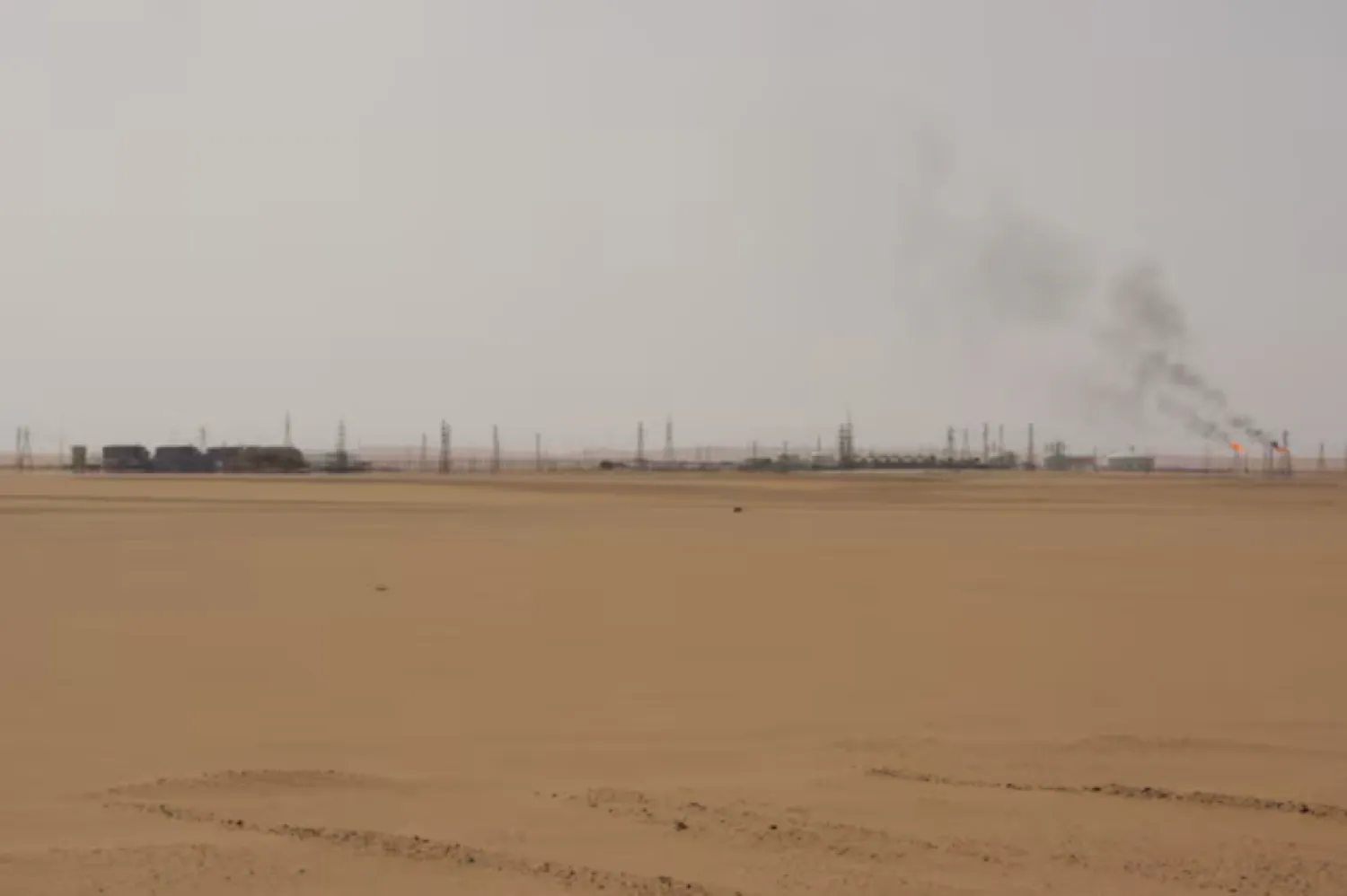
A view shows Sharara oil field near Ubari, Libya, July 6, 2017. REUTERS/Aidan Lewis/File Photo Purchase Licensing Rights
TT

Libya's Eastern Government Says All Oilfields to Close

A view shows Sharara oil field near Ubari, Libya, July 6, 2017. REUTERS/Aidan Lewis/File Photo Purchase Licensing Rights

The government in eastern Libya announced on Monday that all oilfields would be closed down and production and exports halted, while there was no word from the country's internationally recognised government in Tripoli.

The National Oil Corp (NOC), which controls the country's oil resources, also provided no confirmation, according to Reuters.

NOC subsidiary Waha Oil Company, however, announced it planned to gradually reduce output and warned of a complete halt to production citing "protests and pressures".

Waha, which operates a joint venture with TotalEnergies and ConocoPhillips, has a production capacity of about 300,000 barrels per day (bpd) which is exported through the eastern port of Es Sider.

It operates five main fields in the southeast including Waha which produces more than 100,000 bpd as well as Gallo, Al-Fargh, Al-Samah and Al-Dhahra.

Most of Libya's oilfields are in the east, which is under the control of Khalifa Haftar who leads the Libyan National Army (LNA).

The Benghazi government did not specify for how long the oilfields could be closed.

Two engineers at Messla and Abu Attifel told Reuters on Monday that production was continuing and there had been no orders to halt output.

- POWER STRUGGLE

Libyan factions are locked in a power struggle over control of the central bank and the country's oil revenue.

The latest round of tensions emerged after efforts by political factions to oust the Central Bank of Libya (CBL) head Sadiq al-Kabir, with rival armed factions mobilising on each side.

The Tripoli-based CBL said on Monday that it suspended its services at home and abroad "due to exceptional disturbance".

The central bank is the only internationally recognized depository for Libyan oil revenue, which provide vital economic income for the country.

"The Central Bank of Libya hopes that its ongoing efforts in cooperation with all relevant authorities will allow it to resume its normal activity without further delay," it said in a statement.

It temporarily shut down all operations last week after a senior bank official was kidnapped but resumed operations the next day after the official was released.

A major oil producer, Libya has had little stability since a 2011 NATO-backed uprising. It split in 2014 with eastern and western factions that eventually drew in Russian and Turkish backing.

The NOC declared force majeure earlier this month at one of the country's largest oilfields, Sharara, located in Libya's southwest with a capacity of 300,000 bpd, due to protests.

Libya's oil production before Sharara's closure stood at about 1.2 million bpd.

El Feel in southwestern Libya would be the only functioning oilfield, with a capacity of 130,000 bpd, if production is halted in the east.



Saudi Minister of Industry Stresses Kingdom’s Commitment to Expanding Partnerships with Russia

Saudi Minister of Industry and Mineral Resources Bandar Alkhorayef speaks at Monday's event. (SPA)
TT

Saudi Minister of Industry Stresses Kingdom’s Commitment to Expanding Partnerships with Russia

Saudi Minister of Industry and Mineral Resources Bandar Alkhorayef speaks at Monday's event. (SPA)

Saudi Minister of Industry and Mineral Resources Bandar Alkhorayef stressed on Monday the Kingdom’s commitment to deepening its industrial and investment partnerships with Russia and leveraging joint opportunities across several priority sectors to achieve the mutual interests of both countries.

He made his remarks during the keynote speech at the International Industrial Exhibition “INNOPROM. Saudi Arabia,” underway in Riyadh and continuing until February 10. The event is witnessing wide participation from leaders in the public and private sectors, as well as major industrial companies from the Kingdom, Russia, and several other countries.

Alkhorayef said that Riyadh’s hosting of INNOPROM reflects the mutual interest between Saudi Arabia and Russia in boosting industrial and investment cooperation, building on historical relations spanning over a century.

This helps in expanding strategic industrial partnerships and stimulating targeted investments between the two countries, the minister added.

Riyadh’s hosting of the exhibition shortly after the Kingdom’s participation as a partner country in its previous edition in Russia underscores both countries’ commitment to deepening bilateral relations and developing cooperation in priority sectors, particularly industry, logistics, and supply chains, he went on to say.

Moreover, the minister underlined the Saudi and Russian governments' commitment to establish a strong cooperative foundation that provides a stable and secure investment environment for long-term investors.

Alkhorayef addressed the mining and minerals sector, noting that the Kingdom views Russia’s advanced experience in this field as a model to benefit from.

Promising opportunities exist in Saudi Arabia for Russian companies specializing in mining and mine services to participate in developing the vital sector, which constitutes the third pillar of the national industry under Saudi Vision 2030, he remarked.

The Kingdom also possesses an integrated system to support industrial projects, including advanced industrial cities, modern infrastructure, industrial financing, and training and qualification programs, alongside policies that support localization and knowledge transfer, all contributing to enabling high-value industrial investments and bolstering their sustainability, he noted.

INNOPROM is one of the leading international industrial exhibitions, organized annually for more than 15 years in Russia, attracting major industrial companies.

The current edition in Riyadh features broad Saudi and Russian participation, along with a business program that includes dialogue sessions and bilateral meetings aimed at building strategic partnerships that support the economic development objectives of both countries.


Egypt Plans $1 Billion Red Sea Marina, Hotel Development

This picture shows a partial view of Egypt's Red Sea city of Sharm el-Sheikh, October 7, 2025. (AFP)
TT

Egypt Plans $1 Billion Red Sea Marina, Hotel Development

This picture shows a partial view of Egypt's Red Sea city of Sharm el-Sheikh, October 7, 2025. (AFP)

Egypt announced plans on Monday for a new $1 billion marina, hotel and housing development on the Red Sea in a bid to boost the region's tourist industry.

Construction on the "Monte Galala Towers and Marina" project would ‌start in ‌the second ‌half ⁠of the ‌year and run for seven years, Ahmed Shalaby, managing director of the main developer, Tatweer Misr, said.

The 10-tower development - a partnership with the ⁠housing ministry and other state bodies ‌including the armed ‍forces' engineering authority - ‍would cost about 50 ‍billion Egyptian pounds ($1.07 billion), he added.

The project, also announced by the cabinet, will cover 470,000 square meters on the Gulf of Suez, about ⁠35 km south of Ain Sokhna, Shalaby said.

Egypt aims to boost total tourist arrivals to around 30 million by 2030, from around 19 million recorded by the tourism ministry in 2025.


Saudi-Polish Investment Forum Explores Prospects for Economic and Investment Cooperation

The forum brought together government officials, business leaders, and investors from both countries with the aim of enhancing economic cooperation - SPA
TT

Saudi-Polish Investment Forum Explores Prospects for Economic and Investment Cooperation

The forum brought together government officials, business leaders, and investors from both countries with the aim of enhancing economic cooperation - SPA

The Saudi-Polish Investment Forum was held today at the headquarters of the Federation of Saudi Chambers in Riyadh, with the participation of Minister of Investment Khalid Al-Falih, Minister of Finance of the Republic of Poland Andrzej Domański, and Vice President of the Federation of Saudi Chambers Emad Al-Fakhri.

The forum brought together government officials, business leaders, and investors from both countries with the aim of enhancing economic cooperation, expanding investment partnerships in priority sectors, and exploring high-quality investment opportunities that support sustainable growth in Saudi Arabia and Poland.

During a dedicated session, the forum reviewed economic and investment prospects in both countries through presentations highlighting promising opportunities, investment enablers, and supportive legislative environments.

Several specialized roundtables addressed strategic themes, including the development of the digital economy, with a focus on information and communication technologies (ICT), financial technologies (fintech), and artificial intelligence-driven innovation, SPA reported.

Discussions also covered the development of agricultural value chains from production to market access through advanced technologies, food processing, and agricultural machinery. In addition, participants examined ways to enhance the construction sector by developing systems and materials, improving execution efficiency, and accelerating delivery timelines. Energy security issues and the role of industrial sectors in supporting economic transformation and sustainability were also discussed.

The forum witnessed the announcement of two major investment agreements. The first aims to establish a framework for joint cooperation in supporting investment, exchanging information and expertise, and organizing joint business events to strengthen institutional partnerships.

The second agreement focuses on supporting reciprocal investments through the development of financing and insurance tools and the stimulation of joint ventures to boost investment flows.

The forum concluded by emphasizing the importance of continued coordination and dialogue between the public and private sectors in both countries to deepen Saudi-Polish economic relations and advance shared interests.