Weakening Typhoon Churns Through Japan, Up to Six Dead

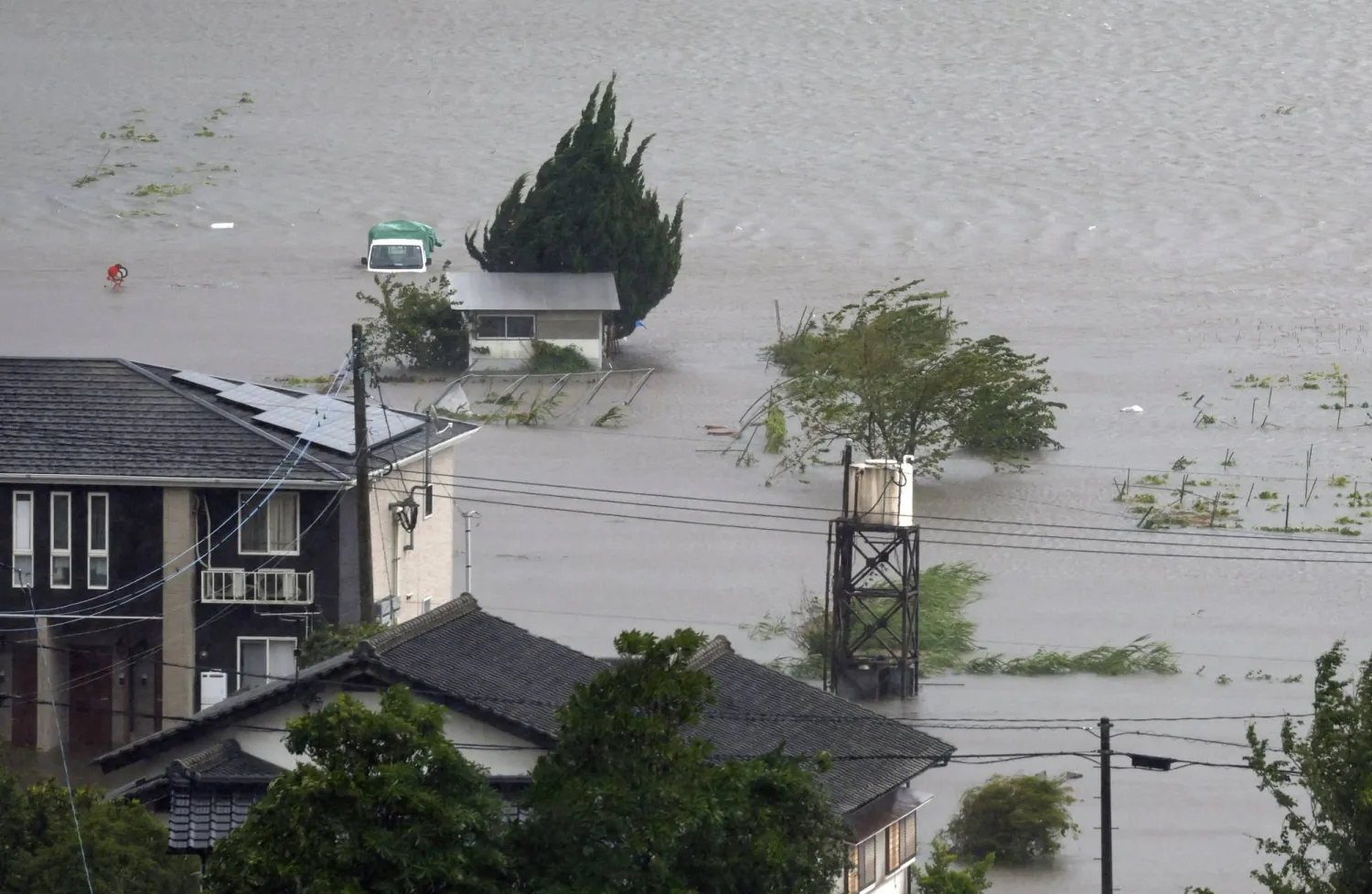
A farmland is submerged due to floods caused by heavy rains from Typhoon Shanshan in Yufu, Oita Prefecture, southwestern Japan, August 29, 2024, in this photo taken by Kyodo. Mandatory credit Kyodo/via REUTERS
TT

Weakening Typhoon Churns Through Japan, Up to Six Dead

A farmland is submerged due to floods caused by heavy rains from Typhoon Shanshan in Yufu, Oita Prefecture, southwestern Japan, August 29, 2024, in this photo taken by Kyodo. Mandatory credit Kyodo/via REUTERS

Typhoon Shanshan weakened to a tropical storm Friday but was still dumping heavy rains as it slowly churned through Japan, triggering transport havoc and landslide warnings, with up to six people killed.
The storm, which at landfall was one of the fiercest to hit Japan in decades, pummeled Kyushu island on Thursday with gusts of up to 252 kilometers (157 miles) per hour. On Friday they eased to 108 kph as it moved up the archipelago.
Even before making landfall, a landslide caused by the heavy rains preceding the storm killed three members of the same family late Tuesday in Aichi prefecture, around 1,000 kilometers (600 miles) away.
Government spokesman Yoshimasa Hayashi on Friday confirmed reports of one additional death, but said that "the relation to the typhoon was being studied". Two more were feared dead and two others were missing, he added.
Eight people were seriously hurt and 70 others had light injuries, Hayashi said, with many injured by broken glass after the typhoon smashed windows and ripped tiles off roofs on Thursday. Almost 200 buildings were damaged.
- Climate change -
Typhoons in the region have been forming closer to coastlines, intensifying more rapidly and lasting longer over land due to climate change, according to a study released in July.
A rapid attribution analysis issued Friday by Imperial College London using peer-reviewed methodology calculated that Typhoon Shanshan's winds were made 26 percent more likely by a warming planet.
"Without phasing out fossil fuels, the root cause of climate change, typhoons will bring even greater devastation to Japan," said Ralf Toumi, director of the Grantham Institute at Imperial.
The coming storm prompted Japanese authorities to issue their highest alert in several areas, with more than five million people advised to evacuate, although it was unclear how many did.
On Friday the Japan Meteorological Agency issued alerts for possible landslides in many parts of Kyushu, and as far away as Shizuoka on the main island of Honshu, the Tokyo region and nearby Kanagawa.
Footage from Japanese broadcaster NHK showed a car park in Kanagawa prefecture with vehicles half-submerged in brown water, with authorities there urging residents to move to higher floors after a local river flooded.
Some parts of Kyushu saw record rains for August, with the town of Misato recording a staggering 791.5 millimeters (31 inches) in 48 hours, the Japan Meteorological Agency said.
Kyushu island's Kitakyushu saw 474 mm in the 24 hours to Friday morning, the most since 2012, when comparative data began to be collected. Nearby Kunimi had 384.5 mm, the most since records began in 1977.
- Inconvenient -
The holiday resort of Beppu in Kyushu suffered no major damage, but tourists were stranded and bored, with the onsen hot springs, a monkey park and even 24-hour convenience stores shut.
"This is my first time (here). I was very looking forward to it," morose visitor Nobuhiko Takagishi from Tokyo told AFP. "But it will be a trip to remember. A trip when I couldn't do anything."
Power cuts hit more than 250,000 Kyushu households, but the utility operator said Friday that only 5,250 were still without electricity as engineers repaired transmission lines.
Overnight, many motorways were fully or partially closed in Kyushu, as were others further afield, media reports said.
Shinkansen bullet trains remained suspended in Kyushu and were also halted on the major route between Tokyo and Osaka, with operators warning of disruptions elsewhere.
Japan Airlines and ANA had already announced the cancellation of more than 600 flights between them for Friday, having scrapped a similar number the previous day, affecting almost 50,000 passengers.
Four baseball games due to take place on Friday, Saturday and Sunday in the central city of Nagoya and Nishinomiya near Osaka were canceled. Five J-League football matches slated for Saturday in different cities were also called off.
Auto giant Toyota said it had extended a production halt at all 14 of its Japanese plants, while a suspension at Nissan's Kyushu factories remained in place.



USS Gerald R. Ford Aircraft Carrier Leaves Middle East

 The USS Gerald R. Ford in the waters of the Eastern Mediterranean, Oct. 11, 2023. (Jacob Mattingly/US Department of Defense/AFP)
The USS Gerald R. Ford in the waters of the Eastern Mediterranean, Oct. 11, 2023. (Jacob Mattingly/US Department of Defense/AFP)
TT

USS Gerald R. Ford Aircraft Carrier Leaves Middle East

 The USS Gerald R. Ford in the waters of the Eastern Mediterranean, Oct. 11, 2023. (Jacob Mattingly/US Department of Defense/AFP)
The USS Gerald R. Ford in the waters of the Eastern Mediterranean, Oct. 11, 2023. (Jacob Mattingly/US Department of Defense/AFP)

The USS Gerald R. Ford aircraft carrier has left the Middle East after taking part in operations against Iran, a US official said Friday, leaving two of the massive American warships in the region.

The Ford is currently in the US European Command area of responsibility, according to the official, who put the number of remaining US Navy ships in the Middle East at 20, including the USS Abraham Lincoln and USS George H.W. Bush aircraft carriers.

The Ford has been at sea for more than 10 months -- a deployment that has already seen it take part in US operations in the Caribbean, where Washington's forces have carried out strikes on alleged drug-smuggling boats, interdicted sanctioned tankers and seized Venezuelan leader Nicolas Maduro.

A fire broke out in a laundry room aboard the carrier on March 12, injuring two sailors and causing major damage to some 100 beds, according to the US military.

The carrier has also reportedly suffered significant problems with its toilet system while at sea, with US media reporting clogs and long lines for restrooms on the ship.

The United States and Iran are currently in an open-ended ceasefire, but the conflict remains unresolved, with Tehran blocking the vital Strait of Hormuz waterway and Washington's forces blockading Iranian ports.


US Treasury Warns Shippers Not to Pay Hormuz Tolls, Even in Form of Charity

 An Emirati patrol boat, left, is near a tanker anchored in the Gulf of Oman near the Strait of Hormuz, as seen from a coastal road near Khor Fakkan, United Arab Emirates, Friday, May 1, 2026. (AP)
An Emirati patrol boat, left, is near a tanker anchored in the Gulf of Oman near the Strait of Hormuz, as seen from a coastal road near Khor Fakkan, United Arab Emirates, Friday, May 1, 2026. (AP)
TT

US Treasury Warns Shippers Not to Pay Hormuz Tolls, Even in Form of Charity

 An Emirati patrol boat, left, is near a tanker anchored in the Gulf of Oman near the Strait of Hormuz, as seen from a coastal road near Khor Fakkan, United Arab Emirates, Friday, May 1, 2026. (AP)
An Emirati patrol boat, left, is near a tanker anchored in the Gulf of Oman near the Strait of Hormuz, as seen from a coastal road near Khor Fakkan, United Arab Emirates, Friday, May 1, 2026. (AP)

Any shippers paying tolls to Iran for passage through the Strait of Hormuz, including charitable donations to organizations such as the Iranian Red Crescent Society, are at risk of punitive sanctions, the US Treasury warned on Friday.

The Strait of Hormuz is one of the world’s most strategically vital maritime routes, with about 20% of the world’s ‌seaborne crude ‌oil and liquefied natural gas ‌flows passing ⁠through it.

Tehran has ⁠proposed fees or tolls on vessels passing through the Strait, as part of proposals to end the war with Israel and the United States.

The advisory, from Treasury's Office of Foreign Assets Control, said ⁠the US is aware of Iranian ‌threats to ‌shipping and demands for payments to receive safe passage ‌through the Strait.

The warning came as Iran ‌sent its latest proposal for negotiations with the US to Pakistani mediators, a move that could improve prospects for breaking an impasse in ‌efforts to end the Iran war.

OFAC said demands may include several ⁠payment ⁠options, including fiat currency, digital assets, offsets, informal swaps, or other in-kind payments, such as nominally charitable donations made to the Iranian Red Crescent Society, Bonyad Mostazafan, or Iranian embassy accounts.

"OFAC is issuing this alert to warn US and non-US persons about the sanctions risks of making these payments to, or soliciting guarantees from, the Iranian regime for safe passage," it said. "These risks exist regardless of payment method."


NATO and China: A Slow Alliance Confronts a Fast-Rising Rival

People visit the BYD booth at the Beijing Auto Show in Beijing on April 30, 2026. (Photo by Adek BERRY / AFP)
TT

NATO and China: A Slow Alliance Confronts a Fast-Rising Rival

People visit the BYD booth at the Beijing Auto Show in Beijing on April 30, 2026. (Photo by Adek BERRY / AFP)

NATO was established in 1949 to provide collective defense against the Soviet Union, based on the principle that an attack on one member is an attack on all. At the time, US President Harry Truman also sought to anchor an American presence in war-ravaged Europe to ensure security and prevent a strategic vacuum.

The collapse of the Soviet Union, along with the socialist bloc, brought the Cold War to an end and forced NATO to adapt. The alliance expanded its operations beyond Europe, intervening in the Balkans during the Bosnia and Kosovo wars, then in Afghanistan after the September 11, 2001 attacks in the United States. It also undertook maritime missions to combat piracy, including off the Horn of Africa, alongside intelligence-sharing and counterterrorism cooperation.

NATO has since built partnerships with countries beyond its traditional scope and broadened its definition of threats to include cybersecurity, hybrid warfare, and energy security, as well as, more recently, the challenge posed by China.

In sum, NATO has evolved from a purely European defensive alliance into a broader global security actor, largely driven by the United States, while still maintaining a central focus on deterring threats within Europe.

In recent years, the Brussels-based alliance has expanded its attention toward the Indo-Pacific region for strategic reasons that extend beyond Europe. Chief among these are the interconnected nature of global security, particularly in cyberspace, the need to ensure resilient and unobstructed supply chains, and the rapid spread of advanced technologies that increasingly diminish the importance of geographic boundaries.

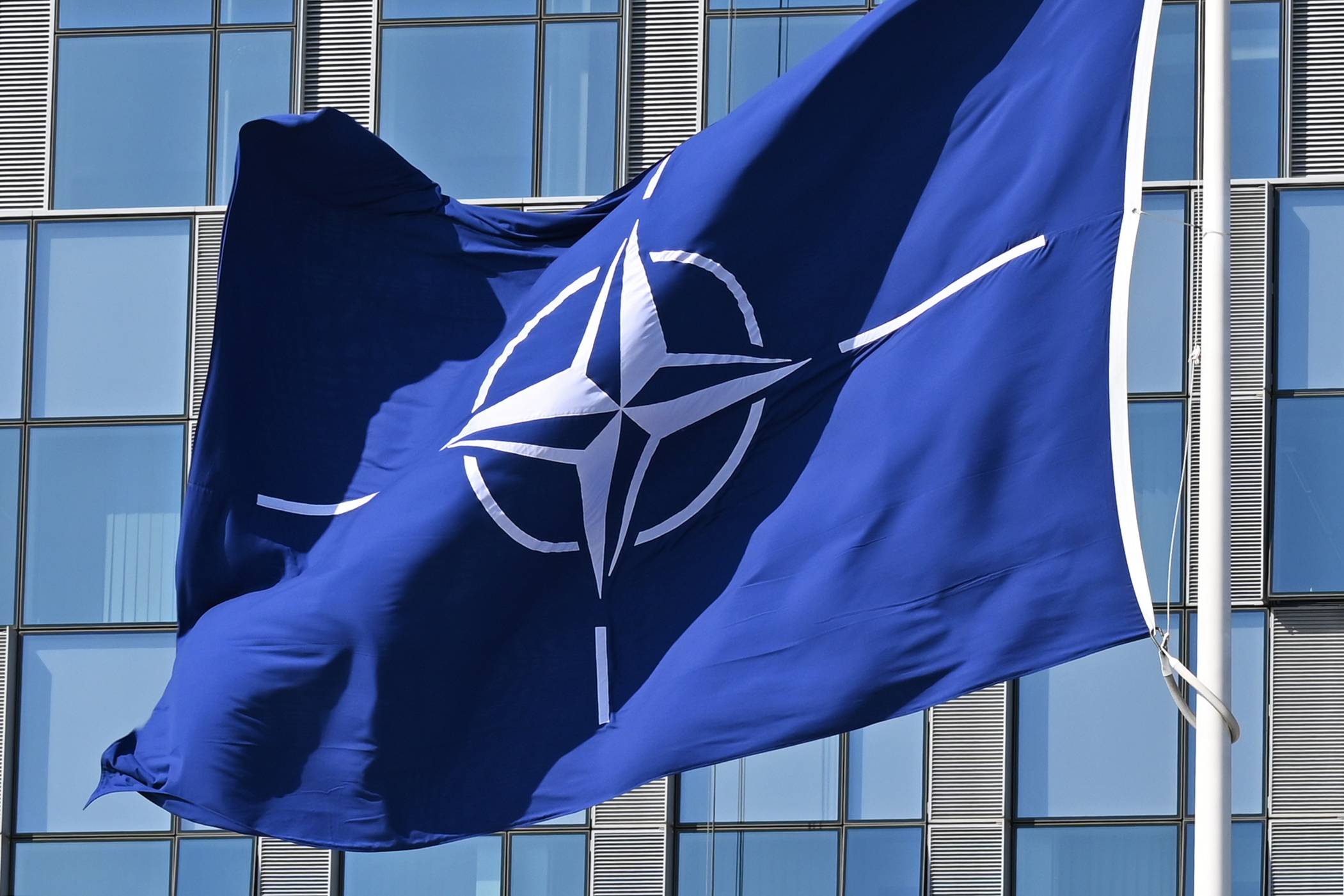
FILED - 03 April 2025, Belgium, Brussels: A NATO flag flies in the wind in front of the NATO headquarters in Brussels. Photo: Anna Ross/dpa

China’s Rise

Another key factor is the view of China’s rise as a strategic challenge reshaping the global balance of power. For NATO’s 32 member states, up from 12 at its founding, safeguarding trade routes is a priority, especially maritime corridors in the Indo-Pacific that are critical to the global economy.

These include the Strait of Malacca between Malaysia and Indonesia, the world’s most important shipping lane, linking the Indian Ocean to the South China Sea and carrying roughly 25 percent of global trade annually. It is also a vital artery for oil and energy flows to major Asian economies such as China, Japan, and South Korea.

NATO member states express “strategic concern” over China for several core reasons. First, China is rapidly modernizing its military, particularly in areas such as missile systems, space capabilities, and cyber operations, developments that are shifting the global balance of power.

Second, and closely linked, is China’s economic rise, reflected in initiatives such as the Belt and Road, which provide Beijing with avenues to expand its economic and political influence across Asia, Africa, and Europe. This expansion risks creating dependencies among countries in or near NATO’s strategic periphery.

Concerns are also fueled by growing ties between China and Russia, particularly following Russia’s invasion of Ukraine in February 2022, which could signal coordination between two major powers against the West.

At the same time, an indirect competition is underway over leadership in fields such as artificial intelligence, telecommunications networks, and semiconductors. NATO sees technological superiority as a core component of security.

The alliance has concluded partnership and cooperation agreements with Japan, South Korea, Australia, and New Zealand, encompassing joint military exercises, intelligence sharing, and political coordination. However, NATO does not appear to be planning an expansion of membership into the Indo-Pacific, instead favoring flexible partnerships over a permanent military presence.