What Impact Will Egyptian-Turkish Rapprochement Have on Resolving Regional Crises?https://english.aawsat.com/features/5058203-what-impact-will-egyptian-turkish-rapprochement-have-resolving-regional-crises
What Impact Will Egyptian-Turkish Rapprochement Have on Resolving Regional Crises?
Sisi and Erdogan stressed the need for an immediate ceasefire in Gaza. (Egyptian Presidency)
Egyptian President Abdel Fattah al-Sisi’s visit to Türkiye and his meeting with President Recep Tayyip Erdogan raised questions about the potential impact of Egyptian-Turkish rapprochement on resolving regional crises, especially after discussions by the joint Strategic Cooperation Council focused on the situation in six Arab nations.
Experts suggest that the alignment between Cairo and Ankara on certain regional crises could lead to a significant shift toward resolving these issues. They emphasized that the Egyptian-Turkish approach could break through in several regional files.
Sisi visited Ankara on Wednesday, following an invitation from Erdogan during his trip to Cairo in February. The Egyptian president described the visit as reflecting a shared will to start a new phase of friendship and cooperation between his country and Türkiye given their pivotal roles in their regional and international surroundings.
The discussions between Sisi and Erdogan highlighted a convergence in views on regional issues, especially the situation in Gaza and Israel’s violations of Palestinian rights.
Additionally, the Strategic Cooperation Council meeting, chaired by the two presidents, addressed cooperation between their countries on six files and Arab issues, including the situation in Gaza, the war in Sudan, tensions in Somalia, and the conditions in Libya, Syria, and Iraq, according to a joint statement issued after the meeting.
Taha Ouda, a researcher in international relations in Ankara, pointed to the significance of the shared positions between Egypt and Türkiye on Gaza, Sudan, and Libya. He predicted that the coming period would witness major shifts in the foreign policies of both countries over regional crises. He also noted that the exchange of visits between Sisi and Erdogan signifies a new era of political and economic cooperation between their countries.
Dr. Tarek Fahmy, a professor of political science at Cairo University, told Asharq Al-Awsat that the Egyptian-Turkish approach will likely lead to breakthroughs in several regional files.
He explained that both countries are driven to achieve mutual interests and coordinate efforts to serve their respective priorities. He viewed the normalization of relations between Cairo and Ankara as a crucial step in light of regional developments.
Egyptian and Turkish officials are seen at the Strategic Cooperation Council meeting. (Egyptian Presidency)
During a joint press conference with Erdogan, Sisi emphasized the unified stance of Egypt and Türkiye in calling for an immediate ceasefire in Gaza and rejecting Israel’s current escalation in the West Bank.
They also called for a pathway that fulfills the aspirations of the Palestinian people to establish their independent state according to the June 4, 1967, borders, with East Jerusalem as its capital, in line with relevant international resolutions.
Fahmy further pointed out that elevating relations between Cairo and Ankara to a revived strategic dialogue will lead to a qualitative shift in addressing regional crises, including cooperation in the Eastern Mediterranean, and the situation in Libya and the Horn of Africa.
He emphasized the coordination mechanism between the two countries, with Egypt playing a mediating role in the Syrian conflict, where Türkiye is involved, in exchange for Türkiye’s mediation in the Nile Basin issue and efforts to resolve tensions in the Red Sea.
The two presidents agreed on consultations to achieve security and political stability in Libya, stressing the importance of ending the prolonged crisis by holding simultaneous presidential and parliamentary elections, removing illegal foreign forces and mercenaries, and dismantling armed militias, allowing Libya to overcome its divisions and restore security and stability, said the Strategic Cooperation Council declaration.
The talks also addressed the crisis in Sudan and Egypt’s efforts, in cooperation with various parties, to secure a ceasefire and promote a political solution. Regarding the Horn of Africa, Sisi and Erdogan agreed on the need to preserve Somalia’s unity, sovereignty, and territorial integrity against challenges.
Former Assistant Egyptian Foreign Minister Ambassador Gamal Bayoumi noted that economic and investment cooperation takes priority over coordination on regional issues. He stressed that energy and gas cooperation in the Eastern Mediterranean would be among the first areas of collaboration between Egypt and Türkiye.
US Sees Lebanon and Israel Framework Agreement as a Step Toward ‘Lasting Peace’https://english.aawsat.com/features/5289169-us-sees-lebanon-and-israel-framework-agreement-step-toward-%E2%80%98lasting-peace%E2%80%99
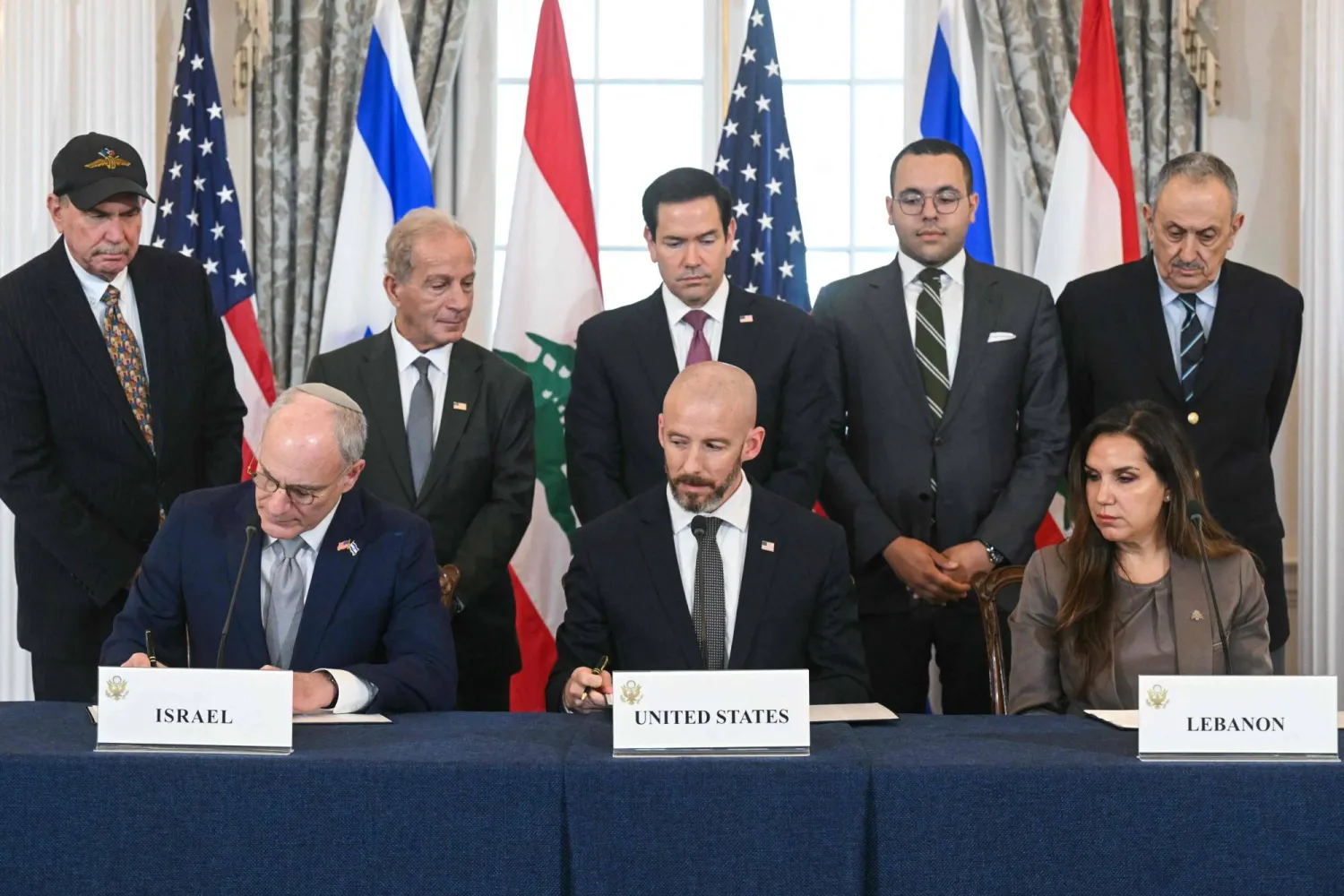
US Secretary of State Marco Rubio (C, back) looks on as (L/R, front row) Israeli Ambassador to the US Yechiel Leiter, State Department Chief of Staff Daniel Holler, and Lebanese Ambassador to the US Nada Hamadeh sign a framework agreement at the US Department of State in Washington, DC, on June 26, 2026. (AFP)
US Sees Lebanon and Israel Framework Agreement as a Step Toward ‘Lasting Peace’
US Secretary of State Marco Rubio (C, back) looks on as (L/R, front row) Israeli Ambassador to the US Yechiel Leiter, State Department Chief of Staff Daniel Holler, and Lebanese Ambassador to the US Nada Hamadeh sign a framework agreement at the US Department of State in Washington, DC, on June 26, 2026. (AFP)
The fifth round of Lebanese-Israeli negotiations ended in Washington on Friday with the signing of a framework agreement that US Secretary of State Marco Rubio said could help lay the foundation for “lasting peace and security” between the two countries.
At a ceremony where the flags of the United States, Lebanon and Israel stood side by side, Rubio announced a framework agreement between the sovereign government of Lebanon and the government of Israel, mediated and supported by Washington.
The US-sponsored talks shifted the discussion from a ceasefire to a field-based model under which Israel would gradually withdraw from areas it occupies in southern Lebanon. The Lebanese Army would then take control of those areas and prevent the return of Hezbollah’s military presence.
Behind closed doors, and despite talk from Tehran and its allies about “victories” and “resistance,” leaks from negotiating rooms in Washington and Switzerland point to a different picture: firm US pressure, Israeli efforts to secure substantial security gains, and Iranian concessions that could reshape Tehran’s regional influence from Beirut to Baghdad.
Before the agreement was announced, Rubio said Israel and Lebanon had made progress and were close to a “declaration of intentions.” Lebanese President Joseph Aoun said the talks focused on security measures needed to restore stability and extend state authority to Lebanon’s internationally recognized borders. Israeli and Lebanese officials, however, denied US claims that Israel had withdrawn from part of the “buffer zone” as a goodwill gesture.
What emerged on Friday was an initial understanding on direction, not an agreement on implementation. The talks therefore appear to mark the start of a new political and security track rather than the end of the current military phase.
The Lebanese track has also become connected, though not fully merged, with US negotiations with Iran. Washington insists Lebanon’s future is being discussed with its government, while also holding Tehran responsible for restraining Hezbollah and ending its funding and armament. The round has thus become part of a broader test of a regional order that did not exist before the war.
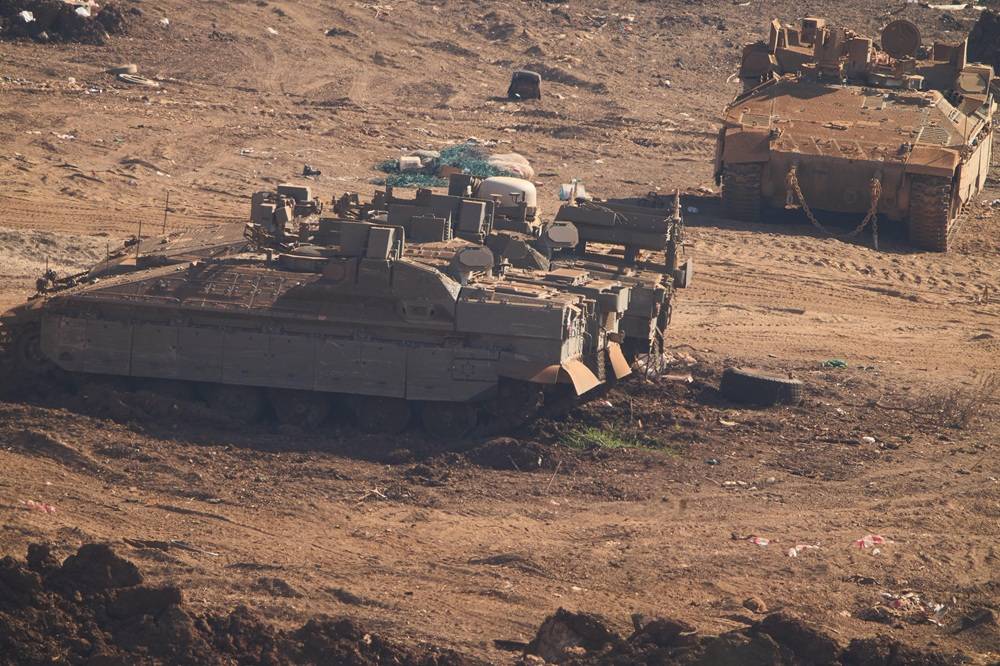
Israeli military APCs parked in northern Israel, near the border with Lebanon, Saturday, June 27, 2026 after Israel and Lebanon sign a framework agreement, described as a first step toward peace following months of conflict between Israel and the Lebanese group Hezbollah. (AP)
Army deployment
The main outcome was preliminary acceptance of “pilot zones.” The plan calls for selecting a defined area from which Israeli forces would withdraw after Hezbollah’s military infrastructure is removed. Lebanese Army units would then deploy and secure the area before the model is repeated elsewhere.
The formula combines Lebanon’s demand for withdrawal and restored sovereignty with Israel’s demand that evacuated territory not become a platform for Hezbollah to rebuild its capabilities.
But Rubio’s phrase “commitment of intentions” also reveals the limits of the achievement. It signals agreement on the broad goal, not on maps, timetables or monitoring rules.
Disagreement also remains over the location of the first zone: whether it begins north of the Litani River, as Lebanese information suggests, or inside the buffer zone established by Israel.
Another unresolved question is whether withdrawal would be part of a comprehensive roadmap or decided case by case according to Israeli security assessments.
The confusion over withdrawal underscored that these questions remain unsettled.
A US official said Israel had pulled forces from part of the area without specifying where. An Israeli security official noted that the army had not withdrawn, while a senior Lebanese official stressed that Beirut knew nothing about such a step.
This may mean Washington announced Israeli political approval before implementation, or that a limited redeployment took place that Israel does not consider a withdrawal and that Lebanon has no information about.
Either way, Washington appears to be trying to prevent the talks from collapsing under the pressure of skirmishes and strikes.
Southern Lebanon remains, in practice, a war zone for tens of thousands of displaced residents unable to return because of Israeli forces or widespread destruction. The success of the agreement will be measured by whether it produces the first clear, documented handover of land to the Lebanese army.
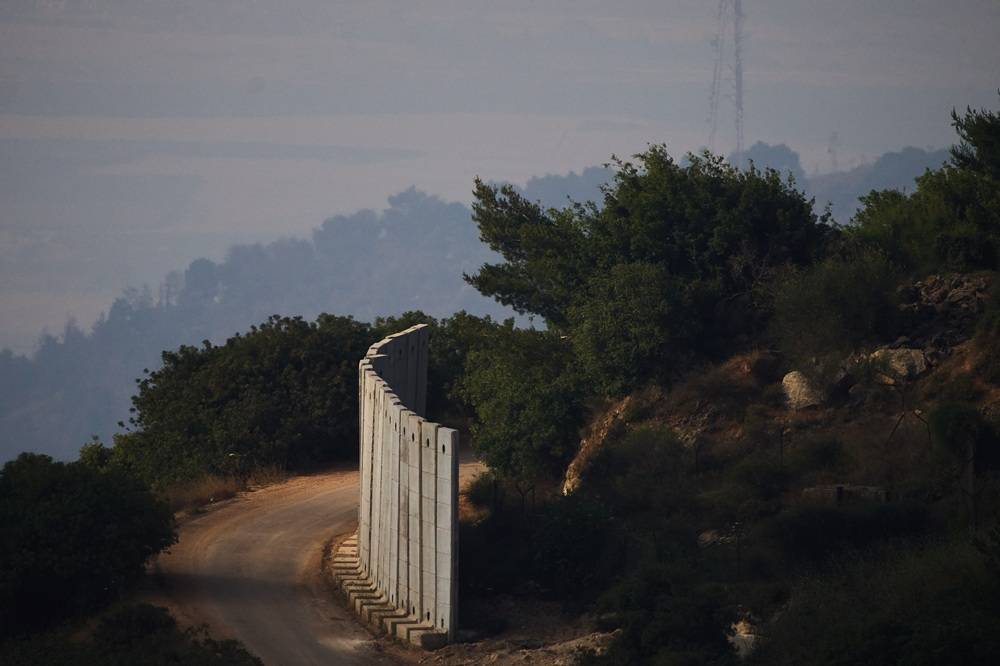
A security wall in northern Israel on the border with Lebanon , Saturday, June 27, 2026 after Israel and Lebanon sign a framework agreement, described as a first step toward peace following months of conflict between Israel and the Lebanese group Hezbollah. (AP)
‘Pilot zones’
The plan means different things to each side. For Lebanon, a pilot zone should be the first step toward full Israeli withdrawal, an end to strikes and assassinations, the return of residents, and the deployment of the state up to the international border.
For Israel, it is a test of the Lebanese army’s ability to dismantle Hezbollah infrastructure, control supply routes and prevent the group’s fighters from returning under civilian cover.
Israel is therefore insisting on a “zone-by-zone” approach. It does not want to commit in advance to a comprehensive withdrawal before seeing the results of the first phase.
It is also linking any pullback to Hezbollah’s disarmament, or at least to clearing the relevant area of military infrastructure and weapons capable of threatening northern Israeli communities.
Beirut fears the plan could yield another form of the occupation: withdrawal from secondary positions while Israel keeps a narrower security strip.
This leaves a central question unanswered: what does Hezbollah’s disarmament actually mean? Does the first phase only require removing weapons and fighters from areas where the state deploys, or does it include Hezbollah’s arsenal across Lebanon? Which weapons come first: precision and long-range missiles, drones, air defenses, anti-tank missiles, tunnels or command centers?
Nothing announced so far proves there is a final agreement on the type of weapons to be collected or the timetable.
Washington appears to be trying to break the problem into stages: first establishing areas free of military presence, then moving to heavy and strategic weapons, while leaving small arms and organizational structures to a longer Lebanese process.
Israel fears this approach will give Hezbollah time to regroup. Lebanon fears a domestic confrontation the army cannot contain.
The US guarantee
This is where the US guarantee becomes essential. The model requires a verification mechanism that determines who decides an area is weapons-free, how violations are monitored, what happens if Hezbollah tries to return, and what limits are placed on Israel’s right to act.
Without agreement on these rules, every violation could become a pretext for renewed Israeli strikes, and every strike could trigger a return to fighting.
Separating Lebanon from Iran’s influence
At first glance, US policy toward Lebanon appears dual-track. Rubio says Lebanon-Israel negotiations are separate from talks with Iran because Lebanon is a sovereign state with a government Washington deals with directly.
In parallel, Vice President JD Vance is leading talks with Tehran that include ending the fighting in Lebanon, while President Donald Trump has threatened to strike Iran again if it fails to stop Hezbollah from “causing trouble.”
Rubio’s track identifies the legitimate decision-maker: the Lebanese government, not Iran or Hezbollah. Vance’s track deals with the actor capable of obstructing the US efforts.
In that sense, Washington is negotiating Lebanon’s future with Beirut, while negotiating with Tehran over support for the force that could derail any arrangement. It is using Iran’s need to stabilize the ceasefire and ease sanctions to pressure it on Hezbollah without granting it guardianship over Lebanon.
Trump’s warnings are therefore more than just threats. They shift responsibility for Hezbollah’s actions to its sponsor, Iran, suggesting that continued violence in Lebanon could carry a direct cost for Tehran.
The strategy is risky. Including Lebanon in a US-Iran understanding could allow Tehran to claim that any Israeli withdrawal resulted from its pressure, not from the Lebanese track.
It also raises fears in Beirut and Tel Aviv that Lebanese security details could become bargaining chips in talks over the nuclear file, sanctions and the Strait of Hormuz.
That is why Rubio insists publicly on separation, even as he acknowledges that Iran’s relationship with Hezbollah cannot be ignored.
Washington may be unable to separate the two tracks completely, but it is trying to prevent their political merger.
Its success depends on using Iranian influence to restrain Hezbollah without turning Iran into a partner in shaping the Lebanese state or its arrangements with Israel.
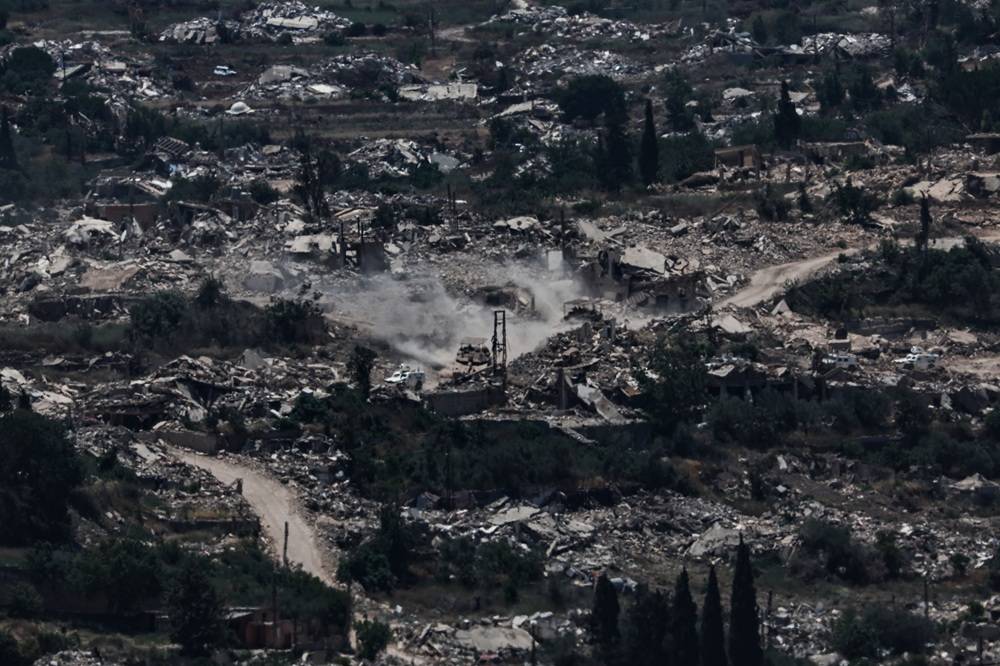
Israeli tank maneuvers as United Nations Interim Force in Lebanon (UNIFIL) convoy drive between destroyed houses in the south Lebanon village of Mais al-Jabal, as seen from the Israeli side of the border in the upper Galilee, 26 June 2026. (EPA)
Israeli concerns
Israel’s concern is that a US-Iran understanding could save Hezbollah from the consequences of the war. Israeli officials fear Washington’s priority may shift from dismantling the group and reducing Iranian influence to simply preserving a ceasefire and preventing conflict, while pressuring Israel to withdraw before durable security guarantees are in place.
Israel therefore is insisting on freedom to act against what it sees as rearmament or imminent threats and has not offered an unconditional commitment to return to the border. The buffer zone has become both a negotiating card and a security guarantee. Giving it up without disarmament would expose Prime Minister Benjamin Netanyahu to domestic criticism.
The Lebanese army, meanwhile, faces a test that goes beyond entering territory vacated by Israel. It must prove it can remain there, control it, prevent Hezbollah’s return, deal with weapons depots and tunnels, and avoid being dragged into civil strife.
It also needs manpower, equipment, funding and political cover, all of which remain uncertain, especially amid widespread destruction and the need to protect returning residents and secure the border.
The United States is studying training for Lebanese units and ways to verify their readiness and reliability. Reports have suggested a possible role for US Central Command, or CENTCOM, in supervision or monitoring, but no final announcement has clarified whether CENTCOM would directly vet personnel or limit itself to support and coordination.
Analysts say the deeper problem is that army deployment is not the same as disarmament.
The army may be able to control a specific area after an Israeli withdrawal if it receives enough support. But dismantling Hezbollah’s network across Lebanon requires a national political decision, a gradual mechanism, guarantees for the Shiite community and steps to prevent Iran from rebuilding funding and weapons channels.
If Washington burdens the army with more than it can carry, the model may turn from a test of state sovereignty into a test that exposes the limits of the state.
Through Lebanon… Is a New Regional Order Taking Shape?https://english.aawsat.com/features/5289167-through-lebanon%E2%80%A6-new-regional-order-taking-shape
Through Lebanon… Is a New Regional Order Taking Shape?
Esmail Qaani
Iran is portraying the outcome of the current war as a “victory” that forced Israel to consider withdrawal. That narrative was reinforced by a warning from Esmail Qaani, commander of the Quds Force, who said Israel would either withdraw voluntarily or “flee in defeat”, a clear attempt to present the negotiating process as the result of the resilience of Tehran’s regional axis.
While Qaani’s remarks are unmistakably mobilizing rhetoric aimed at domestic audiences and Iran’s regional allies, one fact cannot be overlooked: Tehran succeeded in making a ceasefire in Lebanon part of its understandings with Washington. Despite the military blows it has sustained, Iran has preserved both its political system and a key regional bargaining chip.
Measured against the concessions, Tehran has been forced to accept, however, the picture looks different. Lebanon is engaged in direct negotiations with Israel over the deployment of the Lebanese Army and the disarmament of Hezbollah, Iran’s most prominent regional ally. Washington has also publicly held Iran responsible for Hezbollah’s actions, while Iran-aligned factions in Iraq are facing pressure to integrate into state institutions or reduce their independent armed presence. At the same time, negotiations over sanctions and Iran’s nuclear program have become linked, to some extent, to Tehran’s ability to rein in its regional network.
Writing in Foreign Affairs, former US ambassador James Jeffrey argues that failing to achieve maximum objectives does not amount to an Iranian victory. In his view, the conflicts since 2023 have weakened Iran’s capabilities, eroded its network of proxies, and strengthened Washington’s position. That assessment remains open to debate, however, given that Hezbollah has not disappeared, Iraqi armed factions have not been disarmed, and Iran has demonstrated an ability to use the Strait of Hormuz and other regional flashpoints to compel direct negotiations.
It may therefore be more accurate to say the region is entering a transitional phase rather than witnessing the definitive end of Iran’s regional axis. Tehran appears to be shifting from reliance on large, openly organized groups with extensive arsenals to smaller, more clandestine networks, or accepting the formal integration of some factions into state institutions while preserving its influence within them.
The success of the Lebanese model will therefore carry significance far beyond Lebanon itself. If Israel withdraws, the Lebanese Army deploys, and Hezbollah is prevented from re-establishing its presence, it would set a precedent for placing arms exclusively in the hands of the state. Only then could it be said that the fifth round of negotiations marked the beginning of a new phase for Lebanon and the wider region. If, however, withdrawal remains stalled or Hezbollah returns to evacuated areas, the fifth round will amount to little more than another negotiated truce.
Older Buildings and Substandard Construction Left Venezuela Vulnerable to Earthquakeshttps://english.aawsat.com/features/5289157-older-buildings-and-substandard-construction-left-venezuela-vulnerable-earthquakes
People conduct search operations in an area affected by an earthquake in La Guaira, Venezuela, 26 June 2026. (EPA)
TT
TT
Older Buildings and Substandard Construction Left Venezuela Vulnerable to Earthquakes
People conduct search operations in an area affected by an earthquake in La Guaira, Venezuela, 26 June 2026. (EPA)
Older buildings, substandard construction and geography left many neighborhoods in Venezuela vulnerable to strong earthquakes like the ones that struck the country this week.
Engineers and other experts said the back-to-back earthquakes on Wednesday were among the most intense to hit the country in more than a century, leveling buildings and leaving more than 900 dead with the number expected to rise. Videos and satellite imagery from the disaster zone reviewed by The Associated Press reveal scores of multistory buildings had collapsed.
Microsoft’s AI for Good Lab analyzed satellite imagery of Catia La Mar in La Guaira state, one of the hardest hit cities along the Caribbean coast. Using AI-based damage assessment models, Microsoft determined that about a third of the city's nearly 30,000 structures were damaged.
Among the factors that left so many structures at risk: Some housing complexes in northern Venezuela were constructed quickly during recent oil booms, and builders may not have adhered to best practices that mitigate the risks of serious seismic activity, according to experts.
Engineers said that older housing erected in the 1950s and 1960s — before modern earthquake standards were adopted — may not have been retrofitted to survive such violent shaking. And many buildings were constructed on geography and soft soils that compound the danger of the earthquakes, the experts said.
Tall buildings and older concrete contributed to damage David Cocke, a structural engineer in California and former president of the Earthquake Engineering Research Institute, said that a combination of soft soils, tall towers and older concrete structures contributed to the widespread damage, particularly when buildings pancaked, or collapsed floor-by-floor.
“They just don’t have the more modern reinforcing steel connections that we put in those kinds of buildings today,” said Cocke.
Since the 1970s, engineers have known that concrete buildings are particularly susceptible to earthquakes and seek to reinforce new construction with steel. While many rich nations have forced property owners to retrofit or tear down dangerous buildings, many poorer or middle income countries have lagged in enforcing upgrades as they battled more immediate woes.
“Some of the more advanced countries like Japan and New Zealand and the US have made those changes, but some of the other countries have not,” Cocke said. “It’s a very typical kind of construction all over the world.”
‘Soft stories’ and soft soil played a role
Other experts noted that a number of buildings that collapsed also had non-structural walls comprised of heavy bricks, or they had “soft stories" in which their ground floors consisted of garages or similar open spaces. Such construction increases the risk of pancaking, they said.
“Soft stories are a huge problem everywhere in the world,” said Eduardo Miranda, a professor of civil and environmental engineering at Stanford University. “And in Venezuela, they are particularly prevalent, and if you combine softer soils with a soft story, buildings can collapse.”
Marcos Ferreira, a geophysicist and researcher at the Geological Survey of Brazil, said the destruction in Venezuela was compounded by the back-to-back quakes, known as a doublet. A similar incident took place in Türkiye and Syria in 2023, killing almost 60,000 people.
“It is as if I am screaming and then someone starts screaming, too," Ferreira said. “That amplifies the vibration and adds to the potential hazard.”
Newer buildings also collapsed
Venezuelan government officials took steps following a deadly 1967 quake to update building codes. But it is unclear how many buildings were retrofitted to comply with those rules.
In late 1999, former President Hugo Chávez’s first year in office, floods and landslides destroyed housing, including in coastal northern Venezuela. The government went on a building spree to replace the demolished structures and to house so many displaced people, said Juan Carlos Vielma, a Venezuelan civil engineer who is head of academic affairs of the civil engineering school at Pontifical Catholic University of Valparaíso, Chile.
Some of the newer buildings appear to also have collapsed.
“Something that leaves me perplexed is the fact that, among the collapsed buildings, more than one was recently designed and built in accordance with current standards,” Vielma said. “We need to embark on a process not only of reconstruction, but also of reviewing the applicable standards, since something might have gone wrong within our engineering processes, too.”
لم تشترك بعد
انشئ حساباً خاصاً بك لتحصل على أخبار مخصصة لك ولتتمتع بخاصية حفظ المقالات وتتلقى نشراتنا البريدية المتنوعة