Iran Releases Jailed Austrian Citizen

People walk on a market street in Tehran on September 15, 2024. (Photo by ATTA KENARE / AFP)
TT

Iran Releases Jailed Austrian Citizen

People walk on a market street in Tehran on September 15, 2024. (Photo by ATTA KENARE / AFP)

Iranian authorities have released Austrian citizen Christian Weber, detained for crimes committed in Iran's West Azerbaijan Province, to Austria's ambassador in Tehran, the Iranian judiciary's Mizan news agency reported on Tuesday.

Austria had said in 2022 one of its citizens was arrested in Iran on charges not related to protests that broke out in the country after the death of Mahsa Amini, a Kurdish Iranian woman, in custody.
The news agency said the Austrian citizen was freed in consideration of Islamic mercy. He was handed over to his country's ambassador to arrange his exit, the agency said.

Mizan did not specify the crime for which Weber was jailed.


At Least 16 Killed in Russian and Ukrainian Strikes

A Ukrainian rescuer works at the site of a Russian attack on a five-story residential building in Kyiv, Ukraine, 26 September 2026, amid the Russian invasion. EPA/MAXYM MARUSENKO
TT

At Least 16 Killed in Russian and Ukrainian Strikes

A Ukrainian rescuer works at the site of a Russian attack on a five-story residential building in Kyiv, Ukraine, 26 September 2026, amid the Russian invasion. EPA/MAXYM MARUSENKO

Russian and Ukrainian strikes killed at least 16 people over the last 24 hours, both countries said Saturday, with the war still raging in its fifth year.

Both Moscow and Kyiv have stepped up attacks after the deadliest summer since 2022 -- the year Russia launched its invasion, starting Europe's worst war since World War Two.

US-led talks to end fighting have not led to a breakthrough and the Kremlin has repeatedly said it intends to seize the rest of east Ukraine.

Kyiv said Russian strikes had killed at least six people -- in northeastern Sumy, in Zaporizhzhia and in the Dnipropetrovsk region, where a 17-year-old girl was among the victims.

And in Kyiv, several people were wounded a day after a day-time Russian attack killed seven people. Moscow has intensified strikes on the capital as the city prepares for another winter of war.

Russia said Ukrainian strikes had killed four people in its Krasnodar and Belgorod regions.

Vladimir Saldo, appointed by Moscow to lead occupational authorities in the Kherson region, said a Ukrainian drone had hit a cafe in the village of Askaniya-Nova, near Crimea, Friday evening.

"Under the rubble, rescuers found the bodies of two young girls -- born in 2004 and 2006," he said on Telegram, adding that a man had also been killed in the same area.

Moscow-appointed official Yevgeny Balitsky said night-time Ukrainian strikes killed three more people in the occupied part of the Zaporizhzhia region.

United Nations officials have warned about the increasing numbers of civilian victims in the war.

At the UN General Assembly this week, US President Donald Trump once again said that a deal between Moscow and Kyiv to end the war was "going to happen".

For many observers however, that prospect appeared distant, AFP reported.

Ukrainian leader Volodymyr Zelensky said Saturday that Russia was "escalating every single day".

In Kyiv's Solomianskyi district, residents of a typical Soviet-era apartment bock hit by a Russian drone were cleaning up their building -- already worried about what might come next.

Oleksandr Gorlachov, 43, had gone to his allotment plot outside the city Friday night.

Early Saturday morning however, he was woken up by a video call from his elderly parents -- who are both deaf -- and rushed back to help.

"I watched as my mother is standing there in her nightgown, my father in his underwear, outside the building in tears... and there are flames, everything is burning," he told AFP.

"The apartment is completely smashed up."

His mother, he said, is a seamstress.

"Her sewing machine was there. She was in tears because it's broken now. So, well, it's a tragedy. But in my family everyone is alive and for that I thank God," he said.

With mounting Russian attacks on the capital, his family is in "constant stress" and he tries to distract himself by planting tomatoes.

"They don't have enough land," he said, mocking Russia -- the world's largest country. "They want to simply wipe out our nation."

Despite Russia making life in Kyiv increasingly tough, Gorlachov said he "wasn't going anywhere".

But fellow resident Anastasiia Grygorovych -- woken up when her window "fell on me" -- had already fled her home-town of Gorlivka, now occupied by Russia.

Now she was considering leaving Ukraine altogether.

"In general, I'm already thinking that I need to leave," she said.

Russia's invasion has forced millions to flee their homes.

Kyiv also hit Russia with retaliatory strikes Saturday. Ukraine has struck deeper inside Russia this year, hitting as far as the Urals and Siberia.

Zelensky said Kyiv hit an oil refinery in the southern Russian Krasnodar region and a plant "supplying the occupiers" in the neighboring Rostov region.

The Ukrainian leader called on allies to adopt more sanctions on Moscow.


Russia's Lavrov Meets German Foreign Minister at UN

Russian Foreign Minister Sergei Lavrov attends a meeting with Tanzanian Minister of Foreign Affairs and East African Cooperation Mahmoud Thabit Kombo (not pictured), in Moscow, Russia, 09 February 2026.  EPA/RAMIL SITDIKOV / POOL
Russian Foreign Minister Sergei Lavrov attends a meeting with Tanzanian Minister of Foreign Affairs and East African Cooperation Mahmoud Thabit Kombo (not pictured), in Moscow, Russia, 09 February 2026. EPA/RAMIL SITDIKOV / POOL
TT

Russia's Lavrov Meets German Foreign Minister at UN

Russian Foreign Minister Sergei Lavrov attends a meeting with Tanzanian Minister of Foreign Affairs and East African Cooperation Mahmoud Thabit Kombo (not pictured), in Moscow, Russia, 09 February 2026.  EPA/RAMIL SITDIKOV / POOL
Russian Foreign Minister Sergei Lavrov attends a meeting with Tanzanian Minister of Foreign Affairs and East African Cooperation Mahmoud Thabit Kombo (not pictured), in Moscow, Russia, 09 February 2026. EPA/RAMIL SITDIKOV / POOL

Russia's Foreign Minister Sergei Lavrov met his German counterpart Johann Wadephul at the UN on Saturday -- the first such meeting since Moscow launched its full-scale invasion of Ukraine more than four years ago.

The talks took place as tensions between Berlin and Moscow spiralled in recent weeks, with Germany accusing Russia of orchestrating an attempted drone attack on Leipzig airport and each country ordering the closure of the other's consulate, AFP reported.

Lavrov, who will address the UN's gathering of world leaders in New York later in the day, last met with a German foreign minister, Annalena Baerbock, in January 2022, less than a month before Russian forces invaded Ukraine.

Direct flights between Russia and Germany have been suspended since the invasion.

The meeting Saturday was closed to media, but Ukraine will likely have been top of the agenda.

Before the meeting with Lavrov, the German side demanded that media access be restricted and that the opening remarks not be recorded, Moscow's foreign ministry spokeswoman Maria Zakharova said, according to the Russian TASS news agency.

She said Saturday's meeting was initiated by Berlin.


Europe and the Dilemma of Preparing for a '2030 War'

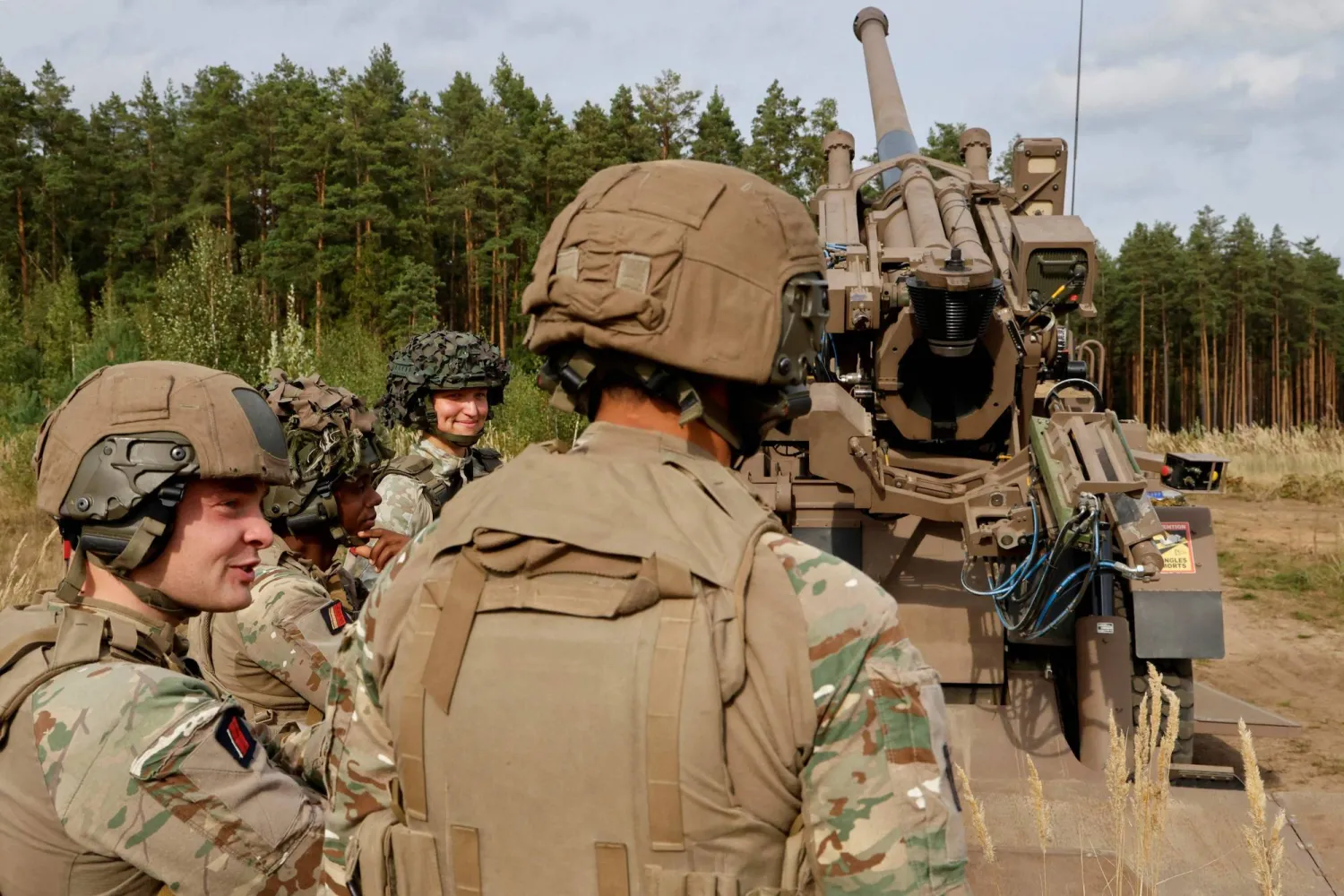
French and Lithuanian soldiers operate a Caesar Mk-I wheeled self-propelled howitzer during a live fire exercise of Lithuanian and French troops along with NATO allies at the General Silvestras Zukauskas Training Area in Pabrade, Lithuania, on September 16, 2026.  (Photo by Petras Malukas / AFP)
French and Lithuanian soldiers operate a Caesar Mk-I wheeled self-propelled howitzer during a live fire exercise of Lithuanian and French troops along with NATO allies at the General Silvestras Zukauskas Training Area in Pabrade, Lithuania, on September 16, 2026. (Photo by Petras Malukas / AFP)
TT

Europe and the Dilemma of Preparing for a '2030 War'

French and Lithuanian soldiers operate a Caesar Mk-I wheeled self-propelled howitzer during a live fire exercise of Lithuanian and French troops along with NATO allies at the General Silvestras Zukauskas Training Area in Pabrade, Lithuania, on September 16, 2026.  (Photo by Petras Malukas / AFP)
French and Lithuanian soldiers operate a Caesar Mk-I wheeled self-propelled howitzer during a live fire exercise of Lithuanian and French troops along with NATO allies at the General Silvestras Zukauskas Training Area in Pabrade, Lithuania, on September 16, 2026. (Photo by Petras Malukas / AFP)

The possibility of the war in Europe expanding is no longer being discussed as a distant scenario or a theoretical assumption. Since the outbreak of the war in Ukraine, the continent has entered a new security phase in which military confrontation overlaps with cyberattacks, sabotage, airspace violations, disinformation campaigns, and pressure on infrastructure. What is concerning is that Europe is increasingly talking about preparing for a possible war with Russia toward the end of the decade, even as NATO continues to emphasize that there are no indications of an imminent attack.

Europe's current situation therefore carries two parallel messages. The first is that the risk of a broader confrontation has become more serious than at any time since the end of the Cold War. The second is that a full-scale war is not, at present, a scenario expected to break out tomorrow or the day after. Current concerns are primarily linked to the accumulation of "hybrid warfare" incidents and the possibility that Moscow could use limited or covert operations to test the alliance's readiness to respond.

Evidence of this is mounting. In recent months, there have been airspace-related incidents, including the interception and downing by NATO fighter jets of a Russian drone over Lithuania, as well as other incidents involving a Russian military aircraft, a Russian vessel, and a Danish military helicopter. In Germany, an attempted drone attack at Leipzig Airport was linked to a person suspected of having ties to Russia. At the same time, European governments have been warning of an increase in acts of sabotage, cyberattacks, and attacks targeting infrastructure.

Field Preparations

The issue is no longer limited to political warnings. Germany is preparing for the possibility of receiving large numbers of casualties in its hospitals, while Lithuania has updated its civilian evacuation plans, and military exercises have intensified across the Baltic region and the Nordic countries. German and Swedish forces have conducted joint exercises near the strategically important island of Gotland, while NATO forces have held other exercises near Russia's Kaliningrad exclave, located between Poland and Lithuania and about 360 kilometers from Russia's main territory.

But the most contentious question concerns not only what is happening now, but also the date for a war that is increasingly being discussed, both privately and publicly, in Europe: 2029 to 2030.

Why the End of the Decade?

The official European and NATO explanation is not that war will break out by 2030. Rather, assessments refer to a period in which Russia could have rebuilt its military capabilities following the war in Ukraine and re-equipped its forces sufficiently to threaten NATO's eastern flank. General Carsten Breuer, Germany's Inspector General of the Bundeswehr and the country's highest-ranking military officer, explains that referring to a specific date is not a prophecy, but a timeframe for assessing the Russian military's potential ability to recover its strength. According to assessments attributed to NATO, Moscow could, by the end of the decade, have accumulated the resources and capabilities needed to launch a potential attack.

This is where Europe's political dilemma emerges. The more frequently warnings are issued about a possible war in 2029 or 2030, the more the dates themselves become part of public consciousness. More importantly, European officials are calling for increased defense spending, governments are rebuilding their military capabilities, and NATO is intensifying its exercises, while the idea of preparing for a future war is becoming a permanent policy.

NATO Secretary General Mark Rutte has articulated this logic by saying that Europe is "safe now," but may not be so in three to five years, using this timeframe to argue for increased defense spending. At the same time, European officials have spoken about the need to prepare to respond to "Russian aggression," rather than about a European decision to go to war with Russia.

Between Prevention and Response

Against this backdrop, one of the most interesting aspects of the situation becomes clearer: Is Europe working to prevent war, or has it begun treating war as a possible outcome for which it must prepare?

The distinction is not merely semantic. Military preparedness can serve as a deterrent, with the aim of convincing an adversary that the cost of an attack would be high. At the same time, however, the intensity of the rhetoric surrounding war can make a scenario that seemed unlikely only a few years ago part of the daily political debate.

In this context, some European voices have also begun calling for a return to dialogue with Moscow. Finnish President Alexander Stubb said it was time for the European Union to begin opening channels of communication with Russia, while European Council President António Costa spoke of Europe's readiness for possible negotiations concerning Ukraine. The European Union is discussing designating a point of contact for such talks.

This tension between military preparedness and the need for dialogue reflects Europe's underlying dilemma. On one hand, public pressure is growing to end the war and reduce the amount of money being spent on weapons. On the other hand, European governments believe that ending the war on certain terms could allow Russia to rapidly rebuild its military strength, while Europe itself is still in a transitional phase of rebuilding its armed forces.

Ukraine finds itself at the center of this equation. Continued European military support means a continued flow of weapons to Kyiv, but it also means the war continues. Military support thus becomes both a means of assisting Ukraine and a means of maintaining military pressure on Russia while Europe waits to restore its own defense capabilities.

A Psychological Campaign?

None of these calculations means that a war between Russia and NATO has become inevitable. On the contrary, NATO sources have confirmed that there is currently no imminent threat of an attack. The alliance's official assessment has not changed, nor have the allies received a formal briefing on new intelligence indicating an imminent attack.

It was notable that Lithuanian Foreign Minister Kęstutis Budrys said political statements could be part of a coordinated campaign to warn Moscow against testing NATO's collective-defense provision under Article 5.

At the same time, the figures illustrate why there is concern. Between January and August 2026, 100 officially recorded hybrid warfare incidents were documented in Europe, compared with 60 during the same period the previous year, according to Ukraine's Sahajdachny Security Center. A NATO source said the actual number could exceed 200 incidents if cyberattacks were excluded, adding that NATO institutions face thousands of cyberattacks each month.

Perhaps the clearest indication of the scale of European concern came on September 18, when French President Emmanuel Macron brought together party leaders and candidates for the upcoming presidential election at the Élysée Palace for a confidential security meeting. Participants received a briefing from senior intelligence officials on the evolving threat. Macron said the nature of the Russian threat in Europe was changing and that sabotage, which had previously targeted primarily government or military facilities, could shift toward targets capable of causing civilian casualties.

Europe therefore appears caught between two wars: an ongoing war in Ukraine and a potential war for which preparations are being made toward the end of the decade. Between them lies a broad space of deterrence, sabotage, cyberwarfare, military exercises, and warnings.

Talk of 2029 or 2030 may simply be a planning framework for rebuilding Europe's military capabilities, or it may form part of a deterrence strategy specifically intended to prevent Moscow from considering a test of NATO. But the risk lies in allowing preparation for war to become a permanent state, and in allowing the scenario of war itself to become more familiar than the prospect of peace.

Ultimately, the current evidence does not indicate that Europe is inevitably heading toward war with Russia. It does, however, indicate something more complex: Europe has begun acting on the assumption that it must be prepared for such a war, while at the same time continuing to search for a path that could prevent it. The latter is a responsibility shared by both sides.