


Iran’s Pezeshkian Says Tehran Ready to Work with World Powers to Resolve Nuclear Standoff

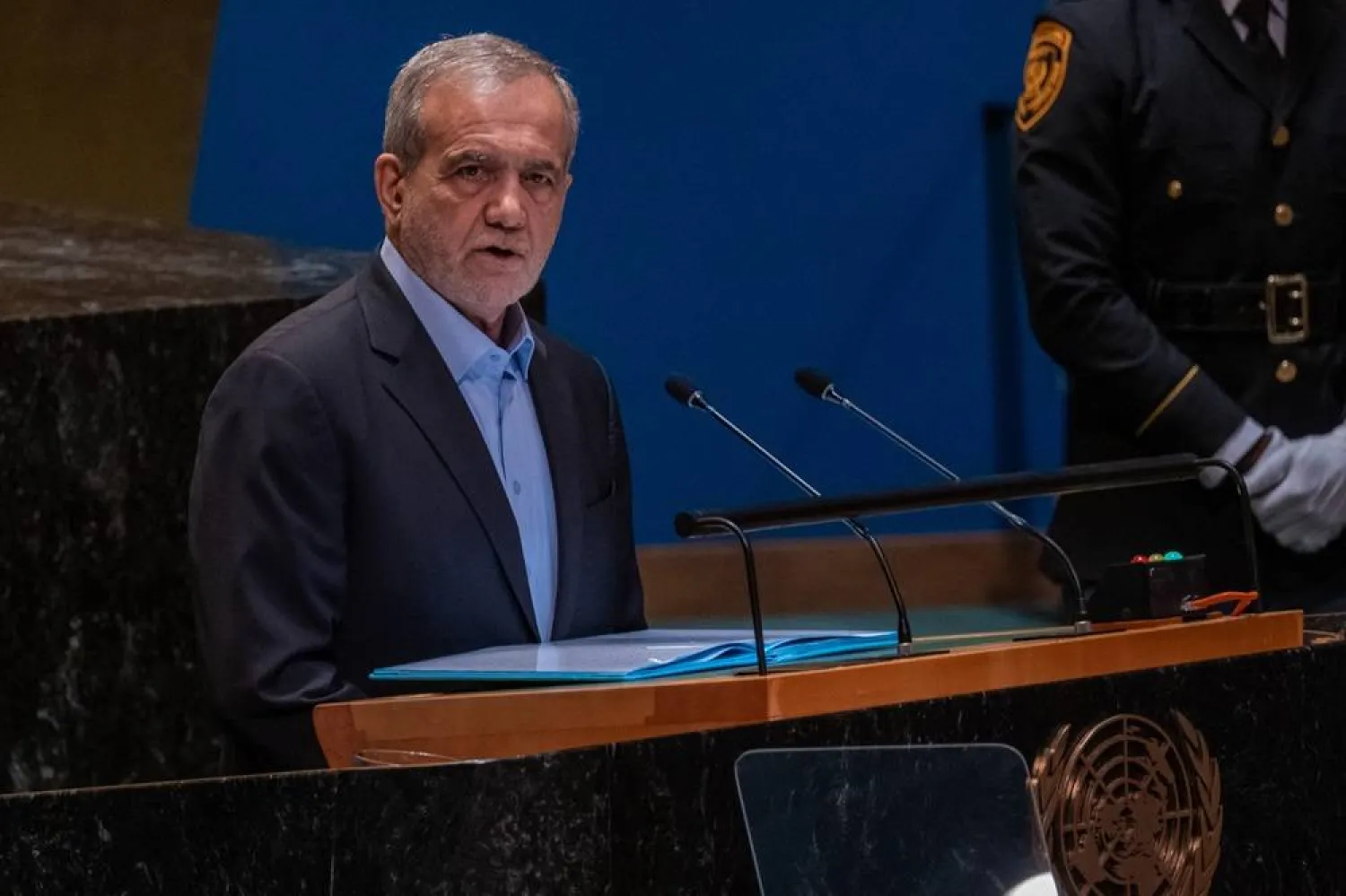
Iranian President Masoud Pezeshkian addresses world leaders during the United Nations General Assembly (UNGA) at the United Nations headquarters on September 24, 2024 in New York City. (Getty Images/AFP)
TT

Iran’s Pezeshkian Says Tehran Ready to Work with World Powers to Resolve Nuclear Standoff

Iranian President Masoud Pezeshkian addresses world leaders during the United Nations General Assembly (UNGA) at the United Nations headquarters on September 24, 2024 in New York City. (Getty Images/AFP)

Iran is ready to end its nuclear standoff with the West, Iranian President Masoud Pezeshkian told the United Nations General Assembly on Tuesday, while calling for an end to Russia's war in Ukraine through dialogue.

Iran's clerical establishment hopes to see an easing of US sanctions that have crippled the country's economy.

"We are ready to engage with participants of the 2015 nuclear deal. If the deal's commitments are implemented fully and in good faith, dialogue on other issues can follow," Pezeshkian said.

Then-President Donald Trump abandoned the nuclear pact between Tehran and six world powers in 2018 and reimposed tough sanctions on Iran. Efforts to revive the pact have failed.

The deal had capped Iran's uranium enrichment at 3.67% purity and its stockpile of this material at 202.8 kg (447 pounds) - limits Tehran has since far exceeded.

For Britain, France and Germany, who remain party to the nuclear deal, there is a sense that Tehran's leadership will not change course and that a broader accord encompassing the nuclear program and Iran's geopolitical role is unrealistic for now.

The United States, its European allies and Israel accuse Tehran of using its nuclear program as a veil for efforts to try to develop the capability to produce weapons. Iran says its nuclear program is for peaceful purposes only.

Tehran's relations with the West have worsened since the Iranian-backed Hamas group attacked southern Israel on Oct. 7 and as Tehran has increased its support for Russia's war in Ukraine.

Pezeshkian, a relatively moderate politician who took office in August promising a pragmatic foreign policy, criticized Iran's arch-foe Israel for what he called "its genocide in Gaza."

"It is imperative that the international community should immediately ... secure a permanent ceasefire in Gaza and bring an end to the desperate barbarism of Israel in Lebanon, before it engulfs the region and the world," he said.

An Israeli airstrike on Beirut killed a senior commander of the Iranian-backed Hezbollah group in Lebanon on Tuesday as cross-border rocket attacks by both sides increased fears of a full-fledged war.

"We seek peace for all and have no intention of conflict with any country ... Iran opposes war and emphasizes the need for an immediate cessation of military conflict in Ukraine," Pezeshkian said.

Russia has cultivated closer ties with Iran since the start of its war with Ukraine and has said it is preparing to sign a wide-ranging cooperation agreement with Tehran.

Iran has brokered secret talks between Russia and Yemen's Houthi militias to transfer anti-ship missiles to that group, three Western and regional sources said, a development that highlights Tehran's deepening ties to Moscow.




German Court Rejects Palestinian's Claim over Weapons Exports

A view shows the front of the Reichstag building, the seat of the German parliament, the Bundestag, in Berlin, Germany March 5, 2025. REUTERS/Annegret Hilse/File Photo
TT

German Court Rejects Palestinian's Claim over Weapons Exports

A view shows the front of the Reichstag building, the seat of the German parliament, the Bundestag, in Berlin, Germany March 5, 2025. REUTERS/Annegret Hilse/File Photo

Germany's highest court on Thursday threw out a case brought by a Palestinian civilian from Gaza seeking to sue the German government over its weapons exports to Israel.

The complainant, supported by the European Center for Constitutional and Human Rights (ECCHR), had been seeking to challenge export licences for German parts used in Israeli tanks deployed in Gaza.

After his case was rejected by lower courts in 2024 and 2025, he had appealed to the Federal Constitutional Court.

But the court in Karlsruhe dismissed the case, stating that "the complainant has not sufficiently substantiated that the specialized courts misjudged or arbitrarily denied a possible duty to protect him", AFP reported.

While Germany is obliged to protect human rights and respect international humanitarian law, this does not mean the state is necessarily obliged to take specific action on behalf of individuals, the court said.

"It is fundamentally the responsibility of the state authorities themselves to decide how they fulfil their general duty of protection," it added.

The ECCHR called the decision "a setback for civilian access to justice".

"The court acknowledges the duty to protect but only in the abstract and refuses to ensure its practical enforcement," said Alexander Schwarz, co-director of the NGO's International Crimes and Legal Accountability program.

"For people whose lives are endangered by the consequences of German arms exports, access to justice remains effectively closed," he said.

The ECCHR had been hoping for a successful appeal after the Constitutional Court ruled last year that Germany had "a general duty to protect fundamental human rights and the core norms of international humanitarian law, even in cases involving foreign countries".

In that case, two Yemenis had been seeking to sue Berlin over the role of the US Ramstein airbase in a 2012 drone attack.

The complainant was one of five Palestinians who initially brought their case against the German government in 2024.


2 Israelis Charged with Using Classified Military Information to Place Bets

The Israeli Iron Dome air defense system intercepts missiles during an Iranian attack on Tel Aviv, Israel, June 18, 2025. (AP Photo/Leo Correa, File)
TT

2 Israelis Charged with Using Classified Military Information to Place Bets

The Israeli Iron Dome air defense system intercepts missiles during an Iranian attack on Tel Aviv, Israel, June 18, 2025. (AP Photo/Leo Correa, File)

Two Israelis have been charged with using classified military information to place bets on how future events will unfold, Israeli authorities said Thursday, accusing the individuals of “serious security offenses.”

A joint statement by the Israeli Ministry of Defense, domestic security service Shin Bet and police said that a civilian and a reservist are suspected of placing bets on the US-based prediction market Polymarket on future military operations based on information that the reservist had access to, The AP news reported.

Israel’s Attorney General’s Office decided to prosecute the two individuals following a joint investigation by police, military intelligence and other security agencies that resulted in several arrests. The two face charges including bribery and obstruction of justice.

Authorities offered no details on the identity of the two individuals or the reservist's rank or position in the Israeli military but warned that such actions posed a “real security risk” for the military and the Israeli state.

Israel’s public broadcaster Kan had reported earlier that the bets were placed in June ahead of Israel’s war with Iran and that the winnings were roughly $150,000.

Israel's military and security services “view the acts attributed to the defendants very seriously and will act resolutely to thwart and bring to justice any person involved in the activity of using classified information illegally,” the statement said.

The accused will remain in custody until the end of legal proceedings against them, the Prosecutor's Office said.

Prediction markets are comprised of typically yes-or-no questions called event contracts, with the prices connected to what traders are willing to pay, which theoretically indicates the perceived probability of an event occurring.

Their use has skyrocketed in recent years, but despite some eye-catching windfalls, traders still lose money everyday. In the US, the trades are categorized differently than traditional forms of gambling, raising questions about transparency and risk.


WhatsApp Accuses Russia of Trying to Fully Block its Service

FILED - 21 January 2022, Berlin: The icon of Whatsapp is seen on the screen of a smartphone. Photo: Fabian Sommer/Deutsche Presse-Agentur GmbH/dpa
TT

WhatsApp Accuses Russia of Trying to Fully Block its Service

FILED - 21 January 2022, Berlin: The icon of Whatsapp is seen on the screen of a smartphone. Photo: Fabian Sommer/Deutsche Presse-Agentur GmbH/dpa

US messenger app WhatsApp, owned by Meta Platforms, accused authorities in Russia on Thursday of trying to fully block its service in order to drive Russians to a state-owned app, which it alleged was used for surveillance.

"Trying to isolate over 100 million users from private and secure communication is a backwards step and can only lead to less safety for people in Russia," WhatsApp said in a statement.

"We continue to do everything we can ‌to keep users connected."

Some ‌domain names associated with WhatsApp on Thursday disappeared from Russia's ‌national ⁠register of domain ⁠names, meaning that devices inside Russia stopped receiving its IP addresses from the app and that it could be accessed only by using a virtual private network (VPN), Reuters reported.

Roskomnadzor, the state communications regulator, and the Kremlin did not immediately respond to a request for comment.

Roskomnadzor first began restricting WhatsApp and other messenger services in August, making it impossible to complete phone calls on them, accusing the foreign-owned platforms of failing ⁠to share information with law enforcement in fraud and terrorism ‌cases.

It said in December it was taking ‌new measures to gradually restrict the app, which it accused of continuing to violate Russian ‌law and of being a platform used "to organize and carry out terrorist acts ‌on the territory of the country, to recruit their perpetrators and to commit fraud and other crimes."

Since then, many Russians have been able to use WhatsApp only in conjunction with a virtual private network and have switched to using rival messenger apps, though some ‌of those - like Telegram - are also under pressure from the authorities for the same reasons.

In a video published by state ⁠news agency ⁠TASS on Wednesday, Kremlin spokesman Dmitry Peskov said there was a possibility of reaching an agreement if Meta entered into dialogue with the Russian authorities and complied with the law.

"If the corporation (Meta) sticks to an uncompromising position and, I would say, shows itself unready to align with Russian legislation, then there is no chance," Peskov said.

Russian authorities, who also block or restrict social media platforms such as Snapchat, Facebook, Instagram and YouTube, are heavily pushing a state-backed messenger app called MAX, which critics say could be used to track users.

The authorities have dismissed those accusations as false and say MAX, which integrates various government-related services into it, is designed to simplify and improve the everyday lives of citizens.