


UN Refugee Agency Says 25% of Lebanon under Israeli Evacuation Orders

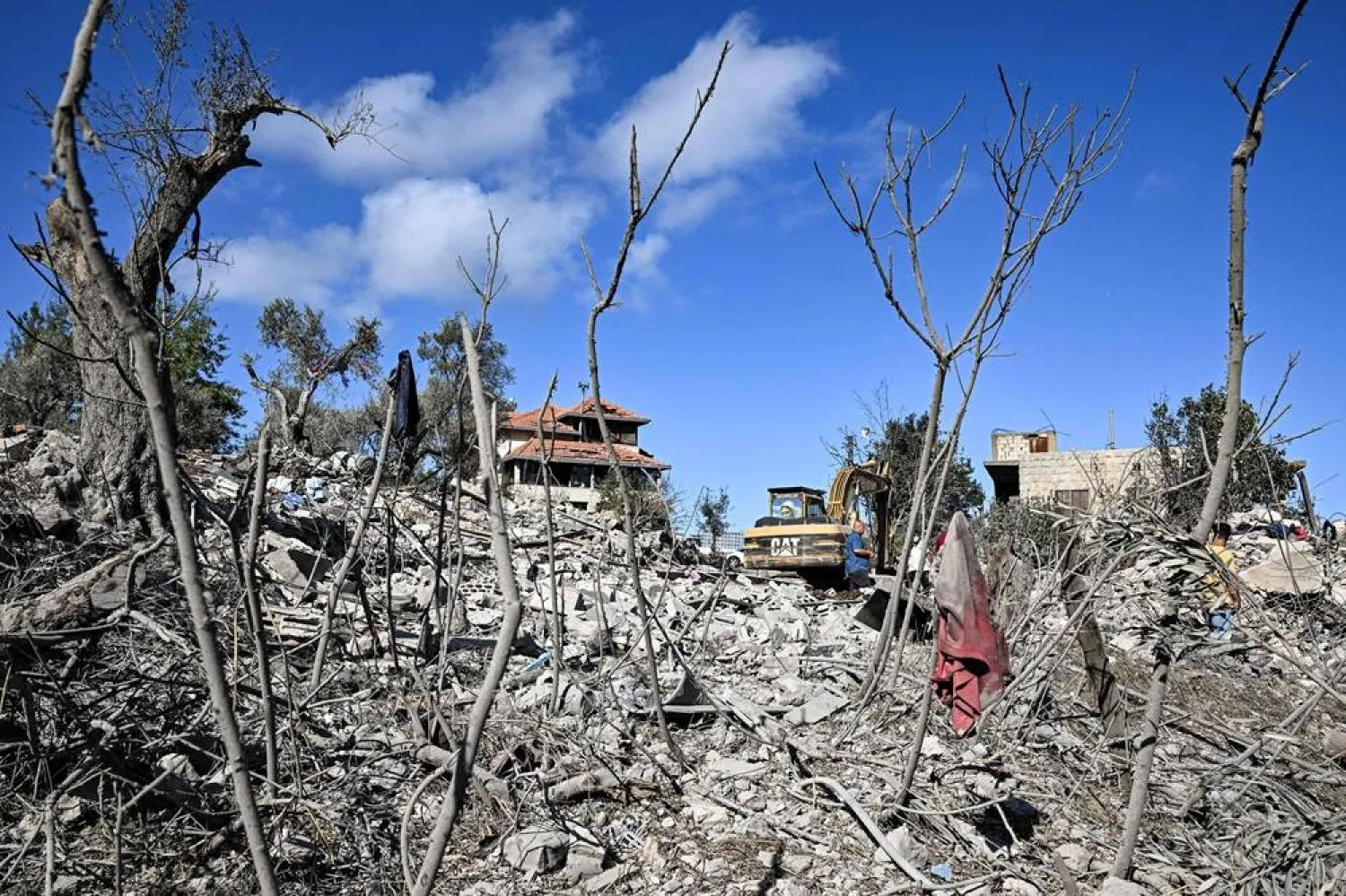
This picture shows debris and rubble at the site of a previous Israeli air strike on the village of Aito in northern Lebanon on October 15, 2024. (AFP)
TT

UN Refugee Agency Says 25% of Lebanon under Israeli Evacuation Orders

This picture shows debris and rubble at the site of a previous Israeli air strike on the village of Aito in northern Lebanon on October 15, 2024. (AFP)

Israel, which began incursions into south Lebanon two weeks ago to battle Iran-backed armed group Hezbollah, has issued military evacuation orders affecting more than a quarter of the country, the UN refugee agency said on Tuesday.

The figures underscore the heavy price Lebanese are paying as Israel steps up its campaign to defeat Hezbollah and destroy its infrastructure in their one-year conflict.

The UN refugee agency's Middle East Director Rema Jamous Imseis told a press briefing in Geneva that new Israeli evacuation orders to 20 villages in southern Lebanon meant that over a quarter of the country was now affected. "People are heeding these calls to evacuate, and they're fleeing with almost nothing."

Israeli strikes have killed at least 2,309 people over the last year, the Lebanese government said, and more than 1.2 million people have been displaced.

The majority have been killed since late September when Israel expanded its military campaign. The toll does not distinguish between civilians and combatants.

Around 50 Israelis, both soldiers and civilians, have been killed, according to Israel.

Israel says its operation in Lebanon aims to secure the return of tens of thousands of its residents forced to flee their homes in northern Israel due to Hezbollah attacks.

Israel expanded its bombing campaign in Lebanon on Monday, killing at least 22 people - most of them women - in an airstrike in the north on a house where displaced people were seeking refuge from Israeli strikes further south, health officials said.

"What we are hearing is that amongst the 22 people killed were 12 women and two children," UN human rights office spokesperson Jeremy Laurence told the same press briefing in response to a question about Monday's strike on Christian-majority Aito.

"We understand it was a four-story residential building that was struck. With these factors in mind, we have real concerns with respect to IHL (International Humanitarian Law), so the laws of war, and the principles of distinction proportion and proportionality," he said, calling for an investigation into the incident.

Rescue workers were still pulling bodies out of the rubble in Aito on Tuesday, local media reported, following one of the deadliest strikes on displaced families in Lebanon, after strikes earlier this month on the southern Lebanese town of Ain Deleb that left more than 30 dead.

Israel has not commented on the Aito strike, but has repeatedly said it takes all possible precautions to avoid civilian casualties.

UN CONCERNED OVER PEACEKEEPER ATTACKS

So far the main focus of Israel's military operations in Lebanon has been in the Bekaa Valley in the east, the suburbs of Beirut, and in the south, where UN peacekeepers have said that Israeli fire has hit their bases on numerous occasions and wounded peacekeepers.

The UN Security Council on Monday expressed strong concern after several peacekeeping positions in southern Lebanon again came under fire amid clashes between the Israeli military and Hezbollah.

Prime Minister Benjamin Netanyahu, visiting a military base in central Israel where four soldiers were killed on Sunday by a Hezbollah drone strike, said Israel would continue to attack the movement "without mercy, everywhere in Lebanon – including Beirut".  

The conflict between Israel and Hezbollah resumed a year ago when the group began firing rockets at Israel in support of Hamas at the start of the Gaza war.

Meanwhile, the Middle East remains on high alert for Israel to retaliate against Iran for an Oct. 1 barrage of missiles launched in response to Israel's assaults on Lebanon.

Netanyahu's office said Israel would listen to the United States but would decide its actions according to its own national interest.

The statement was attached to a Washington Post article which said Netanyahu had told President Joe Biden's administration that Israel would strike Iranian military, not nuclear or oil, targets - suggesting a more limited counterstrike aimed at preventing a full-scale war.

Qatar's emir accused Israel on Tuesday of exploiting "international inaction" on the Middle East crisis to move beyond its "aggression" in Gaza to build more illegal settlements in the occupied West Bank and send troops into Lebanon.

"Israel deliberately chose to expand the aggression to implement pre-planned schemes in other locations such as the West Bank and Lebanon because it sees that the scope for that is available," Sheikh Tamim bin Hamad Al-Thani said in his annual speech to open Qatar's Shura Council.

Qatar, the United States and Egypt have repeatedly mediated in an attempt to end the war in Gaza, which broke out a year ago when fighters from the Palestinian group Hamas burst into Israel from Gaza and killed 1,200 people, according to Israeli tallies.

Israel's offensive has killed more than 42,000 people in Gaza, turned the enclave into piles of cement and twisted metal and created severe shortages of food, water and fuel.


Syria to Start Currency Swap on January 1st, Central Bank Governor Says

Syrian pounds are pictured inside an exchange currency shop in Azaz, Syria February 3, 2020. Picture taken February 3, 2020. REUTERS/Khalil Ashawi/File Photo
TT

Syria to Start Currency Swap on January 1st, Central Bank Governor Says

Syrian pounds are pictured inside an exchange currency shop in Azaz, Syria February 3, 2020. Picture taken February 3, 2020. REUTERS/Khalil Ashawi/File Photo

Syria will start swapping old banknotes for new ones under a ​plan to replace Assad-era notes starting from January 1, 2026, Central Bank Governor Abdelkader Husrieh said on Thursday.

Husrieh announced the introduction of the new Syrian currency, saying the decree "sets January ‌1, 2026, ‌as the start date ‌for ⁠the ​exchange ‌process". Sources familiar with the matter told Reuters in August that the country will issue new banknotes, removing two zeros from its currency in an attempt to restore ⁠public confidence in the severely devalued pound.

The ‌step is intended ‍to strengthen ‍the Syrian pound after its purchasing ‍power collapsed to record lows following a 14-year conflict that ended with President Bashar al-Assad's ouster in December.

Husrieh ​said the operation will take place through a smooth and orderly ⁠swap - a move bankers hope will ease fears that the new currency could fuel inflation and further erode the purchasing power of Syrians already reeling from high prices.

He added that a press conference will soon outline the exact regulations and mechanisms.


Türkiye Begins Black Box Analysis of Jet Crash That Killed Libyan Military Chief and 7 Others

Libyan national flags fly at half-mast in Tripoli on December 24, 2025, after the head of Libya's armed forces and his four aides died in a plane crash in Türkiye. (AFP)
TT

Türkiye Begins Black Box Analysis of Jet Crash That Killed Libyan Military Chief and 7 Others

Libyan national flags fly at half-mast in Tripoli on December 24, 2025, after the head of Libya's armed forces and his four aides died in a plane crash in Türkiye. (AFP)

The technical analysis of the recovered black boxes from a jet crash that killed eight people, including western Libya’s military chief, began as the investigation proceeded in cooperation with Libyan authorities, the Turkish Ministry of Defense said Thursday.

The private jet with Gen. Muhammad Ali Ahmad al-Haddad, four other military officials and three crew members crashed on Tuesday after taking off from Türkiye’s capital, Ankara, killing everyone on board. Libyan officials said the cause of the crash was a technical malfunction on the plane.

The high-level Libyan delegation was on its way back to Tripoli after holding defense talks in Ankara aimed at boosting military cooperation between the two countries.

The wreckage was scattered across an area covering 3 square kilometers (more than a square mile), complicating recovery efforts, according to the Turkish Interior Minister Ali Yerlikaya.

A 22-person delegation, including five family members, arrived from Libya early on Wednesday to assist in the investigation.


Lebanese President: We are Determined to Hold Parliamentary Elections on Time

President Joseph Aoun between Prime Minister Nawaf Salam and Speaker Nabih Berri (Lebanese Presidency file photo)
TT

Lebanese President: We are Determined to Hold Parliamentary Elections on Time

President Joseph Aoun between Prime Minister Nawaf Salam and Speaker Nabih Berri (Lebanese Presidency file photo)

Lebanese President Joseph Aoun reiterated on Thursday that the country’s parliamentary elections are a constitutional obligation that must be carried out on time.

Lebanon’s state-run National News Agency quoted Aoun as saying that he, alongside Prime Minister Nawaf Salam and Parliament Speaker Nabih Berri, is determined to hold the elections on schedule.

Aoun also emphasized that diplomatic efforts have continued unabated to keep the specter of war at bay, noting that "things are heading in a positive direction".

The agency also cited Berri reaffirming that the elections will take place as planned, with "no delays, no extensions".

The Lebanese parliamentary elections are scheduled for May next year.