A Glance at Ukraine's Plan Aimed at Nudging Russia into Talks to End the War

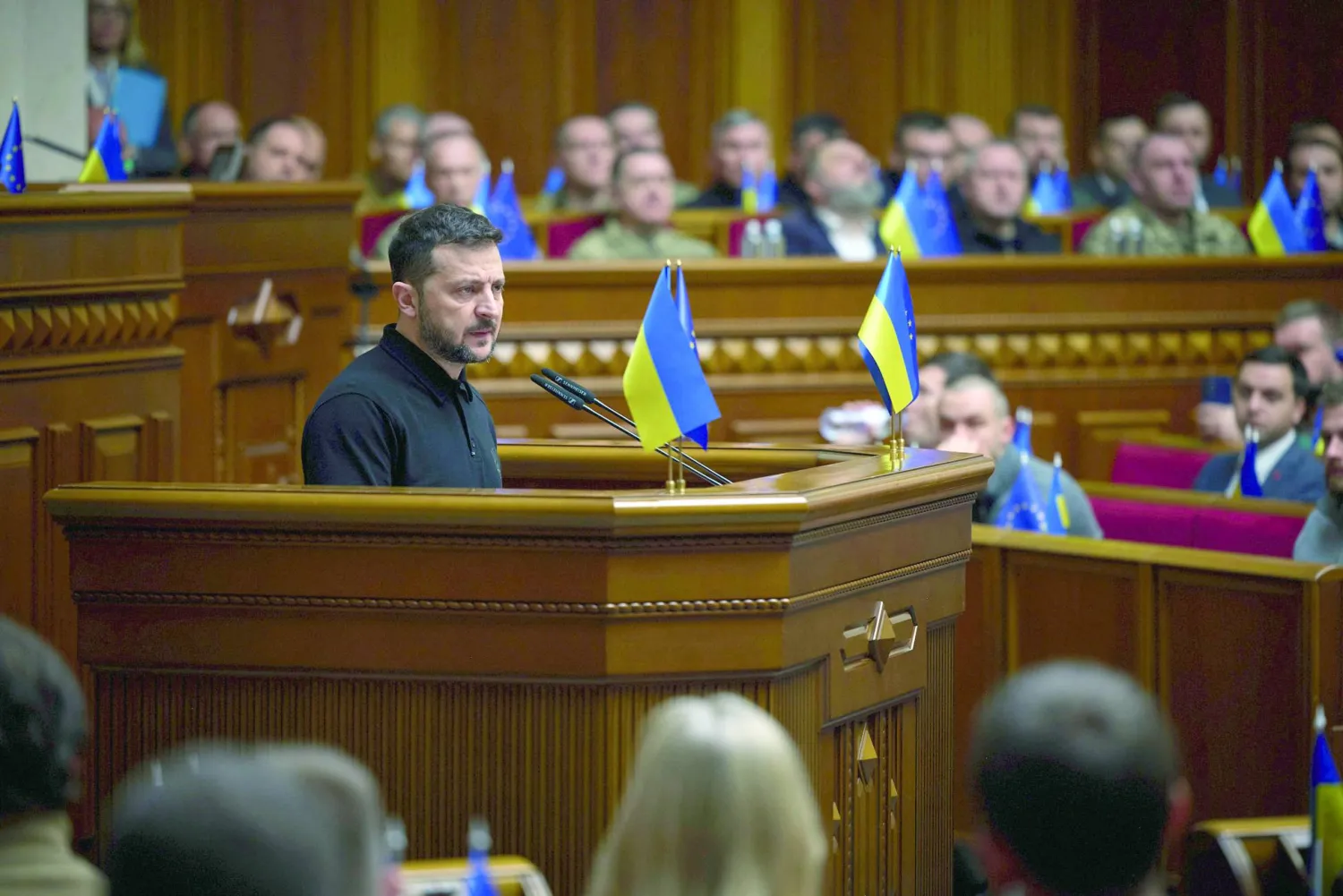
In this photo provided by the Press Service Of The President Of Ukraine on Oct. 16, 2024, Ukraine's President Volodymyr Zelenskyy speaks to parliamentarians at Verkhovna Rada in Kyiv, Ukraine. (Press Service Of The President Of Ukraine via AP)
TT

A Glance at Ukraine's Plan Aimed at Nudging Russia into Talks to End the War

In this photo provided by the Press Service Of The President Of Ukraine on Oct. 16, 2024, Ukraine's President Volodymyr Zelenskyy speaks to parliamentarians at Verkhovna Rada in Kyiv, Ukraine. (Press Service Of The President Of Ukraine via AP)

Ukraine’s President Volodymyr Zelenskyy has partially revealed his five-point plan aimed at prompting Russia to end the war through negotiations. A key element would be a formal invitation into NATO, which Western backers have been reluctant to consider until after the war ends.
Zelenskyy outlined the plan to Ukraine’s Parliament on Wednesday without disclosing confidential elements that have been presented in private to key allies, including the United States, The Associated Press said.
Here’s what we know:
Invitation to NATO The plan's first section involves formally inviting Ukraine to join NATO in the near future.
While this doesn’t mean Ukraine would become a member until after the war ends, it would signal a “testament of determination” and demonstrate how Western partners view Ukraine within the “security architecture,” Zelenskyy said.
“For decades, Russia has exploited the geopolitical uncertainty in Europe, particularly the fact that Ukraine is not a NATO member,” Zelenskyy said. “This has tempted Russia to encroach upon our security.”
He described the invitation to join NATO as “truly fundamental for peace” in Ukraine.
NATO partners have been reluctant to invite Ukraine to join while the war is ongoing, and Zelenskyy’s request for an invitation puts the military alliance in a difficult position.
Since the onset of the full-scale invasion in 2022, the alliance has faced challenges in finding ways to bring Ukraine closer without formally extending an invitation.
At their summit in Washington in July, NATO’s 32 members declared Ukraine on an “irreversible” path to membership. But any decision on offering to start membership talks is not likely before the next summit in the Netherlands in June.
Defense
The second section, entitled defense, focuses on strengthening Ukraine’s capability to reclaim territory and “to bring the war back to Russian territory."
It includes the continuation of military operations in Russia with the aim of strengthening Ukraine's ability to repel Russian forces from occupied territories in Ukraine.
It also would involve enhancing air defense and jointly intercepting Russian missiles and drones with neighboring countries along the international border. Ukraine wants to expand the use of Ukrainian drones and missiles, and lift restrictions on using Western-supplied weapons for long-range strikes against military infrastructure inside Russia.
Ukraine also seeks greater access to a broader range of intelligence from allies and real-time satellite data. This section of the plan has confidential elements accessible only to allies with the “relevant assistance potential,” Zelenskyy said.
He said Ukraine has been providing its partners “with a clear justification of what its goals are, how they intend to achieve them, and how much this will reduce Russia’s ability to continue the war.”
Western partners have been wary of Ukraine using donated weapons in anything but a defensive capacity, for fear of being drawn into the conflict.
Ukraine has long been lobbying for the US to drop its restrictions on using long-range Western weapons to strike deep inside Russia, but the Biden administration’s red line remained unchanged even after Zelenskyy's recent visit to Washington, D.C.
Deterrence
In the deterrence section of the plan, Ukraine calls for deploying “a comprehensive non-nuclear deterrence package on its territory that would be sufficient to protect the country from any military threat posed by Russia.”
Zelenskyy did not elaborate on the details of such a non-nuclear deterrence, but he said it would be used against specific Russian military targets, meaning that Russia would “face the loss of its war machine.”
He said this capability would limit Russia’s options for continuing its aggression and prod it into engaging in a fair diplomatic process to resolve the war.
Classified elements of this section have been shared with the United States, the United Kingdom, France, Italy, and Germany, he said. Other countries capable of contributing also would be briefed, Zelenskyy said.
Economy
The fourth section focuses on developing Ukraine’s strategic economic potential and strengthening sanctions against Russia.
Zelenskyy highlighted that Ukraine is rich in natural resources, including critically important metals “worth trillions of US dollars,” such as uranium, titanium, lithium, graphite, etc.
“Ukraine’s deposits of critical resources, combined with its globally significant potential in energy and food production, are among Russia’s key objectives in this war,” he said. But it also “represents our opportunity for growth.”
The economic component of the plan also includes a confidential addendum shared only with selected partners, he said.
“Ukraine offers ... a special agreement for the joint protection of Ukraine’s critical resources, shared investment, and use of its economic potential,” he said. “This, too, is peace through strength — economic strength.”
Post-war period
The fifth section is geared toward the post-war period. Zelenskyy stated that Ukraine will have a big army of experienced military personnel after the war.
“These are our soldiers — warriors who will possess real experience in modern warfare, successful use of Western weaponry, and extensive interaction with NATO forces,” he said. “This Ukrainian experience should be used to strengthen the alliance’s defense and ensure security in Europe. It’s a worthy mission for our heroes."
He also mentioned that, with partners' approval, Ukrainian units could replace certain US military contingents stationed in Europe.



Indonesia Says Proposed Gaza Peacekeeping Force Could Total 20,000 Troops

Israeli military vehicles drive past destruction in Gaza, as seen from the Israeli side of the Israel-Gaza border in southern Israel, January 21, 2026. REUTERS/Amir Cohen/File Photo
TT

Indonesia Says Proposed Gaza Peacekeeping Force Could Total 20,000 Troops

Israeli military vehicles drive past destruction in Gaza, as seen from the Israeli side of the Israel-Gaza border in southern Israel, January 21, 2026. REUTERS/Amir Cohen/File Photo

A proposed multinational peacekeeping force for Gaza could total about 20,000 troops, with Indonesia estimating it could contribute up to 8,000, President Prabowo Subianto’s spokesman said on Tuesday.

The spokesman said, however, that no deployment terms or areas of operation had been agreed.

Prabowo has been invited to Washington later this month for the first meeting of US President Donald Trump's Board of Peace. The Southeast Asian country last year committed to ready 20,000 troops for deployment for a Gaza peacekeeping force, but it has said it is awaiting more details about the force's mandate before confirming deployment.

"The total number is approximately 20,000 (across countries) ... it is not only Indonesia," presidential spokesman Prasetyo Hadi told journalists on Tuesday, adding that the exact number of troops had not been discussed yet but Indonesia estimated it could offer up to 8,000, Reuters reported.

"We are just preparing ourselves in case an agreement is reached and we have to send peacekeeping forces," he said.

Prasetyo also said there would be negotiations before Indonesia paid the $1 billion being asked for permanent membership of the Board of Peace. He did not clarify who the negotiations would be with, and said Indonesia had not yet confirmed Prabowo's attendance at the board meeting.

Separately, Indonesia's defense ministry also denied reports in Israeli media that the deployment of Indonesian troops would be in Gaza's Rafah and Khan Younis.

"Indonesia's plans to contribute to peace and humanitarian support in Gaza are still in the preparation and coordination stages," defence ministry spokesman Rico Ricardo Sirat told Reuters in a message.

"Operational matters (deployment location, number of personnel, schedule, mechanism) have not yet been finalised and will be announced once an official decision has been made and the necessary international mandate has been clarified," he added.


Iran Offers Clemency to over 2,000 Convicts, Excludes Protest-related Cases

FILE - In this photo obtained by The Associated Press, Iranians attend an anti-government protest in Tehran, Iran, Jan. 9, 2026. (UGC via AP, File)
TT

Iran Offers Clemency to over 2,000 Convicts, Excludes Protest-related Cases

FILE - In this photo obtained by The Associated Press, Iranians attend an anti-government protest in Tehran, Iran, Jan. 9, 2026. (UGC via AP, File)

Iran's supreme leader Ali Khamenei granted pardons or reduced sentences on Tuesday to more than 2,000 people, the judiciary said, adding that none of those involved in recent protests were on the list.

The decision comes ahead of the anniversary of the Iranian revolution, which along with other important occasions in Iran has traditionally seen the supreme leader sign off on similar pardons over the years.

"The leader of the Islamic revolution agreed to the request by the head of the judiciary to pardon or reduce or commute the sentences of 2,108 convicts," the judiciary's Mizan Online website said.

The list however does not include "the defendants and convicts from the recent riots", it said, quoting the judiciary's deputy chief Ali Mozaffari.

Protests against the rising cost of living broke out in Iran in late December before morphing into nationwide anti-government demonstrations that peaked on January 8 and 9.

Tehran has acknowledged that more than 3,000 people died during the unrest, including members of the security forces and innocent bystanders, and attributed the violence to "terrorist acts".

Iranian authorities said the protests began as peaceful demonstrations before turning into "foreign-instigated riots" involving killings and vandalism.

International organizations have put the toll far higher.

The US-based Human Rights Activists News Agency (HRANA) says it has verified 6,964 deaths, mostly protesters.


Macron Says Wants ‘European Approach’ in Dialogue with Putin

Russian President Vladimir Putin attends a meeting with Moscow Mayor Sergei Sobyanin at the Kremlin in Moscow, Russia February 9, 2026. (Sputnik/Vyacheslav Prokofyev/Pool via Reuters)
TT

Macron Says Wants ‘European Approach’ in Dialogue with Putin

Russian President Vladimir Putin attends a meeting with Moscow Mayor Sergei Sobyanin at the Kremlin in Moscow, Russia February 9, 2026. (Sputnik/Vyacheslav Prokofyev/Pool via Reuters)

French President Emmanuel Macron has said he wants to include European partners in a resumption of dialogue with Russian leader Vladimir Putin nearly four years after Moscow's invasion of Ukraine.

He spoke after dispatching a top adviser to Moscow last week, in the first such meeting since Russia launched its full-scale invasion of Ukraine in February 2022.

"What did I gain? Confirmation that Russia does not want peace right now," he said in an interview with several European newspapers including Germany's Suddeutsche Zeitung.

"But above all, we have rebuilt those channels of discussion at a technical level," he said in the interview released on Tuesday.

"My wish is to share this with my European partners and to have a well-organized European approach," he added.

Dialogue with Putin should take place without "too many interlocutors, with a given mandate", he said.

Macron said last year he believed Europe should reach back out to Putin, rather than leaving the United States alone to take the lead in negotiations to end Russia's war against Ukraine.

"Whether we like Russia or not, Russia will still be there tomorrow," Suddeutsche Zeitung quoted the French president as saying.

"It is therefore important that we structure the resumption of a European discussion with the Russians, without naivety, without putting pressure on the Ukrainians -- but also so as not to depend on third parties in this discussion."

After Macron sent his adviser Emmanuel Bonne to the Kremlin last week, Russia's Foreign Minister Sergei Lavrov on Thursday said Putin was ready to receive the French leader's call.

"If you want to call and discuss something seriously, then call," he said in an interview to state-run broadcaster RT.

The two presidents last spoke in July, in their first known phone talks in over two-and-a-half years.

The French leader tried in a series of phone calls in 2022 to warn Putin against invading Ukraine and travelled to Moscow early that year.

He kept up phone contact with Putin after the invasion but talks had ceased after a September 2022 phone call.